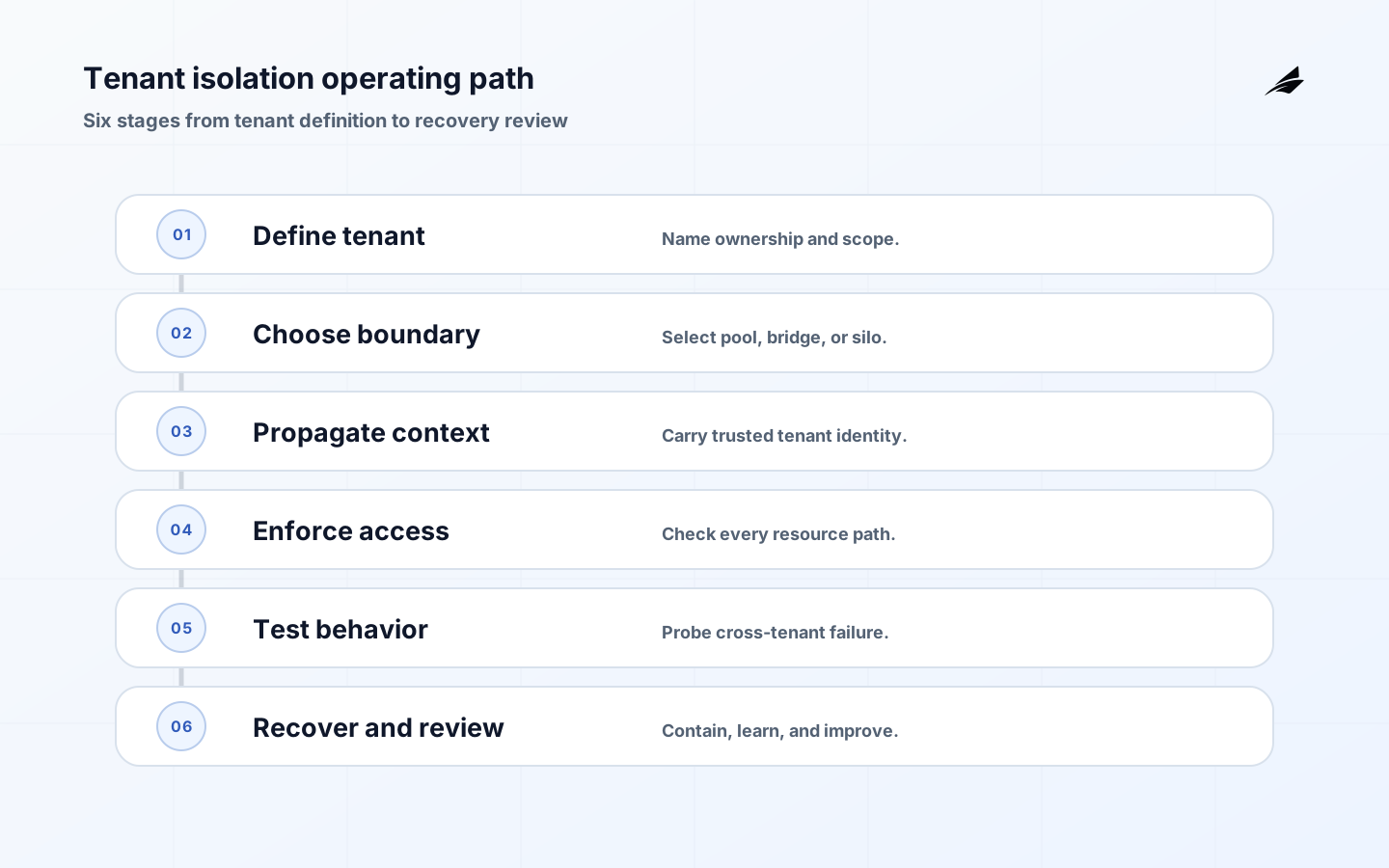
Tenant isolation is the property that keeps one customer’s data, workload, configuration, and operator actions separate from another’s. For operations leaders, it is not a database checkbox or a login-screen feature. The boundary must survive API requests, background jobs, caches, search indexes, files, telemetry, backups, restores, and support tooling. The AWS SaaS Lens makes the same distinction: authentication and authorization are necessary, but they are not equal to isolation. This guide turns tenant isolation into an operating model that can be designed, tested, observed, and recovered.
Define the tenant boundary
Name what a tenant is in the product, who can create it, who owns it, and how it changes over time. A tenant may be a company, workspace, account, project, or regulated environment; the useful definition is the one that determines data scope and customer responsibility. List tenant-owned resources, shared resources, delegated administration, and cross-tenant reporting exceptions. If a support operator can see multiple tenants, treat that as a separate privileged workflow with a reason, scope, and audit trail.
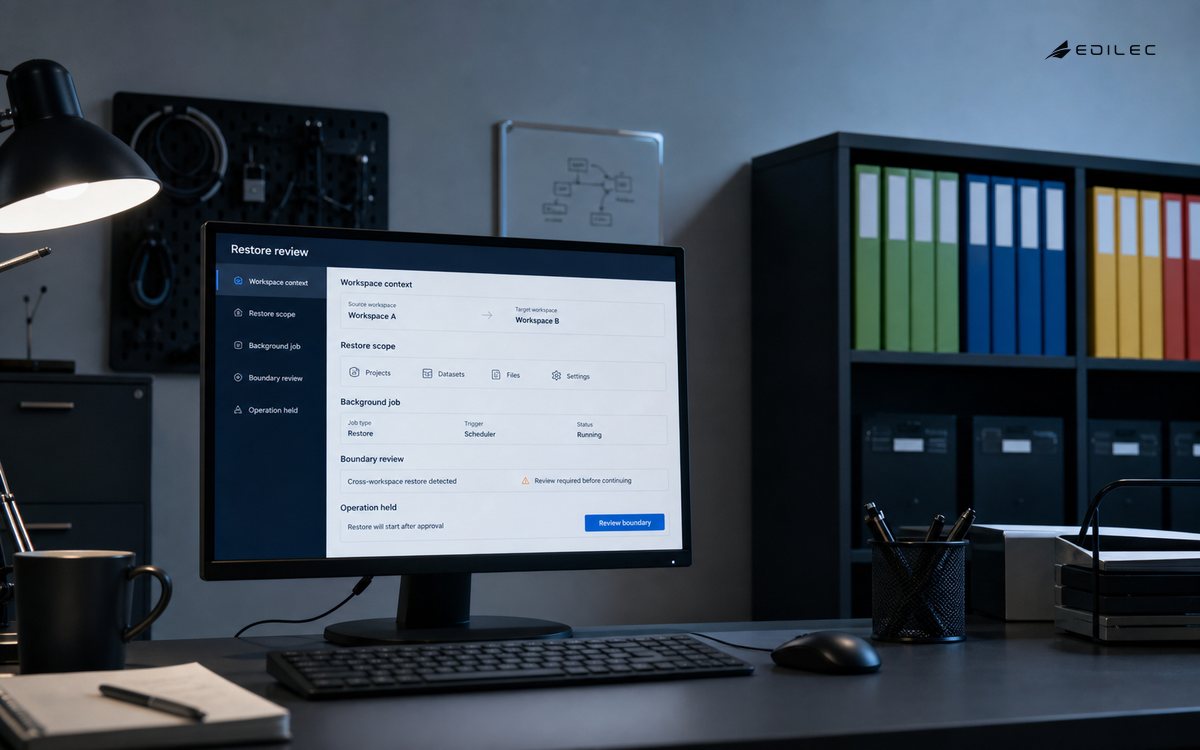
Write the boundary as a rule that can be applied at every resource path: a request may access a record only when the trusted tenant context is authorized for that record and the action is allowed for the current role. Avoid relying on a caller-supplied tenant ID or an implicit browser selection. Bind context to identity and membership, then verify it again where the data or action is enforced. The OWASP Authorization Cheat Sheet is a useful reminder that authentication and authorization are distinct decisions.
| Boundary area | Question | Evidence |
|---|---|---|
| Identity | Who is acting and for which tenant? | Subject, membership, role, effective time |
| Data | Which records belong to the tenant? | Partition key, policy, query test |
| Execution | Which job or service runs the action? | Propagated context and worker scope |
| Operations | Who can inspect or correct data? | Role, purpose, approval, audit event |
| Recovery | How is tenant scope preserved during restore? | Restore test and post-restore verification |
Choose pool, bridge, or silo deliberately
Shared pool, bridge, and silo models are choices about where isolation is enforced and what operational trade-off the team accepts. A pooled model can be efficient but depends on strong logical scoping and tests. A silo can reduce blast radius or satisfy a customer requirement, but it adds provisioning, monitoring, upgrade, and recovery work. A bridge model mixes choices by resource or service. AWS describes targeted isolation as a granular decision rather than an all-or-nothing architecture.
Choose the model per resource profile. A catalog may be safe to pool, while a regulated document store may need a dedicated boundary. A high-volume job processor may need tenant-aware throttling even when its compute is shared. Document why the boundary fits the data sensitivity, compliance need, noisy-neighbor risk, availability target, cost model, and team capability. Do not let a vendor default silently become the tenant architecture.
| Model | Strength | Trade-off to operate |
|---|---|---|
| Pool | Efficient sharing and uniform deployment | Logical enforcement, noisy-neighbor and test discipline |
| Bridge | Targeted separation where risk is concentrated | Multiple patterns and more complex routing |
| Silo | Strong resource boundary and narrower blast radius | Provisioning, upgrades, monitoring, and cost |
| Hybrid | Different choices for different services | Explicit contracts and cross-model operations |
Propagate trusted context through every path
Carry tenant context explicitly through HTTP requests, service calls, messages, scheduled jobs, file generation, search indexing, cache keys, metrics, and traces. Validate it at boundaries instead of trusting a header that can be set by a client. The context should include a stable tenant identifier, authorization version or membership state where needed, and a correlation identifier for investigation. Background work should retain the scope from the authorized command and refuse to run when that scope is absent or stale.
Treat caches and exports as high-risk paths because they can outlive the request that created them. Include tenant scope in cache keys, clear or revalidate cached authorization after membership changes, and ensure bulk exports cannot mix selections. Search indexes and object stores need the same discipline. A support view should show source, freshness, and tenant scope so an operator does not copy a plausible record into the wrong case.
Test isolation and noisy-neighbor behavior
Build tests that attempt to cross boundaries deliberately. Cover direct reads and writes, list endpoints, filters, pagination, imports, exports, file downloads, search, webhooks, retries, restores, and administrative tools. The AWS SaaS Lens recommends tenant isolation, workflow, consumption, API throttling, and data distribution tests. Use those categories to test both confidentiality and availability: a tenant should not see another’s data, and one tenant should not silently consume the shared capacity needed by others.
Keep test evidence specific enough to diagnose a failure. Record tenant fixtures, role, resource, request path, expected decision, actual result, version, and correlation identifier. Run tests in CI for deterministic authorization paths and in staging or controlled production-like environments for caches, queues, search, and restore behavior. A green unit test for one query is not proof that the export worker or support console preserves the same scope.
Give operations a tenant-aware control plane
Operations teams need to view health through tenant and tier context without turning that view into an unrestricted data browser. Add tenant-aware metrics for latency, errors, job age, consumption, throttling, and isolation test results. Limit sensitive fields, record why an operator opened a tenant view, and make containment actions scoped and reversible. NIST Zero Trust guidance focuses protection on resources and requires authentication and authorization before access; that principle applies to support and operations interfaces as much as to customer APIs.
Prepare a recovery playbook for suspected scope loss. Stop the affected path, preserve logs and identifiers, determine the tenant set, prevent further disclosure, and communicate through an accountable owner. Restore or replay only with a verified target scope. After recovery, add a regression test and review whether the isolation model, shared mechanism, or operator workflow needs a change. Recovery is part of the boundary because a system that cannot safely correct itself under pressure will invite improvisation.
Make tenant isolation visible in the service contract and release checklist. Every new resource should answer where tenant scope is stored, how it is derived, which shared mechanism enforces it, how asynchronous work carries it, how exports and caches include it, and which test proves the boundary. This turns isolation from an architectural aspiration into a repeatable review that can keep pace with new endpoints and services.
Practice the operator response before a real boundary incident. Give a responder a simulated cross-tenant read, a shared-cache suspicion, or a mis-scoped export and ask them to contain the path, identify affected tenants, preserve evidence, and communicate the next step. The exercise should expose missing permissions, unclear ownership, and unsafe restore procedures. Fix those gaps while the scenario is still controlled, then rerun it after major changes.
Review tenant isolation after migrations and organizational changes, not only after new features. A partition move, account merge, support reorganization, or new regional deployment can alter the assumptions behind scope and recovery. Record the migration plan, validation query, rollback boundary, and owner. Operational change is still tenant-boundary change when it moves data or authority.
Include observability boundaries in the isolation review. Metrics, traces, logs, and support exports can reveal tenant identifiers or workload patterns even when the application data path is correctly partitioned. Define which tenant context is necessary for diagnosis, who can query it, how long it is retained, and how a cross-tenant alert is prevented from exposing customer details in a shared channel.
Key takeaways
- Define tenant identity, ownership, resources, delegated administration, and lifecycle states.
- Choose pool, bridge, silo, or hybrid boundaries per resource risk and operating capability.
- Propagate and validate trusted tenant context through requests, jobs, caches, exports, search, files, and telemetry.
- Test cross-tenant access, noisy neighbors, distribution, throttling, restore, and support workflows.
- Give operations tenant-aware evidence and scoped containment actions without creating a universal data browser.
- For related product controls, See admin consoles, self-serve onboarding, and feature flag security.
Frequently asked questions
Is authentication enough for tenant isolation?
No. Authentication identifies a subject, and authorization decides whether that subject may perform an action, but isolation also requires correct scope at every resource and processing path. A logged-in user can still be mapped to the wrong workspace, and a correctly scoped API can still leak through a cache, export, worker, or support tool.
Should every tenant have a separate database?
Not always. Pool, bridge, and silo models each have security, reliability, performance, cost, and operational trade-offs. Choose per resource profile and document the enforcement mechanism. A shared database can be appropriate when logical policies and tests are strong; a dedicated store can be appropriate when compliance, blast radius, or workload needs justify its cost.
Where should tenant context be enforced?
Use shared or centralized mechanisms at service and data boundaries, then apply defense in depth in APIs, query builders, queues, caches, search, exports, and operator tools. Validate client input against trusted identity and membership, and recheck current authorization at the action boundary. The goal is to make the safe scope hard to omit in ordinary code.
How do operations teams test isolation?
Run deliberate cross-tenant access attempts and load profiles across normal and asynchronous workflows. Include exports, restores, support views, cache behavior, and throttling. Preserve the fixture, expected decision, actual result, version, and correlation identifier so failures can become actionable engineering work rather than an anecdote from a drill.
Conclusion: make isolation an operating property
Tenant isolation is dependable when the boundary is defined, enforced by shared mechanisms, propagated through every path, tested against deliberate failure, and supported by a tenant-aware recovery process. Operations leaders do not need one architecture for every resource, but they do need clear reasons, evidence, and ownership for each choice. That is how a multi-tenant product can scale without treating separation as an assumption.
For how operations leaders should think about tenant isolation, test a revoked permission before treating the first release as complete. Keep customer language aligned with the recorded state for tenant isolation.
A practical example for how operations leaders should think about tenant isolation is an older fact arrives after a newer decision.
Ownership is clearer when how operations leaders should think about tenant isolation separates the promise from the mechanism. Reconcile tenant isolation changes against the original record.
Before widening how operations leaders should think about tenant isolation, run a small rehearsal with normal, denied, delayed, and corrected cases. Treat tenant isolation exceptions as evidence for the next decision.
This decision also connects to how IT managers should think About Self-serve Onboarding, How CTOs Should Think About SaaS Reliability in Production, Subscription Access Control: An IT Manager’s Operating Guide. Review those boundaries together when how operations leaders should think about tenant isolation shares identity, data, billing, or support evidence with another workflow.
For Tenant Isolation, AWS SaaS Lens: Foundations defines scope; AWS SaaS Lens: Isolation Mindset supports the control; AWS SaaS Lens: Targeted Isolation clarifies evidence; NIST Zero Trust Architecture guides recovery. Give tenant isolation a named owner and a review date.
Evidence for “How Operations Leaders Should Think About Tenant Isolation” is grounded in AWS SaaS Lens: Foundations, AWS SaaS Lens: Isolation Mindset, AWS SaaS Lens: Targeted Isolation, NIST Zero Trust Architecture, OWASP Authorization Cheat Sheet; each source informs a specific decision, test, or operating trade-off described in this guide.