Roadmap Systems for SaaS Product Engineering: a Practical Guide
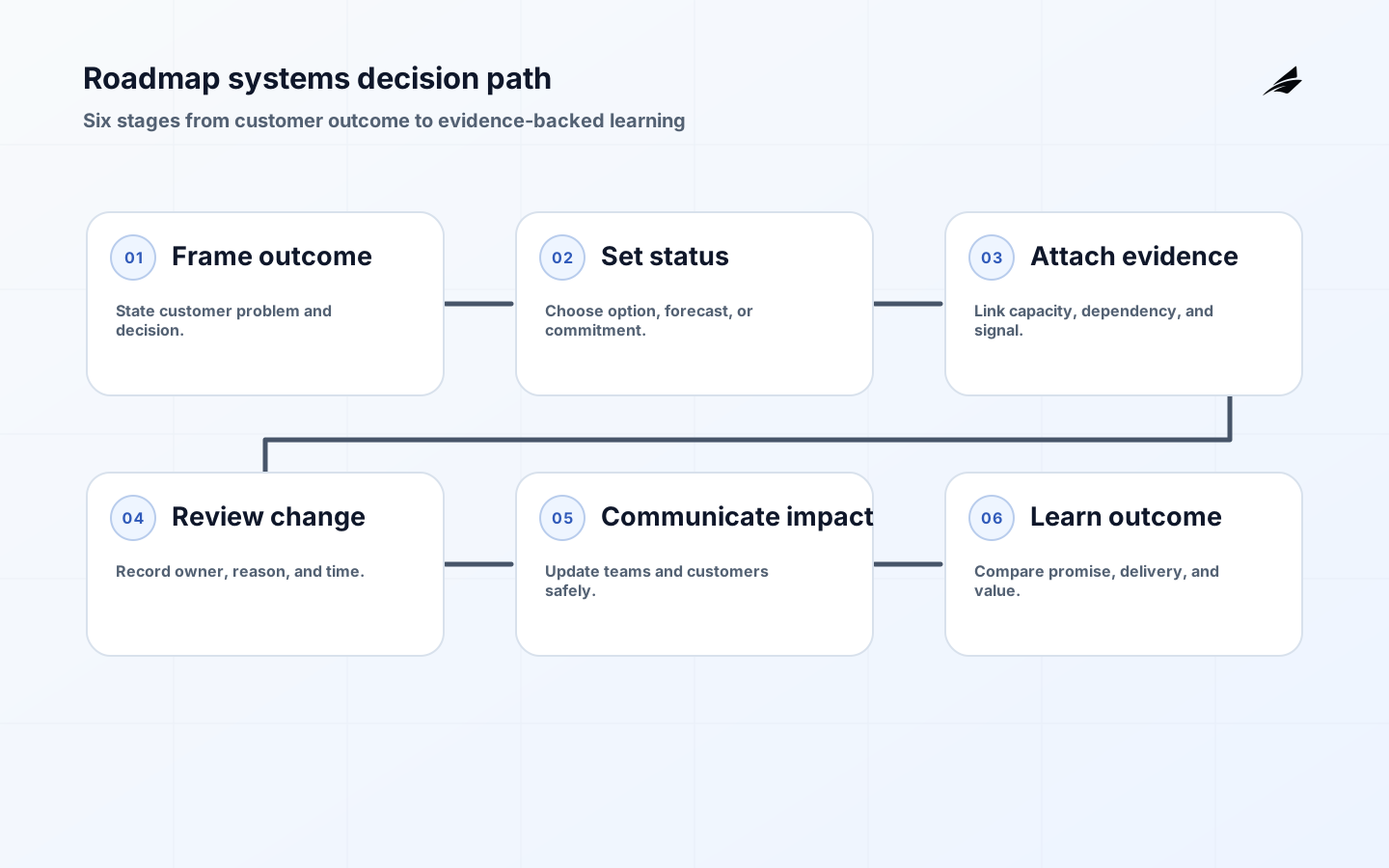
Roadmap systems become engineering systems when a roadmap status changes what people build, promise, staff, or communicate. A list of ideas is not enough. The product team needs a decision model that separates option, forecast, commitment, and completed outcome, then preserves the evidence behind each transition. This guide focuses on the operating mechanics: how roadmap data enters the system, how dependencies and capacity are represented, how changes reach affected people, and how a team can inspect whether the roadmap is helping decisions rather than merely producing activity.
Define the roadmap systems decision
Write the roadmap decision in one sentence before selecting tools: is the initiative an option, forecast, or commitment, and what evidence supports that status? Name the authoritative input as a decision record with the intended outcome, confidence, dependencies, capacity assumption, and next review date. Keep customer language aligned with the recorded state, then test normal, delayed, denied, and corrected workflow cases.

The difficult case is using a single delivery date as a substitute for evidence, dependency ownership, and capacity reality. Design that case deliberately.
| Decision element | Question to settle | Evidence to retain |
|---|---|---|
| Customer promise | What must roadmap systems make dependable? | Affected user, expected outcome, and review date |
| Authority | Which record resolves a conflict? | A decision record containing the intended outcome, confidence, dependencies, capacity assumption, and next review date |
| Boundary | Where must the rule be enforced? | The planning forum and publication channel where commitment level may change |
| Recovery | How is a wrong result corrected? | An explicit re-plan that records the trigger, affected audiences, and replacement decision |
Build evidence and controls into roadmap systems
The Site Reliability Engineering book explains a relevant control or operating model, while the NIST Secure Software Development Framework is useful for checking a boundary that must not rely on client-side convention.
Operational evidence must be usable under pressure. The AWS Well-Architected SaaS Lens is equally useful when the team needs to connect technical events to a real customer outcome. For roadmap systems, record which assumption would cause the commitment level to change.
| Failure mode | Control | Operator signal |
|---|---|---|
| Missing or stale input | Validate freshness and represent uncertainty explicitly | Age of authoritative record |
| Unauthorised operation | Enforce the planning forum and publication channel where commitment level may change at the protected action | Denied decision with actor and reason |
| Duplicate work | Use idempotency and a correlation identifier | One customer effect per request |
| Dependency loss | Choose timeout, fallback, and escalation behavior | Alert linked to customer impact |
Implement a thin, observable roadmap systems slice
The adjacent work in Product Analytics for SaaS Product Engineering, Customer Feedback Loops for SaaS Product Engineering Teams, and how engineering teams should think about roadmap systems often exposes dependencies that otherwise appear only after launch.
- State the roadmap systems decision and its authority in the delivery brief.
- The roadmap systems owner can use that evidence to decide what changes next.
- The roadmap systems owner can use that evidence to decide what changes next
- The roadmap systems owner can use that evidence to decide what changes next
- The roadmap systems owner can use that evidence to decide what changes next
- Rehearse rollback or containment before expanding the audience
Measure the Roadmap Systems outcome, not activity
Review roadmap systems evidence with product, engineering, and support. Track forecast changes by cause, dependency age, decision latency, and outcome-evidence coverage. Make corrections visible, scoped, and reversible, and give the system a named owner and review date.
Operate Roadmap Systems as a customer commitment
For roadmap systems, Treat each status change as a decision with a reason. During a planning cycle, ask owners to distinguish evidence from confidence and confidence from commitment. A dependency should carry an accountable external owner and a date for the next check, not just a label. When capacity, customer evidence, or technical risk shifts, update the item and explain the trigger to affected teams. This prevents roadmap meetings from becoming negotiations over stale dates. The useful artifact is a current decision record that lets a reader see what changed, what remains uncertain, and when the team will decide again.
Review Roadmap Systems operating evidence
A roadmap review earns trust when it makes a difficult trade-off legible. For each major item, record the current option, the evidence threshold for commitment, and the consequence of delay. Invite dependency owners to challenge assumptions before a date is broadcast. The point is not to eliminate change; it is to make change understandable. Teams can adjust well to a revised plan when they know what evidence moved it and what decision will be revisited next.
Design roadmap status as a state machine
Use states that describe decision meaning, not enthusiasm. An option may have a problem statement and evidence but no delivery promise. A forecast has assumptions and a review date. A commitment has an owner, scope boundary, dependency plan, and communication consequence. A completed item needs a release or acceptance record. Define which fields are required for each transition and which actor can approve it. This prevents a date from silently becoming a promise just because it was copied into a planning view.
Dependencies need owners and freshness. Link a roadmap item to the capability, team, customer cohort, or service it relies on, then set a next review date. When a dependency changes, the system should make affected commitments visible rather than leaving the team to discover them in a meeting. Keep a short decision history so a new owner can distinguish an intentional reprioritization from a stale field. The roadmap then becomes useful operational context without pretending that uncertainty has disappeared.
| Decision point | Required record | Safe review question |
|---|---|---|
| Boundary | Actor, resource, scope, and policy | Can the service decide without guessing? |
| State | Current value, effective time, and source | What does the customer see and why? |
| Recovery | Owner, reason, expiry, and result | Can the team correct or contain it safely? |
Evidence that changes Roadmap Systems
The Google SRE book provides an operating lens for reliability, ownership, and learning from incidents. The NIST SSDF supports reviewable development practices, while OpenTelemetry helps connect roadmap changes to observable releases. The AWS SaaS Lens is a useful prompt for tenant-aware operational ownership. These sources should inform fields, evidence, and review cadence rather than dictate a universal planning taxonomy.
Read the roadmap systems guide for engineering teams, product analytics guide, and customer feedback loops guide to connect planning state with evidence and customer learning.
Roadmap Systems: practical questions before rollout
Should a roadmap system show exact delivery dates?
Show a date when its assumptions and commitment meaning are clear. Otherwise show a forecast window, confidence, dependencies, and next review date so precision does not create a false promise.
Who owns a roadmap status change?
The owner should be the person accountable for the decision and its communication consequence, not necessarily the person entering the record. Keep the actor, reason, and effective time.
How can a roadmap system avoid becoming a reporting burden?
Require only fields that change a decision, automate evidence from delivery and feedback systems where practical, and review whether each field is used in a real planning or communication decision.
Key takeaways
- Roadmap systems need one explicit customer decision before it needs more workflow.
- Treat a decision record containing the intended outcome, confidence, dependencies, capacity assumption, and next review date as inspectable evidence, not a private implementation detail.
- Enforce the rule at the planning forum and publication channel where commitment level may change, including non-UI paths.
- Make an explicit re-plan that records the trigger, affected audiences, and replacement decision an owned product capability.
- This creates a concrete recovery and review path for roadmap systems.
Frequently asked questions
What should be built first? Build the smallest path that makes whether a proposed initiative is an option, forecast, or commitment and what evidence supports that status observable and supportable.
For roadmap systems, document who owns a decision during support and how that owner receives the evidence needed to correct it.
For roadmap systems, make the evidence visible during support review and test that the control still holds during normal handling.
For roadmap systems, test the control during support review and confirm that the evidence remains available during normal handling.
Ownership for roadmap systems is clearer when the customer promise is separated from the mechanism. For roadmap systems, review the engineering scope during a measured rollout.
Before widening roadmap systems, rehearse normal, denied, delayed, and corrected cases with realistic identifiers, then confirm ownership during the measured rollout.
The measurement plan for roadmap systems should pair each outcome with a reason to investigate it and a named recovery owner.
For roadmap systems, review the measurement during support and make sure a delayed handoff leaves a clear decision record.
For roadmap systems, test a scheduled change before treating the first release as complete, and verify the recovery path during support review.
A practical example for roadmap systems is an unexpected load spike.
Teams building roadmap systems for SaaS product engineering should compare a normal prioritization decision with a changed-permission case. Rehearse recovery and confirm the accountable owner during reconciliation.
For roadmap systems, review scope during normal handling, control during a delayed handoff, and control again when explaining the result to a customer.
A concrete operating test for roadmap systems for SaaS product engineering is to rehearse recovery during a drill and confirm ownership when a dependency fails.
Teams building roadmap systems for SaaS product engineering should compare a normal prioritization decision with a support-handled dispute. Confirm ownership and the decision history during reconciliation.
For roadmap systems, review control during normal handling and a delayed handoff; review the evidence before explaining the result to a customer.
A concrete operating test for roadmap systems for SaaS product engineering is to rehearse a dependency failure and verify measurement during recovery.
Teams building roadmap systems for SaaS product engineering should compare a normal prioritization decision with a tenant-boundary case. Review the measurement, affected scope, and owner during reconciliation.
Conclusion
Good roadmap systems turn a difficult decision into ordinary, trustworthy work.
Evidence for “Roadmap Systems for SaaS Product Engineering: A Practical Guide” is grounded in Google SRE: Service Level Objectives, NIST Secure Software Development Framework, OpenTelemetry Observability Primer, AWS SaaS Lens Foundations; each source informs a specific decision, test, or operating trade-off described in this guide.