How IT managers should think About Self-serve Onboarding
Self-serve onboarding is an engineering responsibility, not a screen or a vendor setting. For IT managers, the useful question is whether a new administrator can configure a secure, usable first workflow without a live handoff. For this workflow step, name the accountable owner, supporting evidence, exception route, and next measurable check.
Define the self-serve onboarding decision
Start by writing the decision in one sentence: whether a new administrator can configure a secure, usable first workflow without a live handoff. The authoritative input should be a progress model backed by verified setup states, permissions, integration checks, and accountable owners. Within this decision boundary, name the accountable owner, supporting evidence, exception route, and next measurable check.

The difficult case is declaring a person onboarded after a checklist click while required configuration remains unsafe or incomplete. Design for it before adding convenience automation. Put server-verified setup checks with accessible instructions and an escalation route for blocked users near the action that can affect the customer or their data. The recovery should be a resumable setup state plus a support handoff that preserves completed evidence.
| Decision element | Question to settle | Evidence to retain |
|---|---|---|
| Customer promise | What does self-serve onboarding make dependable? | Expected user outcome and affected cohort |
| Authority | Which record wins when facts conflict? | A progress model backed by verified setup states, permissions, integration checks, and accountable owners |
| Boundary | Where is the result enforced? | Server-verified setup checks with accessible instructions and an escalation route for blocked users |
| Recovery | How is a wrong result corrected? | A resumable setup state plus a support handoff that preserves completed evidence |
Use authoritative facts and explicit controls: Self-serve Onboarding
Stripe's entitlements guidance is a concrete example of separating commercial products from the feature access a customer receives. When implementing this workflow step, name the accountable owner, supporting evidence, exception route, and next measurable check.
For onboarding architecture, The secure-development review should make the protected decision and its evidence testable. NIST's Secure Software Development Framework provides a useful discipline. Before releasing this workflow step, name the accountable owner, supporting evidence, exception route, and next measurable check.
| Failure mode | Control | Operator signal |
|---|---|---|
| Stale or missing input | Order facts and expose pending state | Age of authoritative record |
| Unauthorized action | Enforce organization, admin role, setup task, dependency, verification result, and recovery owner at the protected action | Denied decision with actor and reason |
| Duplicate work | Use idempotency and correlation identifiers | One customer effect per request |
| Dependency failure | Choose timeout, fallback, and escalation behavior | Actionable alert linked to the decision |
Implement self-serve onboarding as a thin, observable slice
Model onboarding as a system of dependencies; the interface should reveal the next safe action. Build a test path that includes the normal result, declaring a person onboarded after a checklist click while required configuration remains unsafe or incomplete, and a permissions failure. Link the work to SaaS reliability and subscription access control; those adjacent decisions often reveal dependencies that otherwise surface only after launch.
- Name a product owner, technical owner, and recovery owner for self-serve onboarding.
- Test a normal journey, declaring a person onboarded after a checklist click while required configuration remains unsafe or incomplete, and an unauthorized request.
- For how IT managers Should Think About Self-serve Onboarding, Keep the recovery evidence explicit.
- For how IT managers Should Think About Self-serve Onboarding, Keep the recovery evidence explicit
- For how IT managers Should Think About Self-serve Onboarding, Keep the recovery evidence explicit
Measure the behavior that matters: Self-serve Onboarding
For self-serve onboarding, track completion of verified tasks, time to first successful workflow, integration failures, and setup-related contacts.
Key takeaways
- Self-serve onboarding needs one named customer decision before it needs more workflow.
- Make a progress model backed by verified setup states, permissions, integration checks, and accountable owners inspectable, ordered, and tied to a policy version.
- Enforce the decision at server-verified setup checks with accessible instructions and an escalation route for blocked users, including non-UI paths.
- Treat a resumable setup state plus a support handoff that preserves completed evidence as a product capability with an owner and an audit record.
- For how IT managers Should Think About Self-serve Onboarding, Keep the recovery evidence explicit
Frequently asked questions
What should be built first? Build the smallest path that answers whether a new administrator can configure a secure, usable first workflow without a live handoff and produces a reviewable decision record.
Operate self-serve onboarding as a shared contract
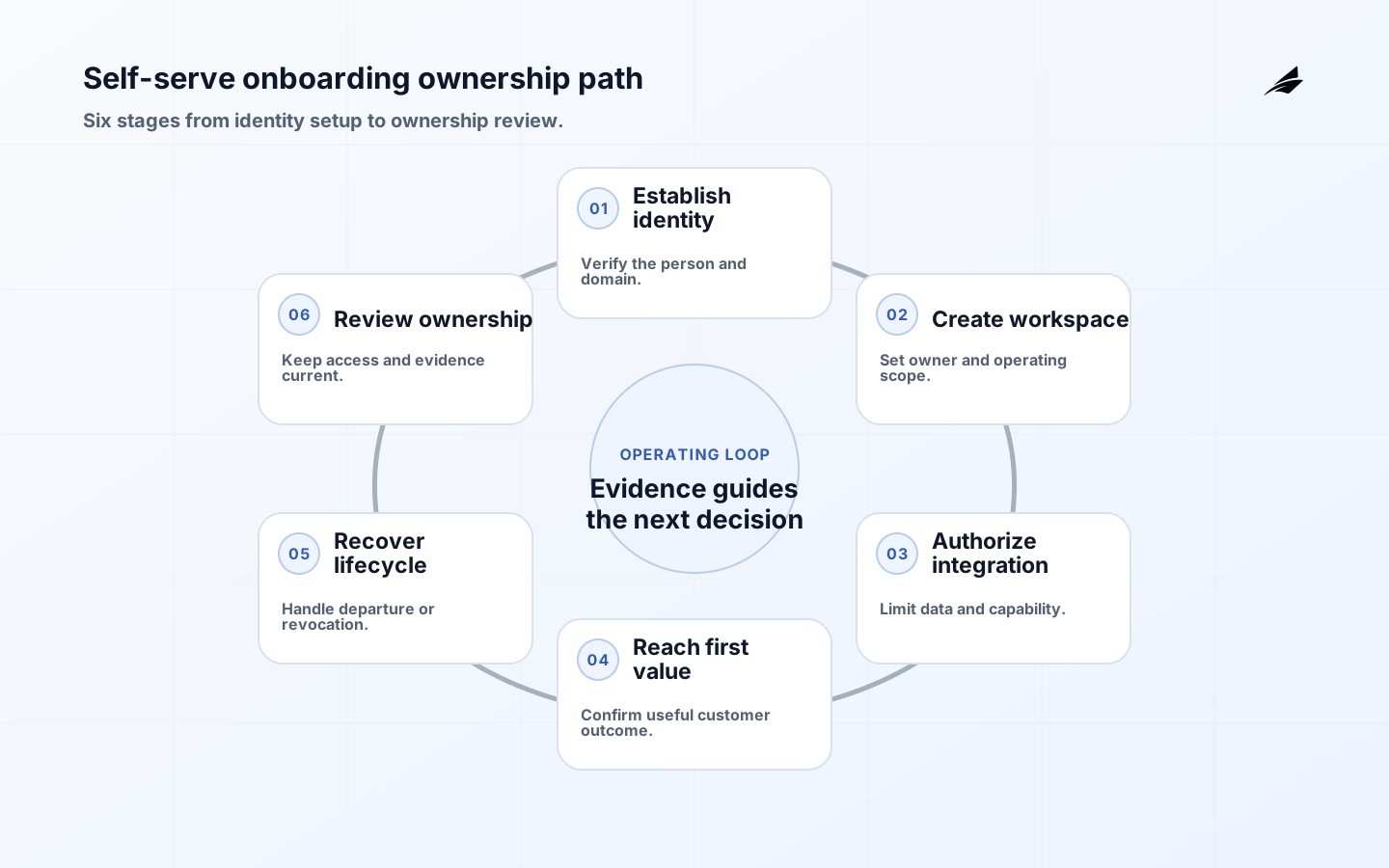
Self-serve onboarding still has an operating model even when no employee is present in the first session. IT managers should be able to answer which identity created the workspace, which role owns setup, which integrations were authorized, and what happens when a staff member leaves. Make invitations, ownership transfer, domain verification, and recovery visible in the same model instead of treating them as unrelated screens.
A practical pilot follows one organization from invitation through first value and then tests a departure, an expired link, a revoked integration, and a support escalation. Compare the control-plane record with the customer-facing state. If an entitlement changes, verify both the billing source and the application decision. This connects self-serve onboarding to workspace models, subscription access control, and SaaS reliability.
What does IT need to own in self-serve onboarding?
Own identity, membership, integration scope, recovery contacts, and the policy for transferring or removing workspace ownership.
How should a company handle an employee departure?
Revoke active access, transfer owned resources deliberately, preserve audit history, and verify that automation credentials are not orphaned.
What is the right self-serve success measure?
Measure time to a meaningful outcome, completion by role, setup failures, recovery time, support load, and safe retention—not only sign-up volume.
For how IT managers should think about self-serve onboarding, a good handoff ends with observable evidence rather than a verbal promise. Reconcile self-serve onboarding changes against the original record.
The smallest useful improvement to how IT managers should think about self-serve onboarding is often a sharper boundary, not another feature.
For how IT managers should think about self-serve onboarding, test a delayed dependency before treating the first release as complete.
A practical example for how IT managers should think about self-serve onboarding is two workers attempt the same transition.
Define the onboarding measurement boundary with the Product Analytics onboarding view: identify the activation milestone, required setup steps, workspace identifier, and event that proves a meaningful outcome.
While operating this evaluation, name the accountable owner, supporting evidence, exception route, and next measurable check.
For self-serve onboarding, review the about self serve onboarding evidence during a customer explanation.
For self-serve onboarding, review the about self serve onboarding evidence during normal handling.
End the handoff with a named owner, a review date, and evidence that the customer-facing state is correct.
Use a concrete support or failure case to test the control and its owner.
A practical example for self-serve onboarding is an incomplete setup. Test normal, delayed, denied, and corrected cases before widening the workflow.
For self-serve onboarding, review the about self serve onboarding scope during a customer explanation.
For self-serve onboarding, review the about self serve onboarding recovery during a customer explanation.
For self-serve onboarding, test a duplicate request before treating the first release as complete.
For a changed permission during onboarding, compare the intended membership and entitlement with the server-side decision and customer-visible state. Rehearse the evidence path before release, including denied and pending outcomes.
Test a delayed dependency and document the recovery decision.
Separate the onboarding promise, such as a configured workspace, from the mechanism that provisions membership or integrations. Assign an owner for each transition and define the evidence that proves setup is complete.
In a support review, walk a real workspace through setup, an interrupted integration, and resumption. Product, engineering, and support should be able to trace the recorded state, customer explanation, and next safe action.
Keep the recorded state aligned with the explanation given to customers.
Rehearse onboarding with realistic workspace and member identifiers, including a duplicate invite and an interrupted dependency. Verify server-side authorization, resumable state, and a named recovery owner.
At a tenant boundary, compare normal onboarding with a workspace whose membership or integration request is rejected. Confirm isolation, explicit pending or denied states, and a support handoff that does not expose another tenant's data.
Show the pending and denied states, and give operators a clear recovery path.
Use a policy change or dependency failure to interrupt setup before expansion. Confirm that the workflow preserves completed evidence, prevents unsafe completion, and resumes or escalates through a documented owner.
Conclusion
Good self-serve onboarding makes a difficult operational decision ordinary. Keep the measured outcome tied to the customer decision it supports.
Evidence for “How IT Managers Should Think About Self-serve Onboarding” is grounded in Stripe Billing Entitlements, Stripe subscription lifecycle, AWS Well-Architected SaaS Lens foundations, NIST Secure Software Development Framework, Product Analytics onboarding view; each source informs a specific decision, test, or operating trade-off described in this guide.