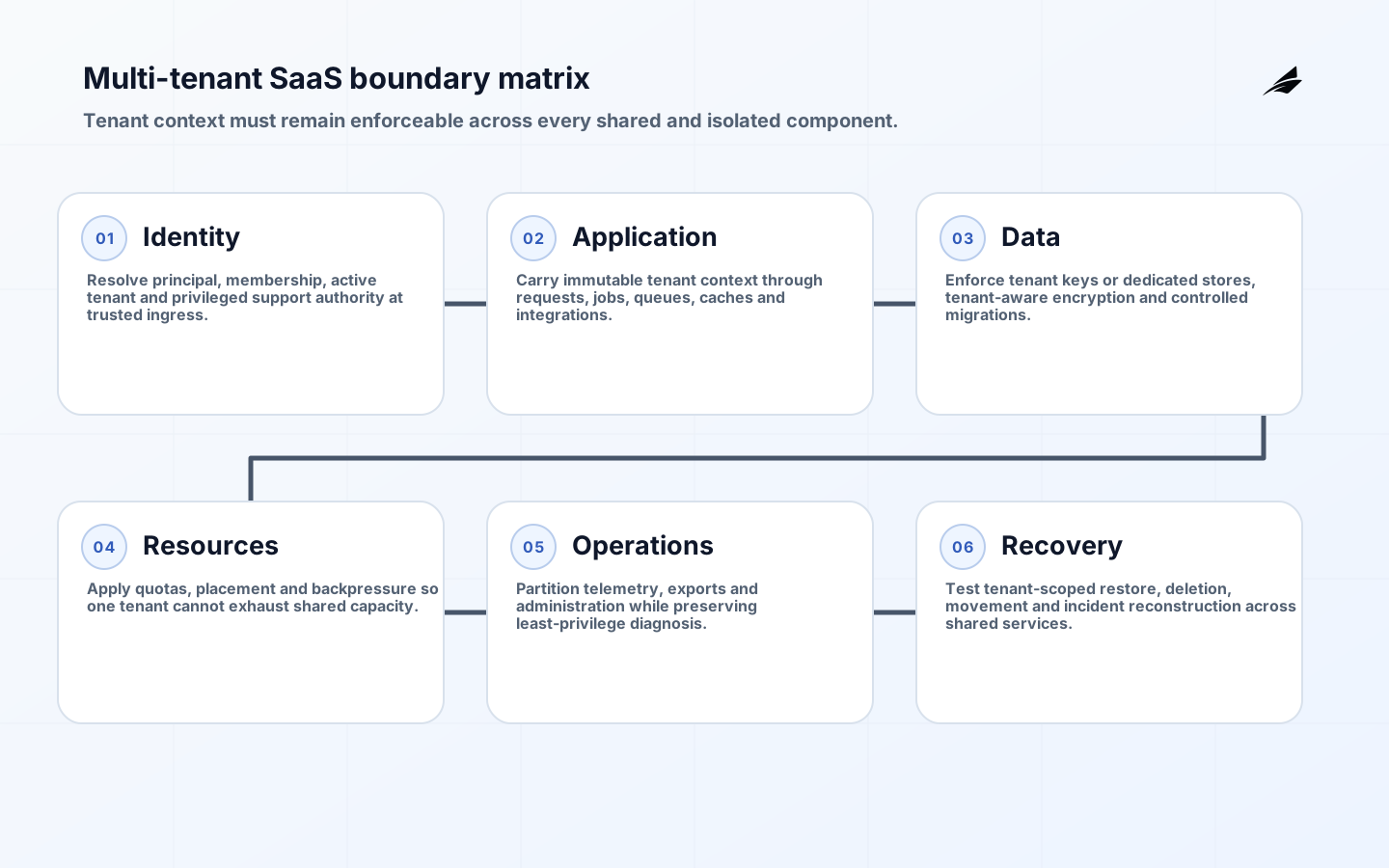
A multi tenant SaaS architecture implementation plan is not a single database choice. It is a set of enforceable boundaries carried through identity, request handling, data, compute, queues, caches, analytics, support tools, backup and deployment. Teams often call a product multi-tenant because customers share an application, while tenant context is still supplied by an editable request field or forgotten in a background job. The implementation plan must specify where tenant identity originates, how every component preserves it, and which resources are shared, partitioned or dedicated.
This FAQ complements the scope and delivery plan, the readiness checklist and the operations-focused multitenancy guide. It treats isolation as a spectrum rather than a slogan. A product can pool one layer and silo another, provided the choice traces to customer risk, performance, compliance, cost and operating capability.
What exactly is a tenant?
A tenant is a customer or organizational boundary, not simply a user. One tenant may contain many users, roles, workspaces and service identities. Define whether subsidiaries, regions or environments are separate tenants and whether a person may belong to several. Create an immutable internal tenant identifier that is independent of display name, domain or billing account. The identity layer should resolve the authenticated principal and tenant membership; application code should not trust a tenant identifier supplied by the browser without authorization.
Document tenant lifecycle states: invited, active, suspended, exporting, deleting and closed. Each state changes permitted operations. Provisioning should create policies, keys, quotas and baseline configuration idempotently. Suspension must stop access without destroying evidence. Deletion needs a record-by-record plan for primary data, replicas, search indexes, caches, logs, analytics and backups. If tenant identity cannot survive those transitions consistently, architecture work is not finished.
How should pooled and siloed isolation be chosen?
Choose isolation per component. A shared application tier with tenant-aware authorization may be efficient, while regulated customers receive dedicated databases or deployment stamps. Microsoft guidance describes a continuum between shared and isolated resources; AWS emphasizes that isolation remains mandatory even when infrastructure is shared. Evaluate confidentiality, noisy-neighbor risk, blast radius, regional placement, customization, service level and fleet complexity. Dedicated infrastructure improves some boundaries but does not remove the need for unified onboarding, identity, deployment, metering and operations.
| Model | Strength | Primary trade-off |
|---|---|---|
| Fully pooled | High density and simple fleet management | Application controls carry more isolation responsibility |
| Pooled compute, separate data | Stronger data boundary with shared application economics | Connection routing and migrations become tenant-aware |
| Deployment stamps | Limits scale and failure domains across tenant groups | Requires placement, fleet rollout and cross-stamp operations |
| Dedicated tenant stack | Strong customization and resource isolation | Higher cost and risk of one-off operational drift |
How should tenant data be partitioned and queried?
Pooled tables require a tenant key on every tenant-owned row and a data-access layer that injects tenant scope centrally. Composite uniqueness and foreign keys should include tenant identity where practical. Schema-per-tenant or database-per-tenant designs reduce some accidental mixing but increase migration, connection and fleet-management work. Whichever model is selected, test object references, search, cache keys, exports, asynchronous jobs and analytics for cross-tenant leakage. Authorization should be checked against the resolved tenant before data retrieval, not after results are returned.
Encryption design also needs tenant semantics. Decide whether keys are shared by environment, separated by tenant tier, or customer-managed. Key rotation, restore and export must work at the selected boundary. Backups are commonly created at infrastructure scope; a promise to restore one tenant therefore requires tested logical extraction or a dedicated store. Record retention and deletion limitations honestly in contracts. A tenant deletion is not complete merely because the primary application row disappeared.
How is tenant context preserved through the application?
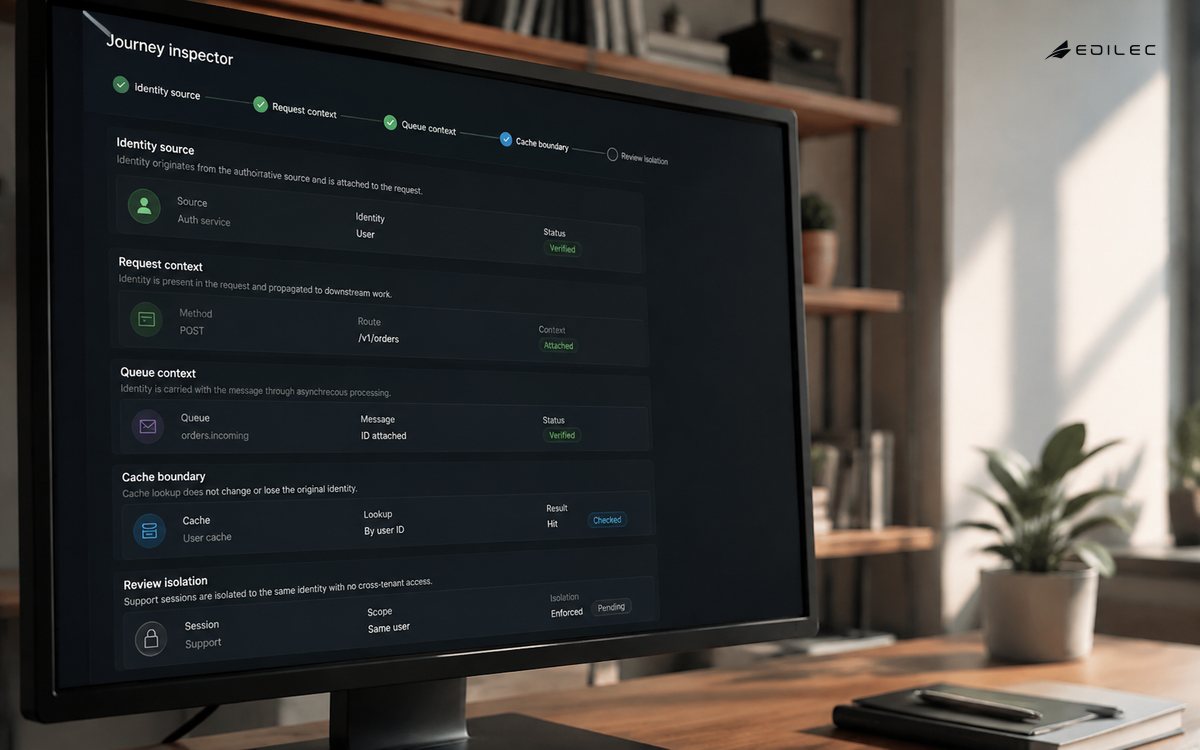
Resolve tenant context once at a trusted ingress and carry it in an immutable server-side object. Propagate it through service calls, messages, scheduled jobs and traces. Sign or authenticate internal messages; do not let a worker infer tenancy from a mutable payload field. Prefix cache keys and object paths with tenant identity, and protect against enumeration. For integrations, bind credentials and destinations to a tenant-owned configuration record. Any global administration path should require separate privileged access, explicit reason and attributable audit events.
Background work deserves special testing because it loses the visible user session. Queue messages need tenant, actor, purpose, schema version and idempotency data. Consumers should reauthorize sensitive actions using current policy. A retry after suspension or deletion must not revive access. Test concurrency where two tenants use the same business identifiers, where jobs move between workers, and where a partial deployment runs mixed application versions.
How are noisy neighbors and shared failures controlled?
Measure consumption per tenant at meaningful choke points: requests, concurrent jobs, queue depth, database work, storage, outbound messages and third-party quota. Apply fair-use limits and backpressure before a large tenant degrades everyone. Premium tiers may map to dedicated pools, but tiering must be enforced consistently. Capacity planning should consider skew, not just average load. A single tenant import can be larger than normal daily traffic for the rest of the fleet.
Use deployment stamps or partitioned services to limit blast radius where scale justifies them. Route tenants through a controlled placement record and design moves between stamps. Observe both fleet health and tenant experience. An aggregate service objective can look healthy while one tenant is unavailable. Incident tooling must identify affected tenants without exposing their data to operators who do not need it.
| Control plane | Required tenant-aware behavior | Test |
|---|---|---|
| Provisioning | Create configuration, quotas, keys and placement idempotently | Replay onboarding and confirm one consistent tenant |
| Deployment | Promote compatible artifacts across stamps and tiers | Canary one stamp and roll back mixed versions |
| Observability | Label telemetry without leaking customer content | Diagnose one tenant with least-privilege support access |
| Backup and restore | Match recovery claims to the storage boundary | Restore one tenant and reconcile related services |
| Deletion | Remove or expire every governed copy | Verify search, cache, analytics, logs and backup policy |
How should an existing single-tenant product migrate?
Inventory every place customer identity is implicit: database, file paths, configuration, secrets, scheduled jobs, URLs, analytics and support scripts. Introduce a stable tenant model before pooling infrastructure. Backfill tenant keys with reconciliation and constraints, then require tenant context in new code. Migrate a low-risk cohort first and compare records, permissions, performance and invoices. Preserve a rollback route that does not merge divergent writes silently.
Avoid combining a tenancy rewrite, billing redesign and major user-interface change in one cutover. Thin slices expose hidden assumptions sooner. Create contract tests that attempt cross-tenant identifiers at every API and job boundary. Run load tests with skewed tenants and chaos tests that fail a shared dependency. Migration is complete only when operations can provision, diagnose, restore, move and delete tenants through supported procedures.
Design support tooling as part of the isolation model. Operators need tenant-scoped search, configuration, health, audit and recovery views without broad database access. Emergency access should be time-bound, approved and attributable, with a reason linked to the incident. Test that screenshots, exports and copied diagnostics cannot silently include neighboring records. A support console that bypasses product authorization is one of the easiest ways to undermine an otherwise careful tenant architecture.
Billing and entitlement services need the same discipline. A plan change may alter limits, features, retention or isolation tier while jobs are already running. Define effective time, proration authority, retry and rollback. Reconcile the commercial record with enforced configuration. If premium isolation maps to a deployment stamp or dedicated database, provisioning and deprovisioning must be automated and observable; a sales promise should never rely on a manual infrastructure note that operations cannot verify.
Design analytics across tenants without weakening isolation. Operational fleet metrics may aggregate capacity and failures, while customer-facing analytics must remain tenant-scoped. Minimize identifiers in shared telemetry and control access to raw logs. For global reporting, use governed extraction that records source deployment, tenant scope, time and transformation version. Test deletion and correction propagation into analytical stores. A warehouse that copies every tenant record without equivalent controls becomes an alternate application boundary and must be treated accordingly. Include analytical exports and machine-learning feature stores in cross-tenant tests. Verify that scheduled reports cannot be delivered to an address owned by another tenant. Audit embedded dashboard tokens and shared links as well. Revoke them promptly.
Key takeaways
- Define tenant identity and lifecycle before choosing infrastructure.
- Select isolation independently for application, data, compute and operations.
- Propagate trusted tenant context through every synchronous and asynchronous path.
- Design quotas, telemetry, backup, deletion and support access as tenant-aware capabilities.
- Test migration and failure with cross-tenant attack cases and skewed workloads.
Frequently asked questions
| Question | Answer |
|---|---|
| Is database-per-tenant always safer? | It strengthens one boundary but still needs correct routing, identity, secrets, operations and cross-tenant administrative controls. |
| Can one user belong to several tenants? | Yes, if membership and active tenant selection are explicit and every request is authorized against both user and tenant. |
| Does a Kubernetes namespace guarantee hard isolation? | No. It is one control; network, identity, node, runtime and data isolation still need a threat-based design. |
| When are deployment stamps useful? | When a single deployment approaches scale limits, regional needs differ, or the team needs smaller failure and rollout domains. |
| What is the most important test? | Attempt cross-tenant access through APIs, jobs, caches, exports and support tools while dependencies fail and versions differ. |
Conclusion
A multi tenant SaaS architecture implementation plan succeeds when tenant context is a first-class security and operating boundary. Make sharing and isolation choices explicit, then prove them across data, compute, asynchronous work, telemetry and lifecycle operations. The right design is not the most pooled or most isolated; it is the one whose customer promises the team can enforce and operate consistently at scale.