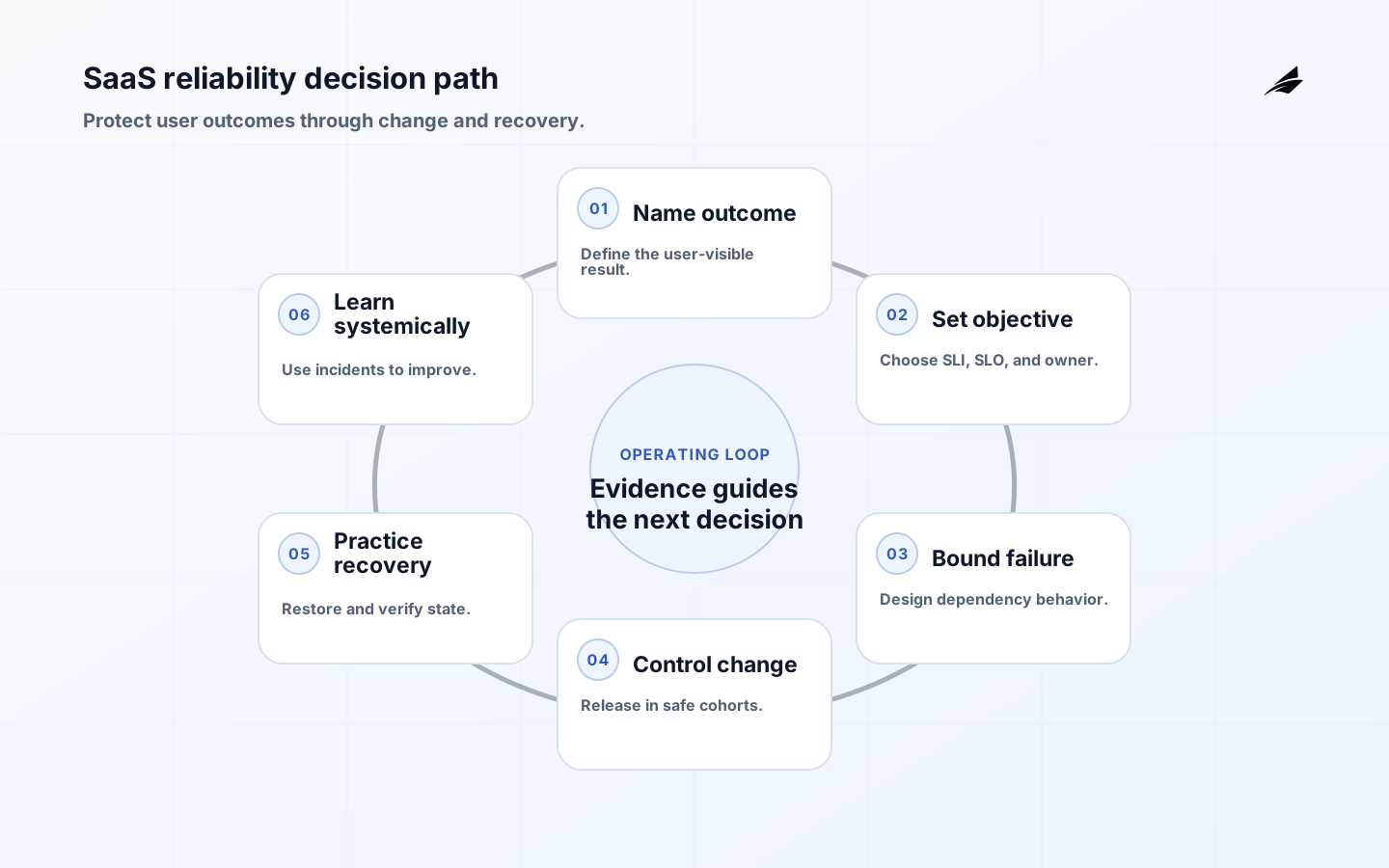
SaaS reliability is not the absence of incidents. It is the disciplined ability to deliver the user’s important outcome through ordinary change, dependency failure, uneven demand, and recovery. A CTO should be able to answer what “available” means for each product path, how the team knows it is falling short, who can make a risky change, and how the service returns to a known state. Infrastructure choices matter, but they are only one part of the operating system that creates confidence.
The related SaaS reliability operations playbook, subscription access control guide, and SaaS MVP guide help connect the reliability decision to operations, entitlements, and product scope.
Define reliability around user outcomes
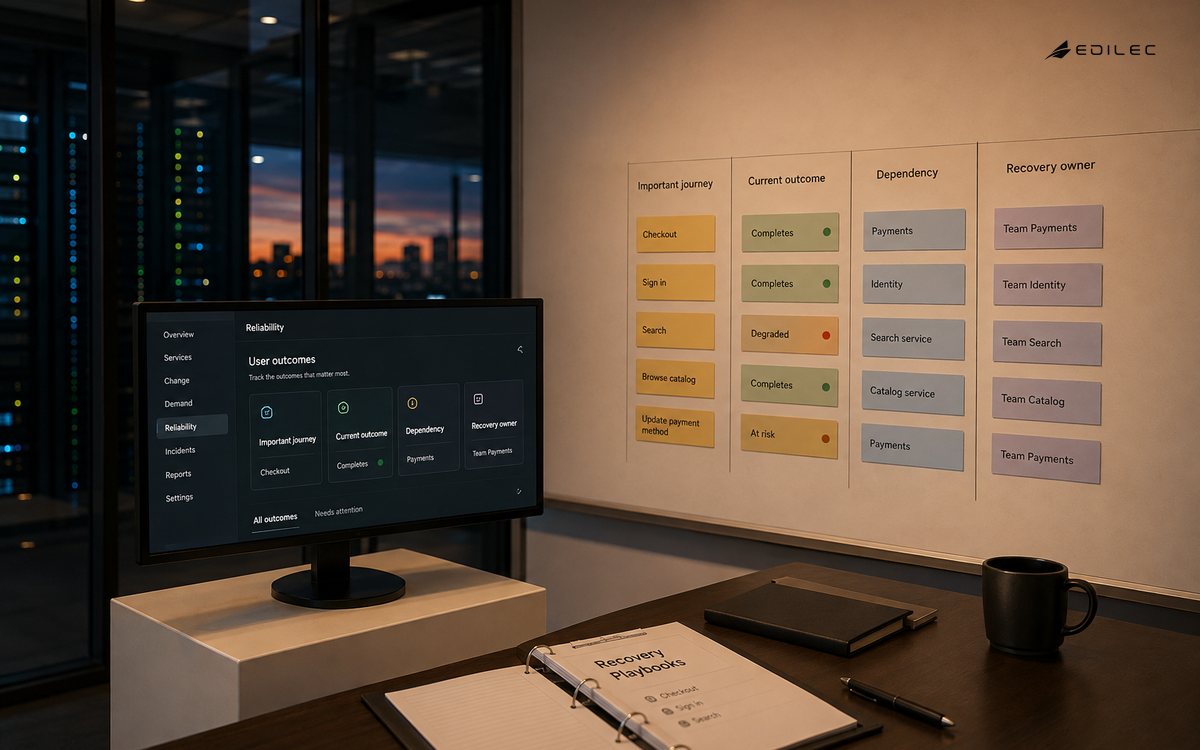
Start with a customer action or business outcome: sign in, submit a payment, complete a workflow, retrieve a record, or receive a notification. Define what success, latency, correctness, and degraded behavior mean for that path. Google SRE’s SLO guidance recommends working backward from what users care about rather than selecting whatever metric is easiest to collect. A service can have excellent CPU graphs while its users cannot complete a critical action. Write the boundary with the dependent systems, data, support process, and communication responsibility included.
| Reliability concern | Decision | Evidence |
|---|---|---|
| Outcome | What must a user complete? | User-centered SLI and journey test. |
| Objective | What target and error budget apply? | Versioned SLO and review owner. |
| Dependency | What happens when it is slow or unavailable? | Timeout, fallback, or safe stop test. |
| Recovery | What known state must return? | Rehearsal result and restoration record. |
Use a small, decision-ready SLO set
Choose indicators that can change engineering behavior. Availability, latency distribution, correctness, freshness, queue age, or successful workflow completion may matter depending on the service. State the measurement window, population, exclusions, and target. An SLO without an owner or response is only a report. Use an error budget as a decision aid: when the budget is being consumed, the team may pause risky releases, invest in capacity, or investigate a dependency rather than arguing from intuition. Keep objectives understandable enough for product and support partners to use them.
Make dependency failure a designed state
List critical dependencies and record their timeout, retry, fallback, and data-integrity behavior. A retry can amplify load; a fallback can serve stale data; a circuit breaker can preserve one path while denying another. Decide which outcomes may degrade and which must stop to avoid corruption. For shared SaaS systems, include tenant impact and noisy-neighbor behavior in the analysis. A dependency map should connect each failure mode to a signal, an owner, and a recovery action. If no one can say what should happen when a dependency is slow, the architecture is already choosing for you.
- Use bounded timeouts and make retries visible in telemetry.
- Separate safe stale reads from writes that require current state.
- Protect critical queues and resources from one tenant or workload.
- Record data-integrity checks alongside availability signals.
- Document the authority to disable or degrade a feature during an incident.
Treat change as a reliability event
AWS frames operational excellence around preparing, operating, and evolving workloads with observable business and operational metrics. For a CTO, that means a release is not complete when code is deployed; it is complete when the service is in the intended state, signals are healthy, and the return path is known. Use progressive delivery, compatibility checks, configuration versioning, and explicit pause criteria. Test schema and data migrations separately from application rollback because an old binary may not understand a new state. Link a change identifier to the resulting telemetry and incident record.
| Control | Protects | Check before expansion |
|---|---|---|
| Canary or staged rollout | Limits user exposure. | Cohort health and stop authority. |
| Compatibility test | Prevents mixed-version failure. | Schema, queue, and client behavior. |
| Capacity guardrail | Avoids overload during change. | Headroom under realistic demand. |
| Return action | Restores a known service state. | Rehearsed execution and evidence. |
Build observability for action, not decoration
Practical alerting should tell a responder that a user-centered objective is at risk and point toward the next investigation. Pair high-level symptoms with enough detail to locate the service, version, tenant cohort, dependency, or region involved. Alert on sustained conditions and actionable burn rather than every component fluctuation. Preserve logs, metrics, traces, and change records with consistent correlation. Review alert ownership and test the response path. A dashboard that no one trusts during an incident is not an observability investment; it is deferred confusion.
Make recovery a practiced capability
A recovery plan should identify detection, authority, containment, restoration, data verification, customer communication, and follow-up. Test backups by restoring them, test failover with realistic dependencies, and test the operator permissions required to perform the action. Google’s reliability material notes that testing reduces uncertainty about future behavior; a document alone does not. Record the actual time, surprises, and evidence from each rehearsal. Set recovery objectives around the protected outcome, not just the time to restart a process.
Review reliability as a portfolio decision
Not every endpoint needs the same target or architecture. Rank customer journeys by impact, frequency, reversibility, and dependency concentration. Invest in redundancy, isolation, or more testing where a failure is costly and the objective justifies it. Avoid buying complexity for a path with no measurable benefit. During roadmap review, show error-budget consumption, incident causes, recovery evidence, capacity risk, and planned change. This makes reliability a shared product decision rather than an invisible tax carried by the on-call team.
Use incident evidence to improve the system
Review incidents and near misses for missing signals, unsafe defaults, unclear ownership, and recovery friction. Track detection time, decision time, restoration time, customer impact, data correction, repeat causes, and whether the documented runbook matched reality. Avoid turning one incident into a broad list of unowned actions. Choose a small number of changes that reduce uncertainty or protect the SLO, assign owners, and revisit the result. Reliability grows when the organization learns from normal operations as well as from visible outages.
- Exercise the dependency timeout path under realistic load.
- Deploy a compatible and incompatible schema change in a test environment.
- Run a restoration and verify data correctness, not just process health.
- Ask an on-call responder to find the change and owner from one alert.
- Revisit an SLO when product behavior or customer expectations change.
A CTO review can make reliability concrete by asking for one completed recovery exercise and one recent change that used a pause criterion. Inspect the user-facing objective, the signal that detected risk, the authority that decided, the action that restored service, and the evidence that the outcome was correct. Then ask what the team learned and what it deliberately did not fix. This keeps reliability work tied to customer value and reduces the temptation to measure success only through infrastructure inventory or a reassuring availability average.
Reliability investment is easier to prioritize when the organization can see the trade-off between a user outcome and the complexity needed to protect it. State what the team will not optimize, what failure is acceptable, and what evidence would change that decision. This prevents both underinvestment in a critical path and overengineering a low-impact one. Keep the decision close to the SLO, error budget, dependency map, and recovery result so the next roadmap review begins with facts rather than slogans.
Key takeaways for SaaS reliability
- Define reliability around user outcomes and explicit degraded behavior.
- Use a small SLO set with an owner, response, and error-budget decision.
- Treat dependency failure, change, and recovery as normal design inputs.
- Build observability that points to action and preserves correlation.
- Test recovery and use incident evidence to reduce future uncertainty.
SaaS reliability FAQ
Reliability conversations improve when the team can name the outcome, target, failure behavior, and evidence. Use these answers to start a CTO or product review.
What should a CTO mean by SaaS reliability?
The ability to deliver defined user outcomes through change, dependency failure, load variation, and recovery, with evidence and ownership. It includes correctness and supportability, not only uptime.
How many SLOs should a service have?
Start with a small set tied to user-visible outcomes and a clear response; add detail only when it changes an engineering decision. Too many objectives dilute ownership.
Is multi-region always more reliable?
No. It adds failure modes and operational complexity; choose it when the protected outcome and recovery requirement justify the trade-off. Test the whole operating path.
What proves a recovery plan works?
A rehearsal or controlled test that demonstrates detection, authority, restoration, data integrity, and communication within the stated objective. Record surprises and update the plan.
A CTO should treat SaaS reliability as an operating agreement rather than a collection of infrastructure features. Pick the customer journeys that deserve explicit objectives, assign owners for the signals, and define what changes when error budget is nearly spent. Reliability work should include dependency limits, durable jobs, safe release controls, and a recovery exercise that proves the team can restore service and communicate clearly. A growing platform does not need every control on day one, but it does need enough evidence to distinguish a localized defect from systemic risk. That evidence is what makes the next investment defensible.
Conclusion: make reliability a product decision
SaaS reliability improves when leaders connect user outcomes to measurable objectives, bounded change, dependency behavior, and practiced recovery. Choose the complexity the product actually needs, make signals actionable, and use error budgets and incident evidence to guide investment. The result is not a promise that nothing will fail; it is a service and organization that can recognize failure, protect customers, and learn without guesswork.
Ownership is clearer when how ctos should think about saas reliability in production separates the promise from the mechanism. Explain saas reliability in production pending and denied states before expansion.
Before widening how ctos should think about saas reliability in production, run a small rehearsal with normal, denied, delayed, and corrected cases. Treat saas reliability in production exceptions as evidence for the next decision.
The measurement plan for how ctos should think about saas reliability in production should pair an outcome with a reason to investigate it.
A durable operating note for how ctos should think about saas reliability in production records the assumptions that made the decision safe: the authoritative source, effective time, permitted actor, protected resource, and recovery route. Measure saas reliability in production outcomes alongside correction effort.
For how ctos should think about saas reliability in production, a good handoff ends with observable evidence rather than a verbal promise. Test saas reliability in production with normal, delayed, denied, and corrected workflow cases.
For SaaS Reliability in Production, AWS Well-Architected Reliability: Operational Monitoring defines scope; AWS Operational Excellence Pillar supports the control; Google SRE: Service Level Objectives clarifies evidence; Google SRE: Practical Alerting guides recovery; Google SRE: Testing for Reliability frames review.
SaaS reliability in production requires an explicit customer promise, an operable mechanism, and a named owner. Document the outcome, the signal that reveals degradation, the authority to pause or change the service, and the evidence required to review the decision.
A practical example for saas reliability in production is a delayed dependency. Review the operating evidence with product, engineering, and support before expansion.
Ownership for saas reliability in production is clearer when the customer promise is separated from the mechanism. Keep the recorded state aligned with the explanation given to customers.
Evidence for “How CTOs Should Think About SaaS Reliability in Production” is grounded in AWS Well-Architected Reliability: Operational Monitoring, AWS Operational Excellence Pillar, Google SRE: Service Level Objectives, Google SRE: Practical Alerting, Google SRE: Testing for Reliability; each source informs a specific decision, test, or operating trade-off described in this guide.