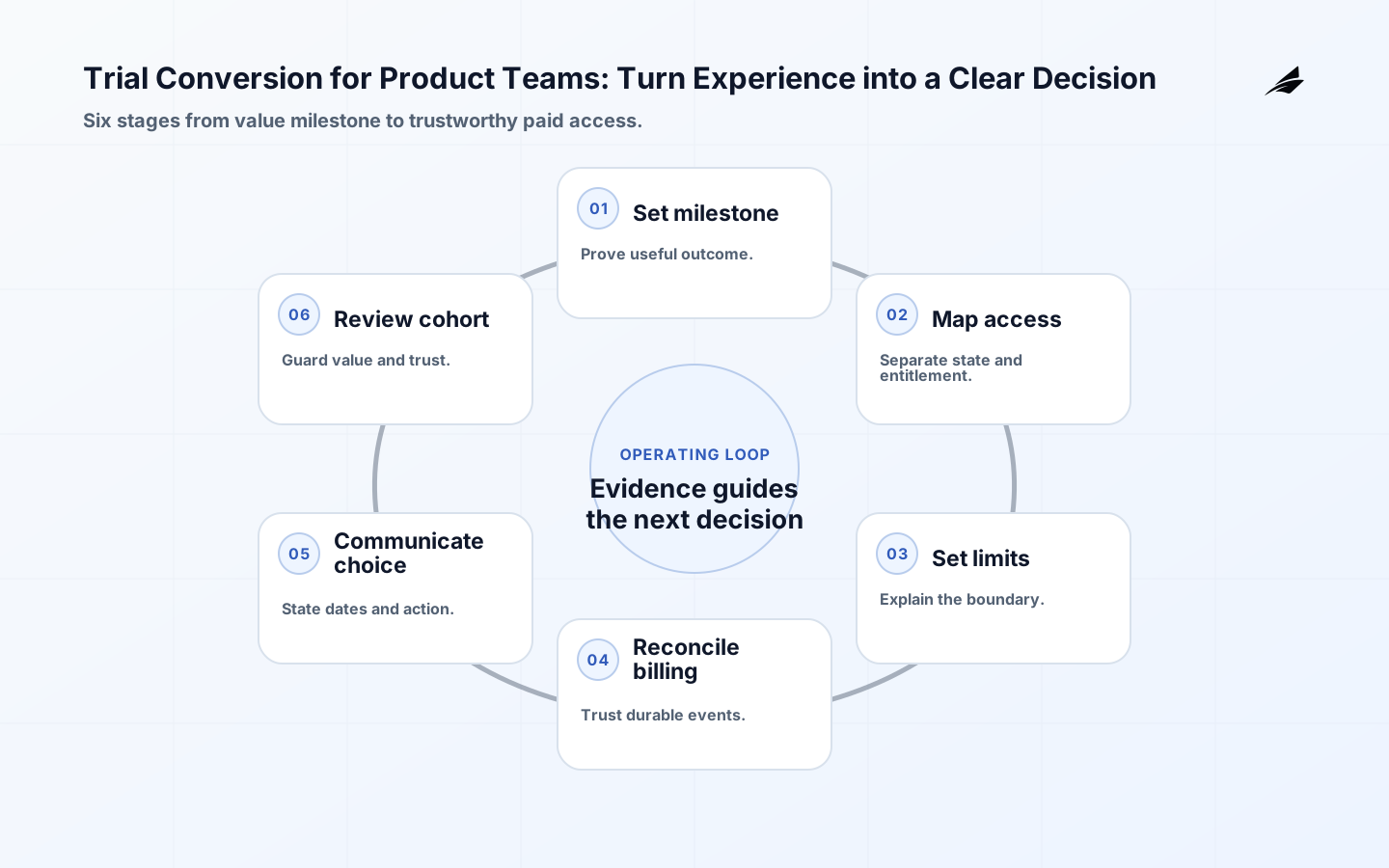
Trial conversion is not a countdown timer with a payment wall at the end. It is the product's test of whether a new customer can reach a useful outcome, understand the value, and choose the right next step without losing trust. Stripe's subscription documentation distinguishes lifecycle states such as trialing, active, incomplete, past_due, and canceled, while its entitlements guidance focuses on when a feature can be granted or revoked. That separation matters. Product teams should define value milestones, access rules, billing evidence, and communication as one system. Compare this guide with the trial conversion checklist and billing workflows for product engineering.
Define the value milestone that earns a trial decision
A value milestone is a customer outcome, not an activity count. It might be a team completing a shared workflow, an analyst producing a report that others can use, or an operator resolving a real case with the product. Define the actor, required context, completion evidence, time window, and quality guardrail. “Created an account” is a useful starting state; “completed a report that a teammate viewed” may be a better signal of value. If the outcome needs an integration, invite, or data import, make that dependency visible and provide a test path when a real production action is not yet appropriate.

| Trial stage | Customer question | Product evidence |
|---|---|---|
| Explore | Can this solve my problem? | Relevant example and safe first action |
| Activate | Did I reach useful value? | Milestone event and outcome quality |
| Evaluate | What changes if I pay? | Plan, entitlement, limit, and support clarity |
| Decide | Can I continue without surprise? | Payment state, access state, and next action |
Separate trial access from payment status
Do not reduce the account to trial or paid when the product needs more precise states. Record the subscription or trial lifecycle, the feature entitlement, the limit or quota, and the reason for a current access decision. Stripe notes that a subscription can be trialing and safely provision a product, can be incomplete while initial payment needs attention, and can be past_due or paused under different conditions. Your application should decide which of those provider states map to which product capabilities, messages, and support actions. A customer should see a truthful state such as available until a date, payment action required, or access paused—not a generic lock screen.
Make value reachable before asking for a commitment
Use the onboarding flow to reduce the distance between signup and the first proof of value. Ask for information that changes the example or permission model, prefill known context, and offer a guided path through the core action. Delay optional configuration. If the product requires a card for a reason, state when it will be charged, how the customer can cancel, and what happens when the trial ends. If a no-card trial is appropriate, define abuse and capacity controls without punishing legitimate users. The right experience is not the one with the most prompts; it is the one that helps a customer make a confident decision.
Use limits as a clear product boundary
A trial limit should protect capacity, guide the customer toward the intended plan, or prevent an action whose consequences are not yet understood. State what is limited, how usage is counted, when it resets, and what happens to existing work. AWS's SaaS foundations guidance recommends tenant-aware throttling and onboarding tests because one workload can affect another; the same principle applies to trial capacity. Avoid a limit that appears only after a customer has built an essential workflow. A preview, warning threshold, and export or downgrade path can make the decision fairer without giving away an unlimited production service.
| Boundary | Good customer message | Operator evidence |
|---|---|---|
| Feature unavailable | This plan does not include the capability | Entitlement rule and plan version |
| Usage threshold | You have used 80 of 100 included runs | Usage source, period, and reconciliation |
| Payment action | Confirm payment to continue access | Invoice, payment state, and event time |
| Trial ending | Your trial ends on a stated date | Effective timestamp and notification result |
Reconcile billing events before changing access
Billing providers and products observe state at different times. A browser redirect is not the same as a settled payment; a webhook may be retried or arrive after a customer returns; an asynchronous payment may activate before final settlement. Use durable event identifiers, idempotent processing, and a reconciliation job that compares provider state with the product's entitlement record. Preserve the source event, received time, processing result, and correction action. When the evidence conflicts, choose a safe, explainable state and route the case for review rather than granting a capability indefinitely or revoking it without context.
Communicate the decision in the product and outside it
A trial message should answer what the customer has achieved, what remains available, what will change, when it changes, and how to act. Avoid vague urgency or a sequence of reminders that ignores the customer's actual progress. Use the same lifecycle vocabulary in the interface, email, receipt, support view, and documentation. If a payment fails, identify the action required without exposing provider internals. If the customer cancels, preserve access promised through the period when applicable and explain what happens to data. Clear communication is a control against support surprises and accidental churn.
Experiment on the path, not only the prompt
The most useful trial experiments change the journey: a better sample, a simpler import, a more relevant value milestone, a clearer plan comparison, or an accessible recovery path. Define guardrails for support volume, failed payment confusion, unwanted messages, and time to first value. Measure by eligible account or workspace rather than raw clicks, and keep assignment stable for the decision period. A higher conversion rate that comes from customers misunderstanding the limit is not a durable win. Review qualitative reports and a sample of completed outcomes beside the experiment result.
Give support a stateful view of a trial
Support needs to see trial start and end, value milestone, plan, entitlement, payment state, relevant event history, and the next safe action. Keep access to payment details appropriately limited; show the provider reference or failure category rather than secrets. Provide a narrow correction path for a missed webhook, duplicate account, or wrongly applied limit, with approval and expiry. The product team should review recurring cases because they often reveal a missing state or an overly broad conversion rule. A support queue is evidence about the journey, not just a place to close tickets.
Roll out with a reversible commercial promise
Before widening a trial change, exercise normal, payment-failure, cancellation, renewal, entitlement, and recovery paths in a realistic environment. Confirm that a customer can understand the state, that an operator can reconcile it, and that data or access is not stranded when the experiment ends. Use a cohort boundary and an explicit rollback condition. NIST's SSDF describes secure development as practices that fit into the lifecycle; the same mindset applies to commercial workflows, where a small access rule can create a large customer promise.
Review a trial conversion scenario end to end
Take a customer who reaches the value milestone on the last day of a trial, starts checkout, and leaves while authentication is still required. The product should preserve the trial or pending state it promised, show the required action when the person returns, and grant or revoke the relevant entitlement only after the provider state is verified. If the trial ends during the delay, the customer-facing message should explain whether work remains viewable, whether new work is paused, and how to continue. Support should be able to inspect the event sequence without asking for payment details. This scenario tests the boundary between product value, billing lifecycle, entitlement, communication, and recovery. It also reveals whether the team has designed for real asynchronous behaviour instead of the clean redirect path.
Review the trial as a sequence of commitments: the customer gives time and data, the product promises an outcome, and the commercial system explains what continued access costs. Each commitment should have a visible state and an owner. If a customer has not reached value, a payment prompt should not be treated as the same conversion opportunity as a customer who has. Segment the decision by milestone and reason so the team improves the value path instead of only increasing reminder frequency.
Key takeaways
- Define trial conversion around a meaningful customer value milestone, not account activity alone.
- Keep subscription lifecycle, entitlement, usage, and payment evidence as related but distinct records.
- Make limits, dates, charges, and data outcomes understandable before they matter.
- Reconcile asynchronous billing events before changing access, and preserve the reason for every correction.
- Experiment on the value path with customer and operational guardrails.
- For related planning, See self-serve onboarding and Tenant Isolation for SaaS Product Engineering: A Practical Guide.
Frequently asked questions
Should a free trial always require a payment method?
There is no universal answer. Decide based on abuse, capacity, payment friction, customer expectation, and the value path. Whichever model you choose, state the charge and access consequences plainly and test the recovery path.
Why not grant access from a successful checkout redirect?
A redirect indicates that a browser returned, not necessarily that the provider settled the payment. Use a verified provider state or durable event and make processing idempotent so a retry cannot create an inconsistent entitlement.
Which trial metric matters most?
Start with the rate of eligible accounts reaching a defined value milestone, then inspect conversion, retention, support effort, failed payment recovery, and outcome quality. A single percentage cannot explain whether the trial is doing its job.
Conclusion: make the paid decision earned and legible
Trial conversion works when the customer experiences the product's value, understands the boundary between trial and paid access, and can act without surprise. Product teams can create that trust by modelling lifecycle and entitlement states separately, reconciling evidence, communicating clearly, and learning from the complete journey. The commercial result is stronger when conversion follows a useful outcome rather than replacing one with a timer or a hidden limit.
Before widening trial conversion for product teams, run a small rehearsal with normal, denied, delayed, and corrected cases. Test trial conversion for product teams with normal, delayed, denied, and corrected workflow cases.
The measurement plan for trial conversion for product teams should pair an outcome with a reason to investigate it. For trial conversion for product teams, name the decision boundary and its owner.
A durable operating note for trial conversion for product teams records the assumptions that made the decision safe: the authoritative source, effective time, permitted actor, protected resource, and recovery route. Treat trial conversion for product teams exceptions as evidence for the next decision.
For trial conversion for product teams, a good handoff ends with observable evidence rather than a verbal promise. Keep customer language aligned with the recorded state for trial conversion for product teams.
This decision also connects to how IT managers should think About Self-serve Onboarding, Billing Workflows for SaaS Product Engineering, Tenant Isolation for SaaS Product Engineering: A Practical Guide. Review those boundaries together when trial conversion for product teams shares identity, data, billing, or support evidence with another workflow.
For Trial Conversion for Product Teams, Entitlements defines scope; How subscriptions work supports the control; Foundations - SaaS Lens clarifies evidence; Secure Software Development Framework (SSDF) Version 1. 1 guides recovery; Stripe Docs: Use trial periods on subscriptions frames review. Measure trial conversion for product teams outcomes alongside correction effort.
Evidence for “Trial Conversion for Product Teams: A Practical Guide” is grounded in Entitlements, How subscriptions work, Foundations - SaaS Lens, Secure Software Development Framework (SSDF) Version 1.1, Stripe Docs: Use trial periods on subscriptions; each source informs a specific decision, test, or operating trade-off described in this guide.