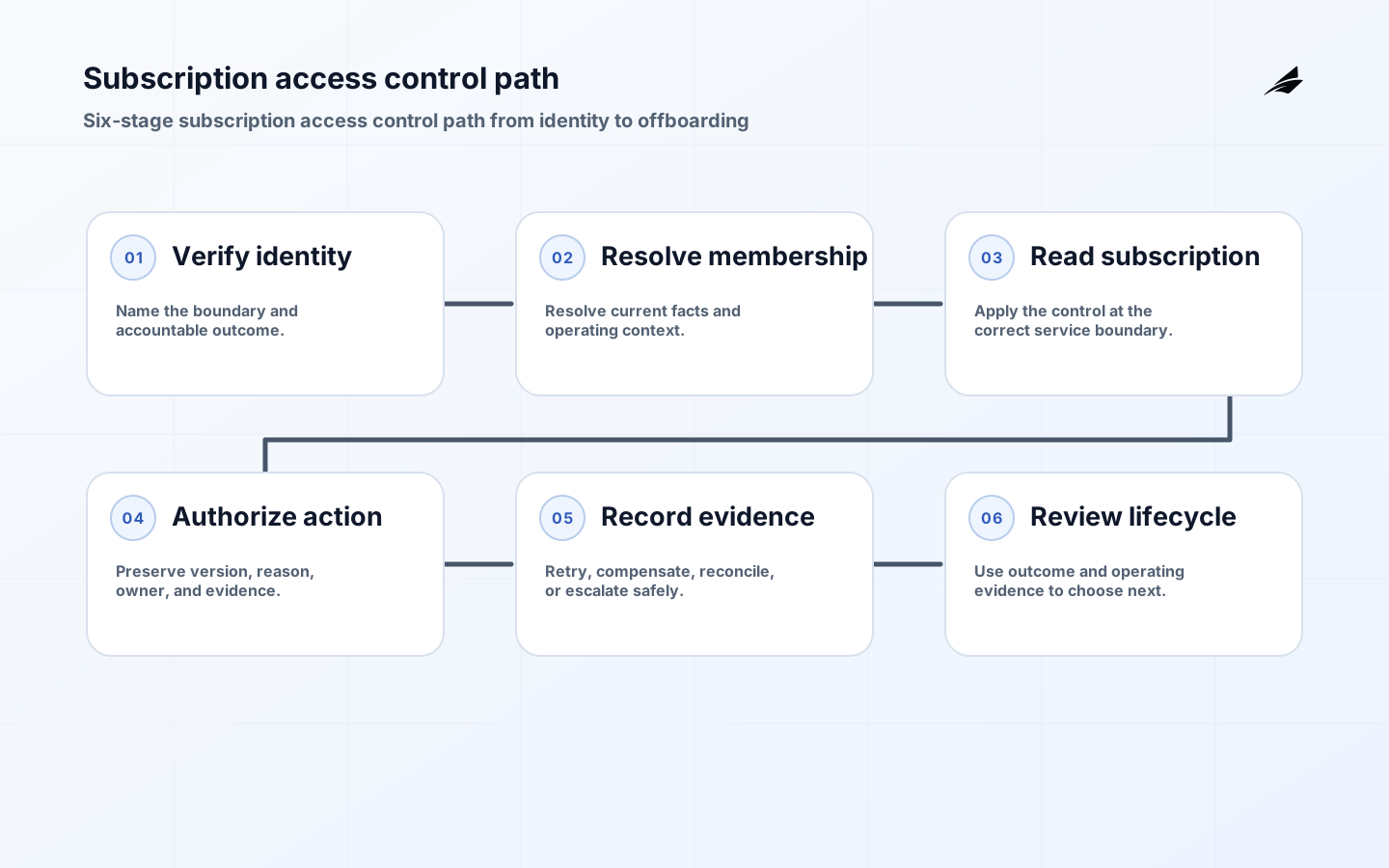
IT management of subscription access lifecycle begins with a bounded operating question. Measure subscription access control outcomes alongside correction effort.
Subscription access control is an engineering responsibility, not a screen or a vendor setting. For IT managers, the useful question is whether an account may use a paid feature after a billing change. During normal handling, define the entitlement scope and control. This article treats subscription access control as a product capability with an observable decision, a controlled implementation path, and a recovery route.
Subscription access control: Define the subscription access control decision for the workflow.
Start by writing the decision in one sentence: whether an account may use a paid feature after a billing change. The authoritative input should be a versioned entitlement record built from verified billing events. Give the decision a stable identifier and retain account, plan, feature, policy version, and effective time. This is less paperwork than it sounds.

The difficult case is delayed, duplicated, or out-of-order invoice events. Design for it before adding convenience automation. Put server-side checks on every protected API, background job, export, and admin action near the action that can affect the customer or their data. The recovery should be deny or pending state with a short support route.
| Decision element | Question to settle | Evidence to retain |
|---|---|---|
| Customer promise | What does subscription access control make dependable? | Expected user outcome and affected cohort |
| Authority | Which record wins when facts conflict? | A versioned entitlement record built from verified billing events |
| Boundary | Where is the result enforced? | Server-side checks on every protected API, background job, export, and admin action |
| Recovery | How is a wrong result corrected? | Deny or pending state with a short support route |
Use authoritative facts and explicit controls: Subscription Access Control
Stripe's entitlements guidance is a concrete example of separating commercial products from the feature access a customer receives. Its subscription lifecycle documentation also illustrates why lifecycle states and verified events matter when access or communication follows a payment outcome. The broader lesson applies even when subscription access control has nothing to do with billing: derive a customer result from facts the team can inspect later.
For subscription access decisions, The secure-development review should make the protected decision and its evidence testable. NIST's Secure Software Development Framework provides a useful discipline for embedding security practice in delivery work. The AWS SaaS Lens foundations add the operational requirement to test tenant-aware health and uneven load.
| Failure mode | Control | Operator signal |
|---|---|---|
| Stale or missing input | Order facts and expose pending state | Age of authoritative record |
| Unauthorized action | Enforce account, plan, feature, policy version, and effective time at the protected action | Denied decision with actor and reason |
| Duplicate work | Use idempotency and correlation identifiers | One customer effect per request |
| Dependency failure | Choose timeout, fallback, and escalation behavior | Actionable alert linked to the decision |
Implement subscription access control as a thin, observable slice
Map commercial plans to feature identifiers, then publish an auditable entitlement snapshot. Build a test path that includes the normal result, delayed, duplicated, or out-of-order invoice events, and a permissions failure. Link the work to release notes and tenant isolation guide; those adjacent decisions often reveal dependencies that otherwise surface only after launch.
- Name a product owner, technical owner, and recovery owner for subscription access control.
- Write the decision rule and the authoritative record in the delivery brief.
- Test a normal journey, delayed, duplicated, or out-of-order invoice events, and an unauthorized request.
- Keep customer-facing states understandable and attach a next action to each one.
- Log correlation identifiers, policy version, and the reason for a manual correction.
- Expand only after the support path and rollback behavior have been rehearsed.
Measure the behavior that matters: Subscription Access Control
For subscription access control, track grant and revoke latency, stale-decision rate, manual overrides, and access disputes.
IT manager access review
Make the normal path and exception path explicit for IT management of subscription access lifecycle.
Treat IT management of subscription access lifecycle as an operating system rather than a screen.
Use a small scenario review before expansion.
Keep customer language aligned with system state for subscription access control.
| Decision area | Control to apply | Evidence to retain |
|---|---|---|
| Scope | Name the supported boundary for IT management of subscription access lifecycle | Approved scope and exclusions |
| Authority | Use trusted facts and current context | Source, version, and timestamp |
| Action | Enforce at the service that commits the result | Allow or deny reason |
| Recovery | Retry, compensate, reconcile, or escalate | Correction and review record |
The primary references for this decision are Stripe Billing Entitlements, Stripe: Using webhooks with subscriptions, OWASP Authorization Cheat Sheet, NIST SP 800-218 Secure Software Development Framework. In this context, subscription access control needs its own decision record.
For related planning, See How CTOs Should Think About Release Notes, How Operations Leaders Should Think About Tenant Isolation, how IT managers should think About Self-serve Onboarding.
Key takeaways
- Subscription access control needs one named customer decision before it needs more workflow.
- Make a versioned entitlement record built from verified billing events inspectable, ordered, and tied to a policy version.
- Enforce the decision at server-side checks on every protected API, background job, export, and admin action, including non-UI paths.
- Treat deny or pending state with a short support route as a product capability with an owner and an audit record.
- Use operational measures to decide whether to extend the first release.
Frequently asked questions
What should be built first? Build the smallest path that answers whether an account may use a paid feature after a billing change and produces a reviewable decision record.
The smallest useful improvement to subscription access control is often a sharper boundary, not another feature. Explain subscription access control pending and denied states before expansion.
For subscription access control, test a scheduled change before treating the first release as complete. Treat subscription access control exceptions as evidence for the next decision.
For subscription access control, review the about subscription access control scope during a late event.
For subscription access control, review recovery after a late event and verify that the control used during normal handling still produces the intended entitlement state.
When a subscription event arrives late, compare the recorded billing or membership evidence with the entitlement state. In the ordinary path, verify that the same authoritative facts produce the intended access decision.
After a permission change, review ownership. During normal handling, test the recovery path.
For subscription access control, review the about subscription access control ownership during normal handling.
For subscription access control, review the about subscription access control measurement during normal handling.
For subscription access control, review the control path when an event is late and confirm that the account remains in a safe, explainable state.
For subscription access control, review the about subscription access control ownership during a late event.
For subscription access control, review the about subscription access control measurement during a changed permission.
For subscription access control, review the about subscription access control scope during a delayed handoff.
A practical example for subscription access control is a revoked permission.
For subscription access control, review the about subscription access control measurement during a late event.
Compare a normal entitlement decision with a changed-permission case. In a support review, confirm the owner, preserve the relevant identity and subscription evidence, and explain the resulting access state.
In the ordinary path, review identity, workspace, billing, and entitlement scope. For delayed, duplicate, or incomplete events, define the state that must remain true and verify it in a recovery drill.
Use a recovery drill to test subscription access control. During the drill, verify the scope and correction path.
Use a support-review case to measure one entitlement outcome and record the correction. The evidence should show the triggering fact, decision, owner, and final account state.
Use the measured rollout to trace the subscription access path from identity and membership through billing and entitlement evaluation. Test delayed and duplicate events, then confirm with support that scope, ownership, and recovery remain clear.
A concrete operating test for subscription access control is to rehearse a dependency failure and a recovery drill. Confirm that the control path is idempotent, that the account reaches the correct entitlement state, and that the correction is recorded.
During rollout, compare a normal account with a tenant-boundary case. Confirm that the entitlement decision uses the correct workspace, that the owner is identified, and that support can reconstruct the result.
Review subscription access evidence during normal handling and when explaining a customer result. For delayed, duplicated, or disputed events, use the recorded facts to choose a correction without widening access.
Use reconciliation to test subscription access control. During a recovery drill, review evidence and correction.
Before release, use a check that follows subscription state to the final entitlement. During rollout, confirm that the result is explainable, recoverable, and owned by the team responsible for the control.
In the ordinary path, verify recovery for identity, billing, and entitlement changes. In an operator rehearsal, test delayed and duplicate events, then review the evidence with support.
Conclusion
Good subscription access control makes a difficult operational decision ordinary.
Evidence for “Subscription Access Control: An IT Manager’s Operating Guide” is grounded in Stripe Billing Entitlements, Stripe: Using webhooks with subscriptions, OWASP Authorization Cheat Sheet, NIST SP 800-218 Secure Software Development Framework; each source informs a specific decision, test, or operating trade-off described in this guide.