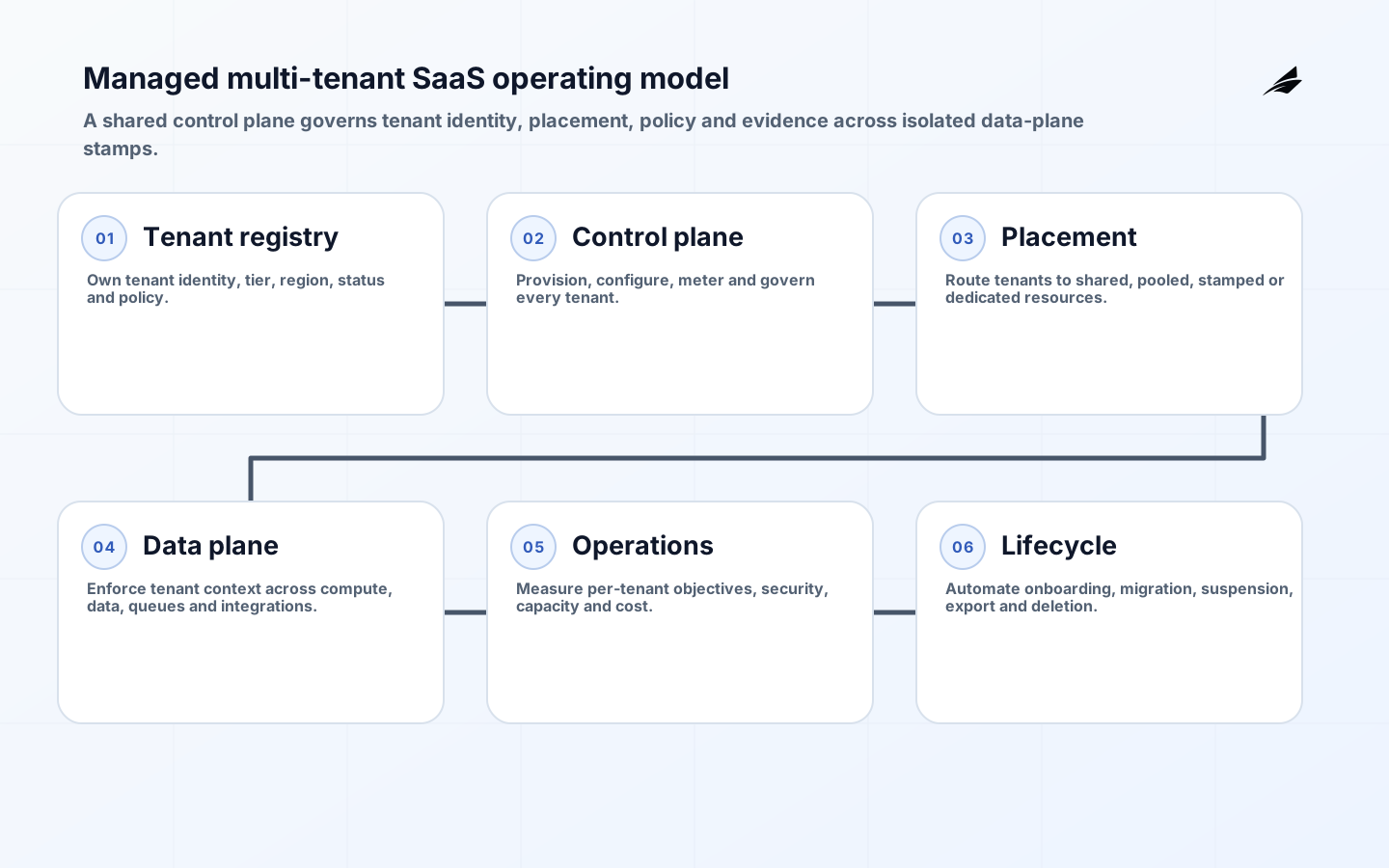
Managed multi-tenant SaaS architecture combines a product model with an operating model. Multiple customers use a common service, but they do not necessarily share every resource. Shared, pooled, deployment-stamp and dedicated patterns can coexist. The defining requirement is that all tenants are governed through a unified experience for identity, onboarding, deployment, observability, metering, support and lifecycle. Deploying a separate stack manually for each customer is hosting; automating and operating those stacks as one product can still support SaaS outcomes.
This implementation checklist helps product engineering teams and managed service providers turn a tenancy design into repeatable operations. It covers tenant definition, isolation, control-plane authority, data models, noisy-neighbor protection, deployment, reliability, security, FinOps and exit. Every architecture choice should state the trade-off among isolation, scale, cost, customization and manageability. “Single tenant” and “multi-tenant” are not complete designs; each component and data flow can make a different choice.
1. Define the tenant and isolation requirements
Define what a tenant represents: customer organization, business unit, consumer group or another commercial and security boundary. Separate tenant identity from individual user identity and from the cloud provider’s directory terminology. Record tenant tier, region, data residency, contract, lifecycle state, features and isolation class in an authoritative registry. Decide whether users can belong to multiple tenants and how context is selected. Ambiguous tenant identity is a direct cause of authorization and billing defects.
For compute, data, cache, messaging, search, files, analytics and keys, choose shared, partitioned, stamped or dedicated resources. State the threat, performance, compliance and cost rationale. Dedicated resources reduce some cross-tenant risks but create fleet drift and higher idle cost. Shared resources improve efficiency but require consistent policy and capacity controls. Mixed models often serve standard and regulated tiers. Document which properties are guaranteed by the platform and which depend on application code.
| Model | Strength | Primary operational risk |
|---|---|---|
| Fully shared | Highest resource efficiency and simplest fleet | Authorization defect or noisy neighbor affects many tenants |
| Pooled partitions | Balanced scale and bounded blast radius | Placement and rebalancing complexity |
| Deployment stamps | Horizontal scale and progressive change | Fleet consistency and cross-stamp operations |
| Dedicated tenant stack | Strong resource separation and customization | Cost, drift and manual exception growth |
2. Build a tenant-aware control plane
The control plane owns tenant onboarding, configuration, placement, entitlements, metering, lifecycle and administrative operations. It should not sit inside each tenant data path unnecessarily, because its outage could stop all customer traffic. Define control-plane APIs, identities, audit, rate limits and failure modes. Provision through idempotent workflows with durable state and compensation. A tenant creation request should be safely repeatable and show every step: account, resources, schema, keys, domains, identity, limits and initial administrator.
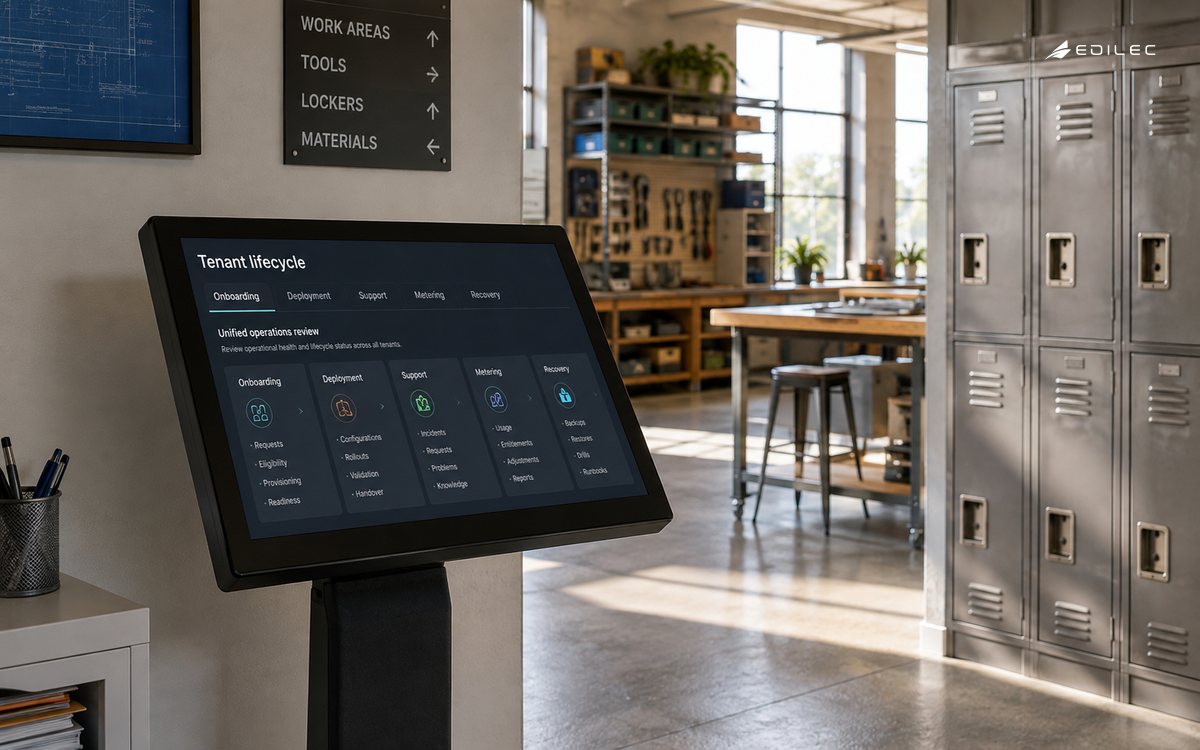
Protect control-plane authority more strongly than ordinary product access. Separate support, billing and infrastructure roles; time-bound elevated operations; require reason and audit for impersonation or tenant movement. Store desired configuration and reconcile actual state rather than relying on one-time scripts. Design regional and global responsibilities so residency policy is enforceable. Test partial provisioning, rollback and repair. A failed onboarding should not leave public endpoints, orphaned keys or billable resources without ownership.
3. Carry trusted tenant context end to end
Derive tenant context from authenticated identity, domain or trusted routing and bind it to authorization. Do not trust a body or query tenant ID by itself. Propagate context through APIs, queues, scheduled jobs and integration callbacks. Include it in database predicates, cache keys, object paths, search filters and telemetry where privacy allows. Use typed middleware or policy enforcement to reduce repeated hand-written checks, but test every boundary. Background work must preserve the same context and entitlement snapshot needed for the action.
Design for users with access to multiple tenants and administrators acting under delegated authority. Make context visible in the interface and audit. Prevent confused-deputy behavior when a service receives a resource identifier from another tenant. Use unguessable IDs but never rely on them for authorization. Verify that exports, reports, backups, analytics and support tooling apply tenant scope. Test negative access and identical identifiers across tenants continuously. Isolation is a system property, not a login feature.
| Lifecycle operation | Control-plane record | Acceptance evidence |
|---|---|---|
| Onboard | Tenant, placement, plan, region, identity and resources | Representative user and API journey succeeds |
| Scale or move | Source, target, state, checkpoint and rollback | No lost or cross-tenant data; routing converges |
| Suspend | Reason, scope, allowed operations and review | Access behavior matches contract without deleting evidence |
| Export | Format, authorization, scope and completion | Customer can validate usable data |
| Delete | Approval, retention, storage locations and proof | Primary and derived stores reconcile to policy |
4. Design tenant-safe data and migration
Shared databases may use tenant keys, row-level policy, separate schemas or a combination. Dedicated databases can simplify some assurance but increase provisioning, migration and connection management. Put tenant ID in every relevant key and uniqueness constraint. Ensure joins cannot accidentally cross scope. Apply repository and database defenses appropriate to risk. Encrypt and manage keys according to the chosen model. Backups must preserve tenant association and support tested restoration without merging data incorrectly.
Schema changes must work across tenant cohorts and large data distributions. Use expand-and-contract migrations, versioned readers and progressive rollout. A deployment-stamp fleet may run mixed versions temporarily; define compatibility and maximum skew. Tenant movement requires a state machine: quiesce or capture changes, copy, verify, switch routing, monitor and retire source. Test rollback before moving high-value tenants. Reconciliation should compare counts, checksums and domain invariants, not only successful copy commands.
5. Control noisy-neighbor and scale behavior
Measure demand per tenant, operation and shared resource. Apply rate limits, quotas, queue fairness, concurrency controls and workload isolation where appropriate. Protect control-plane and interactive work from bulk imports or reports. Autoscaling helps only when downstream databases, quotas and warm-up can follow. Define tenant tiers and burst policy as product behavior. A premium promise needs actual routing and capacity, not only a billing flag. Test one heavy tenant beside ordinary cohorts and observe latency, queue age and throttling.
Use placement and stamps to bound blast radius and scale beyond service limits. Maintain headroom, tenant counts and weight per stamp. Avoid filling every stamp to theoretical maximum. Support rebalancing and evacuation before an emergency. Capacity planning should combine product forecast, tenant onboarding pipeline, seasonal events and observed unit demand. Cost and resilience trade-offs belong in the pricing and architecture model. Unlimited use on shared infrastructure is not a sustainable isolation strategy.
6. Operate a consistent deployment fleet
Deploy application, infrastructure and policy from versioned sources. Progressive delivery canary cohorts should include representative tenant sizes and integration patterns while respecting contracts. Track version and configuration by stamp and tenant. Detect drift and reconcile it; manual customer-specific changes should become explicit configuration or documented exceptions. Keep one product code line where feasible. Forked tenant builds multiply security and support burden and make consistent upgrades difficult.
Define release health through user and tenant indicators, not only infrastructure. Rollback must account for database and event compatibility. Record feature flags and entitlement changes. Validate that new code preserves tenant context and resource limits. Run automated isolation, migration and noisy-neighbor tests before broad rollout. During incident response, identify affected tenants and stamps quickly without exposing other customer information. The managed operations team should be able to pause a cohort without freezing safe customers.
7. Secure support and managed operations
Use least-privilege workforce and workload identities, strong authentication and time-bound privileged access. Customer support should view or change only the tenant and fields required for the case. Impersonation needs customer or policy authorization, reason, duration and complete audit. Separate support tooling from raw database access. Monitor cross-tenant denial, unusual exports, placement changes and control-plane administration. Protect tenant registry and routing because compromise can redirect many customers.
Map shared responsibility among cloud provider, SaaS product, managed operator and customer. Define incident notification, evidence preservation and containment authority. Rehearse a cross-tenant disclosure suspicion and a compromised support identity. Verify tenant-specific logs can be produced without revealing others. Supplier services and analytics pipelines must preserve scope. Assurance reports should accurately describe shared and dedicated variants; a control tested on one model may not cover another.
8. Measure reliability, usage and cost per tenant
Create service-level indicators for core journeys and break them down by stamp, region, tier and tenant cohort. High-cardinality tenant metrics can be costly, so use controlled dimensions, logs or traces for detailed investigation and protect privacy. Detect when one tenant consumes disproportionate resources or experiences hidden degradation. Correlate releases, configuration, placement and incidents. A global average can remain healthy while an entire stamp or small premium cohort fails.
Meter billable usage from durable, reconcilable events with versioned pricing interpretation. Separate operational telemetry from financial records where reliability requirements differ. Allocate shared costs and track unit economics by useful dimensions. Monitor unassigned resources and dedicated idle capacity. Give customers transparent usage and limits. Managed service reports should reconcile reliability, security, consumption and improvement, not present unrelated dashboards. Use evidence to decide placement, pricing and architecture changes.
9. Automate offboarding and exit
Offboarding includes access revocation, export, billing closure, retention, deletion, key handling, resource cleanup and evidence. Define the sequence and approval. A suspended tenant may still require export or legal retention, so suspension is not deletion. Discover derived data in search, analytics, caches and backups. Preserve audit history according to policy while minimizing personal data. Test deletion and provide appropriate completion evidence. Avoid shared storage designs that make one tenant impossible to remove safely.
Managed-service exit also requires platform artifacts: infrastructure definitions, registry data, configuration, logs, runbooks, metering rules and decision history. Keep customer-controlled domains and repositories where practical. Test transfer of one stamp or service component. Portability will never be perfect, but clear boundaries and automated lifecycle reduce dependence. Review tenancy models as customer count and regulation change; architecture that served ten tenants may fail economically or operationally at ten thousand.
Key takeaways
- Define tenant identity and isolation per component, not by slogan.
- Use one protected control plane for repeatable lifecycle and fleet governance.
- Carry trusted tenant context through data, jobs, caches and support tools.
- Manage capacity, releases, reliability and cost by tenant cohort and stamp.
- Exercise movement, suspension, export, deletion and provider exit.
Frequently asked questions
Is a dedicated stack still SaaS?
It can be when all tenant stacks are onboarded, deployed, metered, monitored and operated through one product control model. Manual one-off installations behave more like traditional managed hosting.
Which tenancy model is best?
No universal model exists. Choose per component based on isolation, scale, performance, regulation, cost and operational capability. Mixed models and deployment stamps are common.
How is tenant isolation proven?
Combine architecture review, policy and database controls, negative authorization tests, noisy-neighbor tests, runtime detection and sampled operational evidence across customer and support paths.
Conclusion
Managed multi-tenant SaaS architecture is an operating discipline. A tenant has a trusted identity, deliberate placement and enforceable context; a control plane governs lifecycle; data and capacity controls preserve isolation; and operations measure service outcomes and cost across the fleet. Build and test that model from onboarding through deletion. The result scales because customer variation becomes governed product configuration rather than unmanaged infrastructure drift.