Workspace Models for SaaS Product Engineering: a Practical Guide
Workspace models are not a feature label or a vendor setting. They are a product-engineering decision system that coordinates identity, membership, workspace selection, and role capabilities. For workspace models for saas, record the state, evidence, and recovery path. For workspace models for saas, name the decision boundary and its owner. This guide treats workspace models as a controlled workflow that has to survive real product use.
Define the workspace models decision
For workspace models, the relevant facts are workspace record, member record, role, invitation state, and effective time. Test workspace models for saas with normal, delayed, denied, and corrected workflow cases.
| Decision area | Question to settle | Evidence to retain |
|---|---|---|
| Authority | Which record decides the workspace models outcome now? | Owner, version, source identifier, and effective time. |
| Scope | Who, which account, and which resource are affected? | Actor or system, target, environment, and correlation key. |
| Failure | What happens when data is late, absent, or inconsistent? | Safe state, visible explanation, retry path, and escalation owner |
| Exception | Who can override the normal result? | Purpose, approver, narrow scope, expiry, and reversal action |
Model Workspace Models SaaS facts and transitions
For workspace models, map the normal progression, cancellation or removal, retry, reconciliation, and manual correction paths.
Review workspace models design choices
For workspace models, Decide whether the workspace is a commercial account, a security boundary, a collaboration area, or a combination of those concepts. Conflating them creates awkward edge cases when a parent company needs several departments, when one workspace has several billing contacts, or when a contractor needs temporary access. Create explicit relationships instead of overloading a single workspace identifier with every business meaning.
Role design benefits from capability tables that product and support can read. List actions such as invite, remove, transfer ownership, change billing, manage integrations, export, and delete. Then decide which roles have each action and which require an extra confirmation. This gives teams a stable basis for custom roles and enterprise group mapping, and it exposes accidental privilege escalation before it becomes a customer issue.
Lifecycle review must include recovery. An accepted invitation may be tied to the wrong person, an identity provider may remove a group unexpectedly, and a departing owner may be the only person who can approve a transfer. Give support a narrow verified path to restore legitimate access, with evidence of the request and an expiry for temporary elevation. The recovery path should not be a hidden global-admin shortcut.
The interface should make current scope visible at moments that matter. When someone changes a member, views an export, or opens an integration, show the workspace name and the selected identity. A persistent but quiet scope marker reduces errors without turning the product into a security lecture. Confirmation messages should name the affected person, role, and workspace so mistakes can be noticed immediately.
Implement one narrow Workspace Models SaaS path
Keep customer language aligned with the recorded state for workspace models for saas. Review workspace models for saas evidence with product, engineering, and support for a practical guide. Make workspace models for saas corrections visible, scoped, and reversible during a practical guide. Measure workspace models for saas outcomes alongside correction effort. In a workspace model, put the active workspace in the request contract rather than inferring it from the most recent browser choice. Membership changes should invalidate or re-check that context at the point of action. This avoids the subtle error in which a user who legitimately belongs to two customers performs an operation in the wrong one because a stale tab or token silently supplied scope.
- Write workspace models rules in plain language before encoding them.
- For workspace models, a delayed result should remain distinguishable from a denial.
- Make the consequential server-side boundary enforce the decision
- For workspace models, a delayed result should remain distinguishable from a denial
- Keep the customer-visible state aligned with the authoritative record
Verify Workspace Models SaaS adverse and recovery cases
Use an invitation, ownership transfer, role-revocation, and multi-workspace switching test suite.
| Scenario | Expected behavior | Review signal |
|---|---|---|
| Normal request | The decision follows the current authoritative record. | Outcome, scope, rule or version, and correlation identifier |
| Delayed or duplicate input | Processing converges without repeating the business effect | Suppression or reconciliation record tied to the source event |
| Missing prerequisite | For workspace models, retain the reason and effective time with the outcome. | Reason code, work queue, or targeted alert. |
| Approved correction | The action is attributable, limited, and reversible where possible | Actor, purpose, approval, effective time, and expiry. |
Operate workspace models with evidence
For workspace models, watch for ownerless workspaces, stale guests, cached scope, and incorrect group synchronisation.
Workspace models: practical takeaways
- Workspace models are dependable when the authority, scope, and safe failure behavior are explicit.
- Support should be able to explain the result for workspace models.
- Support should be able to explain the result for workspace models
- Support should be able to explain the result for workspace models
- For Workspace Models for SaaS: Choose Tenant Boundaries That Scale, consult adjacent product context only at a documented boundary. Support should be able to explain the result for workspace models
Frequently asked questions about workspace models for Workspace Models for SaaS
For workspace models, keep this review grounded in the specific authority, scope, and recovery path described above. For example, a workspace transfer should identify the incoming owner, preserve the prior owner record, and block completion until the new owner has accepted responsibility.
For workspace models for saas, a good handoff ends with observable evidence rather than a verbal promise. Reconcile workspace models for saas changes against the original record.
The smallest useful improvement to workspace models for saas is often a sharper boundary, not another feature.
For workspace models for saas, test an unexpected load spike before treating the first release as complete.
For Workspace Models for SaaS, General design principles - SaaS Lens defines scope; Multitenant SaaS database tenancy patterns supports the control; Authorization Cheat Sheet clarifies evidence.
Review the scope for workspace models for SaaS during normal handling. Review the control for workspace models for SaaS during a corrected record.
Review the scope for workspace models for SaaS during a corrected record. Review the control for workspace models for SaaS during normal handling.
Review the recovery for workspace models for SaaS during a denied request. Review the evidence for workspace models for SaaS during normal handling.
For workspace models for SaaS, test a revoked permission before treating the first release as complete. Review the measurement for workspace models for SaaS during a denied request.
A practical workspace-model example is a resource request after membership is revoked. Deny the request, preserve the workspace and actor context, and record the reason for review.
Ownership for workspace models for saas is clearer when the customer promise is separated from the mechanism.
Review the evidence for workspace models for SaaS during a corrected record.
Review the ownership for workspace models for SaaS during a denied request.
Review the scope for workspace models for SaaS during normal handling. Review the evidence for workspace models for SaaS during normal handling. Review the measurement for workspace models for SaaS during a corrected record.
Review the control for workspace models for SaaS during normal handling. Review the evidence for workspace models for SaaS during normal handling. Review the scope for workspace models for SaaS during a changed permission.
Conclusion
Workspace models remains trustworthy when it is run as a sequence of accountable decisions rather than a configuration detail. In this case, the decisive details are the workspace models facts and controls, not a generic implementation label.
Connect the model to Edilec’s workspace architecture notes, multi-tenant production guide and subscription access control guide.
Workspace Models SaaS: production decisions that keep the workflow trustworthy
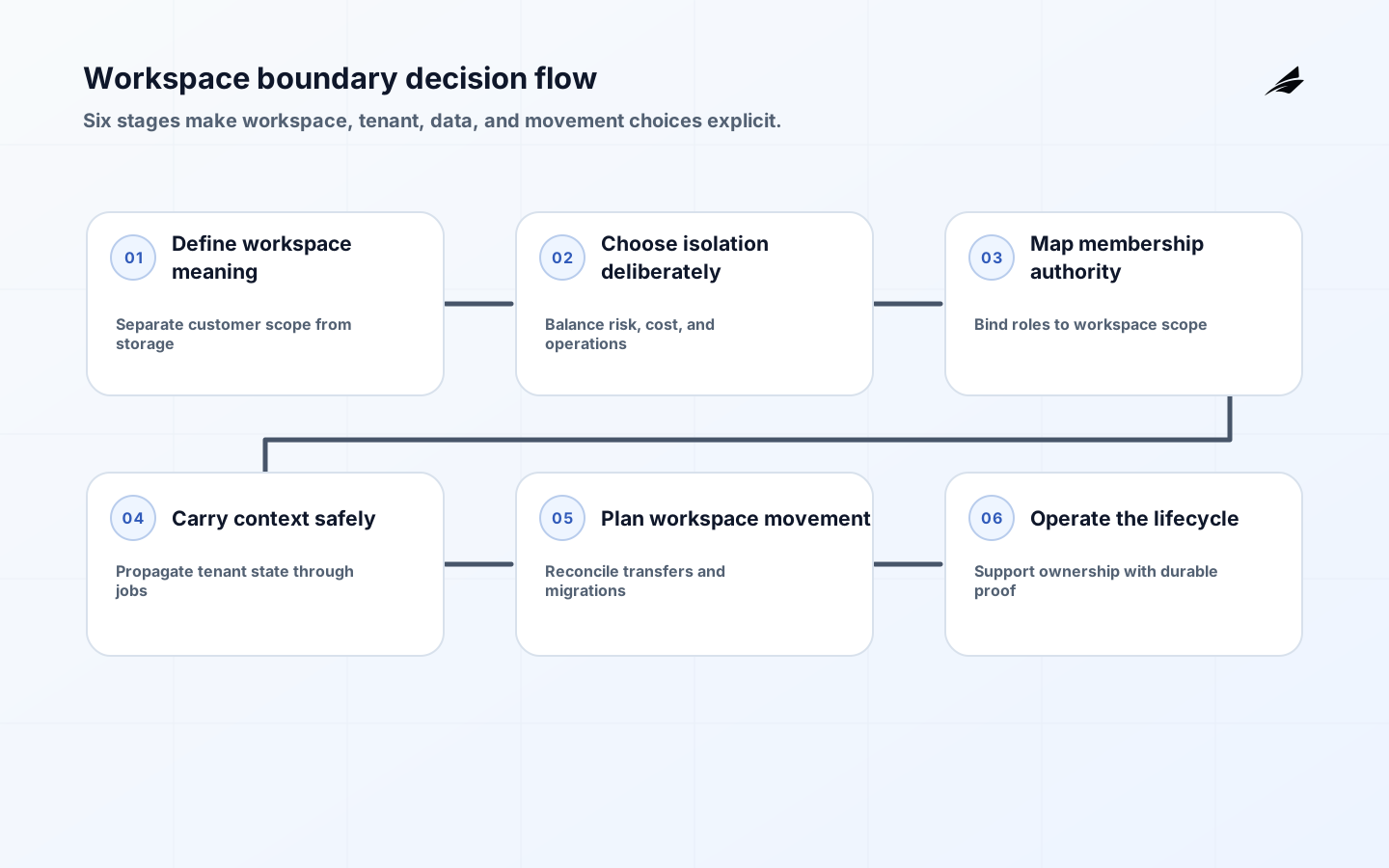
Ask what the customer is grouping: a legal organization, operating team, project, environment, client account, or separate deployment. A B2B customer may need one organization with production and test workspaces. Write the relationship between account, workspace, user, role, resource, and billing subject before choosing table names.
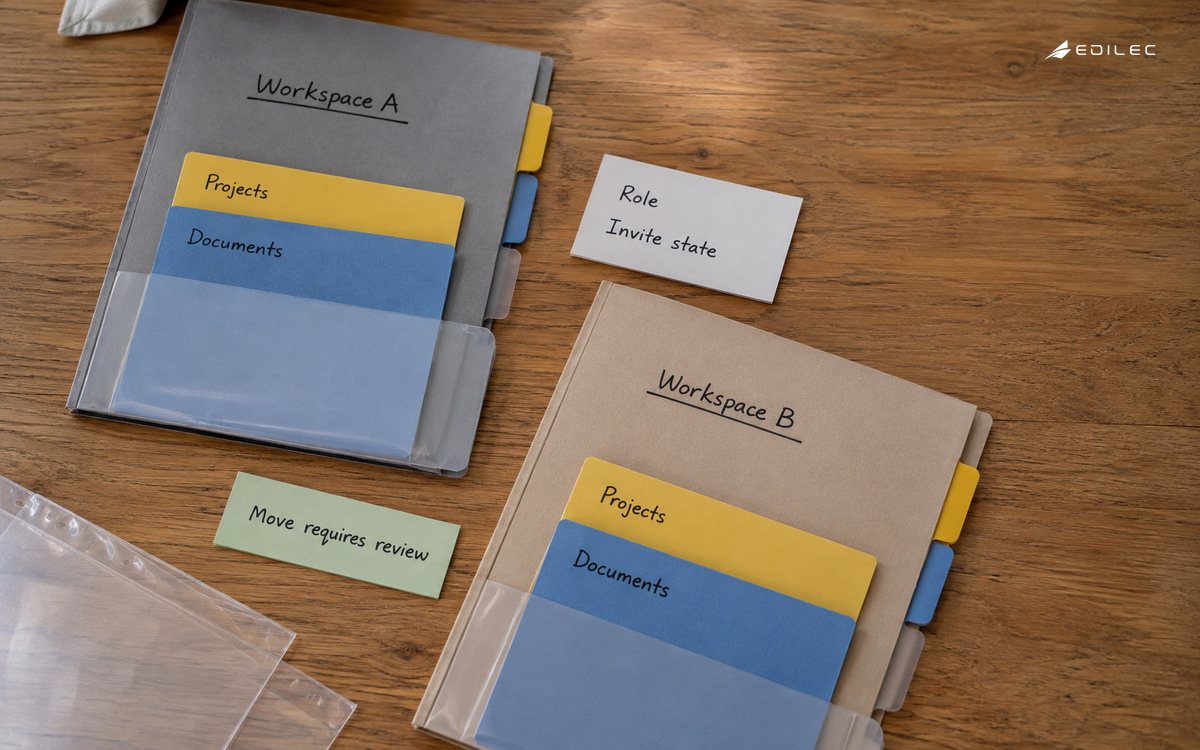
Microsoft’s tenancy-model guidance shows why tenant definition affects cost, scale, compliance, performance, and reliability. AWS guidance adds the idea of targeted isolation, where different services can use different boundaries when the requirement is explicit.
| Model question | Decision example | Why it matters |
|---|---|---|
| Customer boundary | One customer has several workspaces | Billing, contracts, and support scope |
| User membership | A user belongs to several workspaces | Invitation and authorization |
| Resource owner | Every resource belongs to one workspace | Isolation and deletion |
| Deployment mapping | Workspaces can move between stamps | Routing and migration |
Workspace Models SaaS: controls, evidence, and review
Put workspace identity on resources and propagate it through jobs, events, search documents, files, caches, and exports. A missing workspace key is a design error. PostgreSQL row-level security guidance can add a policy layer, but it does not remove the need for correct session context and service-role tests.
Define stable identifiers independent of database location, a mapping from workspace to deployment, and a migration contract for resources, files, search, events, billing, and integrations. Test a small workspace before a strategic customer asks for a region or isolation change.
| Data surface | Workspace control | Test case |
|---|---|---|
| API request | Trusted context and ownership check | Swap workspace ID and expect denial |
| Background job | Workspace in durable payload | Retry after membership removal |
| Search index | Namespace or workspace filter | Search from two memberships |
| File or export | Scoped object key and signed access | Reuse URL across workspaces |
- Name the owner and the failure or exception state.
- Test normal, delayed, duplicate, unauthorized, and recovery paths
- Keep the source, decision, action, and validation evidence together
- Review the workflow on a cadence that matches customer and data risk Apply the rule to workspace models before widening the rollout.
Frequently asked questions
Is a workspace the same as a tenant?
Sometimes, but not always. A tenant usually names the customer isolation or commercial boundary, while a workspace may be a customer-facing grouping inside that boundary.
Should every workspace have its own database?
No. Separate databases can help with isolation, noisy neighbors, or compliance, but they add provisioning, migration, backup, reporting, and support cost.
Conclusion
Workspace models shape security, billing, support, migrations, and the customer’s understanding of the service. Define the boundary in real workflows,
Evidence for “Workspace Models for SaaS: Choose Tenant Boundaries That Scale” is grounded in Tenancy Models for a Multitenant Solution, General design principles - SaaS Lens, Multitenant SaaS database tenancy patterns, Authorization Cheat Sheet, Row Security Policies; each source informs a specific decision, test, or operating trade-off described in this guide.