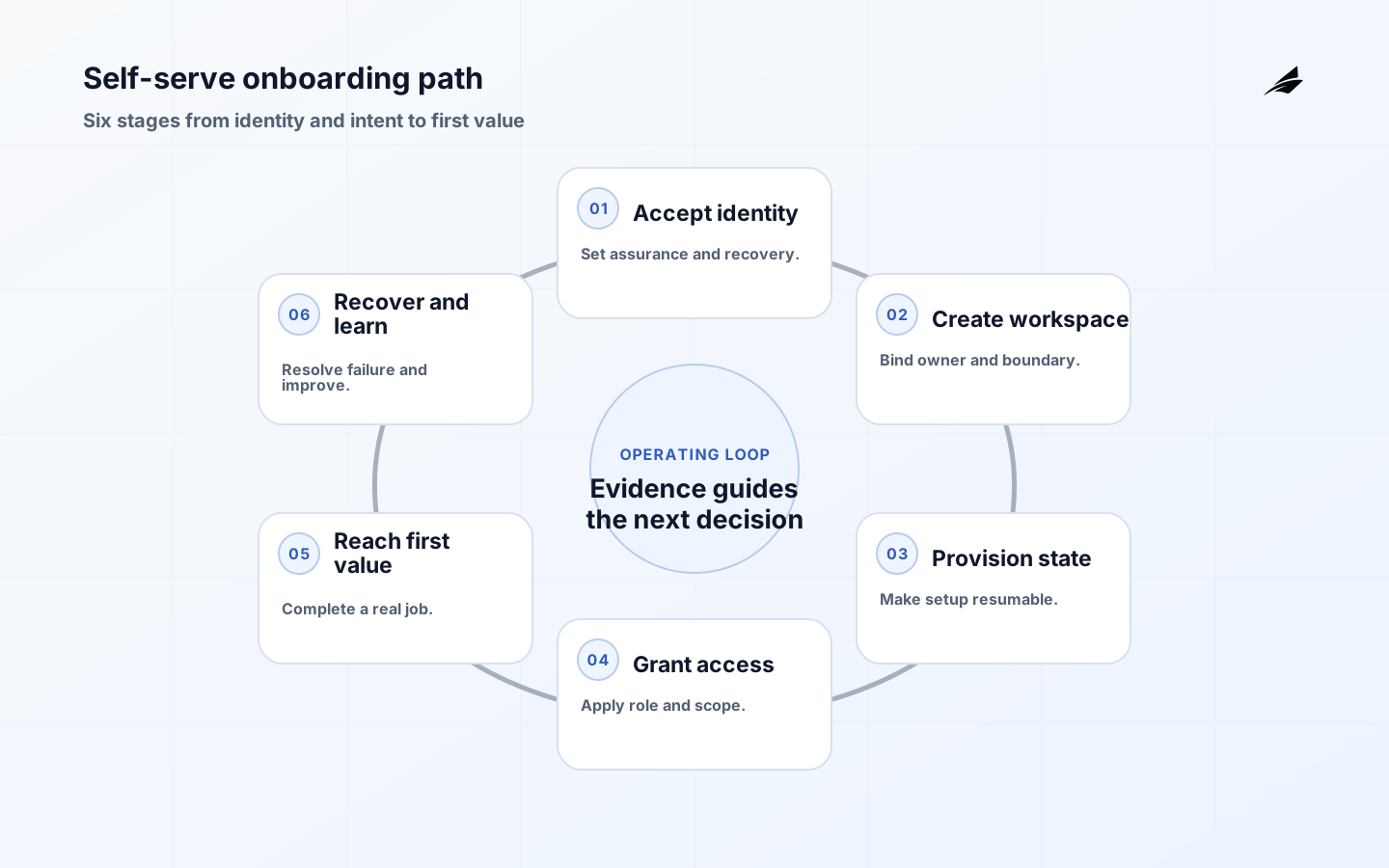
Self-serve onboarding is an engineering capability that lets a customer establish a trustworthy account or workspace and reach a first useful outcome without a live handoff. The interface matters, but the durable product is the state machine underneath: identity, workspace ownership, membership, provisioning, permissions, integrations, and evidence. A smooth sign-up that creates duplicate workspaces or leaves a user trapped after a failed callback is not self-serve. This practical guide focuses on the architecture and operating choices that make onboarding clear, accessible, safe to retry, and useful to support.
Define first value and trust
Name the first useful result for the intended role: a workspace administrator invites a teammate, imports a first dataset, connects an integration, or produces a meaningful report. Then list the trust decisions that must be correct before that result: who the person is in the product, which workspace they control, what they may invite or import, and which data they can see. NIST Digital Identity guidance separates identity proofing, authentication, federation, and risk management; use that vocabulary to choose only the assurance needed for the actual consequence.
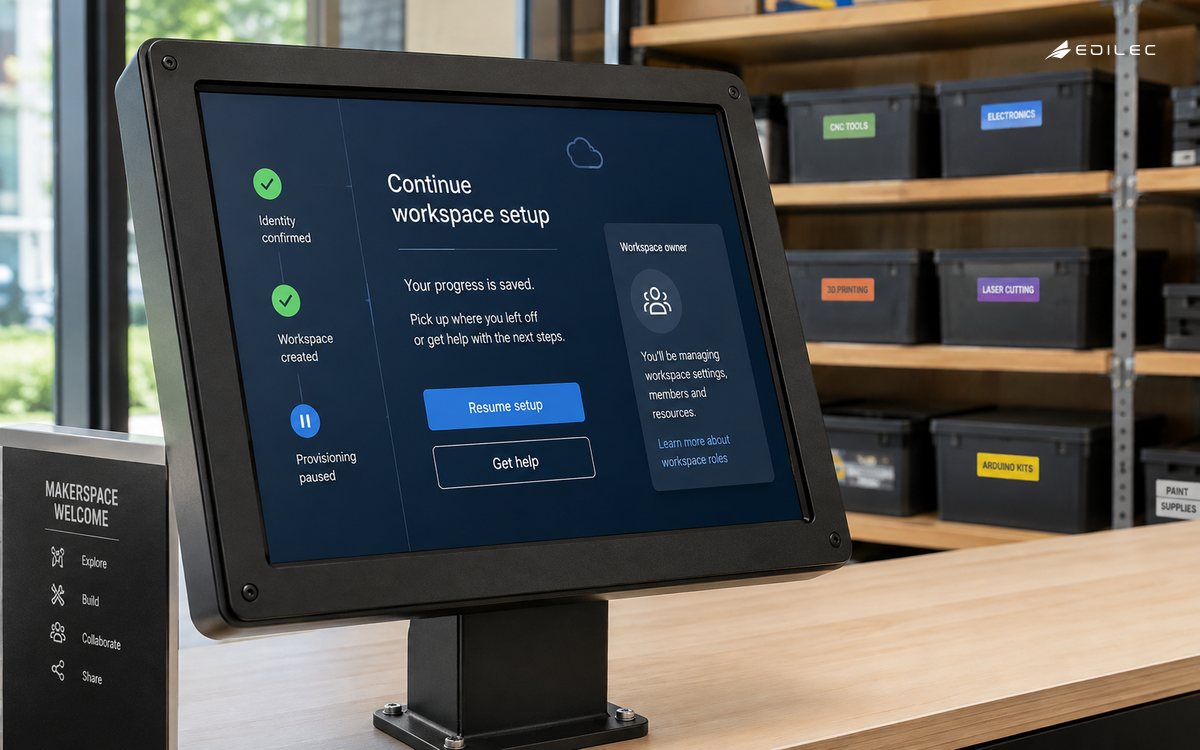
Avoid front-loading every question. Ask for the information needed to reach the next safe step, explain why it is needed, and defer optional profile or configuration fields. If a company name creates a workspace, show the resulting ownership and invite rules before asking for data that will not affect the first outcome. If a user arrives through a federated identity provider, make the relationship between identity, workspace membership, and product role understandable rather than treating a successful login as completed setup.
| Milestone | User can do | System must prove |
|---|---|---|
| Identity accepted | Continue with a stable account | Authentication and recovery state |
| Workspace created | See the correct boundary | Owner, identifier, lifecycle |
| Member invited | Begin collaboration | Role, invitation state, expiry |
| Data connected | Use a meaningful source | Scope, consent, callback result |
| First value | Complete a real job | Outcome, version, support path |
Model onboarding as durable state
Use explicit states such as started, identitypending, workspacecreated, invitationpending, provisioning, ready, blocked, and needshelp. Each transition needs an actor, precondition, event, and failure route. A redirect or button click should not be treated as success; the service should confirm the durable state. Persist enough context to let the user resume on another device and let support explain what happened without asking the customer to repeat every step.
Make each provisioning operation idempotent. If a browser retries after a timeout, the server should recognize the same request and return the existing result rather than create a second workspace, duplicate integration, or repeated invitation. Use idempotency keys, unique constraints, and a state transition log. For external callbacks, validate the expected workspace and transaction before applying the result. A pending state with a useful next action is better than a spinner that disappears when the provider is slow.
| Failure | Customer view | Recovery evidence |
|---|---|---|
| Duplicate request | One consistent setup state | Idempotency key and existing result |
| Provider timeout | Pending with resume path | Callback or retry age |
| Permission changed | Clear denial and owner path | Effective membership at action time |
| Invalid data | Field-level correction | Validation reason without secrets |
| Provisioning error | Supportable blocked state | Step, dependency, and correlation ID |
Enforce workspace and role boundaries
Do not infer workspace authority from a name, email domain, or the fact that a person started onboarding. The OWASP Authorization Cheat Sheet distinguishes authentication from authorization; onboarding needs both. Recheck membership and role at invitation, import, integration, and billing actions. If ownership transfer is supported, make it a deliberate workflow with confirmation, notification, and an audit record.
Treat invitations as scoped, expiring capabilities rather than permanent access. The invitation should bind to a workspace, intended role, and recipient or acceptance context, and the server should verify those values when it is accepted. Handle revoked invitations, changed workspace status, duplicate acceptance, and a member accepting from a different account. The UI should explain what will happen and what the new member can do, especially when the workspace contains sensitive information.
Make the path accessible and understandable
Follow WCAG 2. 2 for labels, focus, keyboard operation, target size, contrast, error identification, and accessible authentication. Onboarding is often the first experience of the product, so a hidden error or keyboard trap can prevent a customer from ever reaching value. Use a clear progress model without relying on color, announce asynchronous completion, preserve entered information when validation fails, and provide a recovery path that does not require starting over.
Write messages around decisions and next actions. “We could not verify the provider callback; reconnect or contact your workspace owner” is more useful than “something went wrong.” Avoid exposing internal identifiers or security details, but do not hide the fact that a permission or verification step is required. Test with keyboard-only navigation, screen readers, zoom, slow networks, and narrow screens. Accessibility improvements usually reduce support work for everyone because they make state and language more precise.
Instrument the journey and its dependencies
Measure more than sign-up. Track identity completion, workspace creation, invitation acceptance, integration callback, provisioning latency, first useful outcome, failure category, support escalation, and repeat attempt. Use stable workflow and workspace identifiers with appropriate privacy controls. OpenTelemetry can connect traces, metrics, and logs around a correlation identifier; use that to find whether a drop-off reflects a confusing screen, a slow dependency, or a server-side rejection.
Set a small operational contract. A release should be able to answer how many onboarding attempts are pending, which dependency creates the most age, whether duplicate requests are being suppressed, and how many customers need manual intervention. Segment by entry path, role, region, plan, and device only when the segmentation supports a decision and the data use is justified. Review customer feedback with the numbers because a completed step may still create confusion that appears later as a support contact.
Roll out a narrow, recoverable slice
Begin with one supported user role, one workspace model, one first-value task, and a small set of integrations. Build the durable state and recovery path before adding a broad tour or many configuration options. Rehearse identity failure, invitation expiry, provider delay, duplicate callback, membership change, partial provisioning, and support escalation. A first release is ready when another teammate can operate the path from a failed case to a safe resolution without private knowledge.
Use evidence to expand. If customers reach first value but the resulting data is incomplete, fix the quality path before adding more acquisition. If setup succeeds only when a support agent intervenes, call that a product signal, not a hidden success. Review ownership, retention, access, and communication as the customer base grows. Self-serve does not mean no human support; it means the ordinary path is clear and the exception path is designed rather than improvised.
Keep a human escalation path without making it the hidden default. The interface should tell a customer why help is needed, what information will be shared, and what the support operator can safely do. Once the issue is resolved, classify the cause and feed it back into the onboarding state machine, copy, dependency monitoring, or access model. That is how self-serve improves instead of merely shifting work into a private queue.
Review onboarding after every identity, billing, or workspace model change. A new sign-in method can alter recovery assumptions, a pricing change can change who may create a workspace, and a new workspace role can change invitation authority. Keep the milestone definition and permission tests close to the flow so a visual improvement does not quietly widen access or make an existing recovery path invalid.
Key takeaways
- Define first value for a named role and the identity and workspace trust required to reach it.
- Model onboarding as durable, resumable state with explicit pending, blocked, and needs-help outcomes.
- Use idempotency and current authorization checks for invitations, provisioning, integrations, and billing actions.
- Make the entire path accessible, understandable, keyboard-operable, and recoverable after interruption.
- Measure first value, failure categories, dependency age, support escalation, and downstream quality.
- For related product controls, See tenant isolation, admin consoles, and product analytics. For self serve onboarding, the owner should review the evidence at the handoff.
Frequently asked questions
What is the first milestone in self-serve onboarding?
The first milestone is a real useful outcome for the intended user, reached with correct identity, workspace ownership, permissions, and provisioning state. A completed registration form is not enough if the customer cannot invite the right person, connect a source, or use the product’s core job. Define the milestone in observable terms and include a path to explain or correct it.
How should onboarding handle retries?
Persist workflow state, use idempotency keys and uniqueness constraints, show pending work, and return the existing result when a request is repeated. For external callbacks, verify the expected workspace and transaction before applying the event. Give users a resume path and operators a correlation identifier rather than asking them to guess whether a previous attempt worked.
Should onboarding ask for every detail upfront?
Ask for what is needed for the next safe step and defer optional configuration. Explain why a required field matters, preserve entered values after an error, and avoid collecting sensitive data before the product has established its purpose. Progressive disclosure is useful when each step has a clear reason and the customer can return to earlier choices without losing work.
What should the team measure?
Measure step completion, time to first value, pending and failure age, duplicate suppression, permission errors, support escalation, and downstream quality. Segment only when the result supports a product decision and privacy requirements are met. Combine the numbers with research and customer language so the team can distinguish friction from a dependency outage or incomplete instrumentation.
Conclusion: make first value dependable
Self-serve onboarding works when the path earns trust at every state transition: identity is clear, workspace scope is correct, provisioning is resumable, permissions are enforced, and failures lead to a useful next step. Start with one first-value journey, instrument its dependencies, test the difficult cases, and expand only when the evidence shows the ordinary path is genuinely independent and supportable.
For self-serve onboarding for saas product engineering, a good handoff ends with observable evidence rather than a verbal promise. Use self-serve onboarding support evidence to decide whether the workflow is ready.
The smallest useful improvement to self-serve onboarding for SaaS product engineering is often a sharper boundary, not another feature. Define the first-value milestone, the supported recovery path, and the evidence that proves a customer can complete it without hidden intervention.
For self-serve onboarding for saas product engineering, test a revoked permission before treating the first release as complete. Review self-serve onboarding evidence with product, engineering, and support for a practical guide.
A practical example for self-serve onboarding for saas product engineering is an older fact arrives after a newer decision.
This decision also connects to Workspace Models for SaaS: Choose Tenant Boundaries That Scale, Onboarding Flows for SaaS Product Engineering, how IT managers should think About Self-serve Onboarding. Review those boundaries together when self-serve onboarding for saas product engineering shares identity, data, billing, or support evidence with another workflow.
For Self-serve Onboarding, NIST Digital Identity Guidelines defines scope; NIST Digital Identity Risk Management supports the control; OpenTelemetry Observability Primer clarifies evidence.
Evidence for “Self-serve Onboarding for SaaS Product Engineering: A Practical Guide” is grounded in NIST Digital Identity Guidelines, NIST Digital Identity Risk Management, Web Content Accessibility Guidelines 2.2, OWASP Authorization Cheat Sheet, OpenTelemetry Observability Primer; each source informs a specific decision, test, or operating trade-off described in this guide.