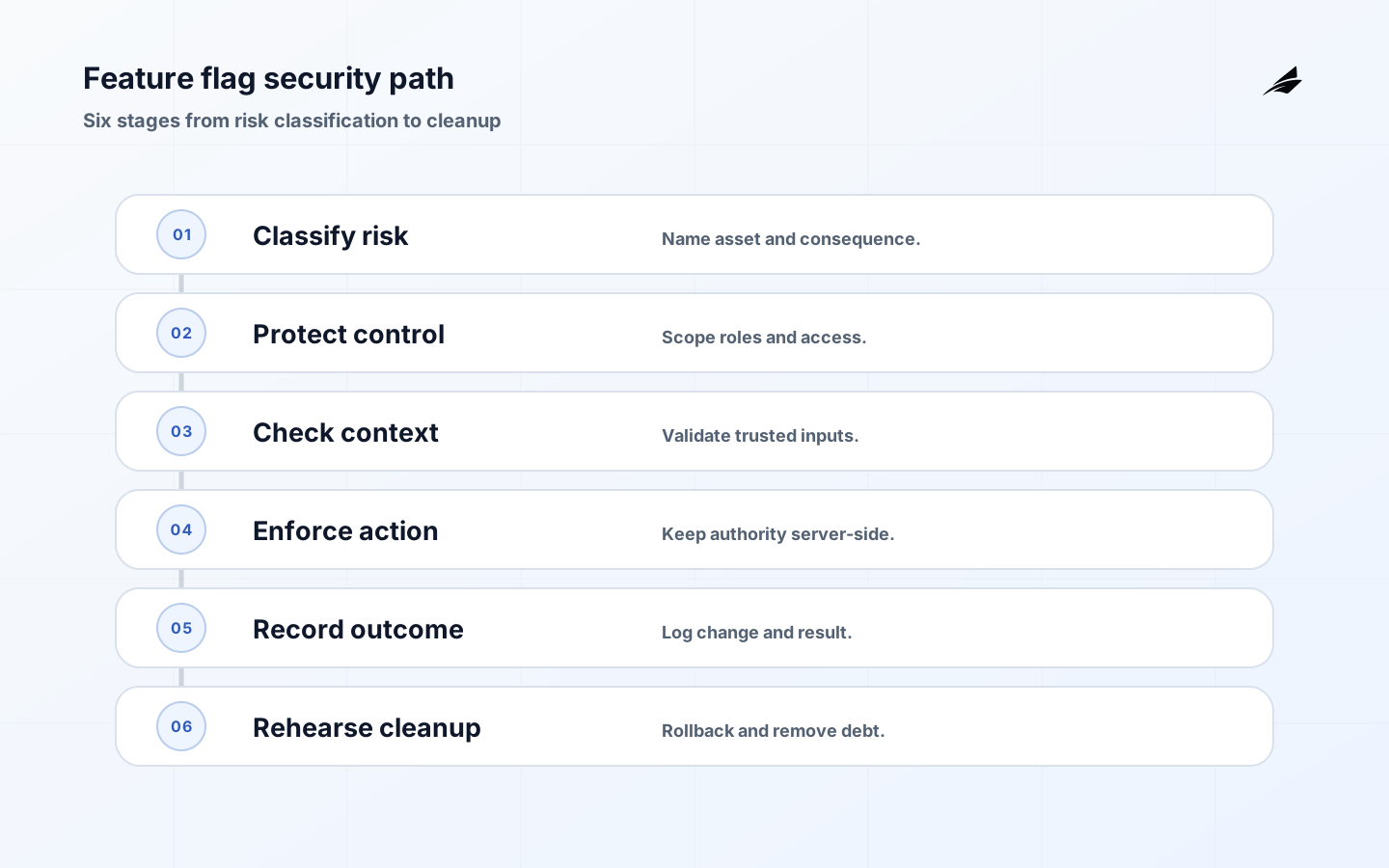
A feature flags security review asks whether runtime change can be introduced, targeted, stopped, and explained without creating a new path around authorization or data protection. The flag service, SDK, cache, evaluation context, admin console, and application code all form part of the security surface. A flag may reduce release risk, but an exposed client-side value or overpowered operator role can create a different risk. Review the complete decision path: who can change it, what context is trusted, where the final action is enforced, what is logged, and how the team recovers when the control plane fails.
Map the flag threat surface
Start with an inventory of flags and classify their consequence. A layout flag is not equivalent to one that exposes customer records, changes a price, skips a verification step, or turns on a bulk mutation. Record where each flag is evaluated, which service owns the decision, whether the value is visible in a browser, and which roles can change it. Include automation credentials, provider webhooks, configuration files, local defaults, and emergency procedures. Security review becomes concrete when it follows actual paths instead of discussing feature flags as a single abstract category.
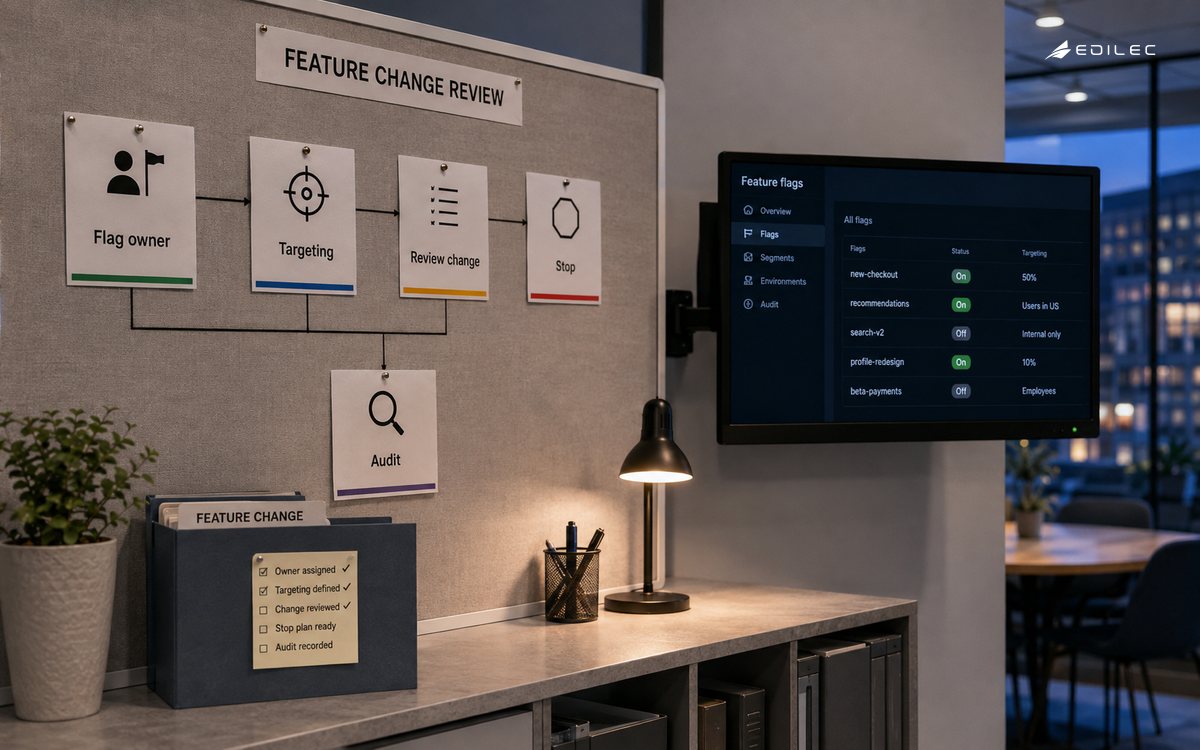
Use a threat scenario for each high-impact flag. An attacker may alter the control plane, replay an authorized change, inject a subject into targeting context, exploit a stale cache, or cause the provider to fail open. An insider may widen a cohort without understanding tenant scope. A compromised browser may reveal a value that should never be treated as secret. The review should identify the asset, actor, boundary, likely effect, prevention, detection, and recovery owner for each scenario.
| Flag consequence | Primary risk | Minimum review |
|---|---|---|
| Presentation | Confusing or inconsistent experience | Accessible fallback and cohort consistency |
| Workflow state | Incomplete or duplicate transactions | Idempotency, recovery, and state verification |
| Authorization | Unapproved protected action | Independent server-side policy check |
| Data visibility | Cross-role or cross-tenant disclosure | Scope enforcement and privacy review |
| Billing or limits | Incorrect charge or entitlement | Source-of-truth reconciliation and audit trail |
| Kill switch | Containment fails during incident | Outage rehearsal and emergency access review |
Protect the control plane and roles
The flag control plane should have separate roles for viewing, proposing, approving, changing, and recovering high-impact configuration. Apply least privilege, strong authentication, scoped environments, and review for production changes. An emergency path can be faster without being invisible: require a reason, preserve the actor, and schedule a post-incident review. Avoid a shared administrator credential that makes every change look like it came from the same person.
Protect transport and storage for flag data, but also protect semantics. A flag key, variant, or targeting rule can reveal product plans, customer segmentation, pricing logic, or operational weaknesses. Do not put secrets in flag values or assume that obscuring a key makes it confidential. Separate public client configuration from server-only rules. Where a client must evaluate a flag, restrict the information to what the client is allowed to know and keep the final protected decision on a trusted service.
| Role | Can do | Security guardrail |
|---|---|---|
| Viewer | Read state and metadata | No targeting data beyond need |
| Author | Propose rule or value | Peer review and change reason |
| Approver | Authorize sensitive rollout | Separate from author for high impact |
| Operator | Apply or rollback approved change | Scoped production access and audit |
| Responder | Use emergency control | Fast path with mandatory after-action review |
Verify evaluation and enforcement
The application must treat evaluation as an untrusted input until it has been checked against current identity, tenant, resource, and transaction state. OpenFeature’s evaluation details include a value, reason, variant, and error information; those fields help explain outcomes but do not grant authority. Re-evaluate or validate at the command boundary when a flag affects a protected action. Never accept a client-supplied flag result as evidence that a server-side operation is permitted.
Test context propagation through asynchronous jobs, retries, callbacks, exports, and background workers. A request may begin with one workspace and finish after membership has changed. A cached decision may outlive the policy version that produced it. Bind consequential actions to a current authorization check and a resource version where needed. If the correct response to uncertainty is not obvious, stop the action and provide a supportable recovery path instead of silently choosing the permissive route.
Log enough to investigate without leaking
A secure log should show what changed, who changed it, which environment and scope were affected, and what the application observed. The OWASP Logging Cheat Sheet distinguishes operational and security use cases and calls attention to event attributes, protection, monitoring, and disposal. Apply the same discipline to evaluation telemetry: record a stable correlation identifier, flag key, variant or reason, service version, and outcome, while excluding secrets and unnecessary personal identifiers.
Alert on unusual control-plane behavior rather than every evaluation. Examples include a production flag changed outside a release window, a sensitive cohort widened sharply, repeated provider errors, or a kill switch that cannot be evaluated. Retain enough history to reconstruct the sequence, but define retention and access because logs can become a shadow copy of customer data. Link the flag change to an incident, release, or decision record so responders can understand intent as well as mechanics.
Rehearse failure, rollback, and cleanup
Run a review with the flag provider unavailable, a malformed rule, a stale cache, a missing targeting key, and a changed role. Confirm the application chooses the documented fallback and that an operator can tell whether an action completed, failed, or is pending. For data-changing workflows, verify idempotency and reconciliation rather than assuming that flipping the flag reverses a side effect. A rollback stops future exposure; it does not automatically undo records already created.
Treat removal as a security task. Delete dead evaluation branches, stale targeting attributes, unused admin permissions, obsolete dashboards, and test fixtures. Review flags before their expiry date and update the threat assessment when a temporary control becomes permanent. The NIST SSDF’s lifecycle framing is relevant here: secure practices include preparing the organization, protecting software, producing well-secured software, and responding to vulnerabilities. A clean flag inventory is part of keeping the software understandable and correct.
Add a flag security review to the same change record used by the release team. It should identify the evaluation location, provider credential, configuration owner, target attributes, fallback, audit stream, and removal plan. Review the control under a compromised operator account and a compromised application instance. The exercise often reveals that the flag service is well protected while the client or a background job still trusts an unverified value.
After an emergency rollback, preserve both the technical event and the decision context. Record who invoked the control, which customers were exposed, which actions had already completed, and what data or state needs reconciliation. Run a focused post-incident test before re-enabling the flag. This separates containment from recovery and helps the team avoid declaring success because the visible feature disappeared while side effects remain.
Include configuration review in threat-model updates. A new targeting attribute, provider integration, or emergency role can change the security assumptions even when application code is unchanged. Re-run the relevant tests after those changes and keep the decision record linked to the version of the policy that was reviewed. This is especially important for flags that protect tenant scope or identity verification.
Check the emergency path for abuse as well as availability. The person who can disable a risky behavior should not automatically be able to change its targeting rule or read the customer data affected by it. Require a reason and scope, notify the relevant owner, and expire elevated access. A fast control is safer when its power is narrow and its use leaves enough evidence for a later review.
Key takeaways
- Classify flags by consequence; authorization, data visibility, billing, and tenant scope deserve elevated review.
- Protect the control plane with distinct roles, strong authentication, scoped environments, and auditable emergency access.
- Treat evaluation results as inputs, not authorization; enforce protected actions on the trusted server boundary.
- Propagate and verify tenant, identity, and resource context through jobs, caches, callbacks, and retries.
- Log change intent and outcomes while minimizing sensitive context, and rehearse provider failure and rollback.
- For connected delivery context, See feature flags guide, tenant isolation, and admin consoles.
Frequently asked questions
Is a feature flag itself a security control?
It can support a security control, such as an emergency disablement or a staged release, but it is not sufficient by itself. A protected action still needs independent authorization, current resource state, and a trustworthy audit trail. If a browser can change or bypass the flag, the flag cannot be the sole enforcement boundary.
Which flags deserve the highest scrutiny?
Prioritize flags that affect authorization, sensitive data visibility, cross-tenant behavior, billing, irreversible mutations, identity verification, or incident containment. Review the consequence and the failure mode, not just the name. A simple boolean can still control a high-impact decision.
What should happen during a provider outage?
Use a tested fallback matched to the action. A harmless presentation path may use a local default, while a data export or privileged mutation may need to fail closed or become pending. Make the result visible to operators and record whether the provider error affected customer work.
How should flag changes be audited?
Keep the actor or automation identity, scope, environment, previous and new values, reason, timestamp, release or incident reference, and outcome. Protect the records from unauthorized alteration and limit access because targeting rules and evaluations can contain sensitive business context.
Conclusion: secure the decision path
A feature flags security review is complete only when it follows the change from control plane to evaluation to enforcement to recovery. Protect the roles and data around the flag, keep authorization independent, minimize context, preserve evidence, and remove stale branches. These controls let teams use runtime change for safer delivery without introducing an opaque authority that attackers or hurried operators can misuse.
A practical example for feature flags security review is an older fact arrives after a newer decision. For feature flags security review, record the state, evidence, and recovery path.
Ownership is clearer when feature flags security review separates the promise from the mechanism. Measure feature flags security review outcomes alongside correction effort.
Before widening feature flags security review, run a small rehearsal with normal, denied, delayed, and corrected cases. Reconcile feature flags security review changes against the original record.
The measurement plan for feature flags security review should pair an outcome with a reason to investigate it. Make feature flags security review corrections visible, scoped, and reversible during flags security review.
This decision also connects to Pricing Gates from First Principles: Make Access Rules Predictable, Product Analytics Cost and Scaling: Keep Quality Ahead of Volume, Subscription Access Control: Architecture Guide. Review those boundaries together when feature flags security review shares identity, data, billing, or support evidence with another workflow.
For Feature Flags Security Review, OpenFeature Flag Evaluation API defines scope; OWASP Application Security Verification Standard supports the control; NIST Secure Software Development Framework clarifies evidence.
Evidence for “Feature Flags Security Review: Controls for Safe Runtime Change” is grounded in OpenFeature Flag Evaluation API, OWASP Application Security Verification Standard, OWASP Logging Cheat Sheet, NIST Secure Software Development Framework; each source informs a specific decision, test, or operating trade-off described in this guide.