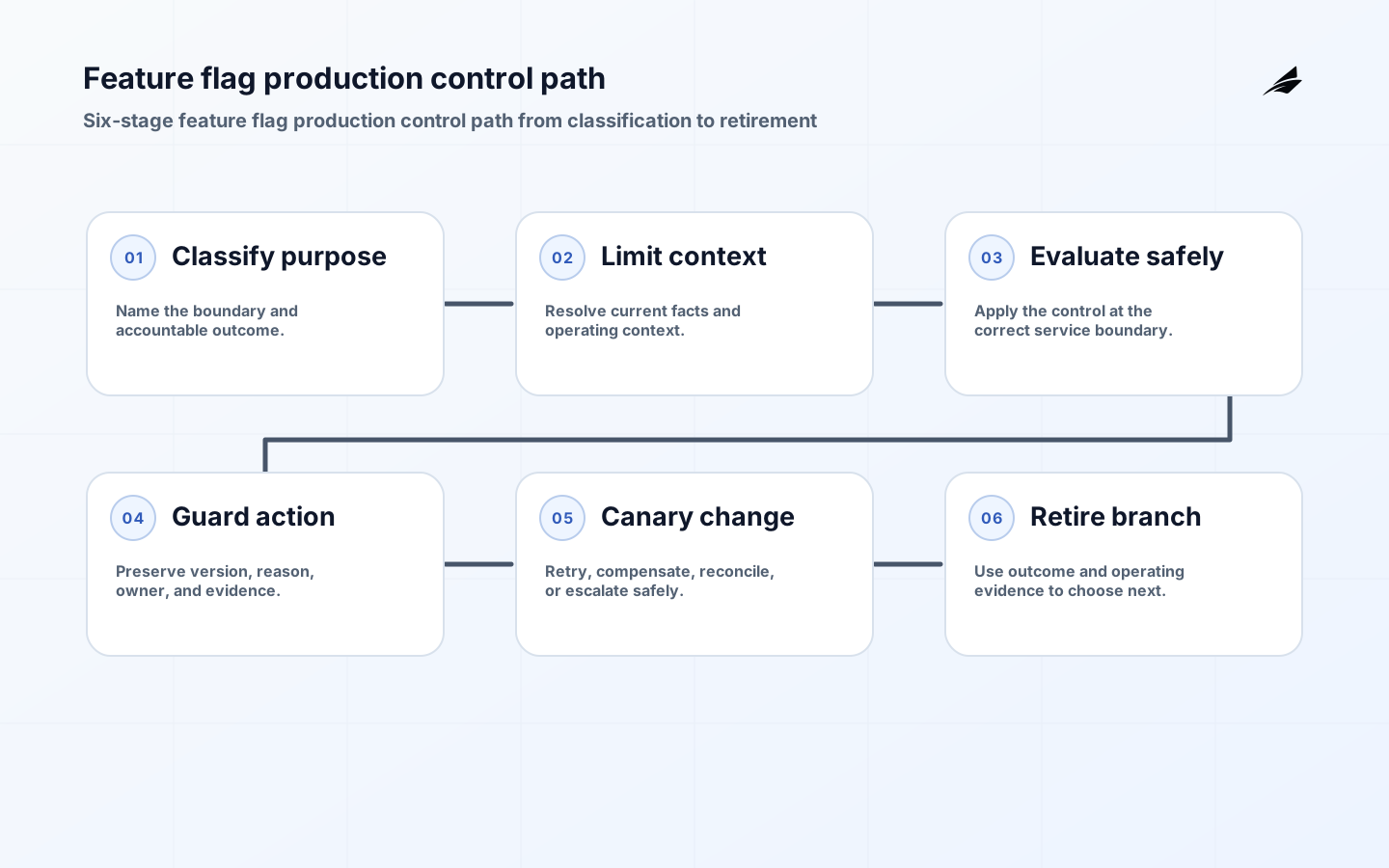
Feature flags as production decision infrastructure begins with a bounded operating question. Treat feature flags in production exceptions as evidence for the next decision.
Feature flags become production infrastructure once they can alter a customer journey, a security boundary, or the load placed on a dependency. The hard part is not evaluating a Boolean. It is deciding which flags are release controls, experiments, operational kill switches, or enduring entitlements, then giving each class an owner and retirement date. A flag that silently becomes permanent is code and policy debt with an unusually friendly user interface. The OpenFeature specification is useful because it treats evaluation context, provider behavior, hooks, and error handling as parts of a portable contract rather than a vendor-specific convenience.
Set the feature flags production boundary
Classify before creating. A release flag narrows exposure while a change proves itself; it should expire. An experiment flag assigns a cohort and measures a declared outcome; it must not be used to disguise an authorization rule. A kill switch provides a rapid operational escape hatch; its default and access control deserve review. A permission flag encodes a commercial or role decision and should usually live with the entitlement or policy model, not in a developer’s ad hoc targeting list. This classification decides who may edit a rule and what evidence is needed to remove it.
| Decision | Question to answer | Evidence to retain |
|---|---|---|
| Scope | What account, role, resource, or period does this feature flag govern? | Stable identifier, effective time, and accountable owner. |
| Authority | Which service provides the fact used by the feature flag? | Source version, freshness, and reconciliation status. |
| Failure | What happens when the deciding fact is late or disputed | Safe state, user explanation, and escalation route. |
| Exception | Who can override the ordinary feature flag result? | Purpose, approver, narrow scope, and expiry. |
Write an explicit feature flags contract
Specify the evaluation contract: flag key, type, owner, intended decision, allowed context fields, default result, rule version, and expected expiry. Context must be stable and privacy-conscious; avoid using raw email addresses or mutable display names for targeting. Evaluation failure needs a documented result per flag class. A checkout flag might fail closed, while a non-critical layout experiment can fail to its old experience. Keep authorization separate: evaluating “true” must not grant a user a capability the server has not independently authorised.
- Name an accountable owner for the feature flag decision and its data contract.
- Version the rule or state transition that changes the feature flag outcome.
- Keep the user-facing explanation tied to a reason the system can reproduce
- Define an expiry and review point for every manual exception
Build controls around the feature flags decision
Test flags in the same places where their effects matter. A client-side evaluation can improve presentation, but a server must enforce payment, data, and privilege decisions. Test provider timeout, malformed context, stale cached rules, concurrent edits, and a rollback during a partially completed workflow. Limit who can change high-impact targeting and record the change reason, reviewer, old rule, and new rule. The OWASP Authorization Cheat Sheet is a good reminder that configuration access is itself an authorization surface.
| Failure mode | Preventive control | Operating signal |
|---|---|---|
| Stale or absent context | Derive scope from a trusted server-side fact. | Decision failures by reason and source. |
| Duplicated work | Use durable identifiers and idempotent processing. | Duplicate suppression and retry outcomes. |
| Unexplained change | Record version, actor, target, and correlation. | Audit completeness and investigation time. |
| Unsafe override | Use narrow, expiring, reviewable exceptions. | Override age and post-expiry activity. |
Implementation decisions for feature flags
Keep flag ownership in the same planning system as the feature or incident it serves. A flag inventory should answer why it exists, who can change it, which environments use it, and the date when the branch will be removed. Without that, a temporary rollout rule becomes a hidden dependency that new engineers fear touching.
Targeting rules need data-quality boundaries. If a cohort depends on plan, region, device, or tenant tier, define the source and freshness of that attribute. Do not let an unknown or malformed attribute fall into a privileged treatment by accident. Explicit “unknown” behavior is often the difference between a safe default and a confusing launch.
Measure the cost of flags themselves: evaluation latency, provider availability, rule complexity, and dead code age. These signals help teams decide when a simple configuration system has become part of the critical path and needs the same operational discipline as other shared services.
Release feature flags with observable limits
Gradual rollout is useful only when the cohort and stop conditions are explicit. Before increasing exposure, compare error rate, latency, support contacts, completion of the affected task, and any domain outcome that motivated the change. The Google SRE canarying guidance explains the value of a representative canary and measured comparison; do not use a tiny, unrepresentative cohort as evidence that an expensive path is safe. Keep a clear path to restore the prior behavior without a rushed code deployment.
Recover without obscuring the feature flags history
An incident response should say who can activate a kill switch, how the team verifies its propagation, and how it handles work already in flight. A flag reversal cannot necessarily undo a submitted order or migrated record. Preserve the evaluation data needed to scope impact, then use a compensating workflow where necessary. Afterward, remove obsolete branches and targeting rules. The retirement review matters because a living flag catalogue should make future production behavior easier, not harder, to reason about.
- Keep a support-ready view of the facts behind an affected feature flag.
- Stop or narrow automated effects before a disputed decision spreads
- Use a corrective action that references the original outcome rather than overwriting it
- For related planning, see the related Feature Flags for SaaS Product Engineering: A Practical Guide.
Preflight review for feature flags
A useful preflight review for feature flags walks through release controls, experiment cohorts, kill switches, and entitlement checks. Test feature flags in production with normal, delayed, denied, and corrected workflow cases.
Use a scenario table built around a flag provider timeout during a partially completed customer action.
The minimum review evidence for this workflow is rule version, cohort size, and evaluated fallback.
Plan now for a rollout rollback and removal of obsolete branches.
Production flag review
Make the normal path and exception path explicit for feature flags as production decision infrastructure.
Treat feature flags as production decision infrastructure as an operating system rather than a screen.
Use a small scenario review before expansion. The review should also name the feature flags in production signal for a recovery case.
Keep customer language aligned with system state for feature flags in production.
| Decision area | Control to apply | Evidence to retain |
|---|---|---|
| Scope | Name the supported boundary for feature flags as production decision infrastructure | Approved scope and exclusions |
| Authority | Use trusted facts and current context | Source, version, and timestamp |
| Action | Enforce at the service that commits the result | Allow or deny reason |
| Recovery | Retry, compensate, reconcile, or escalate | Correction and review record |
The primary references for this decision are OpenFeature specification: Flag Evaluation API, OpenFeature specification: Evaluation Context, Google SRE Workbook: Canarying Releases, OWASP Authorization Cheat Sheet, OpenTelemetry observability primer.
For related planning, See Feature Flags for SaaS Product Engineering: A Controlled Rollout Guide, SaaS Reliability for SaaS Product Engineering: a Practical Guide, In-app Guidance for SaaS Product Engineering: a Practical Guide.
Key takeaways
- Feature flags must be owned as a production decision, not left as interface behavior.
- A versioned contract and evidence trail make changes explainable to customers and operators
- Release signals should measure both technical correctness and the user outcome the workflow serves
- Recovery is stronger when exceptions are narrow, attributable, and reconciled
Frequently asked questions
For feature flags, What is the first production test for feature flags? Exercise one normal path and one hostile or interrupted path with the same identifiers, then confirm that the result, audit evidence, and user explanation agree
Who should own feature flags? Product owns the customer decision and success measure; engineering owns the dependable implementation; operations, security, finance, or support own the specialised controls that apply to their part of the workflow
When is a manual override acceptable for feature flags? Only when its scope, purpose, approver, expiry, and reconciliation action are visible A permanent informal bypass is a missing feature flags rule, not a reliable operating practice.
For feature flags in production, a good handoff ends with observable evidence rather than a verbal promise.
The smallest useful improvement to feature flags in production is often a sharper boundary, not another feature. Use feature flags in production support evidence to decide whether the workflow is ready.
For feature flags in production, test a scheduled change before treating the first release as complete.
A practical example for feature flags in production is normal capacity assumptions stop holding.
Ownership is clearer when feature flags in production separates the promise from the mechanism. Keep customer language aligned with the recorded state for feature flags in production.
For feature flags in production, review the feature flags move into production scope during normal handling. For feature flags in production, review the feature flags move into production ownership during a late event. The feature flags in production review applies this point to flags moves into production during the normal path.
For feature flags in production, test a delayed dependency before treating the first release as complete.
A practical feature-flag example is a duplicate request during a partially completed customer action. Verify that evaluation is idempotent and that the fallback is recorded.
Ownership for feature flags in production is clearer when the customer promise is separated from the mechanism. For feature flags in production, review the feature flags move into production control during a recovery drill.
For feature flags in production, review the feature flags move into production control during normal handling. For feature flags in production, review the feature flags move into production measurement during a late event. The feature flags in production review applies this point to flags moves into production during a delayed handoff.
Teams operating feature flags in production should compare a normal rollout with a support-handled interruption. During review, verify the flag rule, evaluated fallback, customer impact, and recovery owner.
Conclusion
Well-run feature flags make change reversible and observable. They stop being useful when they obscure ownership, create a second authorization
Evidence for “Feature Flags in Production: The Controls That Change After Launch” is grounded in OpenFeature specification: Flag Evaluation API, OpenFeature specification: Evaluation Context, Google SRE Workbook: Canarying Releases, OWASP Authorization Cheat Sheet, OpenTelemetry observability primer; each source informs a specific decision, test, or operating trade-off described in this guide.