Self-Serve Onboarding: Define Trust Before Build
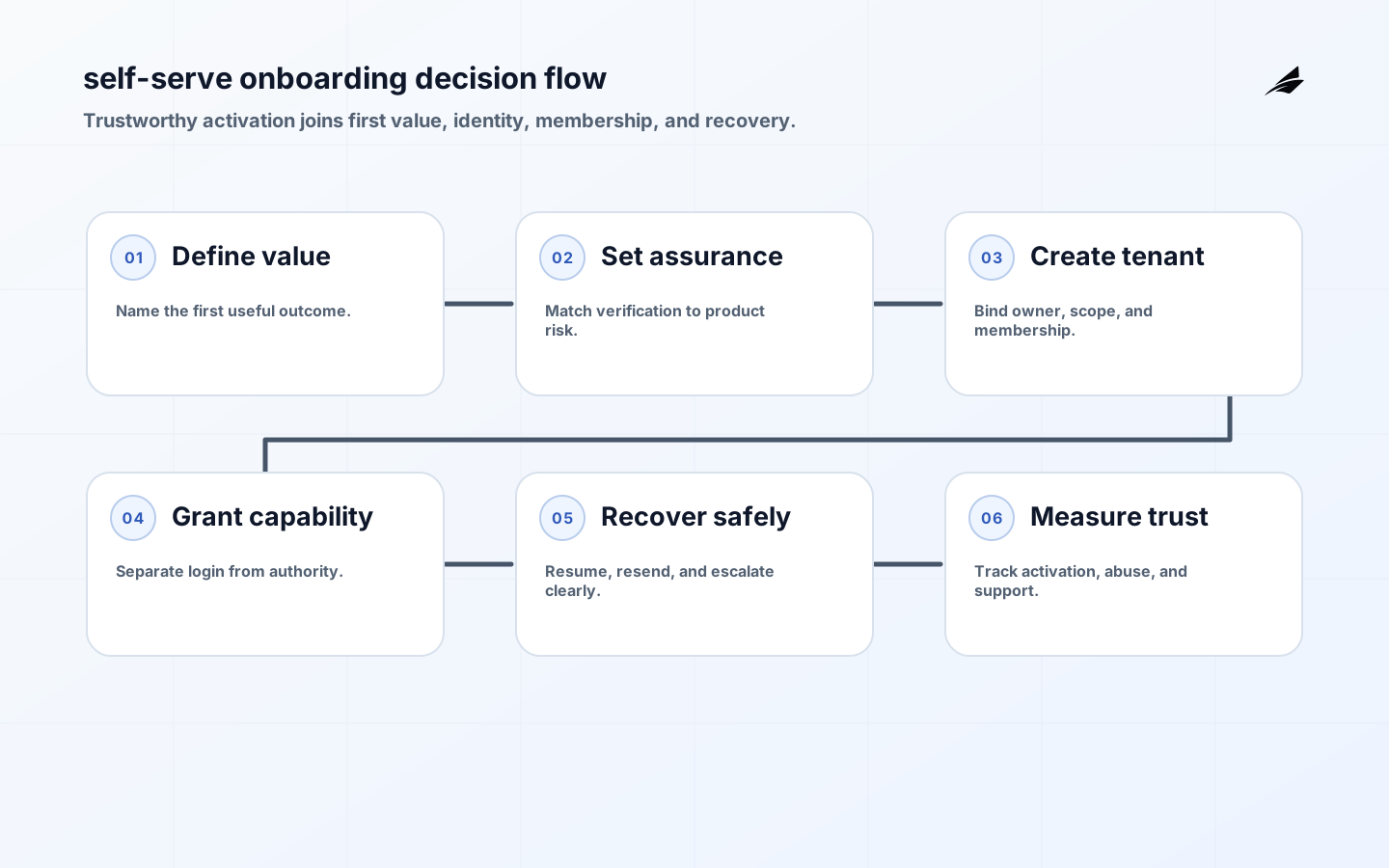
Self-serve onboarding is not a sequence of welcome screens. It is the product boundary where a prospective user becomes an account, an organization becomes a tenant, and an initial promise becomes a first useful outcome. Before building, decide what value the user should reach, what identity assurance is required, which data belongs to which tenant, what happens when verification fails, and where human help begins. The NIST Digital Identity Guidelines Revision 4 is a valuable reference because it separates identity proofing, authentication, federation, security, privacy, and user experience. Your flow should ask for only the assurance and information the product genuinely needs.
Define first value before signup steps
Write the first useful outcome as a user action with evidence of completion. “Create an account” is a system event; “invite a teammate and see the first project report” is a product outcome. Observe the shortest trustworthy path to that outcome and remove fields that do not support it. Link to product onboarding systems for product leaders when mapping the broader lifecycle. Decide whether verification must precede value, can happen progressively, or must be completed before sensitive data or collaboration is available. The answer should follow risk and user need, not a habit copied from another product.
| Decision | Why it matters | Evidence before build |
|---|---|---|
| First value | Defines the shortest path worth optimizing. | Completed user outcome and success condition. |
| Identity assurance | Determines verification and recovery burden. | Risk tier and required assurance. |
| Tenant boundary | Prevents accidental data mixing and wrong invites. | Organization model and scope tests. |
| Human handoff | Catches high-risk or stuck journeys safely. | Escalation trigger, owner, and response target. |
Choose identity and verification deliberately
Different onboarding outcomes require different identity assurance. A low-risk trial may need email verification and a recoverable account; a regulated workflow may need stronger proofing, organization approval, or a human review. NIST’s guidance describes assurance levels for identity proofing, authentication, and federation; use it as a vocabulary rather than forcing the same friction on every user. Make email or phone verification resistant to replay and enumeration, expire tokens, rate-limit abuse, and provide a clear recovery path. Never treat a verified address as proof of every business attribute the user claims.
Model tenant and invitation boundaries
Decide when a tenant is created, who owns it, how a user joins, and how invitations work when an email already belongs to another organization. Keep account identity separate from organization membership. An invite should be scoped, expiring, single-use where appropriate, and unable to grant more than the intended role. If the product supports social or enterprise login, map the identity provider’s claims to an explicit organization and membership policy. Test wrong-tenant links, forwarded invitations, duplicate acceptance, removed members, and a user who belongs to several organizations.
Separate authentication from product authority
Logging in proves something about the account; it does not by itself authorize every onboarding action. OAuth 2.0 describes delegated authorization and token roles, but the product still needs server-side checks for tenant, membership, role, object, state, and action. Decide whether the first user becomes an owner, administrator, or pending member, and define how that authority can be transferred or revoked. Use narrow scopes and avoid placing sensitive business decisions in client-side state. A successful callback should create only the membership and resources explicitly permitted by the product contract.
| Flow point | Risk to decide | Useful test |
|---|---|---|
| Signup | Duplicate, abuse, or unverified identity. | Rate limit, token expiry, and enumeration test. |
| Create tenant | Wrong owner, name collision, or data leak. | Concurrent creation and wrong-scope request. |
| Accept invite | Forwarded or stale invitation grants access. | Expired, reused, and cross-tenant invite. |
| First setup | Partial completion leaves unusable state. | Timeout, retry, and resume test. |
| Recovery | Lost factor or changed email blocks value. | Recovery identity and escalation drill. |
Make progress and failure understandable
Users should know where they are, what remains, why a step is required, and what happens if they leave. Use plain labels, preserve input on validation errors, show useful field-level messages, and avoid a progress bar that implies a false certainty. WCAG 2.2 covers labels, focus, error identification, keyboard access, contrast, and reauthentication concerns that are especially important when a flow contains email links, timeouts, or multi-step setup. Distinguish “we sent a message,” “we verified the address,” “your organization needs approval,” and “the service is unavailable.” Clear states reduce support volume and prevent unsafe retries.
Minimize and govern onboarding data
For each field, state why the product needs it, who can see it, how long it is retained, and whether the user can correct it. Validate at the boundary and normalize values consistently, but do not silently change meaningful identity or organization data. OWASP’s Input Validation Cheat Sheet supports allowlisting and context-appropriate validation. Use the OWASP ASVS to make session, access, error, and data-handling expectations testable. Do not collect sensitive profile fields simply because a future roadmap might use them.
Example: onboard a small operations team
A workflow product wants a team to reach a first shared checklist. The flow asks for email, password or approved identity-provider login, organization name, and one invited teammate. The first user receives an owner role only after verification; the invite is scoped to that organization and expires. The product creates an empty workspace, shows a sample checklist, and measures first completion rather than treating signup as activation. If the invite fails, the owner can continue privately and resend it. If organization verification becomes necessary for a high-risk feature, the team can use the product at lower authority while a named reviewer handles the exception. Every step has a resumable state and a safe retry.
Define outcome measures and guardrails
Measure time to first value, completion by step, verification failure, invite acceptance, recovery success, support handoff, wrong-tenant prevention, and post-onboarding correction. Segment by identity method, device, geography, and organization type only when the data use is justified. Watch for metrics that reward risky shortcuts, such as removing verification to improve conversion. Define thresholds that trigger investigation: a spike in expired links, repeated signup attempts, unusual invitation volume, or a rise in accounts that cannot reach first value. The flow should optimize a trustworthy outcome, not just a lower number of form fields.

Key takeaways
- The first useful outcome and the minimum trustworthy path to it.
- Required identity assurance, verification, recovery, and human review.
- Tenant ownership, membership, invitation, and cross-organization rules.
- Authentication, product authority, scopes, and server-side resource checks.
- Accessible progress, error, timeout, resend, and resume behavior.
- Data minimization, outcome measures, abuse signals, and escalation owners.
Frequently asked questions
Should users verify email before seeing product value?
It depends on risk. Allow low-risk exploration before verification when appropriate, but require stronger assurance before sensitive data, collaboration, export, or consequential actions become available.
What should happen when an invite is forwarded?
Bind the invitation to the intended organization and role, expire it, show the recipient the scope, and require the accepting identity to satisfy the product’s membership rule. Never let forwarding create broader authority.
Turn the onboarding decision into a safe experiment
A good onboarding experiment changes one meaningful part of the path while keeping identity, tenant scope, and recovery controls stable. Define the hypothesis in terms of first value: for example, reducing setup fields should help a new team complete its first shared task without increasing wrong-tenant invites or support handoffs. Instrument the step, the outcome, the error, and the safety signal. Do not count a user as activated merely because a row was created. Keep a versioned record of copy, validation, identity method, default role, and capability gates so the result can be interpreted later.
Build resumability into the state model. A user can close a tab after verification, lose network while an import runs, or return after an invitation expires. Store only what is needed, protect sensitive values, and make each transition idempotent. Show pending, blocked, expired, and complete states with a clear next action. Link to product onboarding systems for lifecycle framing, and to admin console design when onboarding creates settings or memberships that administrators will later manage. A resumable flow is more trustworthy than a shorter flow that leaves hidden partial state.
Treat support as part of the product boundary. Define when a user is sent to a person, what evidence is transferred, how the agent verifies scope, and which actions remain unavailable until uncertainty is resolved. A support shortcut that turns an unverified identity into an owner role can erase the security model in one conversation. Give the agent a bounded tool or checklist, require a reason, and record the decision. Use a clear escalation for organization claims, account recovery, suspicious invitations, and high-risk capability requests. The goal is not to eliminate human help; it is to make human help controlled and explainable.
Review the path by cohort and failure mode. Look at mobile and desktop completion, identity-provider differences, email delivery, invitation acceptance, recovery, timeouts, and setup tasks that users abandon. Pair conversion data with incidents, fraud signals, support effort, and customer corrections. When a metric moves, inspect the user journey and the state transition rather than immediately changing the next screen. A growing team needs a shared decision log that records why assurance, data, and capability rules changed. That log protects the flow from accidental drift as more teams add experiments.
Decide how onboarding ends when the user cannot complete the ideal path. A useful flow may let a user save a low-risk draft, retry a verification step, continue with a limited workspace, or request organization review. Each option should state what remains unavailable and how the user returns to progress. Avoid a dead end that encourages the user to create a second account or ask an employee to bypass the boundary. Link the flow to self-serve onboarding for growing teams for the operating model, and to admin console design when a person must review membership or configuration. The fallback is part of the first experience because users judge trust most clearly when something goes wrong.
Write the onboarding contract so another team can extend it without guessing. State which events create the account, tenant, membership, workspace, and first-value record; which events are reversible; and which require support or approval. Include a user-facing explanation for every blocked or pending state. This record keeps growth experiments from changing the meaning of an account behind the scenes and gives the support team a reliable way to explain recovery.
Conclusion: design trust and value together
Self-serve onboarding works when a user reaches a real outcome without the product losing control of identity, tenant scope, data, or recovery. Define value, assurance, membership, authority, accessibility, and handoff before writing the flow. That gives the team a foundation that can improve conversion without turning trust into an invisible compromise.