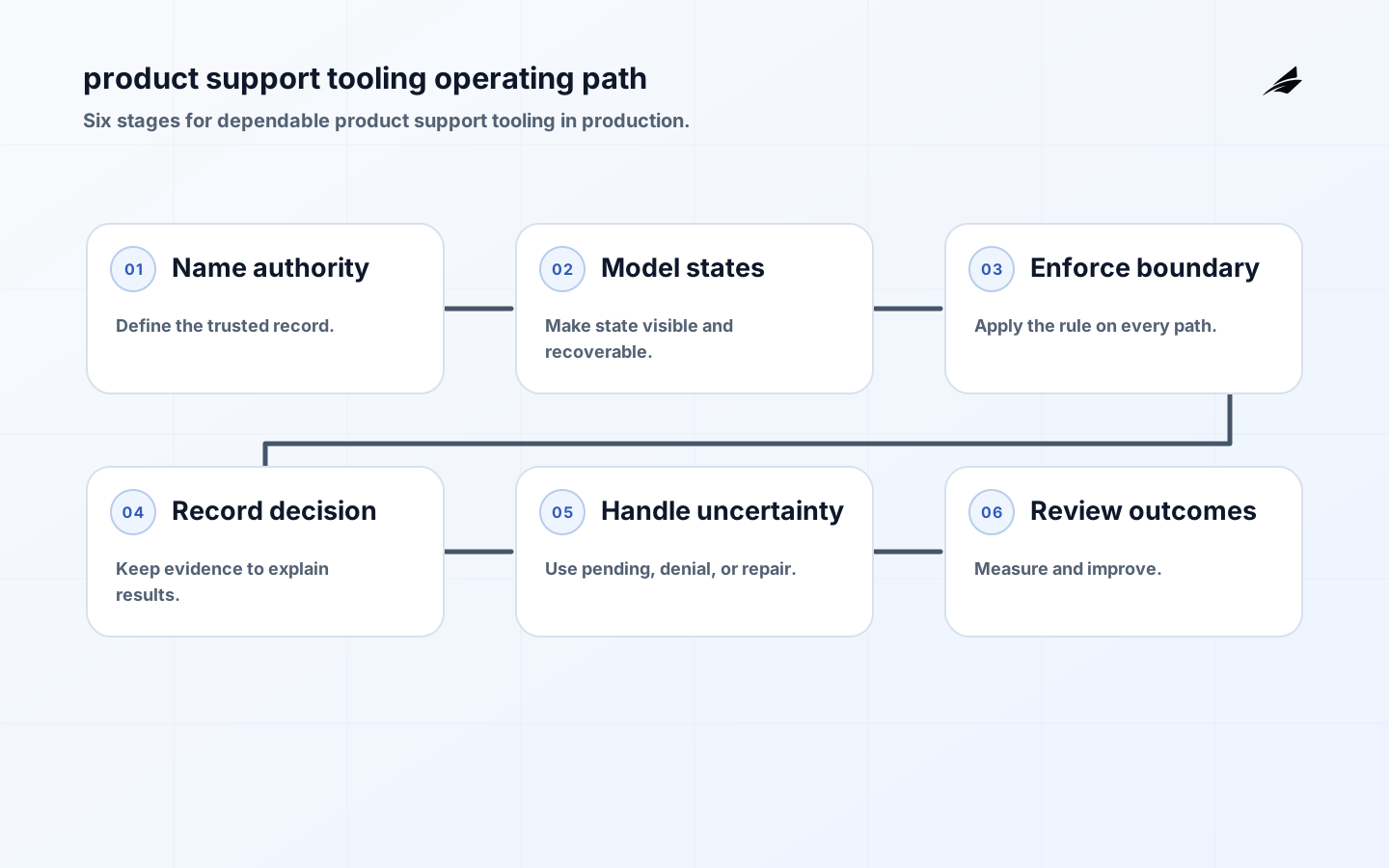
When product support tooling enters production, a private convenience becomes a system that can change customer data, permissions, billing state, or workflow outcomes. The operator may be acting under time pressure, but the tool still needs a clear authority model and a durable record. Search, impersonation, resend, refund, entitlement repair, and account recovery each carry different risks. A useful support surface makes those differences visible, limits the available scope, and preserves enough context for another person to understand the action later.
Key takeaways
- Treat support actions as product operations with explicit impact and authority.
- Separate read-only investigation from commands that alter customer state.
- Require tenant scope, reason, confirmation, and approval for sensitive changes.
- Make retries and uncertain outcomes safe for both operators and customers.
- Show the operator what will change before the tool sends the command.
- Keep an evidence trail that links the request, result, actor, and recovery route.
Classify every support action
Begin with an inventory of commands rather than a menu of screens. A search for account history is observational. Resending an invitation changes delivery behavior. Granting a temporary entitlement changes access. Deleting data may be irreversible. Describe each action by subject, tenant, object, scope, duration, prerequisites, and expected side effects. This catalogue gives engineering, support leadership, and security a shared vocabulary for deciding which commands are safe to automate and which require a second person.
| Action class | Example | Control | Record |
|---|---|---|---|
| Observe | View account status or delivery history. | Read-only scope and masking. | Viewer, tenant, query, time. |
| Assist | Resend a message or retry a safe job. | Idempotency and visible target. | Reason, command id, result. |
| Correct | Repair a stuck entitlement or profile field. | Restricted role and before-state. | Approval, old value, new value. |
| Irreversible | Delete or disclose protected information. | Separate approval and strong confirmation. | Authority, justification, outcome. |
Anchor authority in the server
A hidden button is not a security boundary. The API or trusted worker must re-check the operator, tenant, target, action, and current state when the command arrives. The OWASP Authorization Cheat Sheet provides a strong baseline for server-side enforcement and deliberate failure handling. Use role and purpose together when a person may access a customer account, and prevent a support user from changing scope by editing a request parameter. The NIST Secure Software Development Framework is a useful reference for making these controls part of the delivery lifecycle.
Make customer context hard to lose
Support agents often move between search results, a customer record, an incident, and a command panel. Keep tenant name, stable identifier, environment, and selected object visible at the point of action. Require the operator to confirm a high-impact command against that context. Never let a stale tab silently apply a repair to a newly selected account. Mask secrets and sensitive fields by default, and make any unmasking deliberate, time-limited, and recorded.
Build commands for uncertain outcomes
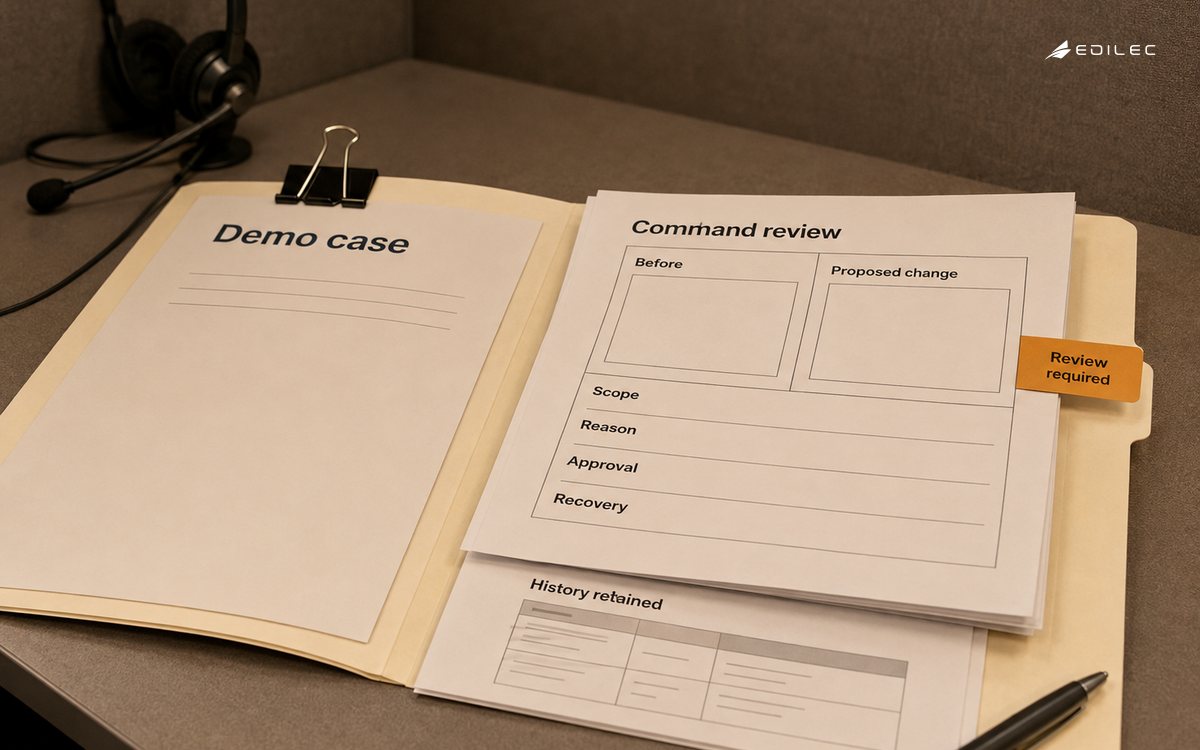
A timeout after clicking a command does not prove that nothing happened. Give each mutation a durable command identifier and show accepted, completed, rejected, or unknown as different states. Let the operator reconcile an unknown result before trying again. Workers should persist the intent before acting, deduplicate retries, and retain the original reason. For a correction, show the proposed before-and-after values and state which downstream systems will be notified. This prevents a support shortcut from becoming an invisible second source of truth.
Use approval where impact warrants it
Not every support command needs a ceremony, but high-impact actions should have a second set of eyes or a bounded approval rule. Consider approval for data disclosure, role elevation, broad tenant changes, refunds above a defined business threshold, and irreversible deletion. The approver should see the target, reason, requested scope, duration, and expected effect rather than simply a button that says approve. An approval should expire, be tied to the exact command, and remain visible if the command later fails.
Record the whole support interaction
A command log alone does not explain a support decision. Capture the operator, purpose, tenant, target, request time, policy version, input summary, outcome, correlation identifier, and any approval. Avoid copying customer secrets into notes. The OWASP Logging Cheat Sheet covers the balance between useful records, privacy, and protection. With OpenTelemetry documentation, teams can connect the support request to the service call, queue job, and customer-visible result without forcing agents to read infrastructure logs.
Design the workflow around the case
Support work is a sequence of observations and decisions, not a series of unrelated buttons. Let the agent begin with the customer problem, inspect relevant history, identify the current owner, and choose a command only after the target is clear. Present related events in time order and label system state separately from an agent's interpretation. When a case crosses teams, preserve the evidence and next action so the receiving person does not repeat a risky lookup or ask the customer for the same details again.
Use different confirmation language for different impacts. A resend can explain that another message will be issued. A role change should name the new privilege and its duration. A deletion should identify what cannot be restored. Avoid a single generic confirmation that trains operators to click through warnings. For commands with customer-visible side effects, show the expected result and the recovery path before submission. The interface should support a careful decision at normal working speed, including when the queue is busy.
| Workflow moment | What the tool should expose |
|---|---|
| Investigate | Current state, source time, tenant, and relevant history. |
| Choose | Command scope, side effects, authority, and reason. |
| Submit | Target confirmation, idempotency status, and approval. |
| Recover | Final result, owner, next action, and linked evidence. |
Release with a narrow operating scope
Start with the smallest group of agents and the least powerful action set that can answer the intended support need. Observe completion time, failed commands, repeated searches, escalations, and correction volume. Review samples for accidental disclosure, wrong-tenant actions, and confusing status. Expand authority only after the team has a tested recovery route and a clear owner for unusual outcomes. A support tool should reduce improvisation, not turn every incident into an opportunity to invent a new procedure.
Prepare for trust-changing failures
Exercise a revoked operator session, a tenant deleted while a case is open, a command sent twice, a downstream service that partially succeeds, and a customer who disputes a manual change. Check that the interface does not encourage repeated clicks when the result is unknown. Test whether an agent can find the current state, original state, and responsible owner. When a command cannot be completed safely, the tool should provide a route to escalate with context intact instead of asking the agent to paste sensitive details into an unstructured channel.
Change the tool without changing accountability
Support commands evolve as teams learn which cases are common and which actions create risk. Keep a versioned definition for each command, including its required role, target scope, confirmation language, downstream effects, and recovery action. When a command changes meaning, do not rely on the old interface label. Review saved procedures, agent training, and incident playbooks so the operational record remains consistent with the implementation.
A new command should be introduced with read-only discovery or a dry-run result when possible. Let operators see which records would change, which dependencies would be notified, and what would happen if one step fails. Keep old commands available only while their behavior is understood and their owner is named. Retirement should revoke authority, preserve historical evidence, and give support a replacement route. This keeps the tool's convenience from becoming an undocumented dependency.
Give agents a way to mark a case as resolved, pending, escalated, or corrected without changing the underlying customer record by accident. The case state should point to the command result and next owner. That separation keeps support coordination useful while preserving the product data as the authoritative history of what actually changed.
Frequently asked questions
Is impersonation safe for support?
It can be useful for reproducing a customer-visible experience, but it should be clearly marked, time-limited, scoped to one tenant, and recorded. Prefer a view-only mode where possible. Any mutation made during an impersonated session should still identify the operator as the actor.
What should be measured first?
Measure resolution of the intended customer problem, time to a safe outcome, failed or repeated commands, escalation quality, and sensitive-data exposure findings. Include sampled case review because a fast resolution can still be the wrong resolution.
For delivery teams working on product support tooling, this operating signal should connect customer outcomes, tenant state, entitlements, release controls, support actions, and operating cost to evidence an accountable owner can inspect. For adjacent decisions, continue with Edilec's Multi-tenant SaaS Architecture: Production Boundaries That Hold and Feature Flags in Production: Safe Release and Rollback. In this production review, move beyond the operating signal only after the owner can show the accepted result, the exception path, and the signal for another review.
Conclusion
Production support tooling earns trust when it makes authority, context, impact, and recovery visible. Separate observation from mutation, enforce every command on the server, preserve uncertain outcomes, and record why a person acted. The result is a support operation that can move quickly while still protecting customers and giving engineering a dependable account of change.