SaaS Reliability for SaaS Product Engineering: a Practical Guide
SaaS reliability is not a feature label; it is the operating decision about whether the service is delivering its promised behavior within agreed conditions and whether the team can recover when it is not. For operations leaders, the practical standard is a reliability practice tied to customer journeys, error budgets, dependency behavior, and owned response work. That standard changes the work. Keep customer language aligned with the recorded state for saas reliability. This creates a concrete recovery and review path for reliability. Test saas reliability with normal, delayed, denied, and corrected workflow cases.
Define the SaaS reliability decision
Write the decision in one sentence before selecting tools: whether the service is delivering its promised behavior within agreed conditions and whether the team can recover when it is not. Then name the authoritative input as service-level objectives, production telemetry, dependency status, and incident records reviewed against customer impact. Review saas reliability evidence with product, engineering and support before expanding scope.
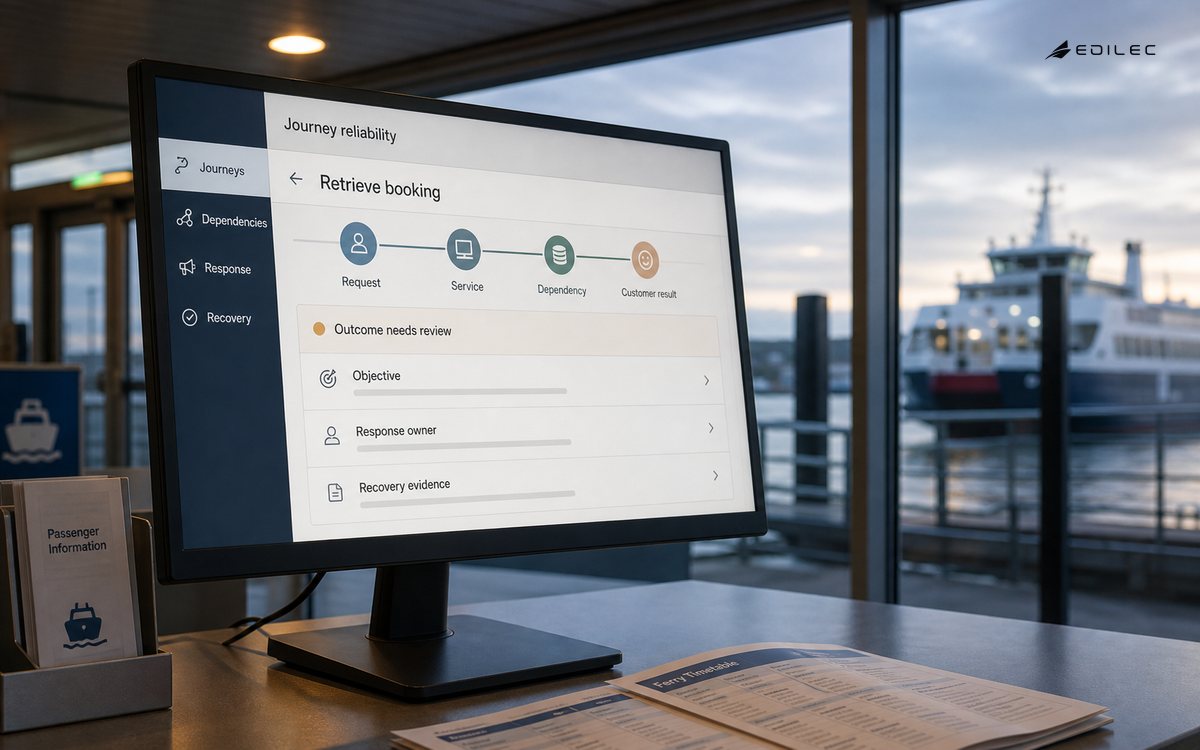
The difficult case is treating an infrastructure metric as healthy while a customer journey is unavailable or unsafe. Design that case deliberately.
| Decision element | Question to settle | Evidence to retain |
|---|---|---|
| Customer promise | What must saas reliability make dependable? | Affected user, expected outcome, and review date |
| Authority | Which record resolves a conflict? | Service-level objectives, production telemetry, dependency status, and incident records reviewed against customer impact |
| Boundary | Where must the rule be enforced? | The services, queues, data stores, third-party dependencies, and operational runbooks that support the promise |
| Recovery | How is a wrong result corrected? | A rehearsed response that stabilises users first, communicates clearly, and turns the incident into tracked follow-up work |
Build evidence and controls into SaaS reliability
The Site Reliability Engineering book explains a relevant control or operating model, while the AWS Well-Architected SaaS Lens is useful for checking a boundary that must not rely on client-side convention. The reliability owner can use that evidence to decide what changes next.
Operational evidence must be usable under pressure. OpenTelemetry documentation provides a credible basis for treating implementation and verification as part of delivery rather than a later audit. The NIST Secure Software Development Framework is equally useful when the team needs to connect technical events to a real customer outcome. For reliability, connect alert evidence to the customer journey rather than a host-level symptom alone.
| Failure mode | Control | Operator signal |
|---|---|---|
| Missing or stale input | Validate freshness and represent uncertainty explicitly | Age of authoritative record |
| Unauthorised operation | Enforce the services, queues, data stores, third-party dependencies, and operational runbooks that support the promise at the protected action | Denied decision with actor and reason |
| Duplicate work | Use idempotency and a correlation identifier | One customer effect per request |
| Dependency loss | Choose timeout, fallback, and escalation behavior | Alert linked to customer impact |
Implement a thin, observable SaaS reliability slice
The adjacent work in Usage Reporting for SaaS Product Engineering, Feature Flags for SaaS Product Engineering: A Controlled Rollout Guide, and how ctos should think about saas reliability often exposes dependencies that otherwise appear only after launch. For reliability, the owner should review the evidence at the handoff.
- State the SaaS reliability decision and its authority in the delivery brief.
- For this part of the system, name the accountable owner, supporting evidence, exception route, and next measurable check.
- Within this part of the system, name the accountable owner, supporting evidence, exception route, and next measurable check.
- When implementing this part of the system, name the accountable owner, supporting evidence, exception route, and next measurable check.
- Before releasing this part of the system, name the accountable owner, supporting evidence, exception route, and next measurable check.
- Rehearse rollback or containment before expanding the audience
Measure the SaaS Reliability outcome, not activity
For SaaS reliability, that means service-level indicator performance, error-budget burn, detection-to-mitigation time, dependency failures, and repeat incidents.
Operate SaaS Reliability as a customer commitment
For SaaS reliability, Introduce objectives alongside a real customer journey and an on-call response, not as a dashboard-only programme. Start by tracing the path that creates customer value, including queues and third-party calls, then choose an indicator whose failure matches a user-visible problem. Route early alerts to a review channel until the team knows the noise profile. Before broadening the objective set, rehearse a dependency outage, a rollback, and a customer update. The result should be a response that restores useful service first and leaves a concrete reliability investment behind, rather than a post-incident document with no owner.
Review SaaS Reliability operating evidence
A reliability review should follow a customer journey from intent to confirmed result. Include the systems that make an asynchronous promise real, such as queues, notifications, and background reconciliation. When an objective is missed, separate immediate mitigation from the engineering work that reduces recurrence. Assign the latter an owner and track it like product work. This prevents a service from appearing reliable merely because incidents are handled heroically while the same dependency weakness remains in place.
Key takeaways
- SaaS Reliability needs one explicit customer decision before it needs more workflow.
- Treat service-level objectives, production telemetry, dependency status, and incident records reviewed against customer impact as inspectable evidence, not a private implementation detail.
- Enforce the rule at the services, queues, data stores, third-party dependencies, and operational runbooks that support the promise, including non-UI paths.
- Make a rehearsed response that stabilises users first, communicates clearly, and turns the incident into tracked follow-up work an owned product capability.
- This creates a concrete recovery and review path for reliability. While operating this part of the system, name the accountable owner, supporting evidence, exception route, and next measurable check.
Frequently asked questions
What should be built first? Build the smallest path that makes whether the service is delivering its promised behavior within agreed conditions and whether the team can recover when it is not observable and supportable.
Use a SaaS reliability incident as a design test
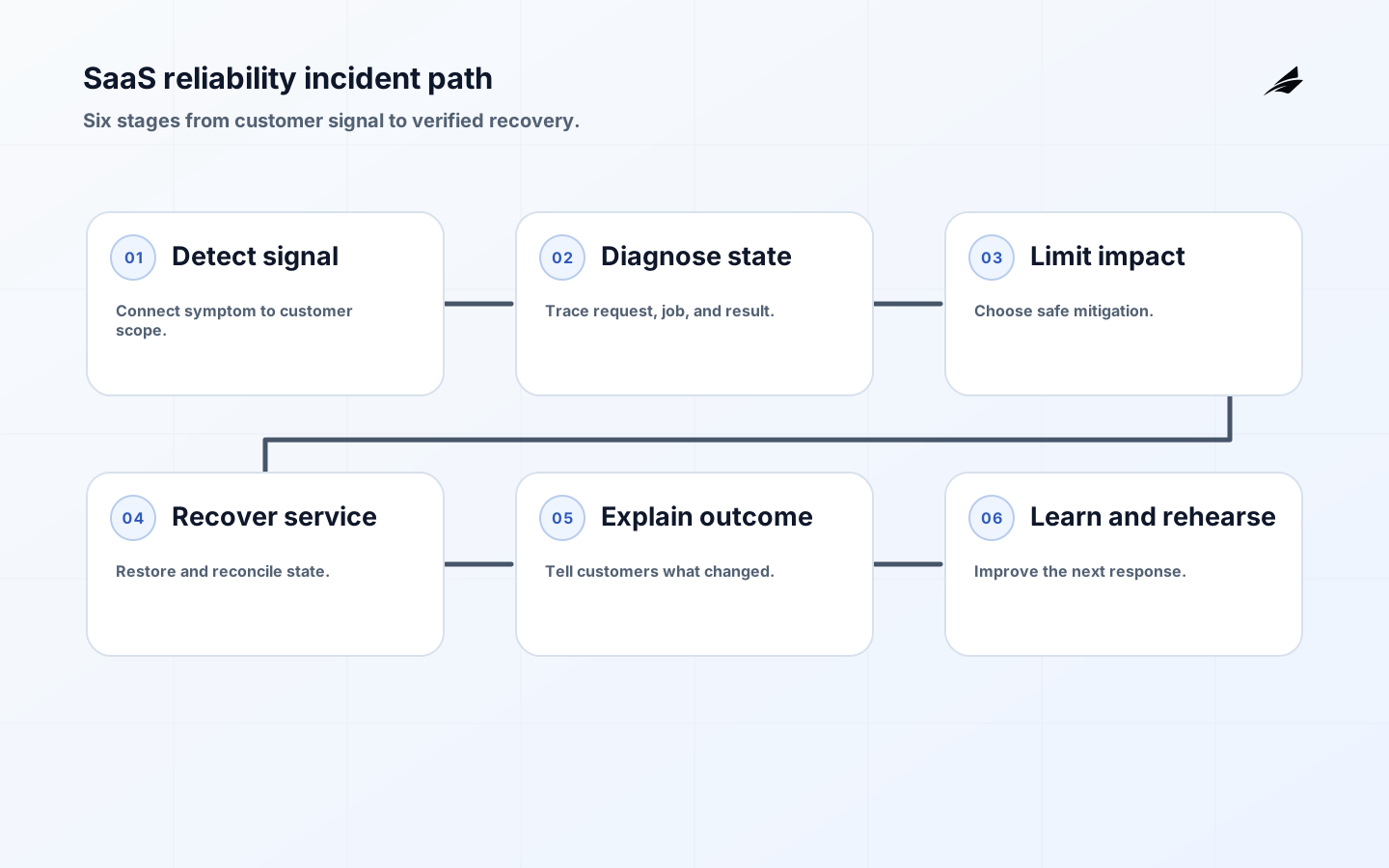
A SaaS reliability review should follow one customer-visible incident across detection, diagnosis, mitigation, recovery, and learning. For example, a queue delay may make a report appear stuck while the underlying job is still progressing. The product needs a state that distinguishes queued, running, failed, and complete; operators need the same correlation identifier across the request, job, storage write, and notification. Without that shared model, a team may retry a safe read as if it were a failed write.
Before rollout, choose a service-level objective or other explicit customer promise, then test the error budget consequences of the change. Rehearse dependency latency, partial writes, stale cache, exhausted worker capacity, and an operator rollback. Afterward, record what the customer saw, what the system knew, and which control reduced impact. Link this work to usage reporting, tenant isolation, and onboarding production.
What makes a SaaS reliability signal useful?
It connects a customer outcome to a defined service event, a time window, a scope, and an owner who can act on the result.
Should every failure page wake an engineer?
No. Page for signals that require immediate action, while routing lower-severity patterns to a queue with an owner and review deadline.
What should a rollback prove?
It should show that the old path is available, the change stops creating new impact, in-flight work is understood, and customer state can be reconciled.
For saas reliability for saas product engineering, a good handoff ends with observable evidence rather than a verbal promise. Give saas reliability a named owner and a review date.
The smallest useful improvement to saas reliability for saas product engineering is often a sharper boundary, not another feature. Use saas reliability support evidence to decide whether the workflow is ready.
Use AWS Well-Architected Reliability: Operational Monitoring to define the signals, thresholds, and ownership for customer-visible service health.
For SaaS reliability, test an unexpected load spike before treating the first release as complete. During that test, review whether the measurement signals identify the tenant boundary, customer impact and recovery owner.
A practical example for saas reliability is a delayed dependency.
For SaaS reliability, review scope during normal handling and recovery during a customer explanation; both should identify the owner, evidence and next safe action.
For SaaS reliability, review scope during a reconciliation pass and control during normal handling; confirm that the recorded state matches the customer-facing result.
For SaaS reliability, test a disputed result before treating the first release as complete. During the test, review the scope and the evidence used to explain the result to the customer.
A practical example for saas reliability is a scheduled change.
For SaaS reliability, review ownership during a customer explanation and confirm that the responsible person can access the evidence and recovery path.
For SaaS reliability, review control during a reconciliation pass and confirm that corrective actions are authorized, recorded and reversible.
A practical review of SaaS reliability for SaaS product engineering should rehearse a disputed customer result with a real identifier and a visible owner. Check the scope and control during normal handling.
Before expanding SaaS reliability for SaaS product engineering, compare the normal case with a delayed dependency. Review the evidence and recovery path while the dependency is unavailable.
For SaaS reliability, review scope during normal handling, ownership during a delayed handoff and scope again after a policy change.
Teams building SaaS reliability for SaaS product engineering should compare a normal customer journey with a support-handled failure. Recheck scope during a backfill review and confirm that the owner can explain the evidence and recovery state.
For SaaS reliability, review control during normal handling, recovery during a delayed handoff and control again after a policy change.
A concrete operating test for SaaS reliability for SaaS product engineering is to rehearse a disputed customer result with a real identifier, visible owner and documented recovery path.
Conclusion
Good SaaS reliability turns a difficult decision into ordinary, trustworthy work.
Evidence for “SaaS Reliability for SaaS Product Engineering: A Practical Guide” is grounded in Google SRE: Service Level Objectives, AWS SaaS Lens Foundations, OpenTelemetry Observability Primer, NIST Secure Software Development Framework, AWS Well-Architected Reliability: Operational Monitoring; each source informs a specific decision, test, or operating trade-off described in this guide.