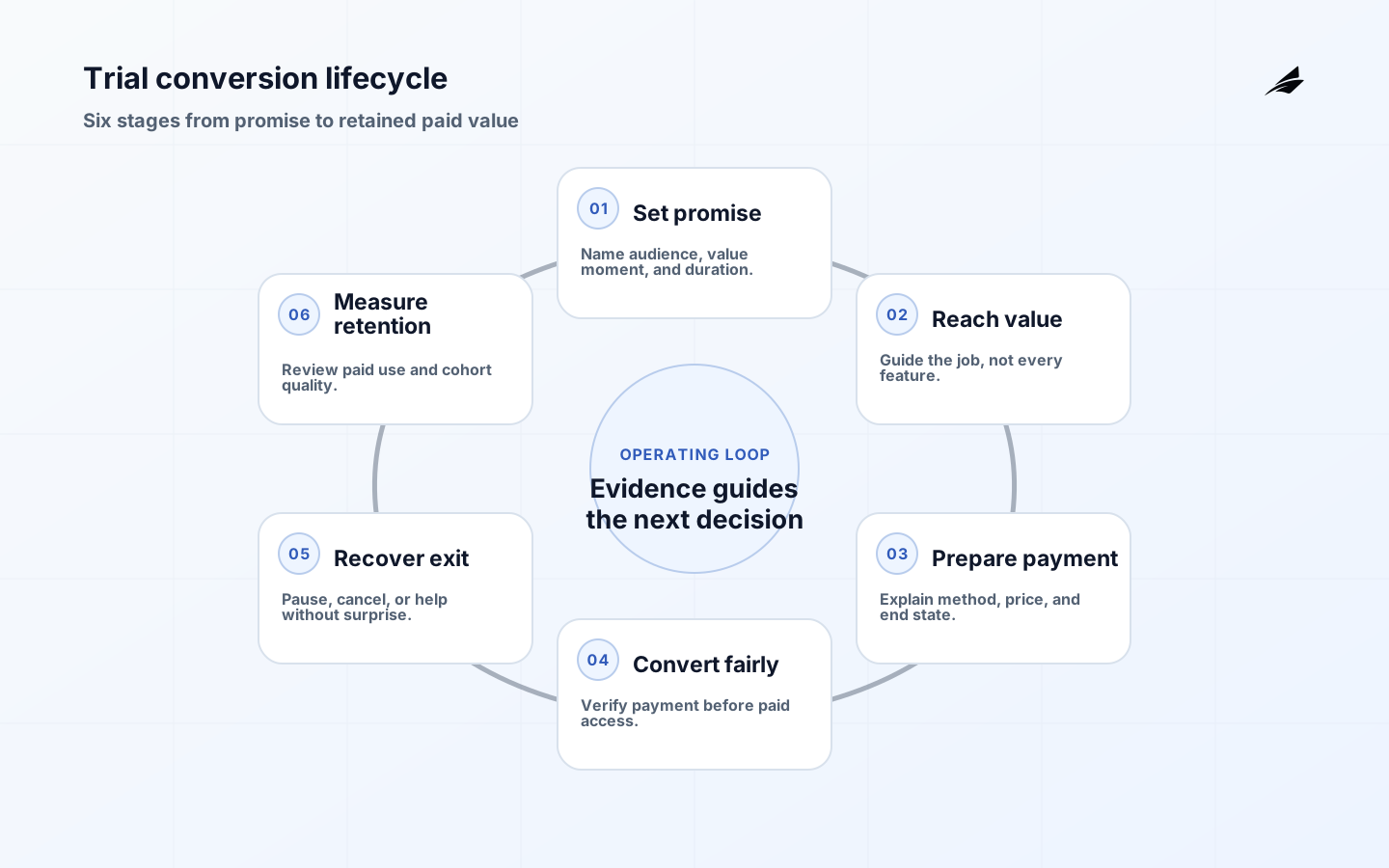
Trial conversion is not a last-day email problem. It is the result of a product helping a qualified user reach value, understand the paid relationship, and complete the next commercial step without surprise. Stripe documents trialing, trialwillend, paused, and active states; Paddle distinguishes card-required and cardless trials and keeps lifecycle events available to the product. Use those states to design a complete journey. Edilec's onboarding flows practical guide covers the activation side, while this guide focuses on the transition from trial promise to retained paid use.
Define the trial promise and value moment
A trial should answer what a user can accomplish before deciding to pay. Choose a value moment such as publishing a report, completing a workflow, or inviting the team that will use the product. Then identify the minimum setup and evidence needed to reach it. A seven-day trial is not automatically better than a fourteen-day trial; the right duration depends on the job's natural cycle and the time required to obtain data or collaborators. If the product cannot deliver value during the chosen window, extending reminders will not solve the underlying design.
Choose card-required or cardless deliberately
A card-required trial can reduce the step between trial and paid collection, but it introduces trust, compliance, and payment-readiness questions at signup. A cardless trial lowers entry friction but requires a clear method to collect payment before the end and a defined pause or cancel behavior when no method exists. Paddle documents both patterns, and Stripe supports trials without collecting a payment method with explicit end behavior. Tell the user what will happen, when, and at what price. Avoid making the payment path discoverable only after the charge fails.
| Choice | Useful when | Risk to control |
|---|---|---|
| Card-required free | Value is clear before the first paid charge. | Trust and failed off-session payment. |
| Cardless free | Users need to explore before payment commitment. | Low payment readiness and noisy follow-up. |
| Paid trial | A real but reduced commitment supports evaluation. | Confusion between trial price and recurring price. |
| Short proof period | The value moment happens quickly. | Insufficient time for data, setup, or team adoption. |
| Long evaluation | The job follows a monthly or quarterly cycle. | Delayed learning and weak reminder timing. |
Connect trial messages to behavior
A welcome message should point to the first useful action, not enumerate every feature. A later message should respond to behavior: a user who created a project needs the next step, while a user who has not started needs a simpler prompt or help. Intercom recommends defining a series goal, audience rules, and message goals. Apply the same discipline to product and email. Stop or change the sequence when the user reaches value, pays, cancels, or becomes inactive. A discount should not substitute for an unresolved setup failure.
Make payment readiness observable
Before trial expiry, the product should know whether a customer has a valid payment method, whether authentication may be required, which price will apply, and what entitlement follows success or failure. Stripe sends a trialwillend event and supports test clocks for exercising the transition. Use equivalent lifecycle signals to trigger a reminder and to prepare customer support. Never provision the paid tier only because a trial ended; verify the payment or approved commercial state, then grant access through the same entitlement path used for renewals.
Design the non-conversion path with respect
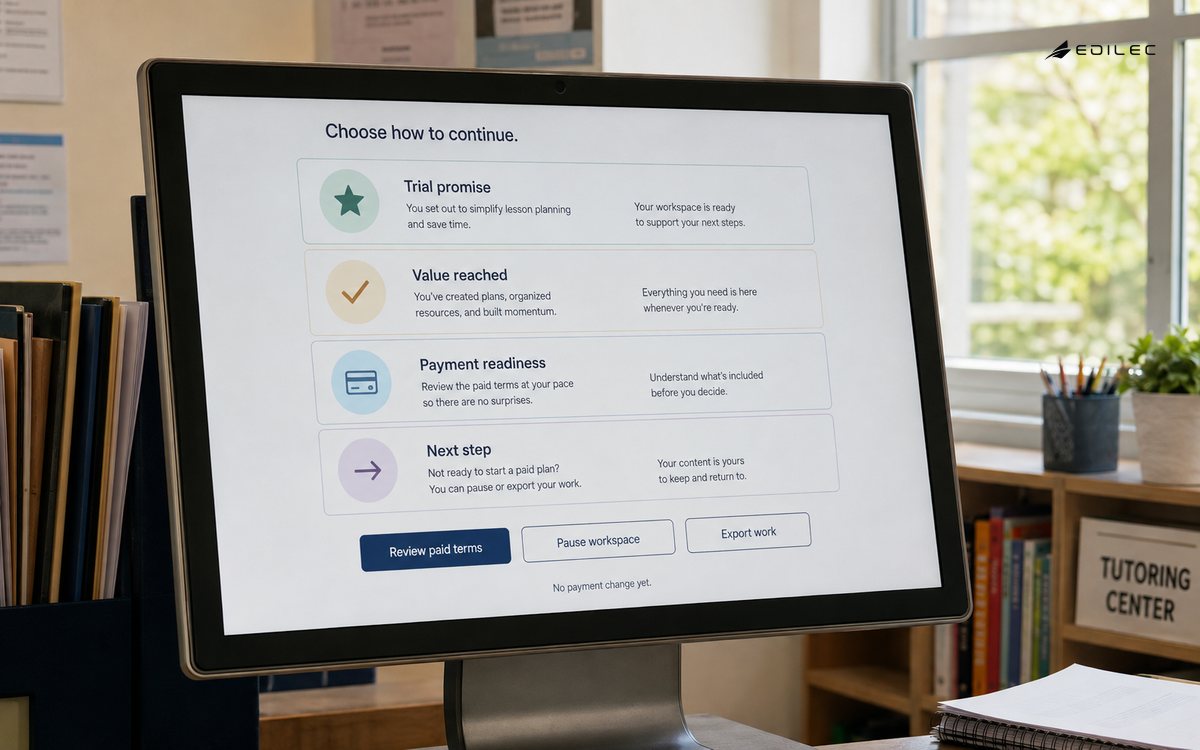
A trial can end in paid, paused, canceled, expired, or a conversation with sales. Each result should preserve useful work where policy permits and explain the next option. If payment fails, say whether the account remains in a grace period, which action is required, and when access changes. If a user cancels, capture a reason without blocking the cancellation. If a cardless trial pauses, allow a straightforward resume path. A fair end state protects trust and creates better conversion evidence than hidden restrictions or repeated discount messages.
- Define the value moment and qualified audience before choosing trial length.
- Explain payment method, price, end date, reminder, and failure behavior plainly.
- Use behavior-based guidance that stops when the user converts or exits.
- Test trial expiry, authentication, pause, cancel, and renewal with time simulation.
- Measure post-conversion retention, not only the first charge.
Example: a seven-day analytics trial
An analytics product offers a seven-day trial to a team that can connect a sample or production data source. Day one asks the team to answer one question; day three highlights sharing; day five checks whether a payment method and workspace owner are ready; day six explains the renewal price and date. The product uses a trialwillend-equivalent event to trigger the reminder, then waits for a successful paid state before changing entitlement. A customer whose import is blocked sees a recovery route rather than a conversion discount. The team measures saved analyses, payment readiness, conversion, and thirty-day retention.
| Lifecycle point | Customer-facing promise | Internal check |
|---|---|---|
| Start | What can I accomplish in this trial? | Audience, price, dates, and access. |
| Activate | Have I reached useful value? | Value event and setup blockers. |
| Prepare | What will happen when it ends? | Payment method, price, reminder, end behavior. |
| Convert | Did paid access begin correctly? | Verified payment and entitlement. |
| Retain | Was the paid product worth returning to? | Usage, support, and renewal cohort. |
Measure conversion quality
Report conversion by trial start cohort and distinguish trials that ended from trials that converted. Include activation rate, time to value, payment-action completion, conversion by plan and acquisition source, refund or dispute signals, support contact, and retention after the first paid period. Stripe describes trial conversion rate as converted subscriptions divided by trials that ended in a selected period, but a team should also ask whether the converted accounts keep using the product. A higher first charge count is not an improvement if it creates rapid cancellation or customer surprise.
Key takeaways
FAQ: Trial conversion questions
FAQ: How long should a SaaS trial be?
Long enough for the intended user to reach the value moment and short enough to preserve a clear decision window. Use the product job, setup cycle, data availability, and cohort evidence rather than copying a standard duration.
FAQ: Are cardless trials worse for conversion?
Not necessarily. They may increase qualified exploration while requiring stronger payment readiness, reminders, and end behavior. Compare activation, conversion, support, and retention across designs.
FAQ: Should every non-converting trial receive a discount?
No. First determine whether the user reached value and whether price, setup, missing evidence, or timing caused the decision. A discount cannot repair a product that never delivered the promised outcome.
Make the paid transition transparent
The transition from trial to paid should be visible before the customer reaches the final day. Show the recurring price, billing interval, taxes or additional usage treatment where relevant, trial end, cancellation route, and what happens when no payment method is available. A reminder is not merely a conversion instrument; it is a chance for the customer to confirm that the product still matches the job. If the price or plan changes during the trial, show the new commercial state and record the effective date. Clear expectations reduce disputes and give support a consistent answer when a customer asks why a charge occurred.
Trial design should account for teams, not only individual clicks. A workspace may need an owner to approve payment, a security reviewer to approve a connection, or several users to adopt the recurring workflow. Measure the sequence that leads to paid value and identify where responsibility changes hands. Offer an invitation or handoff action when collaboration is part of the value moment. A trial that converts one administrator but never becomes part of the teamÃÂÃÂÃÂâÃÂÃÂÃÂÃÂÃÂÃÂÃÂÃÂs work will produce weak retention and misleading optimism.
Use time simulation to test every ending state. Advance a trial clock with and without a payment method, with authentication required, after cancellation, after a plan change, and after a reminder has already been sent. Verify event handling, customer messages, entitlement, invoice state, and support visibility. The edge case is part of the product promise; it should not be discovered only when the first real customer reaches the end of a trial.
Founders should compare trial cohorts by the conditions that shape their decision: role, company size, acquisition promise, data readiness, payment method, and time to first value. A single conversion rate can improve because a different audience entered the funnel, not because the product improved. Keep trial design changes versioned and annotate the cohort report when duration, pricing, reminder, or entitlement behavior changes. Review refunds, disputes, cancellations, and support contacts alongside charges. Sustainable trial conversion means customers understand the offer, reach the job, pay with clear expectations, and keep receiving value after the first invoice.
A trial should have an explicit owner even when it is self-serve. Product owns the promise and value event, engineering owns lifecycle correctness, finance owns price and collection evidence, and support owns the recovery explanation. Bring those roles together when a trial design changes. A single conversion dashboard cannot replace that operating contract, because the same number may hide a payment failure, an unclear offer, or a customer who never reached the job.
Keep trial experiments reversible and document the commercial decision before changing duration, payment collection, or end behavior. The team should know which cohort received which promise and which lifecycle rules, so later conversion comparisons remain meaningful.
Before widening trial conversion for saas product engineering, run a small rehearsal with normal, denied, delayed, and corrected cases. Make trial conversion corrections visible, scoped, and reversible during a controlled rollout.
The trial-conversion measure should pair paid activation with a signal that explains abandonment or exception. Verify scope against the customer promise, owner, and evidence needed for action.
A durable operating note for trial conversion for saas product engineering records the assumptions that made the decision safe: the authoritative source, effective time, permitted actor, protected resource, and recovery route.
For trial conversion for saas product engineering, a good handoff ends with observable evidence rather than a verbal promise. Review trial conversion evidence with product, engineering and support before expanding scope.
For Trial Conversion, Use trial periods on subscriptions defines scope; Handle subscriptions with deferred payment supports the control; Test your Billing integration clarifies evidence; Trials guides recovery; Create an effective onboarding Series frames review.
In a measured rollout, test trial eligibility, payment state, entitlement change, and exception ownership together.
In a measured rollout, rehearse failed-payment and delayed-dependency recovery, then confirm that the controlling decision remains visible.
When a dependency fails, trace trial-conversion evidence from the customer event to the reconciliation record and confirm that the original evidence remains available.
Conclusion
Trial conversion is a lifecycle decision that starts with value and ends with retained paid use. Define the promise, choose payment requirements deliberately, connect messages to behavior, make ending states honest, and test the full transition. Edilec's billing workflows guide helps implement payment and entitlement state, while the roadmap systems guide helps prioritize improvements from cohort evidence. Conversion improves when the trial makes a paid decision easier to understand, not harder to avoid.
Evidence for “Trial Conversion for SaaS Product Engineering: A Practical Guide” is grounded in Use trial periods on subscriptions, Handle subscriptions with deferred payment, Test your Billing integration, Trials, Create an effective onboarding Series; each source informs a specific decision, test, or operating trade-off described in this guide.