Subscription Access Control for SaaS Product Engineering: a Practical Guide
Subscription access control is not a feature label; it is the operating decision about whether a signed-in account may perform a paid capability at a particular time. For CTOs, the practical standard is a feature decision that remains correct through upgrades, cancellations, payment retries, and delayed events. That standard changes the work. Keep the workflow observable, owned, and recoverable through the next review.
Subscription access control for SaaS product teams: Define the access-control decision before choosing implementation details.
Write the decision in one sentence before selecting tools: whether a signed-in account may perform a paid capability at a particular time. Then name the authoritative input as a versioned entitlement record derived from verified billing events.
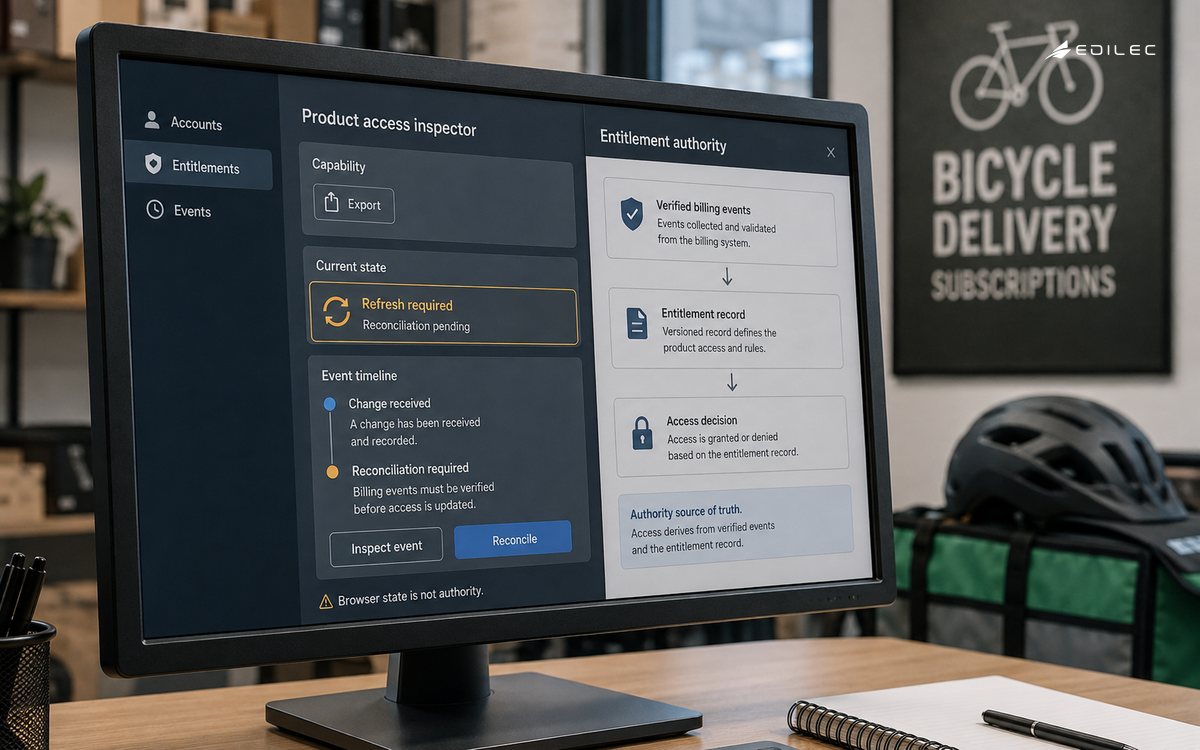
The difficult case is treating a browser flag or a stale customer field as the authority. Design that case deliberately.
| Decision element | Question to settle | Evidence to retain |
|---|---|---|
| Customer promise | What must subscription access control make dependable? | Affected user, expected outcome, and review date |
| Authority | Which record resolves a conflict? | A versioned entitlement record derived from verified billing events |
| Boundary | Where must the rule be enforced? | The service endpoint, background job, export, and administrative action that exposes the paid capability |
| Recovery | How is a wrong result corrected? | A visible pending or restricted state plus a scoped support correction |
Build evidence and controls into subscription access control
The Stripe Billing Entitlements explains a relevant control or operating model, while the OWASP Authorization Cheat Sheet is useful for checking a boundary that must not rely on client-side convention.
Operational evidence must be usable under pressure. NIST Secure Software Development Framework provides a credible basis for treating implementation and verification as part of delivery rather than a later audit. The OpenTelemetry documentation is equally useful when the team needs to connect technical events to a real customer outcome. Keep the workflow observable, owned, and recoverable through the next review.
| Failure mode | Control | Operator signal |
|---|---|---|
| Missing or stale input | Validate freshness and represent uncertainty explicitly | Age of authoritative record |
| Unauthorised operation | Enforce the service endpoint, background job, export, and administrative action that exposes the paid capability at the protected action | Denied decision with actor and reason |
| Duplicate work | Use idempotency and a correlation identifier | One customer effect per request |
| Dependency loss | Choose timeout, fallback, and escalation behavior | Alert linked to customer impact |
Implement a thin, observable subscription access control slice
The adjacent work in Billing Workflows for SaaS Product Engineering, Pricing Gates for SaaS Product Engineering, and how operations leaders should think about tenant isolation often exposes dependencies that otherwise appear only after launch.
- State the subscription access control decision and its authority in the delivery brief.
- Assign named owners for product outcome, technical control, and recovery.
- Exercise a normal path, a stale-input path, and a denied path with realistic data.
- Expose a customer state that explains the next action rather than implying silent success.
- Log the correlation identifier, version, and reason for each scoped correction.
- Rehearse rollback or containment before expanding the audience.
Measure the Subscription Access Control SaaS Product outcome, not activity
For subscription access control, that means entitlement lag, denied-action rate, correction age, and reconciliation drift.
Operate Subscription Access Control SaaS Product as a customer commitment
For subscription access control, A rollout must separate a new billing rule from a new enforcement point. First replay representative upgrade, downgrade, cancellation, and payment-retry events into a non-production resolver. Then enable server-side enforcement for an internal cohort while comparing its decision with the existing path. Watch for disagreement, especially around effective dates and scheduled changes. Only then expose the new rule to a small customer cohort. Keep a repair job idempotent and require a human reason for manual entitlement changes. This sequence preserves revenue protection without locking customers out because an event stream was late.
Review Subscription Access Control SaaS Product operating evidence
A monthly reconciliation is the guardrail that catches the cases a request-time check cannot see. Sample accounts across plans and compare the provider event history, local entitlement, and successful protected actions. Investigate a mismatch as a data-quality incident before modifying a customer record. This protects both the customer and the team: the correction has evidence, and the underlying ordering or mapping fault can be fixed once instead of rediscovered in each support ticket.
Key takeaways
- Subscription Access Control needs one explicit customer decision before it needs more workflow.
- Treat a versioned entitlement record derived from verified billing events as inspectable evidence, not a private implementation detail.
- Enforce the rule at the service endpoint, background job, export, and administrative action that exposes the paid capability, including non-UI paths.
- Make a visible pending or restricted state plus a scoped support correction an owned product capability.
- Use outcome and operational signals together before extending the design.
Frequently asked questions
What should be built first? Build the smallest path that makes whether a signed-in account may perform a paid capability at a particular time observable and supportable.
Review subscription access control at the engineering boundary: confirm the authoritative state, evidence, and recovery path during normal handling.
A durable operating note for subscription access control for saas product teams records the assumptions that made the decision safe: the authoritative source, effective time, permitted actor, protected resource, and recovery route. Test subscription access control for saas product teams with normal, delayed, denied, and corrected workflow cases.
For subscription access control for saas product teams, a good handoff ends with observable evidence rather than a verbal promise.
For Subscription Access Control for SaaS Product Teams, Receive Stripe events in your webhook endpoint defines scope. Make subscription access control. Keep the workflow observable, owned, and recoverable through the next review.
During a delayed handoff, verify that subscription access control preserves the authoritative state, records the evidence, and routes recovery to an owner.
When access is denied, verify the reason and recovery path; during normal handling, confirm that the same rule is enforced at the server boundary.
During a denied request, verify the entitlement reason and customer message; during normal handling, confirm that the evidence supports the decision.
Record the authoritative source, effective time, permitted actor, protected resource, and recovery route. During a delayed handoff, verify that an owner can reconcile the entitlement state.
For subscription access control for saas product teams, test a stale event before treating the first release as complete.
A practical example for subscription access control for SaaS product teams is an incomplete setup. During a delayed handoff, review whether the access decision, evidence, and recovery path remain clear.
During a delayed handoff, verify that the entitlement evidence remains available and the customer sees an honest state.
During a denied request, verify that the decision reason is recorded and the customer has a clear next step.
Compare a successful entitlement decision with a changed permission, then test the measurement and recovery path for a denied request.
During normal handling, verify scope and control at the server boundary, then rehearse recovery for a denied request.
A concrete operating test for subscription access control for SaaS product teams is to rehearse the access decision during a recovery drill. During a denied request, review the evidence, authorization result, and recovery path.
Compare a successful entitlement decision with a support review, then verify scope and recovery after a corrected record.
During normal handling, verify the server-side control; during a denied request, confirm that ownership and escalation are explicit.
A concrete operating test for subscription access control for SaaS product teams is to rehearse the access decision during a dependency failure. During a denied request, review the evidence, authorization result, and recovery path.
Evidence for “Subscription Access Control for SaaS Product Teams” is grounded in How subscriptions work, Using webhooks with subscriptions, Authorization Cheat Sheet, Stripe API idempotency; each source informs a specific decision, test, or operating trade-off described in this guide.
Conclusion
Good subscription access control turns a difficult decision into ordinary, trustworthy work.
Define the entitlement contract
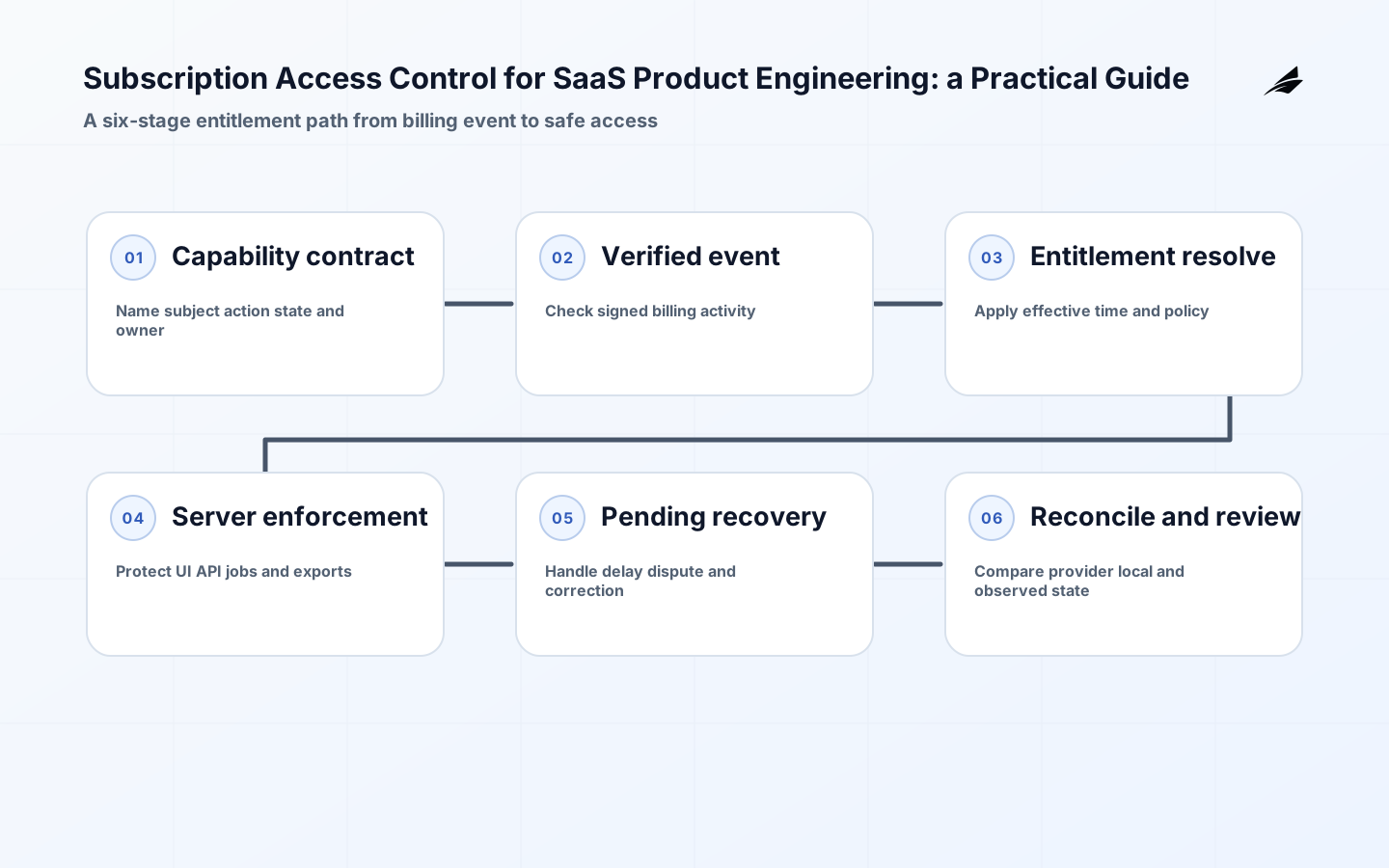
Subscription access control should answer one question consistently: may this account perform this protected action at this time, under which entitlement, and based on which authoritative record? Separate identity, subscription state, entitlement calculation, and enforcement. Stripe’s subscription overview describes recurring access relationships with lifecycle events, invoices, trials, prorations, and recovery; your product still needs an internal contract explaining how those states become capability.
| Contract field | Decision | Evidence |
|---|---|---|
| Subject | User, workspace, account, or service principal | Stable internal identifier |
| Capability | Exact action or quota being protected | Capability key and version |
| State | Active, trial, grace, paused, canceled, or pending | Effective time and source event |
| Authority | Which service resolves access? | Resolver version and inputs |
| Recovery | What happens on delay or dispute? | Pending state and correction route |
Do not enforce access from a browser plan label or cached checkout result. The OWASP authorization guidance recommends deny-by-default and server-side validation on every request. The protected endpoint, background job, export, and administrative action should all use the same resolver or a tested equivalent.
Treat billing events as inputs
Subscription activity is asynchronous. Stripe’s subscription webhook guidance recommends using events for subscription activity and verifying their origin. Keep a durable event record, verify signatures, handle duplicates, process asynchronously, and make state transitions idempotent. A late payment failure should not be ignored, but a late event should not erase a customer’s last verified entitlement without an effective-time policy.
Model pending and grace states explicitly. If the provider is unavailable or an event is out of order, retain the last verified state, mark uncertainty, and choose a customer-safe action based on capability risk. For a low-risk preview, a short grace period may be acceptable; for a costly action, pause and route to support. Record the policy choice so the result can be explained later.
Secure the event boundary
The Stripe webhook security guidance calls for signature verification, duplicate handling, asynchronous processing, replay protection, and quick acknowledgment. Use those controls as part of the access system. A forged or replayed event that grants capability is an authorization incident. Store event identifier, object type, received time, effective time, verification result, and processing outcome while limiting sensitive payload exposure.
Reconcile and review
Run reconciliation between provider state, local subscription state, entitlement record, and observed protected actions. Sample upgrades, downgrades, trials, failed payments, cancellations, scheduled changes, and restored subscriptions. Give support a scoped correction flow with reason, approver, expiry, and a link to original evidence.
Release changes in shadow mode or against an internal cohort first. Compare old and new decisions around effective dates and scheduled changes. Keep a disable switch and an idempotent repair job. Expand only when the team can explain an unexpected denial, restore a correct entitlement, and show that non-UI paths enforce the same rule.