Feature Flags for SaaS Product Engineering: A Controlled Rollout Guide
Feature flags are valuable when they reduce the cost of a controlled product decision; they are dangerous when they become an invisible second codebase. A SaaS engineering team needs to know which flag controls which behavior, who owns it, what the safe default is, how evaluation context is assembled, and when the flag will be removed. The practical guide is therefore about lifecycle and evidence as much as targeting. A flag should help a team release, observe, pause, and clean up a change without leaving customers in a state nobody can explain.
Define the feature flags decision
For feature flags, name the decision boundary and its owner. For feature flags, the relevant facts are flag key, owner, class, safe default, targeting key, reason, and rollback threshold. Put an owner and effective time beside each fact. Test feature flags with normal, delayed, denied, and corrected workflow cases. For feature flags, record the state, evidence, and recovery path. Keep customer language aligned with the recorded state for feature flags.
| Decision area | Question to settle | Evidence to retain |
|---|---|---|
| Authority | Which record decides the feature flags outcome now? | Owner, version, source identifier, and effective time. |
| Scope | Who, which account, and which resource are affected? | Actor or system, target, environment, and correlation key. |
| Failure | What happens when data is late, absent, or inconsistent? | Safe state, visible explanation, retry path, and escalation owner |
| Exception | Who can override the normal result? | Purpose, approver, narrow scope, expiry, and reversal action |
Model Feature Flags facts and transitions
For feature flags, map the normal progression, cancellation or removal, retry, reconciliation, and manual correction paths. This creates a concrete recovery and review path for feature flags.
Review feature flags design choices
For feature flags, keep business semantics out of arbitrary strings. A flag named after a ticket may be fine for a short containment change, but a durable capability needs an owner, a documented default, and a clear evaluation contract. Define whether a variation changes only presentation, controls a workflow, or protects an irreversible action. The greater the consequence, the closer evaluation and enforcement should be to the server-side action.
Targeting deserves a privacy review. A rollout may need a stable account or tenant key, but it rarely needs email addresses, free-form profile text, or every attribute known to the product. Limit context to the decision, document which provider sees it, and avoid using a mutable identifier that changes a user’s experience between requests. Deterministic cohorts make both support diagnosis and experiment interpretation more reliable.
Rollout decisions should include an exposure schedule and stop conditions. Before moving from internal users to a small cohort, write the reliability, task-success, and support evidence that would hold or reverse the change. That protects teams from arguing over a graph after an incident. Record why a cohort changed and who approved it, especially when a flag touches billing, access, or a contractual promise.
Removal is delivery work, not cleanup for another day. Once a release or experiment concludes, delete the targeting rules, obsolete variants, tests that describe retired behavior, and code branches that no longer reflect the product. A flag inventory with approaching expiry dates makes this visible. It also prevents a future engineer from reactivating an old decision without understanding the conditions under which it was originally made.
Implement one narrow Feature Flags path
Review feature flags evidence with product, engineering, and support for a practical guide. Make feature flags corrections visible, scoped, and reversible during a practical guide. Do not record credentials or unrelated personal data. Measure feature flags outcomes alongside correction effort. Reconcile feature flags changes against the original record. In a flag system, keep evaluation details available to the service that must support the result. A false value caused by an intentional cohort rule is different from a false value caused by a provider error or missing context. Treat those states differently in telemetry and operational response, or a healthy rollback mechanism can be mistaken for an unexplained product failure.

- Write feature flags rules in plain language before encoding them.
- For Feature Flags for SaaS Product Engineering, Keep the recovery evidence explicit. For feature flags, retain the reason and effective time with the outcome.
- Make the consequential server-side boundary enforce the decision
- For Feature Flags for SaaS Product Engineering, Keep the recovery evidence explicit For feature flags, retain the reason and effective time with the outcome
- Keep the customer-visible state aligned with the authoritative record
Verify Feature Flags adverse and recovery cases
Define the evidence and recovery rule. Use a provider-timeout, missing-context, changed-type, and canary rollback test suite.
| Scenario | Expected behavior | Review signal |
|---|---|---|
| Normal request | The decision follows the current authoritative record. | Outcome, scope, rule or version, and correlation identifier |
| Delayed or duplicate input | Processing converges without repeating the business effect | Suppression or reconciliation record tied to the source event |
| Missing prerequisite | For Feature Flags for SaaS Product Engineering, Keep the recovery evidence explicit That matters here because feature flags has a distinct recovery boundary. | Reason code, work queue, or targeted alert. |
| Approved correction | The action is attributable, limited, and reversible where possible | Actor, purpose, approval, effective time, and expiry. |
Operate feature flags with evidence
For feature flags, watch for provider failure, unstable targeting, stale caches, conflicting flags, and old code paths.
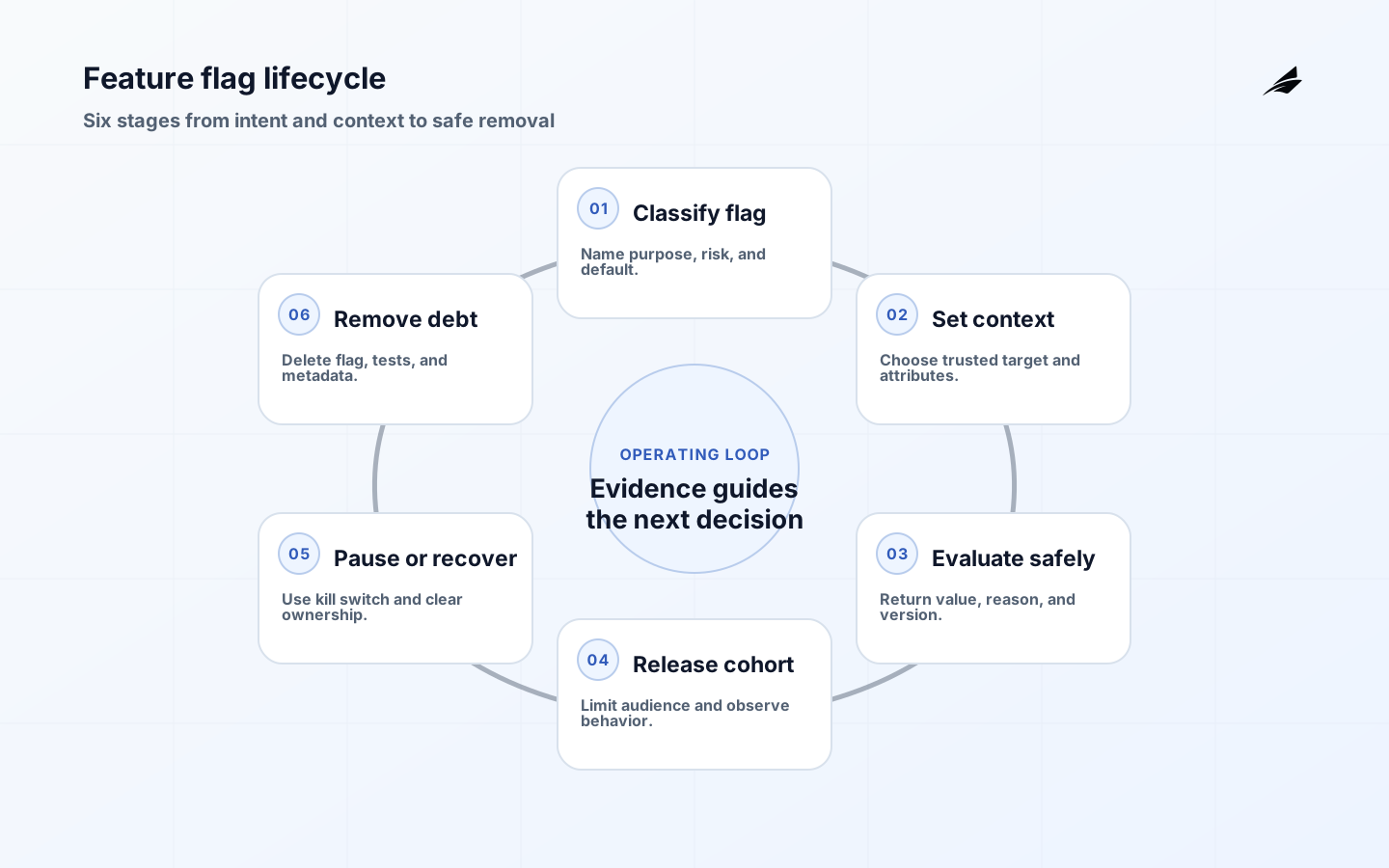
Give every flag a class, owner, and exit condition
Classify a flag before creating it: release control, experiment, operational kill switch, permission gate, or configuration. The class determines default behavior, audience rules, telemetry, approval, and expiry. A temporary release flag should have a removal issue and a date. A kill switch needs a safe state that responders can activate during an incident. A permission gate should not substitute for authorization. The metadata belongs beside the evaluation rule so a reviewer can understand the flag without searching a separate system.
Evaluation context deserves the same care as the flag key. Decide whether the target is a user, account, workspace, request, or deployment, then define which attributes are trusted and how missing context behaves. Use stable identifiers and avoid high-cardinality or sensitive attributes that are not needed for the decision. Test cache freshness, offline behavior, inconsistent targeting, and a flag service outage. The result should be deterministic enough to debug and safe enough to operate.
| Decision point | Required record | Safe review question |
|---|---|---|
| Boundary | Actor, resource, scope, and policy | Can the service decide without guessing? |
| State | Current value, effective time, and source | What does the customer see and why? |
| Recovery | Owner, reason, expiry, and result | Can the team correct or contain it safely? |
Evidence that changes Feature Flags
OpenFeature evaluation context defines the contextual data used in flag evaluation, while the OpenFeature evaluation API helps keep provider results and reasons explicit. OWASP authorization guidance is a reminder that a feature flag is not a substitute for access control. The OWASP Logging Cheat Sheet supports recording decisions without logging unnecessary sensitive data.
For related product operations, Read the feature flags guide, SaaS reliability guide, and product support tooling guide. These routes add context for rollout, response, and customer impact.
Feature Flags: practical questions before rollout
Are feature flags an authorization mechanism?
No. Flags can control rollout or product behavior, but authorization must still be enforced by a trusted permission policy at the action boundary.
When should a flag be removed?
Remove it when the rollout decision is complete, the code path is stable, or the operational incident has ended. Record an owner and exit condition when the flag is created so cleanup is not dependent on memory.
What should a flag evaluation log contain?
Record flag key and version, evaluation reason, safe or selected variant, relevant non-sensitive context, release identifier, and correlation ID. Avoid logging raw personal data merely to make debugging convenient.
Feature flags: practical takeaways
- Feature flags is dependable when the authority, scope, and safe failure behavior are explicit.
- For Feature Flags for SaaS Product Engineering, Keep the recovery evidence explicit That matters here because feature flags has a distinct recovery boundary
- For Feature Flags for SaaS Product Engineering, Keep the recovery evidence explicit That matters here because feature flags has a distinct recovery boundary
- For Feature Flags for SaaS Product Engineering, Keep the recovery evidence explicit That matters here because feature flags has a distinct recovery boundary
- For Feature Flags for SaaS Product Engineering: A Controlled Rollout Guide, consult adjacent product context only at a documented boundary. That matters here because feature flags has a distinct recovery boundary
Frequently asked questions about feature flags
For feature flags, keep this review grounded in the specific authority, scope, and recovery path described above. For example, a containment flag should name the incident or risk it addresses and be removed after responders confirm the permanent corrective change is active.
Review the scope for feature flags during normal handling. Review the evidence for feature flags during a support review. Apply this point to feature flags during the normal path.
For feature flags, test a delayed dependency before treating the first release as complete. Review the scope for feature flags during a support review.
A feature-flag scenario is a duplicate rollout request. Record one decision, retain the request history, and use a recovery drill to verify the measurement.
Ownership for feature flags is clearer when the customer promise is separated from the mechanism. Review the measurement for feature flags during a support review.
Review the control for feature flags during normal handling. Review the recovery for feature flags during a support review. Apply this point to feature flags during a delayed handoff.
For feature flags, test a scheduled change before treating the first release as complete. Review the control for feature flags during a support review.
A practical example for feature flags is an unexpected load spike.
Conclusion
Feature flags remains trustworthy when it is run as a sequence of accountable decisions rather than a configuration detail. In
Evidence for “Feature Flags for SaaS Product Engineering: A Controlled Rollout Guide” is grounded in OWASP Authorization Cheat Sheet, OWASP Logging Cheat Sheet, Feature flags primary reference, Feature flags implementation reference; each source informs a specific decision, test, or operating trade-off described in this guide.