The Plain-language Guide to Workspace Models
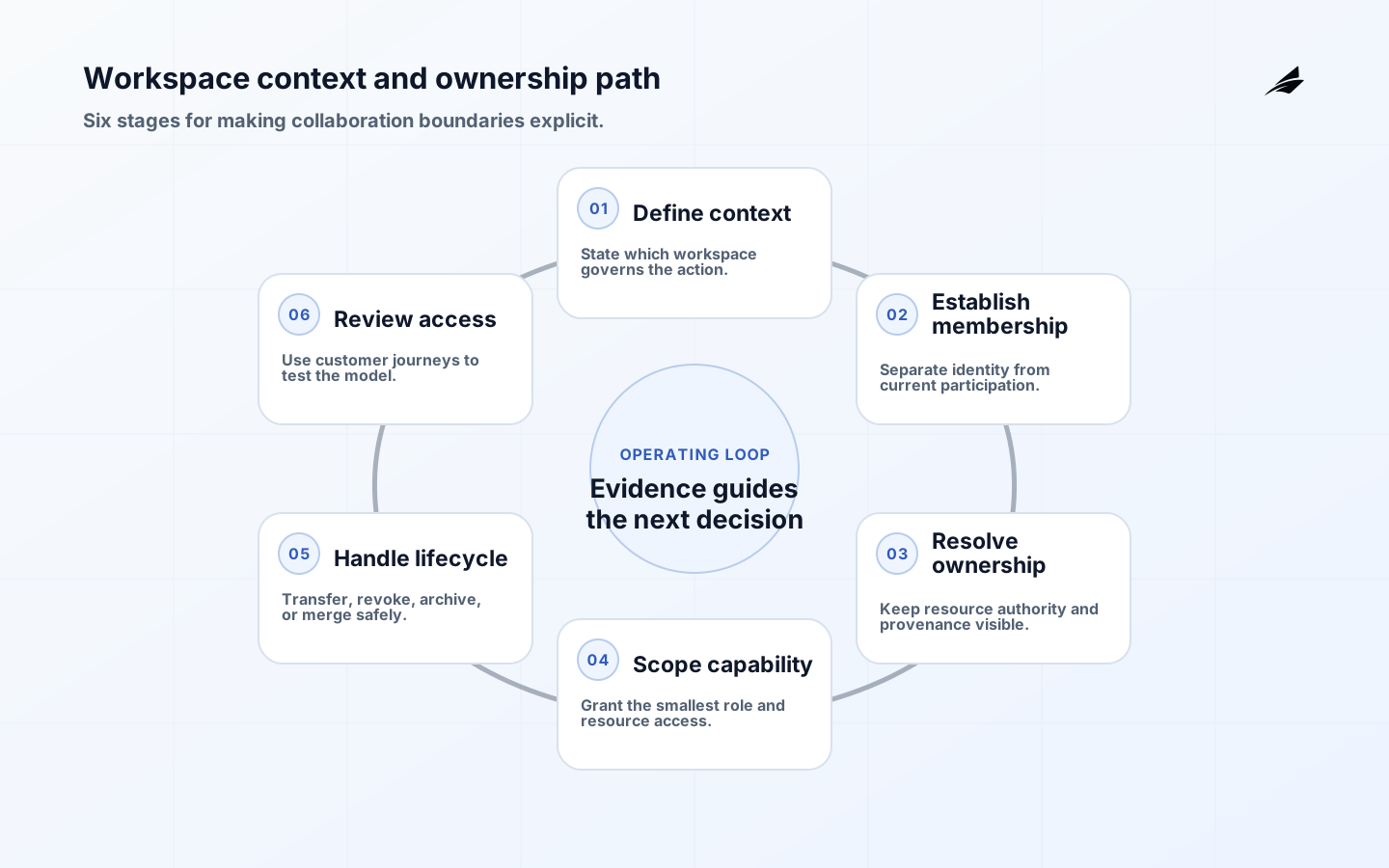
Workspace models define the shared context in which people use a product. They answer where work belongs, who can act there, which resources are owned by that context, and what happens when the context changes. A workspace is not simply a folder with an invite button. It becomes an operating boundary when customers have several teams, external collaborators, delegated administrators, or resources that must outlive their creator. A clear model separates identity, membership, role, resource ownership, and policy. That separation makes navigation easier to understand and makes later access reviews, migrations, support cases, and deletions possible without guesswork.
Define the workspace boundary in ordinary language
Write down the smallest unit that can own a resource and receive a policy. If an invoice, project, dashboard, or integration belongs to a workspace, say so directly. Then define the lifecycle: creation, invitation, acceptance, suspension, transfer, merge, archive, and deletion. Include the uncomfortable cases before implementation: a user belongs to multiple workspaces, an invitation is forwarded, a domain administrator joins late, a resource has no active owner, or an external collaborator must keep access to one project but not the whole workspace. The NIST Privacy Framework is a useful reminder to connect data processing to purpose, responsibility, and appropriate handling rather than treating membership as a purely technical convenience.
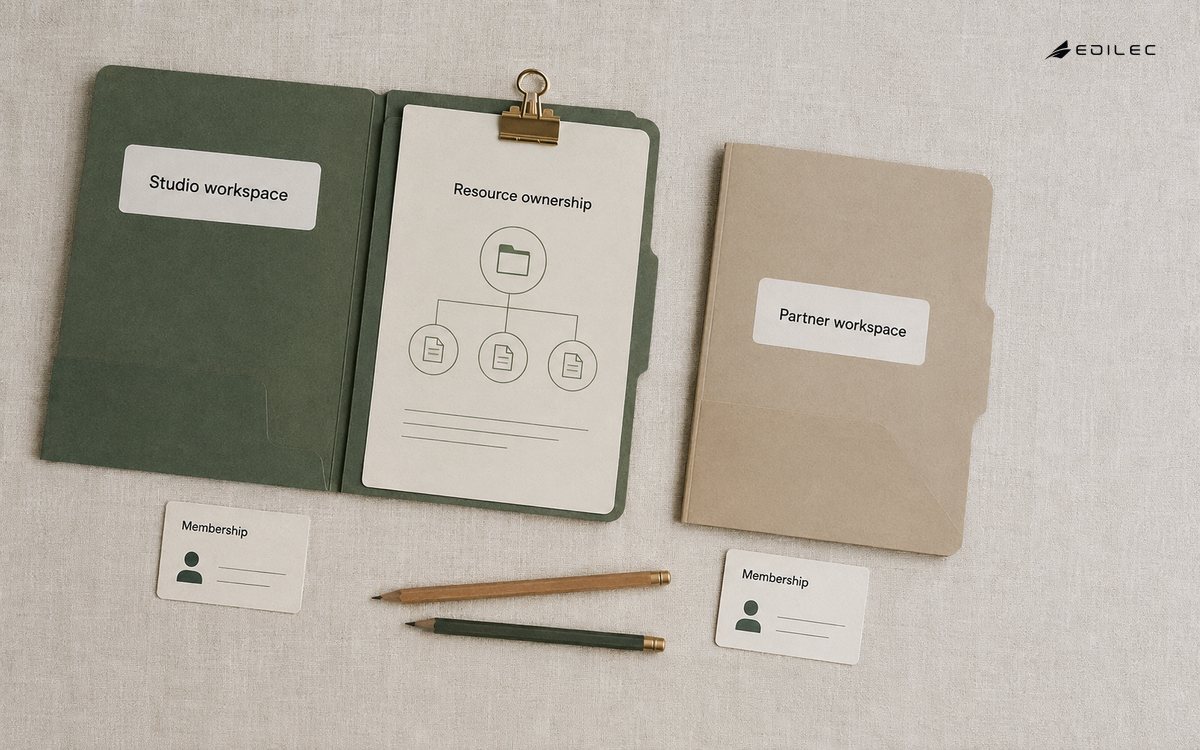
| Model question | Decision to make | Proof for a reviewer |
|---|---|---|
| Context | Which workspace governs this action? | Resolved workspace ID and effective policy |
| Membership | How does a person join, leave, or switch? | Invitation or membership event with actor |
| Ownership | Who owns a resource after its creator leaves? | Owner record and transfer history |
| Delegation | Which administrators may change membership or policy? | Role grant, scope, and expiry |
Keep identity, membership, and permission separate
Identity answers “who is this? ” Membership answers “in which workspace may this identity participate? ” Permission answers “what may this member do to this resource right now? ” Collapsing those questions causes familiar bugs: a user switches workspace in the browser but an API still uses the old context, a token claim is treated as permanent authorization, or a deleted member remains the owner of a critical integration. RFC 7519 describes a token format, not a complete authorization policy. Validate the current membership and requested action at the server boundary, especially for invitations, exports, billing, and administrative changes.
- Resolve workspace context from an explicit route, selection, or trusted server-side relationship.
- Treat membership changes as events with effective time and notification.
- Use role names that describe capabilities, not status or seniority.
- Test a user who belongs to two workspaces and owns different resources in each.
- Give guests a narrow scope and a predictable expiration or removal path.
Choose resource ownership deliberately
A resource can be owned by a workspace, a project inside it, an individual, or an external system. Choose one authority and document how references work when a resource crosses contexts. If a report is generated for a workspace but includes a shared data source, preserve both the workspace scope and the source relationship. The W3C PROV data model offers a helpful way to think about entities, activities, and responsible agents: a resource record should make it possible to explain what was created, by which activity, and under whose responsibility. This does not require implementing every PROV concept; it requires keeping ownership and provenance visible enough to support correction.
| Resource pattern | Recommended owner | Lifecycle check |
|---|---|---|
| Team project | Workspace or project | Transfer or archive when the team changes |
| Personal draft | Member | Delete or transfer on account closure |
| Shared integration | Workspace | Re-authorize and revoke by workspace |
| Cross-workspace report | Defined reporting context | Record source scopes and recipient access |
Design delegated administration without a role maze
Start with a few capabilities: invite, remove, manage roles, change policy, view sensitive records, and transfer ownership. Add a role only when a real workflow needs a stable combination of capabilities. Keep resource scope explicit; a project administrator should not automatically become a workspace billing administrator. The OWASP ASVS can turn this principle into reviewable tests for access control and session handling. Try every protected action as an owner, administrator, ordinary member, guest, suspended member, and a user who has switched context. Record both denied and allowed results so a support engineer can distinguish a missing invitation from a policy denial.
Make membership changes and migrations recoverable
Invitations, ownership transfers, domain claims, and workspace merges are long-running changes, not one request. Give each operation a durable identifier, idempotent retry behavior, and a visible pending state. If a transfer fails after the notification is sent, the original owner and target owner should see which step completed and who can resume it. During a migration, retain an alias from the old workspace identifier and record the mapping. Avoid a silent rewrite of history; a customer asking about an old export or access decision needs the old context to remain explainable.
Review the model through customer journeys
Test workspace models with journeys rather than only database fixtures. Create a workspace, invite a member, switch between two workspaces, share a resource with a guest, revoke access, transfer ownership, and close the original creator’s account. Observe what the user sees, what the server authorizes, what notifications say, and what an operator can later reconstruct. Measure invitation completion, time to revoke access, failed context resolutions, orphaned resources, support contacts after a role change, and the age of pending transfers. A short, regular sample of real cases usually reveals more than a large role matrix reviewed once.
Use lifecycle cases to validate the model
Review the model with a small group that includes a product owner, an administrator, a support operator, and an engineer. Give them the same scenario: a person belongs to two workspaces, creates a resource in one, receives a guest invitation in the other, and then loses access to one context. Ask each person what they believe should happen. Differences in the answers are evidence that the model or its language is incomplete.
Trace one resource through creation, sharing, role change, export, transfer, and deletion. At each step, record the governing workspace, actor, capability, source record, and notification. This exercise often exposes a hidden assumption that a resource belongs to its creator forever or that a workspace switch changes ownership. Those assumptions become expensive when customers need migration or account closure.
Review support recovery as part of the workspace design. A support person should be able to tell whether an invitation was accepted, whether a role was reduced, whether a resource was transferred, and which policy now applies without opening an unrestricted data store. If the answer requires a manual database edit, document the safer product workflow that should replace it and track the gap.
Finally, examine the model after a real lifecycle event. Compare the intended state with notifications, cached screens, queued jobs, and audit history. Keep a record of what customers found confusing and which terms they used. Workspace models become easier to operate when the vocabulary is tested against real moments of change, not just against a static role table.
A useful implementation checkpoint is a workspace switch followed immediately by a protected action. The interface may change context quickly, but the server must still prove membership, role, and resource scope. Capture the decision and its reason so a support operator can explain a denial without revealing another workspace’s records.
Also test the calm path after a difficult event. A removed member should disappear from active access, but their historical authorship and the resource’s ownership history should remain understandable. That balance keeps the system secure without making audit and support records unintelligible.
Before adding another workspace feature, write a small decision pack: the customer scenario, governing context, affected resources, allowed roles, lifecycle events, and recovery owner. Review it with someone who administers real organizations. If the scenario cannot be explained without product jargon, simplify the model or improve its language before expanding the implementation.
Key takeaways
- A workspace should have a stated boundary, owner, lifecycle, and policy scope.
- Keep identity, membership, permission, and resource ownership as separate decisions.
- Prefer a small capability model with explicit resource scope over a long list of vague roles.
- Make invitations, transfers, migrations, and removals observable and reversible.
- For related context, See multi-tenant architecture, onboarding flows, and billing workflows.
Frequently asked questions
Should every workspace map to a legal customer?
It can be a useful commercial default, but it is not a universal product rule. A customer may need several workspaces for regions, subsidiaries, or environments, while a partner may collaborate across customer contexts. Model the legal, billing, and workspace relationships separately when they differ, then state which one governs each action.
What happens when the workspace owner leaves?
Do not let an account deletion implicitly decide. Require a transfer to an eligible member, a service owner, or an archival state. Notify affected people, record the effective time, keep the old owner in history, and make an administrator or support path available if the transfer cannot complete.
How should cross-workspace resources work?
Choose a primary ownership context and represent the other relationship as a scoped reference or share. Check access in both contexts, show the source of the resource, and define what happens when either workspace changes policy. A copied identifier should never be enough to bypass the governing context.
Conclusion: make context visible
Good workspace models make collaboration legible. People can tell where work belongs, administrators can tell what they may change, and engineers can explain why a request was allowed or denied. Start with one bounded workspace journey, separate the underlying decisions, and exercise lifecycle changes before scaling the role model. The payoff is not abstract elegance; it is fewer access surprises and a product that remains understandable as organizations grow.
The smallest useful improvement to the plain-language guide to workspace models is often a sharper boundary, not another feature. For workspace models, review control during normal handling.
For the plain-language guide to workspace models, test an incomplete setup before treating the first release as complete.
A practical example for the plain-language guide to workspace models is support and engineering initially read different evidence.
Ownership is clearer when the plain-language guide to workspace models separates the promise from the mechanism. Give workspace models a named owner and a review date.
This decision also connects to The Plain-language Guide to Multi-tenant Architecture, The Plain-language Guide to Onboarding Flows, Admin Consoles in Plain Language for SaaS. Review those boundaries together when the plain-language guide to workspace models shares identity, data, billing, or support evidence with another workflow.
For Workspace Models, NIST Glossary: Data Processing defines scope; OWASP Application Security Verification Standard supports the control.
For workspace models, review scope during a dependency failure. For workspace models, review scope during normal handling.
For workspace models, measure whether users and administrators can identify the governing workspace, owner, and permission boundary during a measured rollout.
For workspace models, review scope during a measured rollout. For workspace models, review evidence during normal handling.
Evidence for “The Plain-language Guide to Workspace Models” is grounded in NIST Glossary: Data Processing, OWASP Application Security Verification Standard, RFC 7519: JSON Web Token, PROV-DM: The PROV Data Model; each source informs a specific decision, test, or operating trade-off described in this guide.