Self-serve onboarding is a product-engineering concern because it shapes what a customer can trust in the product, what an operator can explain, and what a delivery team can change safely. For CTOs, the work is not to collect more tooling or policy language. It is to make one important decision visible: what state is authoritative, who owns it, which controls enforce it, and how the team learns when reality differs from the plan.
Why Self-serve onboarding Matters
Self-serve onboarding is not a sequence of screens. It is the first production workflow a customer asks the product to perform for them, often before anyone at the vendor knows their context. When it fails, the team may see only a half-created account and assume a user lost interest. In reality, the customer may have encountered an identity proofing requirement, a confusing workspace decision, a missing integration permission, or a setup step that cannot be completed without an administrator.
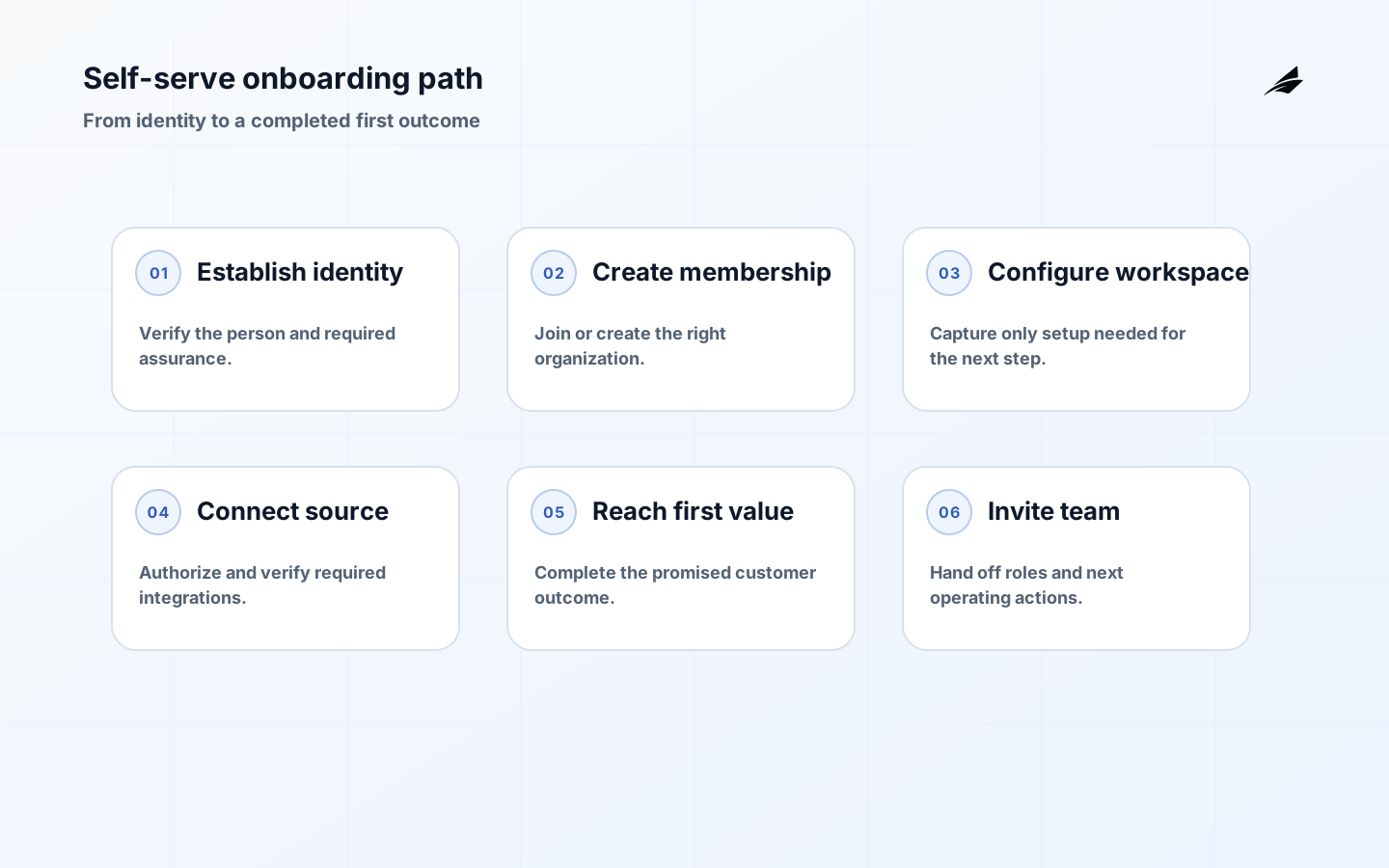
Design onboarding around a small number of completed states, each with a clear owner and recovery path. Typical states include identity established, organization created or joined, workspace configured, source connected, first outcome produced, and teammates invited. The product should know which state is true from server-side records, not from a browser tour flag. This lets it resume safely, explain what remains, and avoid sending a person in one role instructions that only another role can complete.
Build the Operating Model
A useful self-serve path gives people a choice only when the choice matters. Collect the minimum information needed for the next decision, explain why it is needed, and defer optional configuration until after first value. Progressive setup is not hiding complexity; it is sequencing it so a customer can learn the product in context. For team products, distinguish account creator, administrator, operator, and end user because each may have different authority and a different definition of successful setup.

| Onboarding state | Evidence of completion | Recovery path |
|---|---|---|
| Identity established | Verified session and required assurance level | Resend or restart verification without losing intent. |
| Organization ready | Membership and role are stored | Join existing organization or request administrator approval. |
| Integration ready | Scoped connection passes a health check | Explain missing permission and allow secure reauthorization. |
| First value reached | Customer completes the promised outcome | Show the next relevant collaboration or operating step. |
Create an onboarding state model with preconditions, transition owner, evidence, and fallback for each step. An integration connection may require a redirect, a consent record, a verified callback, and a job that tests access before it is considered ready. An invitation may be sent but not accepted. A workspace may exist but lack billing authority. Express these distinctions in data and UI language. They prevent the common error of marking an account 'onboarded' because one early request succeeded.
Design the Architecture and Controls
Make the workflow observable and recoverable. Emit structured events for each state transition with a correlation identifier and a reason for failure that can guide support without exposing secrets. Store drafts where abandonment is expected, but expire sensitive setup artifacts. Use secure, standard identity and authorization flows rather than collecting credentials in the product. For dynamic UI steps, preserve semantic HTML, keyboard operation, and accessible status messages so the path is usable with assistive technology and under slow or interrupted connections.
Onboarding fails when the system assumes a happy path. A customer may join an existing organization instead of creating one. A company may require an administrator to approve the integration. A verification email may be delayed. A user may retry after switching devices. Model these as ordinary transitions, not exceptional errors. Do not trap a user in a modal or hide the current state behind transient notifications. Every blocked step should say what happened, what can be done now, and who can do it.
Roll Out with Evidence
Instrument the current path before rebuilding it. Review recordings and support cases with consent and privacy protections, then identify the first state where qualified users commonly stop. Improve that state with a clear hypothesis, such as reducing unnecessary setup or adding an administrator handoff. Test the change with real roles and different accessibility tools. A release is ready when the team can recover a failed or interrupted journey without manually editing database records.
| Signal | What it can reveal | First response |
|---|---|---|
| High state abandonment | A step asks for too much or lacks authority | Review the role, copy, and prerequisite. |
| Repeated callback failure | Integration state is not recoverable | Verify redirect, token storage, and retry logic. |
| Low administrator handoff completion | The request is unclear or hard to approve | Add context, expiry, and a clear approval route. |
| Accessibility defect in setup | A customer cannot operate a core control | Fix semantics and keyboard behavior before optimizing polish. |
Operate and Measure
Measure completion by state, median time between states, resume rate after interruption, setup error classes, administrator handoff success, first-value rate, and support contacts within the first week. Segment by role, company size, device, and integration type where that helps identify barriers. Avoid treating every faster path as better: a security-sensitive workflow may appropriately ask for deliberate confirmation. The goal is a trustworthy path to value, with friction proportional to the risk of the decision.
- Model onboarding as durable states, not a one-time tour.
- Collect only what the next decision requires.
- Make role and authority visible throughout setup.
- Provide a recovery route for every interrupted transition.
- Instrument first value, not merely account creation.
Implementation Detail
A self-serve payroll integration illustrates why state modeling matters. A user may authorize the connection, but the integration is not ready until the product validates the expected account, permissions, and data access. If validation fails, the onboarding surface should retain the intent, describe the missing permission in plain language, and offer a secure reauthorization path. Marking the integration complete at redirect time creates a false success state that later becomes a confusing support ticket and a difficult engineering investigation.
Design handoffs between roles intentionally. The person exploring a product may be unable to approve a domain, connect a company account, accept contractual terms, or enter billing details. The product can let them prepare the request, then send an administrator a bounded approval link with enough context to decide safely. After approval, return both people to the correct state. Do not make an evaluator share credentials or repeat setup work because the system assumes one person controls every step.
Review Before Scaling
Test onboarding as an interrupted distributed workflow. Stop after each state, switch devices, expire a session, delay a callback, revoke an integration permission, and retry a submitted request. Verify that the product explains the current state and never creates duplicate organizations, invitations, or charges. Include keyboard and screen-reader checks on the core path, because accessibility defects at registration or connection are hard for customers to route around. A resilient setup flow is one that can resume without staff intervention.
At scale, onboarding ownership should include product, identity, integration, support, and customer-success perspectives. Product can own the outcome definition, engineering can own state and recovery, and operations can own the evidence needed during a blocked setup. Review the top failure states monthly and decide whether to simplify the product, improve guidance, or provide an explicit assisted route. This avoids a familiar trap where each team improves its local step while the customer still experiences one broken journey.
Document the supported self-serve path as a living operational artifact. It should list role prerequisites, integration permissions, recovery contacts, and the evidence that proves each setup state. Support and customer-success teams can use it to diagnose a blocked customer, while engineering can use it to spot a state that exists only in documentation rather than in the product. Update it whenever the flow changes. Review this evidence with the owner of self-serve onboarding, the people who operate the surrounding workflow, and the team responsible for customer communication. Agree on one change, one measure, and one follow-up date. That closed loop keeps local fixes from becoming unexamined policy and makes the next decision easier to defend.
Key Takeaways
- Make self-serve onboarding a named operating decision rather than an implicit implementation detail.
- Keep customer impact, evidence, and recovery visible to the team that owns the workflow.
- Start with a narrow path, learn from real outcomes, and expand only after the controls hold.
Frequently Asked Questions
Where should a team start with self-serve onboarding? Start where an incorrect decision would create meaningful customer, commercial, or operational harm. Map the current state, the owner, the boundary, and the evidence available during failure. How much process is enough? Use the smallest process that makes the decision repeatable, reviewable, and recoverable. Add rigor when the data, action, or customer consequence makes a shortcut unsafe.
Conclusion
Strong self-serve onboarding work is not a one-time project. It is a durable agreement between product, engineering, and operations about how the system behaves under ordinary and difficult conditions. When the contract, controls, telemetry, and recovery path agree, CTOs can improve the product without turning each release or customer exception into a new source of uncertainty.
The practical continuity test for self-serve onboarding is whether a qualified teammate who did not design the workflow can inspect the current state, understand the relevant decision and its limits, and take the next safe action without improvised access or tribal knowledge. Keep the owner, evidence location, escalation route, and recovery rule visible. That discipline makes routine operations calmer and gives the organization a reliable starting point when a customer, release, or incident exposes a new edge case.
Sources
The implementation advice in this self-serve onboarding guide is grounded in Web Content Accessibility Guidelines 2.2, WAI-ARIA Authoring Practices Guide, NIST Digital Identity Guidelines, OpenTelemetry documentation. These references are useful for checking platform-specific controls and terminology during delivery; the decisions here still need to be applied to the product's data, risk, and customer context.