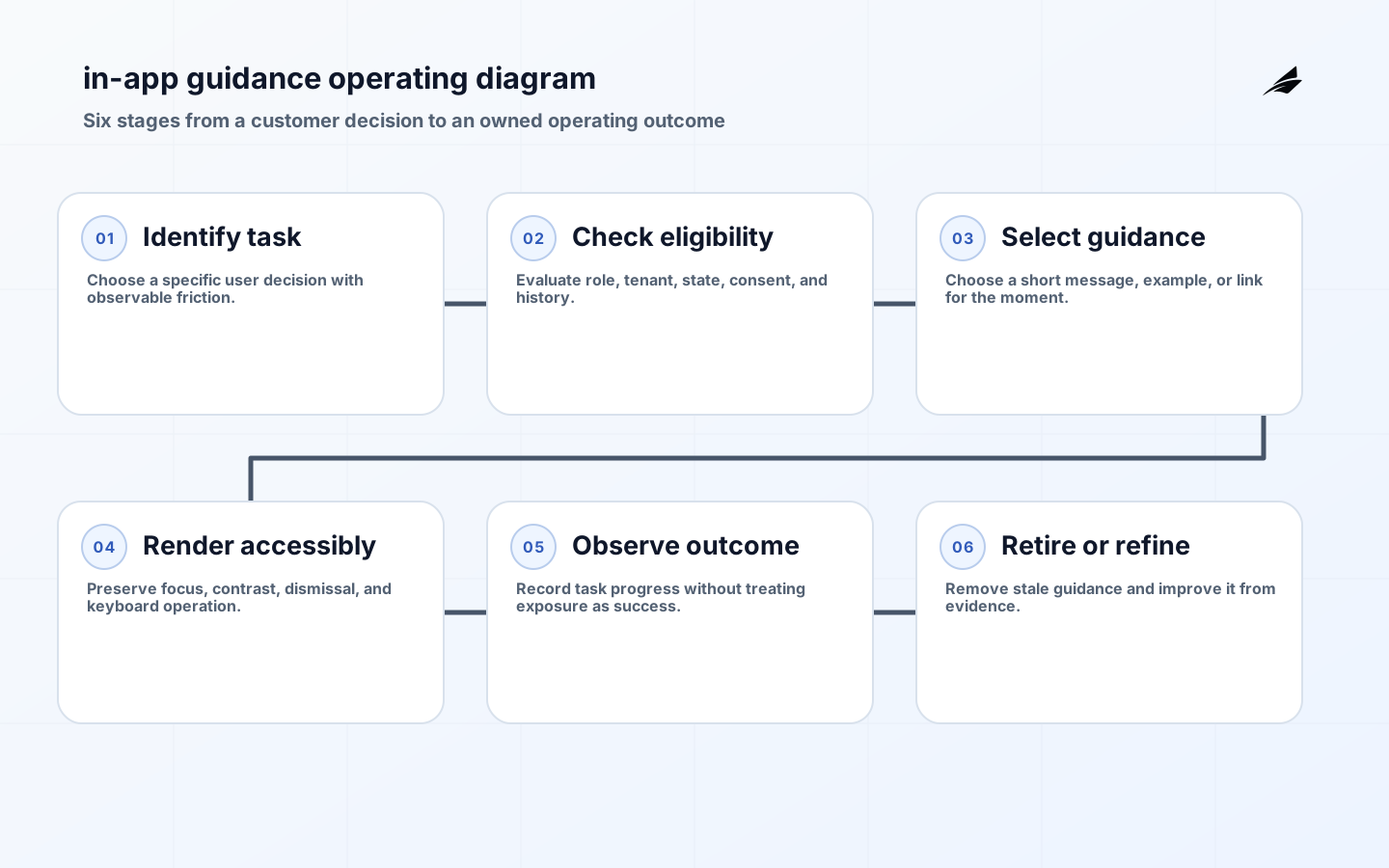
How Founders Should Think About In-app Guidance
In-app guidance is an engineering responsibility, not a screen or a vendor setting. For founders, the useful question is whether a person receives the smallest helpful instruction for the current task without losing control of the product. That question forces a team to name the customer promise, the facts that support it, and the person who can resolve a bad outcome. This article treats in-app guidance as a product capability with an observable decision, a controlled implementation path, and a recovery route. The aim is practical: make ordinary work predictable while retaining enough evidence to investigate the uncomfortable cases that arrive during a release, a support escalation, or a change in customer demand.
Define the in-app guidance decision
Start by writing the decision in one sentence: whether a person receives the smallest helpful instruction for the current task without losing control of the product. The authoritative input should be a guidance decision that uses page context, user role, product state, consent, and content version. A team should then state what is deliberately outside the decision. A customer-facing message, a dashboard tile, and a background job may all display related information, but none should quietly become a competing authority. Give the decision a stable identifier and retain user role, tenant scope, task state, trigger, content version, dismissal, and outcome event. This is less paperwork than it sounds. It is the shortest path to answering why a particular result occurred after records disagree or a system is retried.

The difficult case is a blanket tour interrupting experts, exposing the wrong tenant context, or steering a person into an unsafe action. Design for it before adding convenience automation. Put a rules service that evaluates eligibility before rendering a message and allows a person to dismiss it near the action that can affect the customer or their data. A durable implementation distinguishes an expected pending state from a failure, avoids silent retry loops, and makes an exception legible to the affected person. The recovery should be a quiet fallback to documentation, support, or a later moment rather than repeated interruption. That approach supports accountability without forcing every unusual case through an irreversible workflow. It also gives engineering, support, and product a shared vocabulary for deciding when a manual action is justified.
| Decision element | Question to settle | Evidence to retain |
|---|---|---|
| Customer promise | What does in-app guidance make dependable? | Expected user outcome and affected cohort |
| Authority | Which record wins when facts conflict? | a guidance decision that uses page context, user role, product state, consent, and content version |
| Boundary | Where is the result enforced? | a rules service that evaluates eligibility before rendering a message and allows a person to dismiss it |
| Recovery | How is a wrong result corrected? | a quiet fallback to documentation, support, or a later moment rather than repeated interruption |
Use authoritative facts and explicit controls
A reliable design does not rely on a single current-state field. It records the event or observation that changed the state, the ordering rule, the policy version, and the actor or automation that performed the work. Stripe's entitlements guidance is a concrete example of separating commercial products from the feature access a customer receives. Its subscription lifecycle documentation also illustrates why lifecycle states and verified events matter when access or communication follows a payment outcome. The broader lesson applies even when in-app guidance has nothing to do with billing: derive a customer result from facts the team can inspect later.
For contextual guidance, the secure-development review should make the protected decision and its evidence testable. NIST's Secure Software Development Framework provides a useful discipline for embedding security practice in delivery work. The AWS SaaS Lens foundations adds the operational requirement to test tenant-aware health and uneven load. Use both as prompts: challenge scope, stale facts, repeated requests, and dependency loss; then save the expected result with the release evidence.
| Failure mode | Control | Operator signal |
|---|---|---|
| Stale or missing input | Order facts and expose pending state | Age of authoritative record |
| Unauthorized action | Enforce user role, tenant scope, task state, trigger, content version, dismissal, and outcome event at the protected action | Denied decision with actor and reason |
| Duplicate work | Use idempotency and correlation identifiers | One customer effect per request |
| Dependency failure | Choose timeout, fallback, and escalation behavior | Actionable alert linked to the decision |
Implement in-app guidance as a thin, observable slice
Begin with one customer journey and one explicitly supported variation. Write guidance around a user decision, then test whether it reduces confusion instead of merely increasing clicks. Keep the data contract small enough to review: identify what creates the record, which service can update it, and which callers may read it. Build a test path that includes the normal result, a blanket tour interrupting experts, exposing the wrong tenant context, or steering a person into an unsafe action, and a permissions failure. The release should expose a useful customer state rather than an optimistic completion message. Link the work to SaaS MVPs guide and product support tooling guide; those adjacent decisions often reveal dependencies that otherwise surface only after launch. A narrow first slice is valuable because it produces evidence about behavior, support demand, and operational cost before the team commits to a larger platform.
- Name a product owner, technical owner, and recovery owner for in-app guidance.
- Write the decision rule and the authoritative record in the delivery brief.
- Test a normal journey, a blanket tour interrupting experts, exposing the wrong tenant context, or steering a person into an unsafe action, and an unauthorized request.
- Keep customer-facing states understandable and attach a next action to each one.
- Log correlation identifiers, policy version, and the reason for a manual correction.
- Expand only after the support path and rollback behavior have been rehearsed.
Measure the behavior that matters
Use measures that answer whether the customer promise is being kept, not merely whether a deployment completed. For in-app guidance, track task completion after guidance, dismissal rate, repeat errors, assistance requests, and content staleness. Segment the view by plan, role, integration, or tenant only when that segment can change an owner’s decision. Review both the median experience and the long tail: a good aggregate can hide a small cohort that is repeatedly blocked. Pair the chart with sampled decision histories and support cases. Numbers tell a team where to look; the linked evidence explains whether the cause is a product rule, a data contract, a dependency, or a human handoff.
Key takeaways
- In-app guidance needs one named customer decision before it needs more workflow.
- Make a guidance decision that uses page context, user role, product state, consent, and content version inspectable, ordered, and tied to a policy version.
- Enforce the decision at a rules service that evaluates eligibility before rendering a message and allows a person to dismiss it, including non-UI paths.
- Treat a quiet fallback to documentation, support, or a later moment rather than repeated interruption as a product capability with an owner and an audit record.
- Use operational measures to decide whether to extend the first release.
Frequently asked questions
What should be built first? Build the smallest path that answers whether a person receives the smallest helpful instruction for the current task without losing control of the product and produces a reviewable decision record. How much automation is appropriate? Automate repeatable, low-ambiguity steps; retain a narrow and auditable correction for cases where the record is incomplete or policy needs interpretation. Which team owns it? Product owns the customer promise, engineering owns the technical boundary, and operations or support owns the recovery path, but the named individuals should agree on the same evidence. When is the work ready to expand? Expand when the normal path, the failure path, and the operator path have been exercised with realistic data and the results can be explained without reconstructing context from memory.
Conclusion
Good in-app guidance makes a difficult operational decision ordinary. The team states the promise, chooses inspectable facts, enforces a clear boundary, and retains a humane recovery route. That discipline is what lets a product evolve without turning every exception into a private escalation. Start with the thin slice, learn from decision histories and customer outcomes, then extend only the controls that the evidence shows are necessary.