The Plain-language Guide to Trial Conversion
Trial conversion is not simply the moment a person clicks a plan button. It is a chain of product, billing, identity, entitlement, and communication decisions that must agree about what the customer can do and why. A useful trial conversion guide starts with the customer value event, defines the surrounding state transitions, and gives product and operations a way to explain or correct an unexpected result. Early shortcuts become difficult to unwind once pricing, access rules, analytics, and support depend on them.

Define the trial conversion operating model
Separate three facts that are often collapsed into one status label. Product value describes whether the customer reached the behavior that makes a paid plan useful. Billing describes the commercial arrangement, including trial period, payment method, price, and end behavior. Entitlement describes the capabilities available now. These facts may change at different times, so keeping them distinct lets the product show a pending state instead of implying that a delayed payment event or missing setup step is resolved.
Write a small contract before implementation. Name the customer or workspace boundary, trial start and end, value event, billing source, entitlement decision, permitted actor, and evidence kept for review. The AWS SaaS Lens foundations notes that tenant workload, tier, and consumption can affect other customers, so identify tenant and plan context at every protected action.
| State or decision | Authoritative question | Evidence to retain |
|---|---|---|
| Value reached | Has the customer completed the behavior that represents the product promise? | Event name, subject, workspace, timestamp, and definition version |
| Trial active | Is the account within the declared trial window and eligible for the promised experience? | Start and end time, plan or offer, consent state, and source record |
| Conversion pending | Is a dependency still processing before access or billing can be finalized? | Correlation ID, dependency status, retry history, and customer-facing message |
| Paid or ended | What commercial and entitlement state applies after the trial boundary? | Billing result, effective time, entitlement version, and reason |
| Corrected | What changed after a dispute, retry, refund, or approved extension? | Before-and-after values, actor, approval, expiry, and notification |
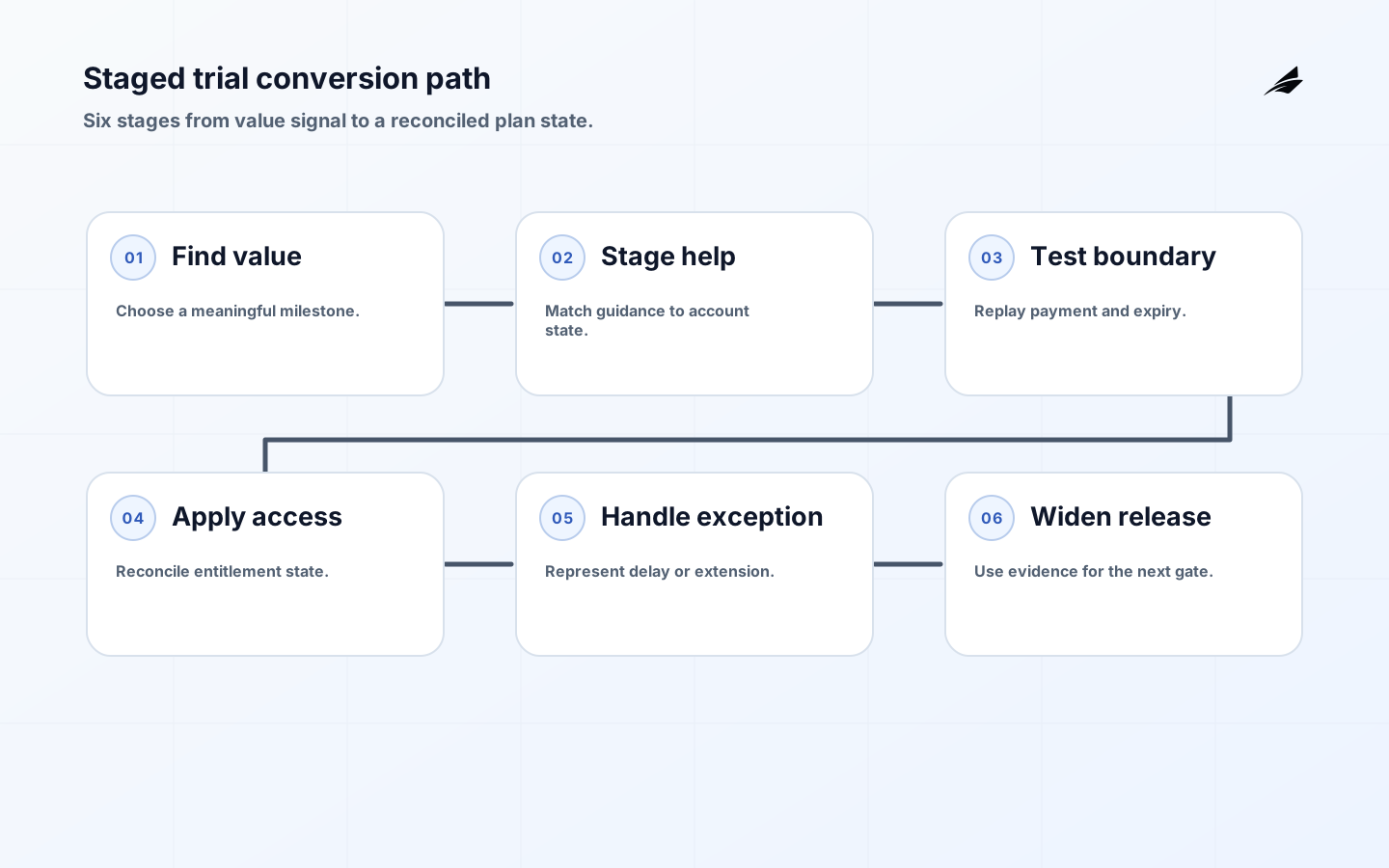
Use a six-stage trial conversion lifecycle
1. Establish the value signal
Choose useful progress rather than a shallow engagement count. For a reporting workspace, that might be a report shared with a colleague after a data refresh. For a collaboration product, it might be a workflow completed with another member. Define who performed the event, on which workspace, with what inputs, and within what time window. Record it once with an idempotency key so retries do not create duplicate opportunities. The value signal should inform the next decision, not grant paid access by itself.
2. Create a visible trial state
A trial should tell the customer what is available, when the state changes, what action is expected, and what happens if no action is taken. Show the effective time clearly and keep the same state available to support. Do not derive access from a browser countdown or cached pricing page. The server should evaluate account, workspace, plan, and current time before a protected action.
3. Check conversion readiness
Before asking for payment or changing access, check that the account is attached to the intended workspace, the plan matches the capability, required consent is present, and the customer can see price and timing. Identify a missing payment method or incomplete setup here. Make the response actionable: payment method required, billing update pending, or administrator approval needed gives the customer a route forward, while a generic error produces another support ticket.
4. Process the billing transition
Treat the billing provider as a source of commercial events, not a substitute for the product's entitlement model. A webhook may be delayed, duplicated, retried, or out of order. Verify it, process it idempotently, store its identifier, and project the result into a local record. Stripe's trial documentation distinguishes trial duration from the end behavior that determines what happens next; map that result deliberately instead of assuming every trial becomes paid in the same way.
5. Apply entitlement at the protected action
Put the final entitlement check beside the consequential action: creating a report, adding a member, exporting data, or starting a job. Check workspace and subject, capability, usage limit, effective window, and policy version. If the check reserves capacity, make it atomic with resource creation or define how a failed follow-up is released. A feature flag can control rollout exposure, but it should not become a hidden billing ledger. See the feature flags guide and pricing gates guide for adjacent context.
6. Reconcile and learn
Close the lifecycle with a record connecting value event, trial state, billing event, entitlement decision, and customer communication. Reconciliation lets support explain a dispute and engineering find where state diverged. Keep corrections attributable and reversible. An extension should include original and new end time, reason, approver, changed entitlement, and expiry. Recurring extensions may indicate a product or plan problem rather than a reason to keep adding grants.
Handle billing and entitlement edge cases explicitly
The happy path is the least informative test. Decide what the customer sees and what the server permits when payment succeeds but projection lags, a trial ends during an in-flight request, or a plan changes at a period boundary. A written policy is better than accidental behavior: allow bounded grace, deny with a recoverable message, or route to an operator. The choice depends on risk, but the product should not silently drift between open access and lockout.
| Edge case | Risk | Design response |
|---|---|---|
| Duplicate billing event | The same trial or payment is applied twice | Use the provider event ID and an idempotent projector; keep the first accepted result |
| Out-of-order event | An older cancellation or update overwrites newer state | Compare effective times and version the local entitlement record |
| Payment succeeds, entitlement lags | The customer is charged but cannot use the paid action | Show pending status, retry safely, and give support a traceable correction path |
| Trial expires during a request | A job is created under an obsolete state | Recheck at the protected action and define whether a reserved job completes or is stopped |
| Workspace has multiple members | One person changes a commercial state for the wrong tenant | Authorize workspace scope and role; never infer tenant from an email domain |
| Manual extension or refund | A temporary exception becomes permanent drift | Record reason, approver, old and new dates, entitlement change, and expiry |
Accessibility belongs in these states, not only on the marketing page. Trial expiry, payment errors, and changed access are consequential messages. Make status available to keyboard users, identify errors in text, preserve focus when the interface changes, and keep controls usable at reflowed sizes. WCAG 2.2 covers keyboard operation and error identification; apply those criteria to conversion and recovery.
Measure conversion quality and experiment carefully
Measure the whole decision, not just the paid outcome. Track eligible trials reaching the value event, time to plan decision, payment or setup completion, entitlement delay, failed protected actions, extension and refund reasons, and support caused by state mismatch. Define each signal with a population, source, owner, and cadence. A rising conversion rate is not an improvement if it brings more disputed charges, accidental access, or preventable support work.
Use traces, metrics, and logs to connect a customer outcome to the service path that produced it. The OpenTelemetry observability primer describes these signals as essential to understanding behavior and reliability. Carry a correlation ID and low-cardinality dimensions such as plan family, region, state, and reason. Keep sensitive data out of shared dashboards while preserving restricted investigation context.
Experiment on one decision at a time: compare explanations of a trial end state, a shorter setup path, or a prompt after the value event. Keep billing and entitlement rules constant while testing the product treatment, and exclude manual exceptions or unresolved events from conclusions. Define guardrails before launch: support contacts, payment recovery, incorrect access, cancellation, and reversal. Use the trial conversion checklist to turn them into a release review.
A concrete trial conversion example
Consider a reporting workspace with a time-limited trial, a shared report capability, and a paid export limit. The team defines the primary value signal as a report shared with another workspace member after a successful data refresh. The event is recorded against the workspace, report, actor, and definition version. The product then shows the trial end time and the selected plan, while a server-side policy keeps the export limit explicit.
At trial end, the billing provider reports a successful transition, but entitlement projection is delayed. The workspace can view existing reports, while a new export returns a pending billing state with a retry route rather than an unexplained denial. Once projected, the next export checks paid capability and allowance, and support can see the event ID and policy version. A two-day extension remains visible with approver and expiry.
Before rollout, replay a successful payment, a duplicate event, a delayed event, an expired trial, a changed plan, a missing consent record, and a member from another workspace. Compare the customer message, billing state, entitlement result, analytics event, and audit record after every case. A complete test proves more than a button appearing: it proves that the right tenant receives the right capability, the system can recover, and a person can explain the outcome.
Implement, review, and expand in stages
Build one complete path before adding prompts or plan variants. Start with one value event, trial policy, protected action, and correction route. Run the new path beside existing behavior, compare mismatches, and classify them as data, policy, integration, or product-understanding problems. Then enforce it for a narrow cohort with an owner who can pause rollout and reconcile affected accounts.
The NIST Secure Software Development Framework supports integrating security practices into the software development lifecycle. Applied here, that means treating identity, tenant scope, event verification, authorization, logging, and recovery as delivery work rather than post-launch cleanup. Review the conversion contract when pricing, payment provider behavior, workspace roles, or protected capabilities change.
- Name the value event and version its definition.
- Separate product value, billing state, and entitlement state.
- Make billing event processing idempotent and replayable.
- Authorize the protected server action for the correct workspace and subject.
- Record every extension, refund, correction, and override with an owner and expiry.
- Test delayed, duplicated, out-of-order, expired, and cross-tenant cases before widening scope.
- Pair conversion measures with guardrails for access errors, support effort, and recovery.
Key takeaways
- Trial conversion is a lifecycle of value, billing, entitlement, communication, and reconciliation decisions.
- The best first signal is a defined customer value event, not a generic click or login.
- A billing provider event should update a deliberate entitlement record; it should not be copied blindly into every product service.
- Grace periods, pending states, extensions, and refunds need explicit rules and visible evidence.
- Measure customer outcomes together with incorrect access, failed transitions, support work, and recovery quality.
Trial conversion FAQ
What is the best first conversion signal?
Choose a behavior that demonstrates the product's core promise, such as a real report shared, workflow completed, or result used by the intended team. Define who, what, where, and when so the event can be measured and audited.
How should a trial extension be represented?
Store the original and new end time, reason, approving role, affected workspace, changed entitlement, and expiry or review date. An extension should be a visible exception, not a silent edit to the original trial record.
Should trial conversion be automatic?
Automate predictable, low-risk transitions when the billing, identity, and entitlement rules are explicit and recoverable. Keep human review or a clear escalation route for disputed charges, ambiguous workspace ownership, sensitive access, and policy exceptions.
How should teams measure trial conversion?
Track the defined value event, time to plan decision, payment or setup completion, entitlement delay, failed protected actions, cancellations, extensions, refunds, and support contacts caused by state mismatch. Review the measures together so a higher paid rate is not mistaken for improvement when it creates more customer harm.
Conclusion
Dependable trial conversion comes from making each transition legible. Define the customer value event, keep billing and entitlement responsibilities distinct, enforce access at the protected action, and retain enough evidence to explain a delay or correction. Then measure both commercial progress and the effort required to recover from mistakes.
Start narrow: one workspace boundary, one trial policy, one valuable action, and one recovery path. Expand after the flow survives delayed events, plan changes, expiry, manual exceptions, and cross-tenant tests. Pair this guide with the trial conversion checklist, feature flags guide, and pricing gates guide. For broader delivery context, review multi-tenant architecture, MVP delivery, and SaaS product development.