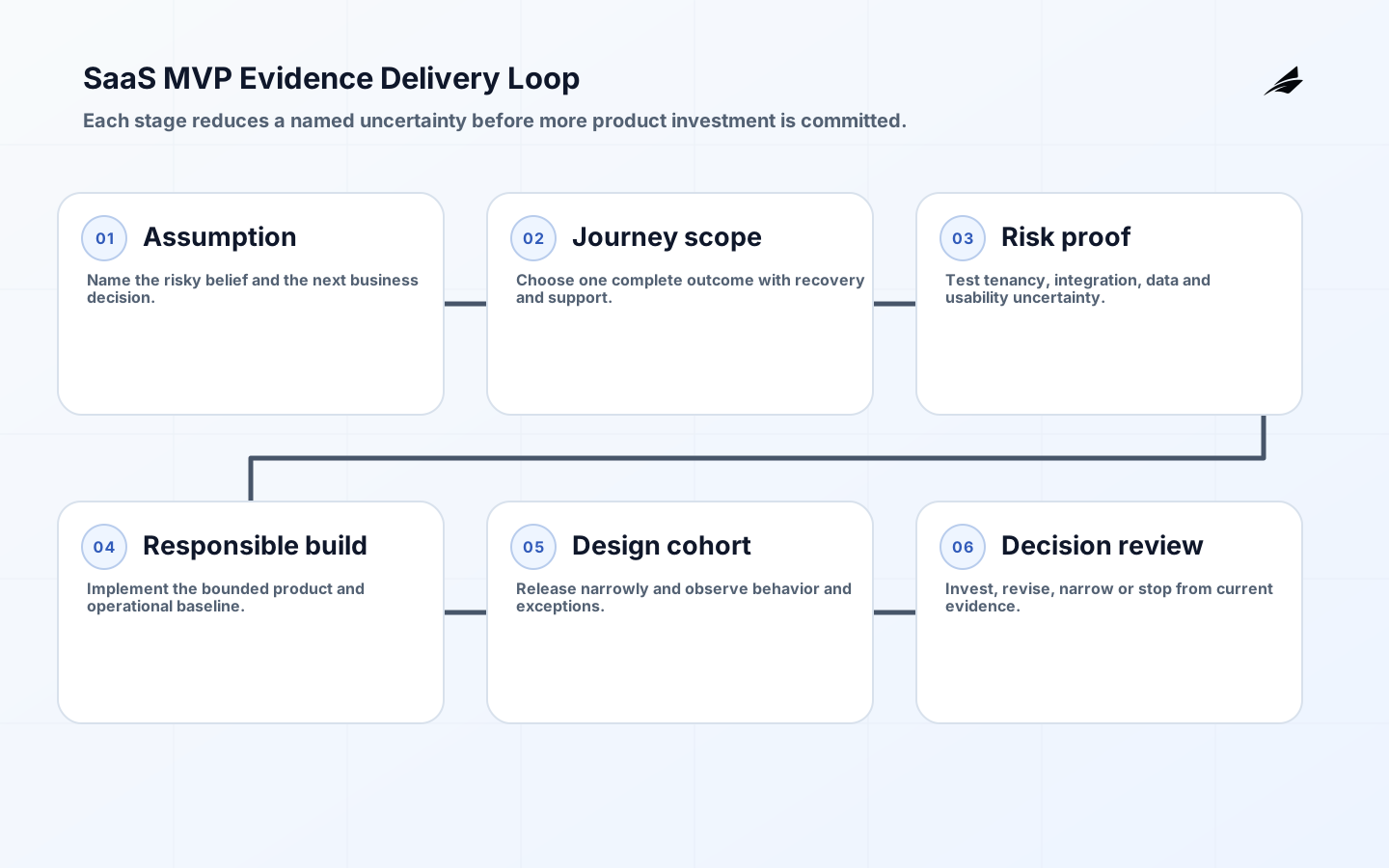
A SaaS minimum viable product is the smallest responsible product release that can test a consequential assumption with real users. “Minimum” does not excuse weak security, inaccessible core tasks or records that cannot be recovered. “Viable” does not require a miniature version of every future feature. The planning challenge is to preserve one complete customer outcome while deferring breadth, automation and optimization that do not improve the learning decision.
This guide treats saas mvp development: scope, cost drivers, risks and an evidence-based delivery plan as a set of decisions that can be reviewed and tested. The aim is not to prescribe one vendor or promise a universal result. It is to help business and technical owners define boundaries, preserve evidence, expose failure behavior and decide when the work is ready to expand.
Name the assumption and next decision
Write the uncertainty that matters: whether a user will complete a workflow, trust an output, invite colleagues, pay for a defined outcome or return without assisted setup. Connect the assumption to a decision such as continue, change segment, revise workflow or stop.
Define evidence before building. Use observable behavior and interviews together, set a review date, and state what result would contradict the team’s belief. Avoid treating sign-ups or compliments as universal product validation.
| Scope layer | Include in the MVP | Usually defer |
|---|---|---|
| Customer outcome | One complete high-value journey | Adjacent personas and secondary workflows |
| Trust baseline | Identity, authorization, privacy and recovery | Advanced policy administration |
| Operations | Logging, support, rollback and data repair | Highly automated back-office optimization |
| Product experience | Accessible core task and clear error states | Broad customization and cosmetic variants |
| Learning | Events, interviews and decision review | Large reporting suites |
Recruit representative users and test the problem and current workaround first. If the uncertainty is still about desirability, a service prototype may provide better evidence than production software.
Turn "Name the assumption and next decision" into a working control by naming one accountable owner, one maintained artifact and one review forum. The exit standard for this part of saas mvp development: scope, cost drivers, risks and an evidence-based delivery plan is concrete: Recruit representative users and test the problem and current workaround first. If the uncertainty is still about desirability, a service prototype may provide better evidence than production software. For this decision boundary, name the accountable owner, supporting evidence, exception route, and next measurable check.
Scope one end-to-end customer journey
Map entry, identity, setup, core action, result, recovery, support and exit. Select the thinnest complete path that allows a user to reach the promised outcome without hidden manual steps they do not understand.
Maintain separate lists for required now, deliberately manual, deferred and excluded. Include administration, data correction and support surfaces needed to operate the release, even when they are not visible in a demo.
Walk the scope through normal, invalid, duplicate, cancelled and failed cases. A feature is not complete if the team cannot explain who repairs its records or answers the user.
Turn "Scope one end-to-end customer journey" into a working control by naming one accountable owner, one maintained artifact and one review forum. The exit standard for this part of saas mvp development: scope, cost drivers, risks and an evidence-based delivery plan is concrete: Walk the scope through normal, invalid, duplicate, cancelled and failed cases. A feature is not complete if the team cannot explain who repairs its records or answers the user. Within this decision boundary, name the accountable owner, supporting evidence, exception route, and next measurable check.
Build a small but honest SaaS foundation
Establish tenant identity, authorization, environments, deployment, audit events, backups and telemetry before adding product breadth. These are cross-cutting boundaries that are expensive to retrofit after customer data accumulates.
Keep the architecture modular enough to change but avoid speculative services. A well-structured deployable application with clear internal boundaries can be more suitable than an early distributed system.
Turn "Build a small but honest SaaS foundation" into a working control by naming one accountable owner, one maintained artifact and one review forum. The exit standard for this part of saas mvp development: scope, cost drivers, risks and an evidence-based delivery plan is concrete: Test tenant isolation, account recovery, backup restoration, failed jobs and rollback. Record architecture decisions and the conditions that would justify a later change. When implementing this design choice, name the accountable owner, supporting evidence, exception route, and next measurable check.
Estimate cost through scope drivers and uncertainty
Cost follows workflow breadth, role complexity, data sensitivity, integrations, migration, availability expectations, compliance, design maturity and operating support. A screen count misses the work hidden behind permissions and exceptions.
Estimate by capability slices with assumptions and confidence. Include discovery, design, engineering, testing, security, launch, cloud services, third-party fees, support and the cost of resolving findings from real users.
Use a range and revisit it at evidence gates. When scope changes, show the effect on learning, risk and operating burden instead of silently compressing quality.
Turn "Estimate cost through scope drivers and uncertainty" into a working control by naming one accountable owner, one maintained artifact and one review forum. The exit standard for this part of saas mvp development: scope, cost drivers, risks and an evidence-based delivery plan is concrete: Use a range and revisit it at evidence gates. When scope changes, show the effect on learning, risk and operating burden instead of silently compressing quality. Before releasing this decision boundary, name the accountable owner, supporting evidence, exception route, and next measurable check.
Deliver in discovery, proof, build and cohort stages
Discovery validates the problem and maps constraints. A prototype tests interaction. Technical spikes reduce integration or performance uncertainty. Production build then creates the bounded journey and its operational controls.

Release to a small design cohort with explicit support and consent to close collaboration. Keep feature flags, rollback, data repair and communication ready; early customers should not become unacknowledged testers of unsafe behavior.
Review evidence after each stage and remove work that no longer serves the learning decision. A calendar demonstration is not an evidence gate.
Turn "Deliver in discovery, proof, build and cohort stages" into a working control by naming one accountable owner, one maintained artifact and one review forum. The exit standard for this part of saas mvp development: scope, cost drivers, risks and an evidence-based delivery plan is concrete: Review evidence after each stage and remove work that no longer serves the learning decision. A calendar demonstration is not an evidence gate. While operating this design choice, name the accountable owner, supporting evidence, exception route, and next measurable check.
| Cost driver | Question | Planning response |
|---|---|---|
| Integrations | How reliable and documented are dependencies? | Prototype risky contracts and budget failure handling. |
| Roles and tenancy | Who may act on which customer resources? | Model authorization and negative tests early. |
| Data | What must be imported, retained or deleted? | Define lifecycle, migration and recovery evidence. |
| Service level | What interruption can users tolerate? | Match architecture and support to the promised outcome. |
| Compliance | Which obligations apply to this exact use? | Obtain specialist review and scope required controls. |
Manage MVP risks without overbuilding
Common risks include solving a weak problem, serving the wrong segment, insecure tenant boundaries, irreversible data choices, dependency surprises and a manual service that cannot become sustainable. Each needs an owner and a cheap test.
Time-box experiments and document non-production shortcuts. Anything reaching customers needs an explicit plan for support, privacy, accessibility, vulnerability response and data export or deletion.
Track assumptions, incidents, support interventions, failed tasks and architecture exceptions. Retire temporary code and manual operations intentionally rather than letting them define the permanent product.
Turn "Manage MVP risks without overbuilding" into a working control by naming one accountable owner, one maintained artifact and one review forum. The exit standard for this part of saas mvp development: scope, cost drivers, risks and an evidence-based delivery plan is concrete: Track assumptions, incidents, support interventions, failed tasks and architecture exceptions. Retire temporary code and manual operations intentionally rather than letting them define the permanent product. When changing this part of the system, name the accountable owner, supporting evidence, exception route, and next measurable check.
Read MVP evidence with context
Combine funnel behavior, task success, retention relevant to the use case, support demand, qualitative explanation and operating cost. Small cohorts create noisy results, so inspect sessions and reasons instead of claiming statistical certainty.
Instrument the critical journey with stable event names and tenant-safe properties. Keep product analytics separate from billing authority and sensitive content, and document changes to event definitions.
Hold a decision review that compares observed behavior with the original assumption. The outcome can be invest, revise, narrow or stop; learning is useful only when it changes allocation.
Turn "Read MVP evidence with context" into a working control by naming one accountable owner, one maintained artifact and one review forum. The exit standard for this part of saas mvp development: scope, cost drivers, risks and an evidence-based delivery plan is concrete: Hold a decision review that compares observed behavior with the original assumption. The outcome can be invest, revise, narrow or stop; learning is useful only when it changes allocation. During support for this evaluation, name the accountable owner, supporting evidence, exception route, and next measurable check.
Key takeaways
- Define the MVP by the assumption and investment decision it must inform.
- Preserve one complete customer journey, including recovery and support.
- Build tenant isolation, authorization and operational evidence into the first release.
- Estimate with ranges tied to integrations, roles, data and service expectations.
- Use cohort evidence to continue, revise, narrow or stop deliberately.
Frequently asked questions
How long should a SaaS MVP take?
There is no responsible universal duration. Timing depends on uncertainty, workflow breadth, integrations, data sensitivity and release obligations. Estimate the chosen journey, publish assumptions and update the range after discovery.
Can an MVP use manual operations?
Yes, when the manual step is transparent, safe and useful for learning. Record its cost and failure modes, protect customer data, and define what evidence would justify automation or show the model is unsustainable.
Does an MVP need multi-tenancy?
If multiple customer organizations will use the same service, tenant identity and isolation must be explicit. Infrastructure can remain simple, but authorization cannot rely on UI filtering or future cleanup.
What should happen after the cohort launch?
Compare evidence with the original assumption, resolve incidents and architecture exceptions, then decide whether to scale, revise the workflow, change segment or stop. Do not roll automatically into a broad roadmap.
Conclusion
A SaaS MVP earns further investment by resolving uncertainty through a responsibly operated product, not by maximizing feature volume. One complete journey, honest tenant boundaries, observable behavior and explicit decision criteria make that possible. Scope ruthlessly around learning, but keep the controls that protect users and their records. The next roadmap should be a response to evidence gathered, not a delayed version of the original wish list.