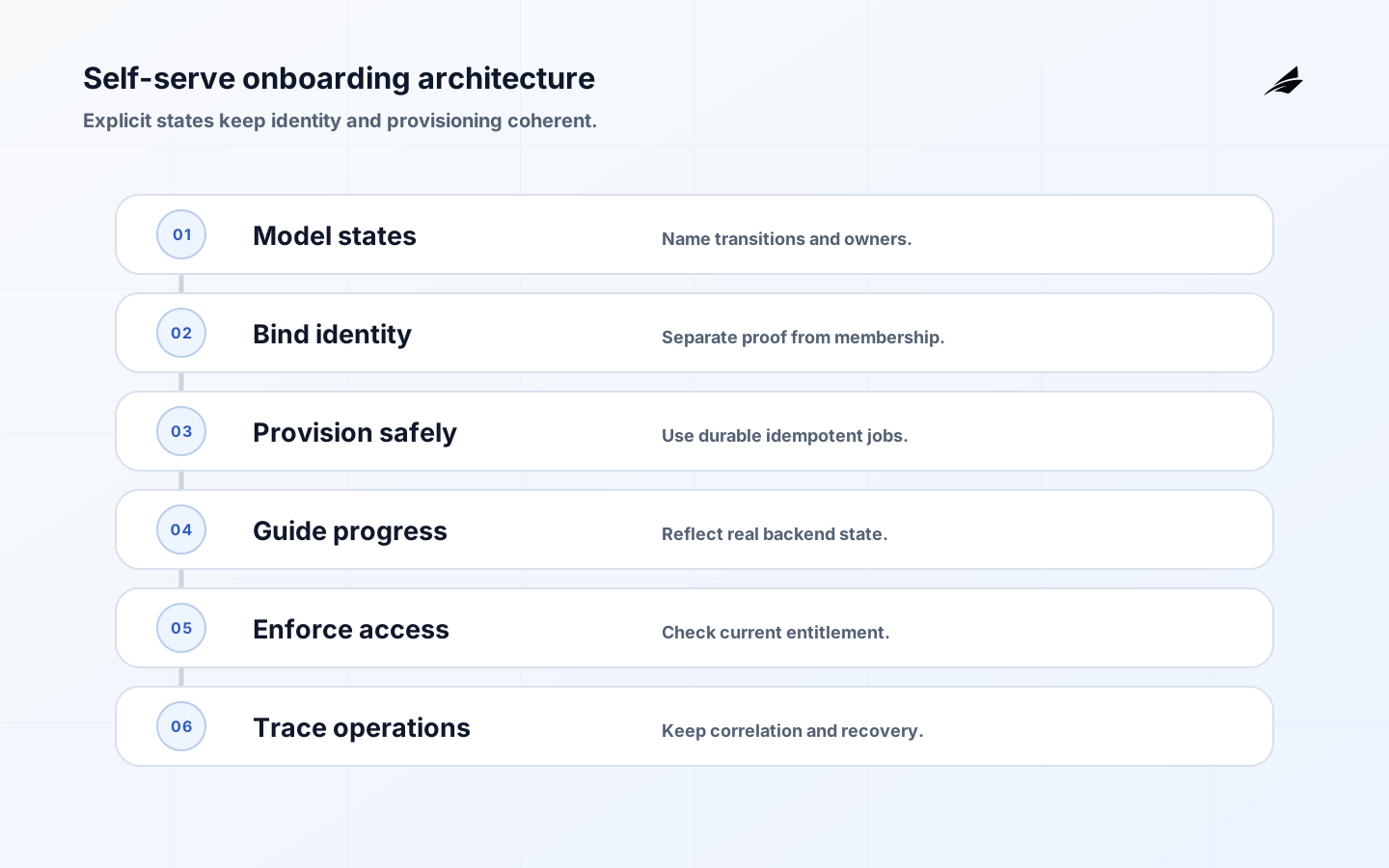
Self-serve onboarding architecture is the set of boundaries that lets a new customer move from an unknown visitor to a correctly scoped, useful account without an operator assembling the pieces by hand. The visible form is only one part. Behind it sit identity proofing, session management, tenant creation, membership, defaults, product guidance, billing state, analytics, and support recovery. A good architecture lets each concern change at its own pace while keeping the customer’s state coherent. A bad one hides all of those decisions inside a single signup request that is difficult to retry, audit, or explain.
Read this with multi-tenant architecture implementation guidance, SaaS MVP development planning, and in-app guidance. Those resources cover neighboring choices; this article focuses on the seams where onboarding systems most often lose consistency.
Start with the state transitions
Define the states before selecting services. A useful sequence might be applicant, verified account, pending workspace, active workspace, invited member, activated workflow, and suspended or recovery-required. For every transition, document the actor, trusted inputs, side effects, retry behavior, and evidence. Do not let a payment event or an identity callback directly decide a broad permission without checking the current account and tenant state. A small state model is easier to reason about than an informal promise that several tables and queues will eventually converge.

| Boundary | Owns | Must not assume |
|---|---|---|
| Identity | Account and authenticator state. | That the user owns a tenant. |
| Tenant | Workspace identity, owner, and lifecycle. | That every account action is in scope. |
| Provisioning | Defaults, resources, and integrations. | That a callback is delivered once. |
| Experience | Guidance and next actions. | That a visible success means all work completed. |
Choose an identity boundary that can evolve
NIST’s digital identity model distinguishes proofing, authentication, and federation assurance. Even for a commercial SaaS product, that separation helps prevent a common architectural mistake: using a verified email as if it proves every organizational relationship. Store the identity provider subject, verified contact, assurance signals, and last authentication event separately from tenant membership. When an account links a second provider or changes its email, use a controlled binding flow and preserve the old evidence long enough to investigate disputes. Recovery is part of the architecture, not an exception handled by a support script.
Make provisioning idempotent and observable
Provisioning commonly creates a tenant row, default policy, sample data, billing relationship, analytics identity, and invitation record. These operations have different failure and retry characteristics. Give the overall request a correlation identifier and each side effect an idempotency key. A retry should reconcile the expected state rather than create another workspace or charge. Keep a durable job record with input version, attempt count, last error, and next action. The user experience can remain simple while the system preserves enough information for an operator to answer whether the workspace is pending, complete, partially complete, or blocked.
- Keep account, tenant, membership, and billing identifiers distinct but linkable.
- Derive authorization context on the server from current membership and tenant state.
- Give every async step a durable status and safe retry operation.
- Make webhook consumers idempotent and tolerant of late delivery.
- Expose a support-safe state view without exposing secrets or unnecessary personal data.
Treat guidance as a state-aware client
A checklist or in-app guide should read the same state model as the rest of the product. If the workspace is still provisioning, the guide should explain that status and offer a useful next step rather than presenting a control that will fail. WCAG 2. 2 makes accessibility a testable concern: labels, focus, input assistance, keyboard paths, and accessible authentication all matter in a setup journey. Preserve safe inputs on validation errors, avoid forcing redundant entry, and ensure a user can return to a completed step without being sent backward by a delayed event.
Separate entry from entitlement
The account may be allowed to enter the application before it is allowed to export data, administer members, configure an integration, or increase a plan. Model these as separate decisions. A tenant-aware authorization check should consider the current actor, tenant, resource, action, and lifecycle status. OAuth redirect safety is also part of the boundary: registered destinations, state, and token handling should follow the current IETF best practice. Avoid putting a broad “onboarding complete” claim in a long-lived token when the underlying tenant state can change.
| Design choice | Useful when | Trade-off to name |
|---|---|---|
| Synchronous setup | The dependency is fast and local. | A timeout can leave the user uncertain. |
| Asynchronous job | Provisioning crosses services or may retry. | The UI must explain pending state. |
| Event-driven completion | Multiple consumers need the result. | Ordering and duplicate delivery require care. |
| Human review | Relationship or risk cannot be automated safely. | Define response time and escalation. |
Test the seams, not just the happy path
Unit tests can verify individual transitions, but onboarding architecture fails at boundaries. Test the browser closing after a successful provider callback, a duplicated event, a tenant owner leaving during setup, an invite accepted after revocation, a billing event arriving before the local customer record, and an import completing after a plan change. Verify that a late event cannot overwrite a newer state. Run negative authorization tests through direct API calls as well as through the visible experience. Keep test fixtures for multiple tenants so a cache, queue, or default lookup cannot accidentally cross the boundary.
Roll out architecture changes behind a checkpoint
Choose one signup route, one plan, and one tenant shape for the first rollout. Compare activation, provisioning delay, retry rate, support intervention, and authorization denials against the old path. Use feature flags or a routing layer to keep a return path, but do not let both paths create competing owners or duplicate analytics. Declare the migration complete only when existing accounts and newly created accounts have an unambiguous source of truth. Record the schema or event version with the rollout so future responders can tell which state machine they are looking at.
Measure architecture health through customer outcomes
Track time from signup to verified account, tenant creation, first useful workflow, and stable return visit. Add job retry count, duplicate suppression, state mismatch, provider failure, and manual repair. Break down the results by identity route, plan, and tenant size when the segment changes a decision. A low average provisioning time can conceal a long tail caused by one provider or one region. Make alerts about durable conditions such as stuck jobs or repeated reconciliation failures, not every transient retry. Retain enough correlation to trace a customer-visible issue across identity, provisioning, billing, and guidance.
- Refresh or close the browser after every callback-driven transition.
- Replay events out of order and confirm newer state wins.
- Change membership while a provisioning job is queued.
- Remove a dependency and verify the customer receives a bounded recovery path.
- Inspect a complete activation trace using only the retained correlation evidence.
Architecture reviews should trace one customer across both synchronous and asynchronous work. Follow the initial request through account creation, tenant assignment, invitation, billing state, feature provisioning, analytics, and support recovery. At each handoff, ask what happens if the message is late, repeated, missing, or contradicted by a newer state. This exercise usually finds more valuable improvements than adding another service boundary. It also exposes where a customer-visible screen is claiming completion before the system has a durable fact to support that claim.
Key takeaways for onboarding architecture
- Model onboarding as explicit state transitions with owners and evidence.
- Keep identity, tenant membership, provisioning, and entitlements separate.
- Make asynchronous work idempotent, visible, and recoverable.
- Build accessibility and authorization into the architecture rather than adding them at the end.
- Measure the seams where events, retries, and permissions meet.
Self-serve onboarding architecture FAQ
Architecture decisions are easier to review when the team can state the boundary, failure behavior, and evidence for each stage. Use these questions to guide a design review.
What is the most important boundary in onboarding architecture?
Separate identity establishment from tenant provisioning and from access to consequential actions, so each can be tested and recovered independently. This avoids one callback becoming authority for the whole product.
When should provisioning be asynchronous?
Use asynchronous work when a dependency can be slow or retried, but expose a durable pending state and an idempotent completion path. Synchronous work is fine when the boundary is local and its timeout behavior is clear.
How should a tenant identifier be selected?
Derive it from trusted account and membership state rather than accepting a client-supplied identifier as authority. Validate the requested resource against that context at the point of action.
What should happen when an identity provider is unavailable?
Preserve the request as pending or offer a documented alternative that does not weaken the required assurance level. Do not turn an outage into an implicit allow decision.
Self-serve onboarding is an architecture concern when the journey crosses identity, workspace setup, entitlements, guidance, and support. Keep those boundaries visible. A user should be able to retry a failed step without duplicating an account or losing the state already confirmed. The product should record which step was offered, completed, skipped, or escalated, while respecting privacy and tenant boundaries. That evidence lets a team distinguish a confusing instruction from a real dependency failure. It also makes removal safer: retire one prompt or branch at a time, compare the outcome, and keep a recovery path for customers who began before the change.
Conclusion: make onboarding a coherent system
The best self-serve onboarding architecture is not the one with the fewest services. It is the one whose states, boundaries, retries, permissions, and recovery paths remain understandable as the product grows. Establish identity carefully, create tenant state deliberately, make provisioning observable, and let the user see the truth about progress. With those foundations, new guidance and commercial experiments can evolve without turning every failed callback into a support emergency.
For the plain-language guide to self-serve onboarding architecture, test an unexpected load spike before treating the first release as complete. For self-serve onboarding architecture, record the state, evidence, and recovery path.
A practical example for the plain-language guide to self-serve onboarding architecture is a customer-visible result remains pending. Review self-serve onboarding architecture evidence with product, engineering, and support for self serve onboarding.
Ownership is clearer when the plain-language guide to self-serve onboarding architecture separates the promise from the mechanism. Make self-serve onboarding architecture corrections visible, scoped, and reversible during self serve onboarding.
Before widening the plain-language guide to self-serve onboarding architecture, run a small rehearsal with normal, denied, delayed, and corrected cases. Reconcile self-serve onboarding architecture changes against the original record.
For Self-Serve Onboarding Architecture, NIST SP 800-63-4: Digital Identity Guidelines defines scope; OWASP Authentication Cheat Sheet supports the control; OWASP Email Validation and Verification in Identity Systems clarifies evidence; Web Content Accessibility Guidelines (WCAG) 2. 2 guides recovery; RFC 9700: Best Current Practice for OAuth 2 0 Security frames review.
Ownership for self-serve onboarding architecture is clearer when the customer promise is separated from the mechanism. Reconcile the evidence against the account, tenant, and provisioning state before closing the pass.
Before widening self-serve onboarding architecture, rehearse normal, denied, delayed, and corrected cases with realistic identifiers. During reconciliation, measure completion time, retry rate, and support intervention for each state transition.
The measurement plan for self-serve onboarding architecture should pair an outcome with a reason to investigate it. During reconciliation, assign an owner to each exception and record the next action with the measurement it should change.
Evidence for “The Plain-Language Guide to Self-Serve Onboarding Architecture” is grounded in NIST SP 800-63-4: Digital Identity Guidelines, OWASP Authentication Cheat Sheet, OWASP Email Validation and Verification in Identity Systems, Web Content Accessibility Guidelines (WCAG) 2.2, RFC 9700: Best Current Practice for OAuth 2.0 Security; each source informs a specific decision, test, or operating trade-off described in this guide.