SaaS product development implementation turns a commercial promise into a service that many customers can use without compromising each other's data or the team's ability to operate it. Scope must cover more than screens: tenant lifecycle, identity, entitlements, billing, integrations, support, security, release control and reliability all shape whether the product can be sold and retained. A useful plan links each capability to customer evidence and an accountable owner.
This guide is for product, engineering and operations leaders preparing a new SaaS build or a major platform release. Continue with the SaaS development readiness checklist and SaaS implementation FAQ, and compare partner considerations in the startup SaaS delivery guide.
Define product evidence and commercial scope
Name the target customer, user role, urgent job and measurable result. Map the smallest complete journey from account creation to recurring value, including failure and support. Define the first saleable package, pilot cohort and evidence that permits expansion. Keep a separate list of assumptions about acquisition, activation, retention, willingness to pay and support burden so delivery milestones do not masquerade as product validation.
Commercial scope determines technical state. Define plan, entitlement, trial, upgrade, downgrade, cancellation, suspension and renewal behavior. Decide whether usage affects access or invoicing, what record is authoritative and how disputes are corrected. Include administrative and support functions needed to explain customer state. A launch that relies on database edits for entitlement or billing exceptions is not operationally complete.
| Scope layer | Decision | Acceptance evidence |
|---|---|---|
| Customer outcome | Job, cohort and success threshold | Observed end-to-end completion |
| Tenant lifecycle | Create, invite, transfer, suspend and delete | State-transition tests |
| Commercial model | Plans, entitlements, billing and cancellation | Reconciled subscription scenarios |
| Operations | Support, incidents and release ownership | Runbook exercises |
| Expansion rule | Evidence required for more scope | Recorded product decision |
Design tenancy and authoritative data
Choose a tenant isolation model based on data sensitivity, customer requirements, scale and operating capacity. Shared infrastructure can be appropriate when tenant identifiers are mandatory, authorization is enforced centrally and every data path is tested. Dedicated resources may provide stronger isolation or contractual fit but increase provisioning and operational complexity. Document how caches, search, files, queues, analytics, exports and backups preserve the boundary.
Define authoritative records and state transitions for users, organizations, subscriptions and the product's core domain. Use durable identifiers and versioned migrations. Classify data, minimize collection and record retention and deletion rules. Test restoration at the application level, including tenant associations and external references, rather than treating a successful infrastructure snapshot as proof that the business service can recover.
Select architecture and integration boundaries
Prefer the simplest structure that preserves module ownership and future change. A modular monolith often supports an early product better than many independently deployed services. Introduce separate services where scaling, security isolation, technology needs or team ownership justify their cost. Keep APIs explicit and prevent modules from bypassing business rules through shared tables. Record architecture decisions with the evidence and conditions that would cause reconsideration.
For each identity, payment, messaging, analytics or customer-system integration, specify authentication, schema, timeouts, bounded retries, idempotency, rate limits, versioning and degraded behavior. Process asynchronous provider events with stable identifiers and reconciliation. Expose failed work to operators instead of trapping it in logs. Contract tests should cover both normal and changed provider responses before release.
Integrate security into the delivery system
Use NIST SSDF practices to organize repository protection, secure design, dependency review, build integrity, vulnerability handling and release evidence. Apply least privilege to humans and workloads, store secrets in managed facilities and separate production administration from ordinary development. Threat-model tenant boundaries, invitations, account recovery, exports, billing changes, webhooks and support impersonation because these workflows combine authority and sensitive state.
Protect the main branch, require appropriate review and automate build, tests and deployment from versioned configuration. Create immutable artifacts traceable to source. Test business rules, authorization, integration contracts, migrations and critical journeys. Maintain a vulnerability intake and response owner. Security review should be repeated when trust boundaries or high-consequence features change, not deferred to a single pre-launch penetration test.
Use staged SaaS implementation gates
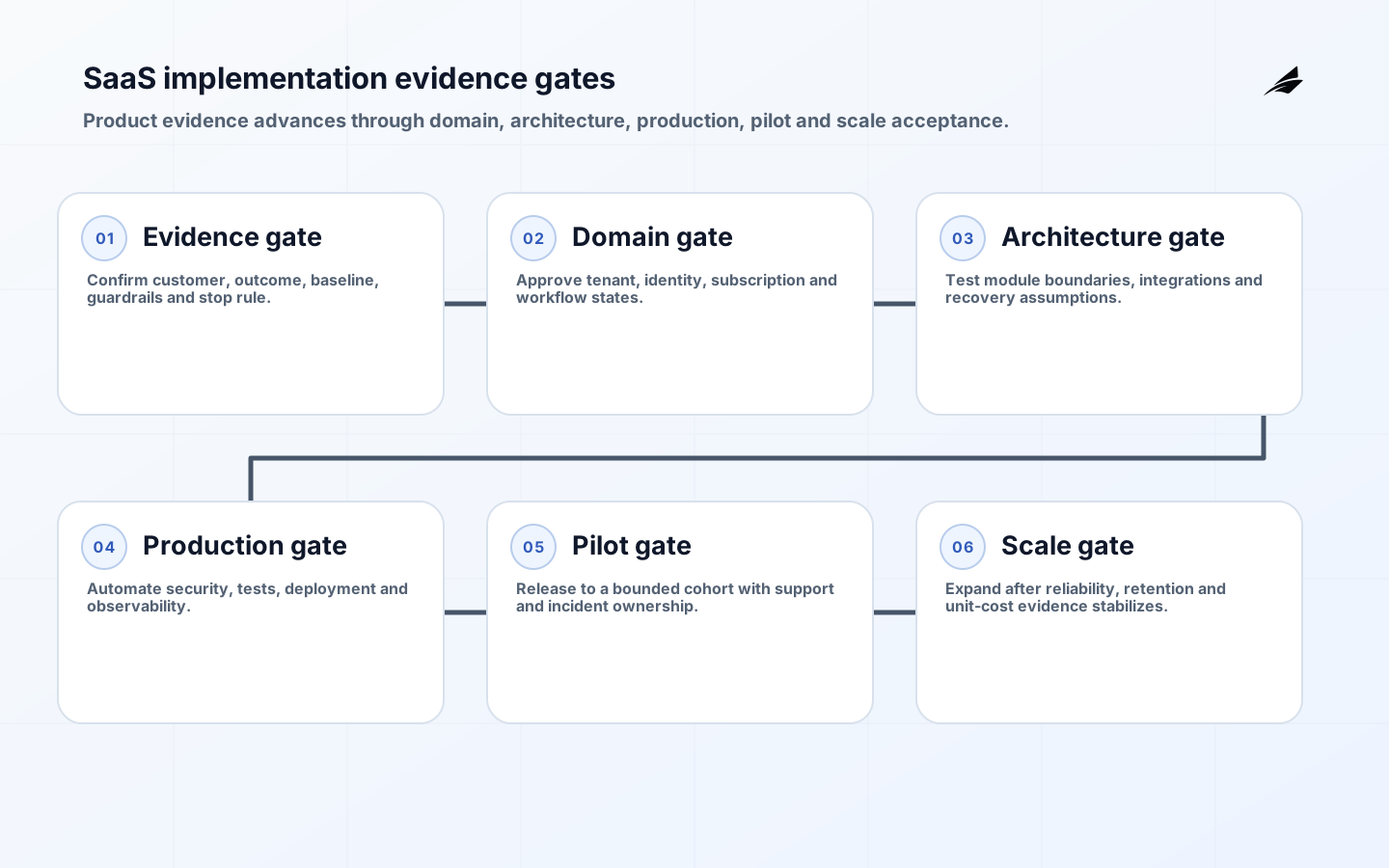
- Evidence gate: confirm user, outcome, baseline and stop rule.
- Domain gate: approve tenant, data, subscription and workflow states.
- Architecture gate: test boundaries, integrations and recovery assumptions.
- Production gate: automate security, tests, deployment and telemetry.
- Pilot gate: release to a bounded cohort with support ownership.
- Scale gate: expand only after reliability, retention and cost evidence stabilizes.
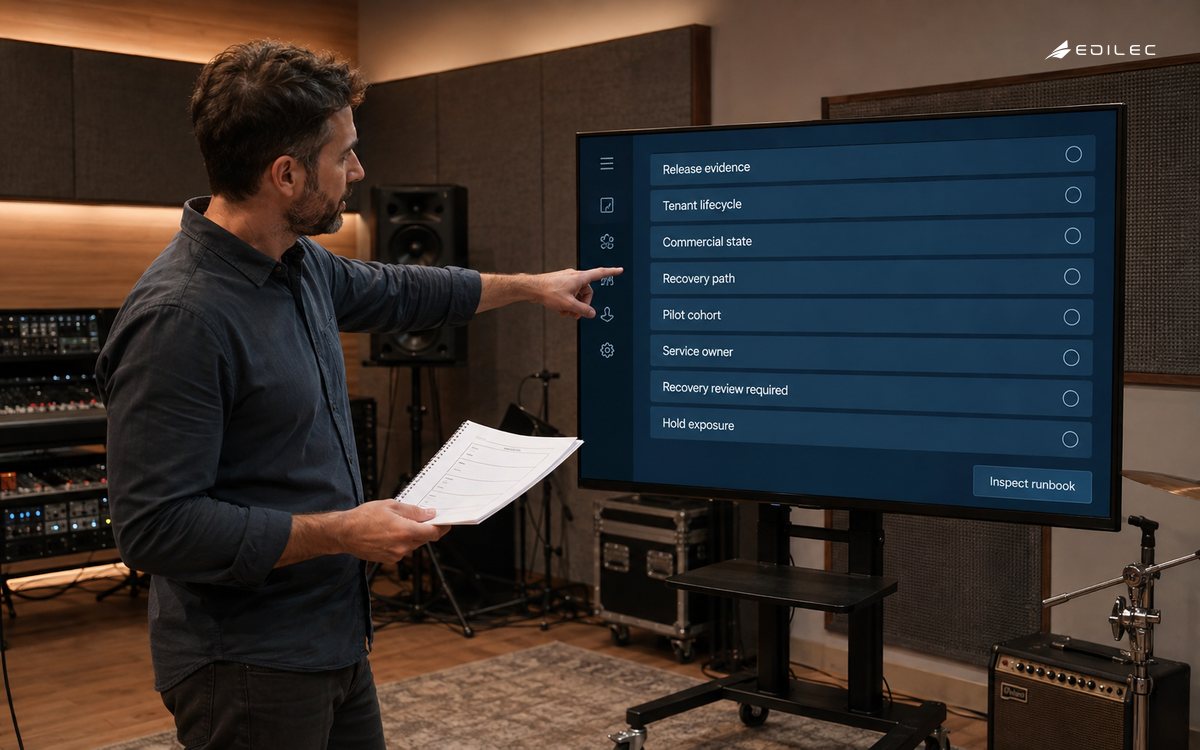
Each gate needs observable acceptance, an approver and a decision if evidence is missing. A demonstration can satisfy workflow proof but not production readiness. Before pilot, rehearse migration, deployment, smoke testing, rollback or forward repair, dependency failure, backup restoration and support lookup. Record elapsed time and unavailable access. Feature flags can limit exposure, but they also require ownership and removal so dormant paths do not accumulate.
Operate around customer outcomes
Define service level indicators from what users care about: successful workflow completion, durable writes, freshness or processing latency. Google SRE guidance recommends working backward from user expectations. Set initial objectives with an action when the error budget is consumed. Instrument logs, metrics and traces around the transaction. OpenTelemetry describes these signals as complementary; correlation across them is more useful than collecting high-volume telemetry with no question or owner.
Alert on conditions requiring timely action, with severity, owner and runbook. Monitor queue age, provider failures, tenant-scoped errors, authorization denials, billing reconciliation and support cases. Rehearse at least one dependency outage and one account compromise. Incident review should identify system contributors and funded improvements without treating individual error as the root cause. Reliability work competes transparently with feature work through service evidence.
| Operating measure | Purpose | Decision it should drive |
|---|---|---|
| Successful core transactions | Shows delivered customer service | Investigate segment or release regressions |
| Change lead time | Shows delivery flow | Remove approval or automation bottlenecks |
| Change failure rate | Shows release stability | Improve tests, scope or rollout |
| Failed deployment recovery time | Shows recovery capability | Rehearse and simplify remediation |
| Deployment rework rate | Shows unplanned corrective load | Address quality and planning causes |
| Cost per active tenant or transaction | Connects usage to economics | Optimize architecture, pricing or placement |
Estimate cost and govern technology value
Estimate discovery, experience design, domain implementation, tenant and billing foundations, integrations, data migration, security, testing, infrastructure, launch and stabilization separately. Cost grows with workflow breadth, tenant isolation, data sensitivity, compliance evidence, migration quality, integration uncertainty, performance and availability targets, and support coverage. Recurring cost includes cloud usage, SaaS dependencies, observability, support, security operations and platform maintenance.
The FinOps Framework treats technology value as collaboration across engineering, finance, product, procurement and leadership. Allocate spend to products, environments and major capabilities; forecast with usage assumptions; detect anomalies; and track unit economics. Do not optimize raw cloud cost in isolation. A managed service that costs more per unit may still improve value if it reduces operational risk and accelerates customer outcomes. Record the tradeoff and revisit it with real volume.
Design lifecycle UX and customer administration
Customers need predictable organization setup, invitation, role change, ownership transfer, plan change, export and closure. Show the current state, effective date and consequence of each action. Require confirmation and stronger authorization for destructive or financially material changes. Make errors recoverable without exposing another tenant's information. Administrative UX is part of the product because it determines how safely customers can operate without support.
Include accessibility in design and acceptance for sign-in, onboarding, billing and the core workflow. Test keyboard use, focus, labels, contrast, error association and zoom. Provide durable notifications for asynchronous results rather than relying on brief visual messages. Track abandonment and support requests by lifecycle step; repeated confusion is product evidence, not merely a documentation problem.
Define customer communication for planned maintenance, incidents, security events and material subscription changes. Templates should name known impact, workaround and next update without speculation. Give support a service-status view and correlation identifiers. The communication owner must be able to reach affected tenants even when the primary product is impaired. Rehearse the alternate channel and contact ownership before launch.
Key takeaways
- Scope the full customer and commercial lifecycle, not only the visible workflow.
- Make tenant boundaries and authoritative state explicit across every subsystem.
- Use staged gates with evidence for security, recovery, support and pilot value.
- Measure delivery, reliability and unit economics as a balanced operating system.
- Expand architecture and feature breadth only when observed constraints justify it.
Frequently asked questions
What determines SaaS implementation cost?
The strongest drivers are workflow breadth, tenant model, commercial states, integrations, data migration, security and compliance evidence, service objectives and support expectations. A discovery phase should reduce uncertainty in these drivers before a fixed commitment is treated as credible.
Should a new SaaS product use microservices?
Only when independent scaling, isolation, release or ownership needs outweigh distributed-system cost. A modular monolith with explicit boundaries is often easier for a small team to test and operate. Record the triggers that would justify extraction later.
What must be ready before the first paid customer?
The promised workflow, tenant and role enforcement, subscription state, data recovery, traceable releases, customer-facing error states, support lookup, security response and basic service telemetry must all work. Contractual and jurisdiction-specific obligations also need qualified review.
Conclusion
A reliable SaaS implementation connects product evidence to a secure, operable commercial service. Define tenant and subscription truth, keep architecture proportionate, automate the release path and measure outcomes, stability and unit cost together. The delivery plan becomes credible when each stage ends with tested evidence and a decision, not simply a growing feature inventory.