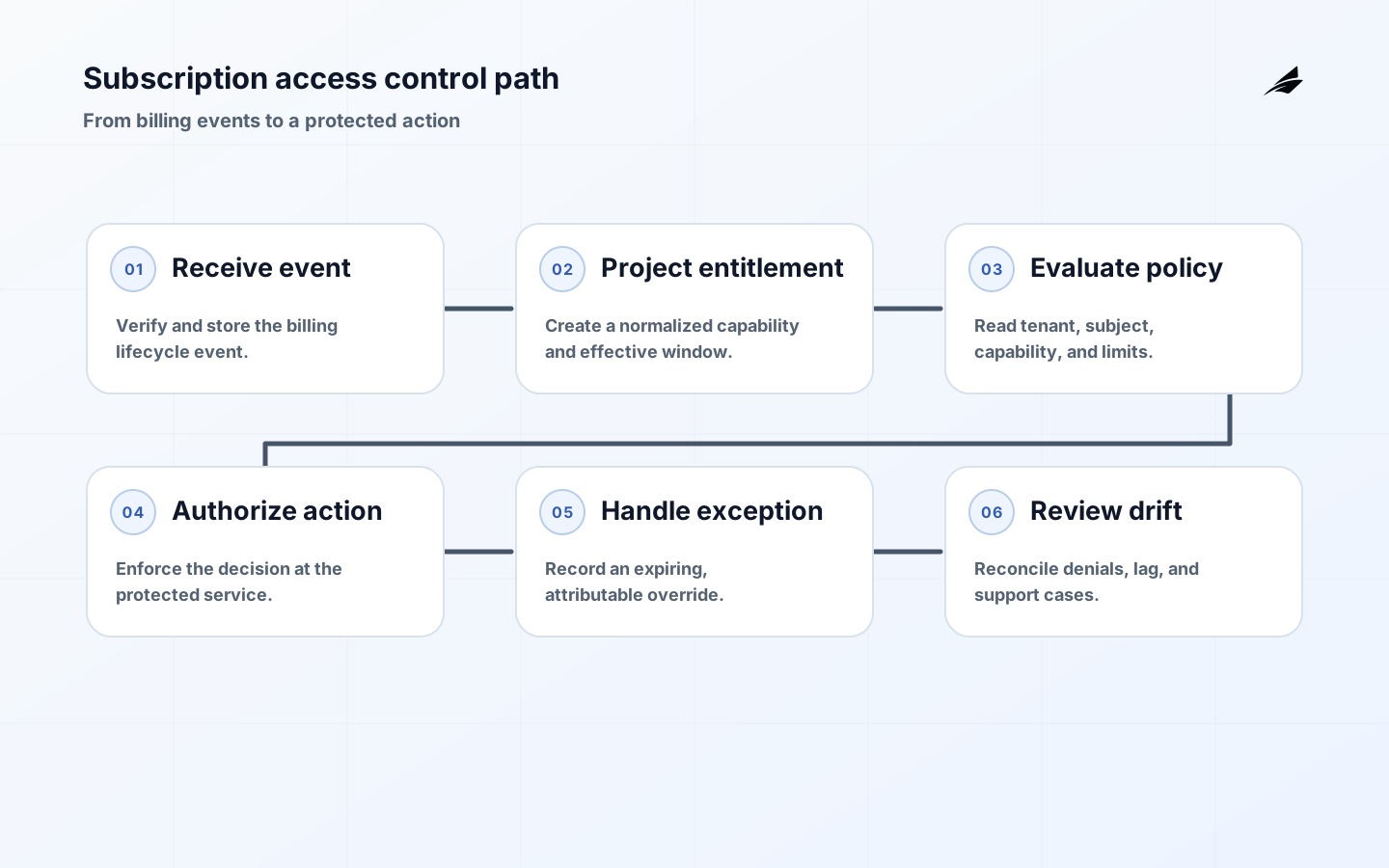
Subscription access control is a product-engineering concern because it shapes what a customer can trust in the product, what an operator can explain, and what a delivery team can change safely. For CTOs, the work is not to collect more tooling or policy language. It is to make one important decision visible: what state is authoritative, who owns it, which controls enforce it, and how the team learns when reality differs from the plan.
Why Subscription access control Matters
A subscription state is often treated as a UI badge, then quietly becomes the only thing separating a paid capability from an unpaid one. That shortcut fails when a payment succeeds but a webhook is delayed, a downgrade takes effect at a period boundary, a support agent grants a temporary exception, or a customer belongs to more than one workspace. The practical question is not whether the billing provider is correct. It is which service may authorize a consequential action at the moment the action is requested.
Treat entitlement as a versioned decision, not a copied billing field. A service should receive a subject, tenant, product capability, and request context, then evaluate an authoritative entitlement record. Billing events can update that record asynchronously, but an API that creates an export, adds a user, or calls a premium model should check the same policy path every time. This keeps paid access understandable during retries, refunds, cancellations, and manual adjustments.
Build the Operating Model
The useful boundary has three layers. Billing owns charges, invoices, and subscription lifecycle. An entitlement service owns a normalized statement such as tenant A may use feature B until time C, subject to quantity D. Product services enforce that statement immediately before protected work. Separating those layers avoids asking every application team to interpret provider-specific states, and it gives finance and support a concrete record to reconcile when a customer disputes access.
| Question | Design choice | Operational consequence |
|---|---|---|
| Where is paid access decided? | Server-side entitlement check | A browser flag cannot unlock a protected API. |
| How are limits counted? | Atomic reservation or explicit eventual limit | Concurrent requests have defined behavior. |
| How are exceptions handled? | Expiring, attributable override | Support can help without creating permanent drift. |
| What happens during provider delay? | Written grace or deny policy | Customers and operators see predictable behavior. |
Define the entitlement contract with explicit fields: tenant identifier, subject or role, capability, limit, effective window, source event, policy version, and change reason. Do not infer a tenant from an email domain or a client-supplied header. For quantity limits, decide whether the check reserves capacity, merely reports it, or denies the request atomically. That distinction matters for invitations, exports, and API calls that may arrive concurrently.
Design the Architecture and Controls
A durable design has an ingestion path for signed billing events, an idempotent projector that updates entitlement state, and a low-latency authorization path used by the product. Keep the raw event and its processing result so a failed projection can be replayed. Cache decisions only for a bounded interval and include policy version or expiry in the cache key. A cache is an availability optimization; it must not become an undocumented source of truth for who can do what.
The uncomfortable cases reveal the architecture. A duplicate event should not grant two seats. An event that arrives out of order should not reactivate a cancelled plan. If billing is unavailable, the product needs an explicit grace rule rather than accidental open access or accidental lockout. Make a manual override time-bound, attributable, and visible in the decision record. The security posture should assume an attacker will try an endpoint directly, bypassing every upgrade screen.
Roll Out with Evidence
Start by inventorying every protected capability and ranking it by commercial and security consequence. Put one high-value action behind the new decision point, compare its outcomes with the old checks, then migrate adjacent actions. During the comparison period, log differences without changing the customer result. Resolve differences as policy questions, not just code defects: a disagreement may expose an unclear definition of a seat, add-on, grandfathered plan, or trial.
| Signal | What it can reveal | First response |
|---|---|---|
| Entitlement projection lag | A webhook or worker is delayed | Inspect signature verification, queue depth, and retries. |
| Unexpected authorization denial | Policy and product state disagree | Trace the decision inputs and policy version. |
| Override older than its expiry | A manual exception escaped review | Remove it or convert it into a documented plan rule. |
| Limit check contention | Capacity accounting is not atomic enough | Reserve before creating the protected resource. |
Operate and Measure
Monitor both correctness and customer impact. Count denials by capability and reason, grants after a billing event, projection lag, stale-cache use, override age, and support cases caused by access mismatch. Segment these signals by plan and tenant, but never leak tenant identifiers into shared dashboards. The best operational report lets a CTO answer whether the system denied the right requests, whether revenue events reached the product quickly enough, and which policy exception is becoming permanent.
- Authorize protected server actions, not screens.
- Keep subscription events, entitlement state, and product policy separate.
- Make reversals and backfills replayable.
- Give every exception an owner, reason, and expiry.
- Test renewal, downgrade, refund, and delayed-event paths.
Implementation Detail
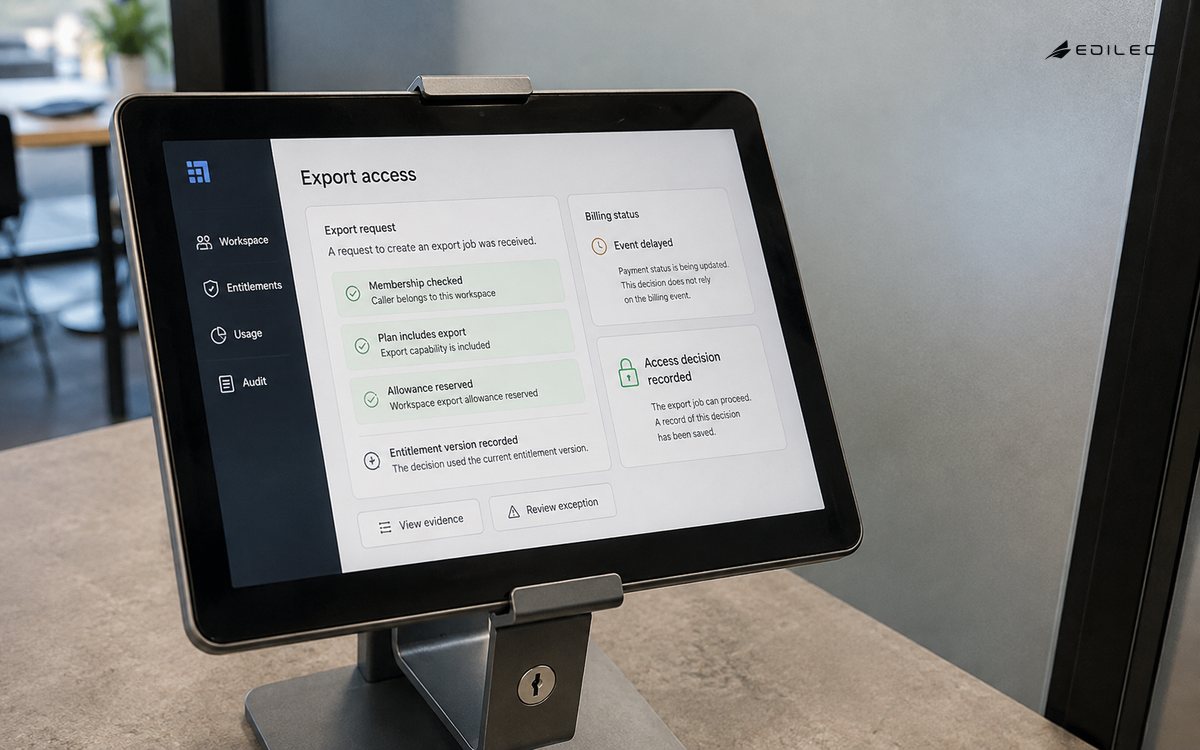
Consider a B2B analytics product with monthly and annual plans. A billing event may say the account is paid, but the authorization request still needs to know whether the caller belongs to the workspace, whether the export capability is included in that plan, and whether the workspace has already used its allowed exports. Put that check next to the export job creation, not only next to the upgrade page. The job can reserve the allowance, record the entitlement version it used, and later explain a denial without asking an operator to reconstruct billing history.
For a migration, run the old and new decision paths in observation mode for a limited set of actions. Store both results with the request and inspect every mismatch. A mismatch can reveal stale plan mappings, a manual grant that was never documented, or a customer whose plan definition changed over time. Decide which system is authoritative before flipping enforcement. This comparison also produces a real test corpus for the lifecycle cases that are easy to overlook: cancellation followed by renewal, payment reversal, plan change, and a delayed event retry.
Review Before Scaling
Before widening access, write assertions at the policy boundary. A customer with a cancelled entitlement must be denied even if a cached screen still displays a premium option. A renewal event must not duplicate a seat reservation. A support override must expire even when no one returns to the account page. Exercise these tests at API level and through the worker that receives events, because a beautifully tested policy function does not protect a service that never calls it.
The human operating model matters as much as the service design. Finance needs a way to reconcile plan state, support needs a safe way to explain or temporarily correct it, and engineering needs a single route for permanent policy changes. Review overrides and denial reasons regularly with all three groups. Repeated exceptions are valuable evidence that the product or plan model is unclear. Turn the recurring pattern into a documented entitlement rule, then retire the manual path.
Create a monthly entitlement review that samples real decisions across plans and tenants. Compare the plan catalogue, billing event history, entitlement record, and protected-action result for each sample. Include an account with a temporary override and one with a recent plan change. This is a practical way to detect semantic drift before it becomes a revenue dispute or an access incident. Review this evidence with the owner of subscription access control, the people who operate the surrounding workflow, and the team responsible for customer communication. Agree on one change, one measure, and one follow-up date. That closed loop keeps local fixes from becoming unexamined policy and makes the next decision easier to defend.
Key Takeaways
- Make subscription access control a named operating decision rather than an implicit implementation detail.
- Keep customer impact, evidence, and recovery visible to the team that owns the workflow.
- Start with a narrow path, learn from real outcomes, and expand only after the controls hold.
Frequently Asked Questions
Where should a team start with subscription access control? Start where an incorrect decision would create meaningful customer, commercial, or operational harm. Map the current state, the owner, the boundary, and the evidence available during failure. How much process is enough? Use the smallest process that makes the decision repeatable, reviewable, and recoverable. Add rigor when the data, action, or customer consequence makes a shortcut unsafe.
Conclusion
Strong subscription access control work is not a one-time project. It is a durable agreement between product, engineering, and operations about how the system behaves under ordinary and difficult conditions. When the contract, controls, telemetry, and recovery path agree, CTOs can improve the product without turning each release or customer exception into a new source of uncertainty.
The practical continuity test for subscription access control is whether a qualified teammate who did not design the workflow can inspect the current state, understand the relevant decision and its limits, and take the next safe action without improvised access or tribal knowledge. Keep the owner, evidence location, escalation route, and recovery rule visible. That discipline makes routine operations calmer and gives the organization a reliable starting point when a customer, release, or incident exposes a new edge case.
Sources
The implementation advice in this subscription access control guide is grounded in AWS SaaS tenant isolation guidance, NIST SP 800-207: Zero Trust Architecture, OWASP Application Security Verification Standard, Stripe subscription trial documentation. These references are useful for checking platform-specific controls and terminology during delivery; the decisions here still need to be applied to the product's data, risk, and customer context.