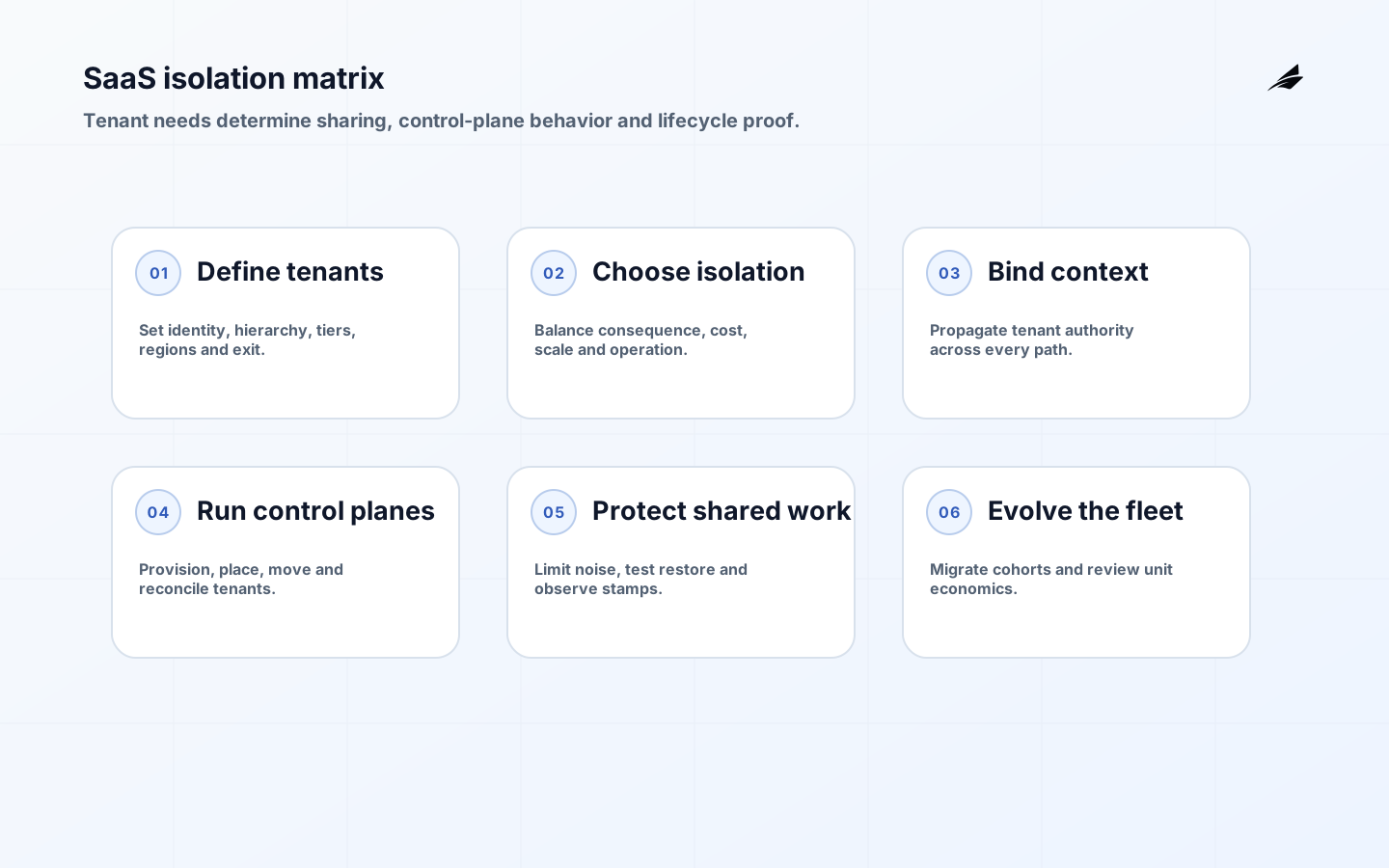
A multi-tenant SaaS architecture implementation plan must reconcile two forces: customers need credible isolation and predictable service, while the provider needs repeatable onboarding, efficient shared operation and sustainable unit economics. Multi-tenancy is not simply adding a tenant ID to tables. Tenant context must remain correct through identity, requests, jobs, data, caches, messages, telemetry, support tools and deletion. Isolation also varies by resource and customer tier. The plan should make those choices explicit before growth hardens accidental boundaries.
Use this plan with Edilec's multi-tenant readiness checklist, tenant isolation guide and managed multi-tenant architecture checklist. It covers product and delivery decisions independent of a specific cloud. Service limits and security capabilities differ by provider, so confirm the design against current platform documentation and actual threat and performance tests.
1. Define tenants, users and commercial boundaries
Define what a tenant represents: customer organization, subsidiary, workspace, region or another administrative boundary. Model relationships such as reseller, parent and child organization without using ad hoc exceptions. Name who creates, suspends, merges, exports and deletes a tenant. Separate tenant identity from deployment placement so a customer can move between shared and dedicated infrastructure. Establish which configuration, data residency, keys, domains, support and service levels vary by tenant or tier.
Forecast tenant count, size distribution, transaction and storage growth, burst shape, geography and contract needs. Include a few very large customers and long-tail small customers. The Microsoft tenancy model guidance describes isolation as a spectrum rather than one binary architecture. Use a component-level decision: identity may be shared, data dedicated for some tiers, and compute pooled inside regional stamps. Price dedicated resources so the commercial model covers their full lifecycle cost.
| Resource | Shared option | More isolated option |
|---|---|---|
| Compute | Tenant-aware pooled service | Tenant or cohort deployment stamp |
| Database | Shared schema with tenant key | Database or account per tenant |
| Storage | Shared account with scoped paths | Tenant-specific account or bucket |
| Keys | Shared service keys with context | Tenant-controlled or dedicated key |
| Telemetry | Shared backend with filtering | Tenant or stamp-specific destination |
| Release | One global version | Cohort or tenant release ring |
2. Choose isolation per resource and threat
For each resource, identify confidentiality, integrity, availability and performance consequences of cross-tenant failure. Shared resources improve utilization but require correct application enforcement and fair consumption. Dedicated resources strengthen some boundaries but increase provisioning, patching, fleet visibility and cost. Microsoft's multitenant architecture overview highlights trade-offs among isolation, scale, cost, complexity and manageability. Document the decision and the trigger for moving a tenant to another model.
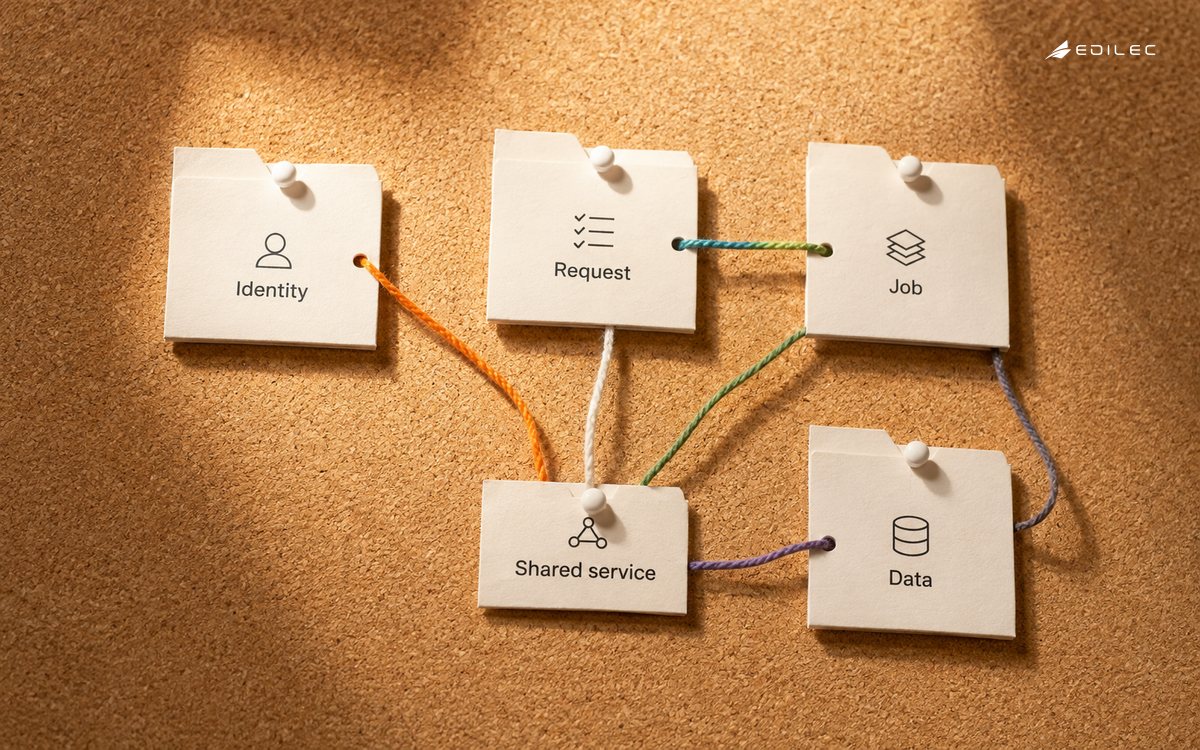
Use deployment stamps or cells to bound scale and failure where appropriate. The deployment stamps pattern places a subset of tenants in independent copies of the solution, supporting controlled scaling, region placement and smaller incident impact. Automate stamp creation and keep versions observable. Avoid a single global dependency that defeats cell isolation. Shared identity or control services need resilient design and a degraded mode that prevents one failure from disabling every tenant.
3. Enforce tenant context and authorization
Resolve tenant context from authenticated identity and trusted routing, not a client-supplied field alone. Bind user membership, role, tenant and deployment at the edge, then propagate signed or integrity-protected context through synchronous calls and background messages. Reauthorize server-side at each sensitive operation. Repository and service APIs should require tenant context rather than offering optional filters. Include tenant in cache keys, idempotency keys, object paths, search indexes, rate limits and audit events.
Threat-model cross-tenant object access, query omission, batch-job mix-up, support impersonation, export leakage, cache collision, message replay and telemetry exposure. Use the OWASP Application Security Verification Standard as a structured source of application security requirements, supplemented with explicit tenancy abuse cases. Test negative authorization automatically with two or more tenants. Production support access should be approved, time-limited, visible to the right customer stakeholders where promised, and attributable to an individual.
4. Build a reliable SaaS control plane
The control plane manages tenant lifecycle and placement; the data plane serves customer work. Make create, configure, move, suspend, restore, export and delete operations idempotent, observable and resumable. Keep a tenant registry containing stable identity, deployment, region, tier, state and resource references. Microsoft's control-plane guidance distinguishes global placement and lifecycle responsibilities from stamp-level resource management. Minimize control-plane complexity and protect it as highly privileged infrastructure.
Automate provisioning through declarative templates and workflows that emit state and evidence. Handle partial failure: a tenant record may exist while storage creation or identity federation fails. Reconciliation should detect and complete or unwind incomplete operations. Use quotas, admission control and placement capacity so onboarding cannot overload a stamp. Test tenant moves with dual-write or controlled downtime strategies appropriate to the product; verify identities, data, domains, integrations and audit continuity before changing routing.
5. Design data lifecycle and noisy-neighbor controls
Choose shared schema, schema per tenant, database per tenant or hybrids based on isolation, scale, tooling and recovery needs. Apply tenant predicates at a central enforcement layer where the platform supports it, while retaining application authorization. Partitioning must account for skew; tenant ID alone can create a hot partition for the largest customer. Define backup, point-in-time recovery, legal hold, export and deletion behavior per isolation model. Prove that restoring one tenant does not corrupt or expose another.
Control noisy neighbors with per-tenant rate limits, concurrency, queue partitions, fair scheduling, query budgets and workload classes. Monitor both tenant and stamp saturation. The AWS SaaS Lens frames SaaS architecture through operational and business considerations; connect consumption telemetry to cost and tier policy. Avoid high-cardinality telemetry that makes observability uneconomic, but retain enough tenant attribution to diagnose impact, enforce service and explain billing.
| Failure mode | Control | Proof |
|---|---|---|
| Cross-tenant read | Mandatory context and database policy | Negative tests across every data path |
| Noisy neighbor | Quota, fair queue and stamp capacity | Stress test with skewed tenant load |
| Partial onboarding | Idempotent workflow and reconciliation | Fault injection at each provisioning step |
| Tenant restore | Isolated backup or filtered recovery process | Exercise with integrity and leakage checks |
| Regional move | Placement abstraction and data migration | Reconciled cutover with rollback criteria |
| Fleet drift | Declarative stamps and version inventory | Progressive rollout and conformance scan |
6. Deliver in increments and govern unit economics
Implement a vertical slice with two tenants before broad feature work: onboarding, identity, one critical journey, data, telemetry, support access, export and deletion. Add automated tenancy tests to the delivery pipeline. Next test a skewed tenant, a dedicated tier and a second stamp. Release through rings and preserve compatibility while tenants move. Define exit criteria for manual provisioning and customer-specific code; both become expensive and risky as tenant count grows.
Measure cost per active tenant and per business transaction, shared-resource utilization, support effort, onboarding lead time, placement capacity, isolation defects and tenant-level service attainment. Separate base platform cost from dedicated customer cost. Review architecture when a small set of tenants dominates usage or exceptions. The cheapest shared design at launch may create the highest support and migration cost later, while premature dedicated infrastructure can prevent viable margins. Revisit the spectrum using observed demand and contract needs.
Migrating an existing single-tenant product requires an explicit transition model. Inventory assumptions that treat one deployment, customer, timezone, currency, identity provider or data set as global. Introduce tenant context at boundaries, then propagate it through jobs and storage before sharing infrastructure. Backfill and validate tenant ownership for existing records. Run cross-tenant negative tests continuously. Move customers in cohorts and preserve a path to isolate a tenant whose behavior or contract does not fit the shared model.
Design incident response for tenant scope. Detection should identify affected tenants without exposing one customer's data to another. Support and communications teams need accurate placement and dependency information. Be able to disable a feature, credential, integration or tenant independently when safe. After an isolation incident, search all paths sharing the defective control, rotate affected credentials, reconcile access and provide evidence appropriate to obligations. A stamp limits some failures, but logical authorization defects may exist in every stamp.
Plan product deletion and customer exit as first-class workflows. Export must preserve useful schema, attachments, identity references and timestamps, not just dump internal tables. Deletion should cover primary stores, search, caches, analytics copies and queued work according to policy, while backups follow documented expiry. Record completion and exceptions such as legal hold. Test with a representative large tenant; an untested exit process can become the most expensive operation in the platform.
Keep an architecture decision record for each isolation tier and major shared service. Include assumptions about tenant count, largest-tenant demand, region, recovery, support and price. Review the record against actual distribution quarterly. This prevents an old optimization from becoming an unexplained constraint and gives product and sales teams clear criteria before promising dedicated environments, residency or unusual service levels.
Key takeaways
- Define a stable tenant model separately from physical deployment.
- Choose isolation per resource, threat, service tier and lifecycle cost.
- Propagate authenticated tenant context through every request, job and data path.
- Treat the control plane as privileged, idempotent and recoverable product infrastructure.
- Test skew, noisy neighbors, tenant restore, movement and deletion before scale.
Frequently asked questions
Does multi-tenant mean every resource is shared? No; most products use a spectrum or hybrid. Is database-per-tenant always safer? It strengthens some boundaries but adds fleet and recovery complexity. Should tenant ID come from the request body? No; resolve it from trusted identity and routing, then validate it throughout. When are stamps useful? When scale, region, release or incident containment needs bounded deployments. How should dedicated tiers be priced? Include infrastructure, provisioning, upgrades, monitoring, support and reduced utilization, not only raw compute.
Conclusion
A scalable multi-tenant SaaS is built from explicit boundaries and repeatable lifecycle operations. Make tenancy a first-class context, select isolation by consequence, automate a secure control plane and observe both customer service and provider economics. With those foundations, the product can add customers and regions without turning every exception into a bespoke architecture or every shared resource into an uncontrolled risk.