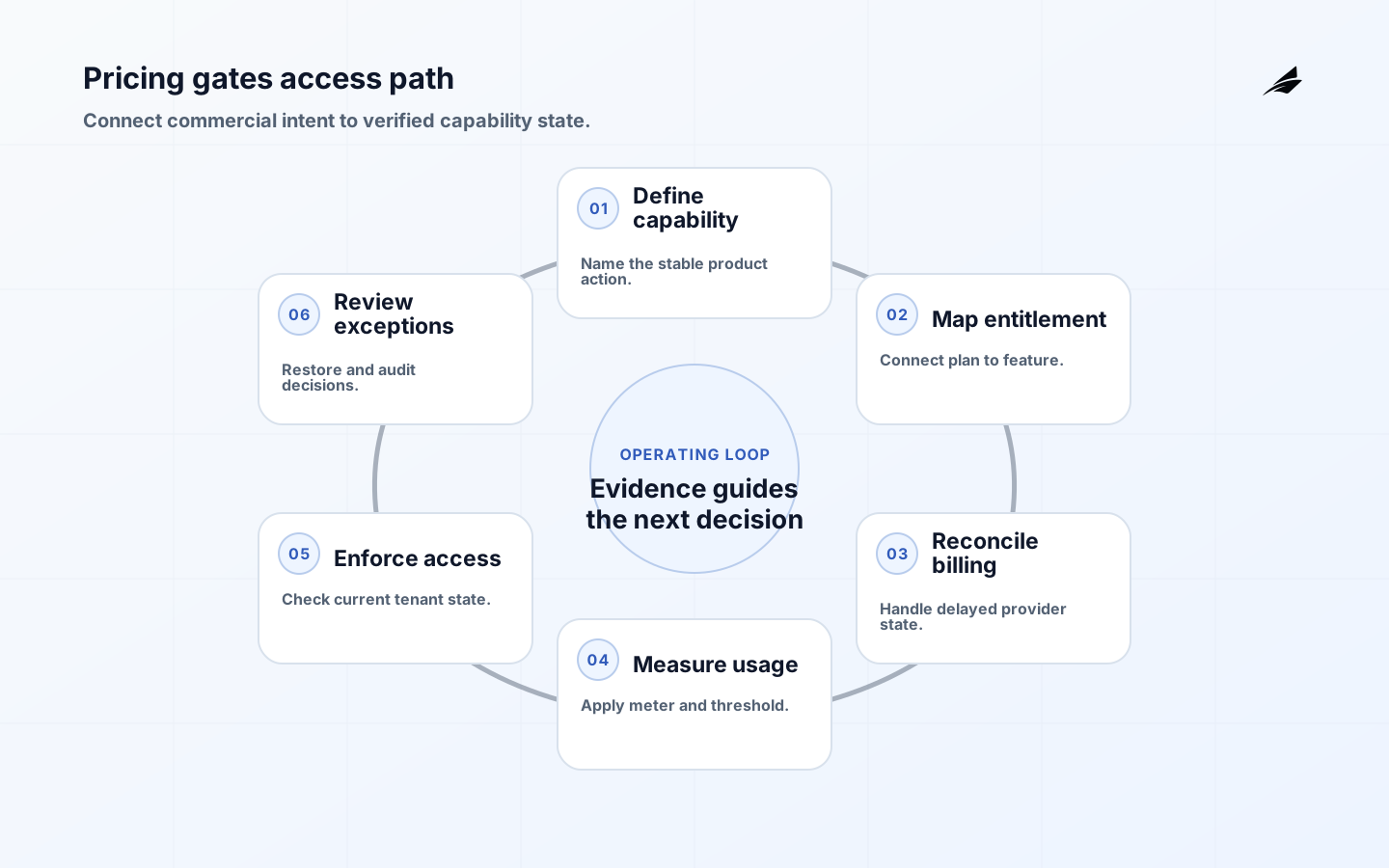
Pricing gates are the points where a commercial decision becomes a product capability: a plan unlocks a feature, a usage threshold triggers a message, a past-due state limits an action, or an administrator approves an exception. They are easy to describe as a few if-statements and difficult to operate when billing, entitlements, usage, support, and authorization disagree. A strong pricing-gates design makes the source of truth, timing, customer communication, and return path explicit. It protects revenue without turning a delayed event into an accidental outage.
For related product decisions, See subscription access control, billing workflow fixes, and self-serve onboarding. For pricing gates, the owner should review the evidence at the handoff Pricing gates often sit at the intersection of all three, so the implementation should not be owned by billing code alone.
Define the capability before the commercial rule
Name the capability, actor, resource, plan or usage condition, effective time, and acceptable degraded behavior. “Pro plan users get exports” is incomplete until export scope, tenant membership, data state, and the effect of a downgrade are defined. Decide whether a gate blocks starting a workflow, limits quantity, changes priority, or only changes presentation. Keep the commercial description and technical entitlement separate but linked. That lets pricing evolve without embedding plan names throughout the product and gives authorization a stable capability to evaluate.
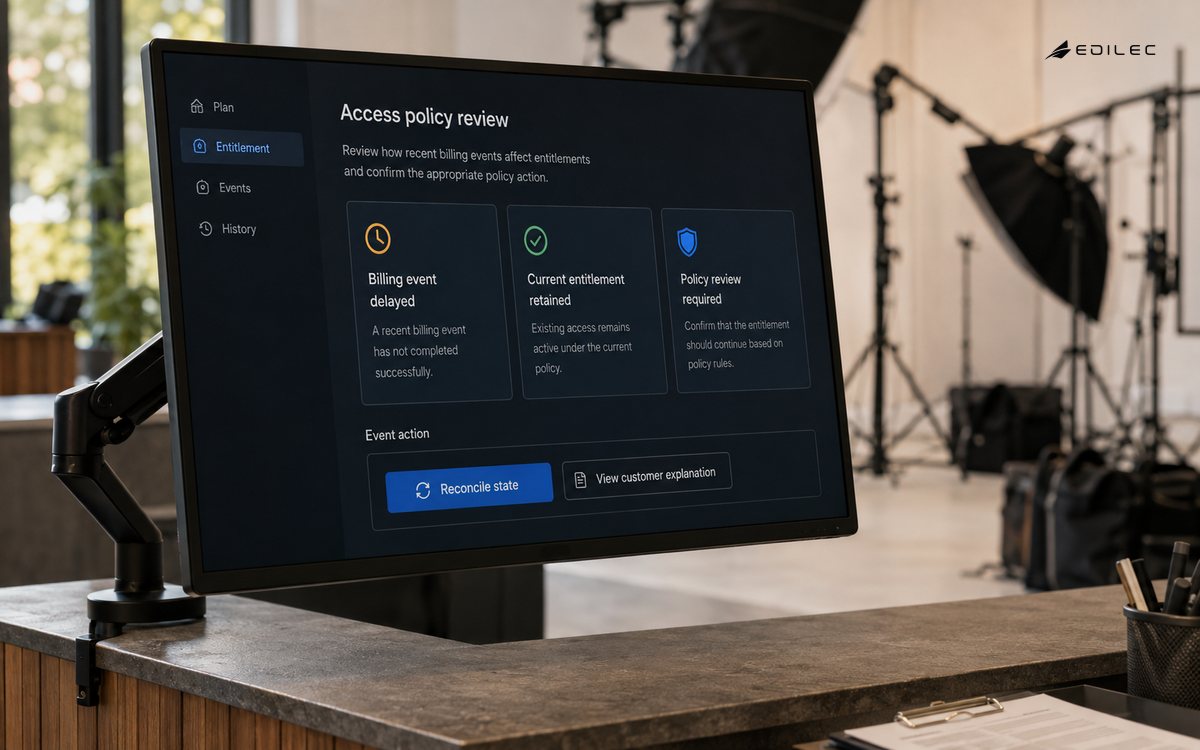
| Gate type | Example decision | Required evidence |
|---|---|---|
| Plan entitlement | Capability is included in the active product. | Product, price, and feature mapping. |
| Usage threshold | Account has reached a measured limit. | Meter definition, period, and observed total. |
| Payment state | Service is active, past due, or unpaid. | Invoice or subscription event and timestamp. |
| Exception | Named reviewer grants temporary access. | Reason, scope, approver, and expiry. |
Use entitlements as a durable boundary
Stripe’s entitlement guidance maps products to feature access and notifies a service when access should be provisioned or de-provisioned. The general design lesson is to represent capability state explicitly instead of scattering plan checks across handlers. Store the capability, subject or tenant, source version, effective period, and current status. The authorization layer should evaluate that state with the actor, resource, and current action. A user interface may hide an unavailable feature, but the server must enforce the decision. If an entitlement is pending, show pending rather than inventing a success or deny state.
Treat billing events as delayed inputs
Subscription and invoice events can be retried, arrive out of order, or be delayed while a provider resolves a payment state. Stripe documents lifecycle transitions such as trialing, active, past_due, canceled, and unpaid; map those states to your own access policy rather than treating one event name as a universal instruction. Verify signatures, deduplicate event IDs, record provider and local timestamps, and make the consumer idempotent. Define a grace period for customer communication, but do not let a grace period become an undocumented permanent entitlement.
- Keep product, price, entitlement, subscription, invoice, and usage identifiers distinct.
- Derive access from a durable local state with a recorded provider event.
- Make event consumers idempotent and safe when events arrive late.
- Define customer-visible messages for pending, grace, restricted, and restored states.
- Give every manual override an owner, scope, reason, and expiry.
Design usage gates around the meter
Usage-based billing has an ingestion, catalog, billing, and monitoring lifecycle. Define the event, unit, aggregation window, tenant attribution, cutoff, lag, rounding, correction, and threshold notification before implementing a gate. A customer should know whether a limit is based on observed usage or a provisional estimate. Engineers should know what happens when the meter is delayed or corrected after a restriction has been applied. Separate a warning threshold from a hard block and ensure the hard block has a safe return path. Do not make an unverified client-side counter authoritative.
| State | Customer behavior | Engineering rule |
|---|---|---|
| Below threshold | Capability works within plan. | Evaluate current entitlement and tenant scope. |
| Near threshold | Show forecast and next action. | Use a consistent meter and notification policy. |
| Exceeded | Warn, limit, or stop as documented. | Require fresh usage evidence and idempotent transition. |
| Corrected | Explain restored or changed status. | Reconcile and record adjustment reason. |
Keep the gate inside authorization
A pricing gate is not a frontend condition. The server must check current entitlement, actor, tenant, resource, action, and lifecycle state on every consequential request. Test direct API calls, old tokens, cached pages, bulk jobs, exports, and background workers. Decide whether a downgrade affects existing data, new writes, scheduled work, or only future capacity. If the business wants a grace path, encode it as a named policy with an expiry rather than an operator habit. Business-logic security guidance is helpful here because the failure is often an invariant mismatch, not a missing role check.
Roll out pricing changes with parallel decisions
Before changing a gate, calculate the old and new entitlement for representative accounts: active, trial, past due, grandfathered, high-usage, refunded, and manually overridden. Compare the results and investigate every difference. Run the new calculation in shadow mode where possible, then enable a bounded cohort with explicit stop conditions. Keep the previous entitlement source available during the observation window. Test provider retry, duplicated events, late usage, cancellation, plan migration, and a failed notification. Financial correctness and customer trust both require a record of why access changed.
Monitor access quality and commercial drift
Track entitlement update lag, event failure, duplicate suppression, access-denial rate, restored-access rate, usage freshness, manual overrides, support contacts, and invoice-to-entitlement mismatches. Segment by plan, provider route, and customer cohort to find a local failure. Alert on durable disagreement between billing and access state, not on every individual event retry. Review the top denied actions with product and support because a spike may reflect unclear messaging or a capability that no longer matches the price description.
- Replay a webhook and verify the entitlement does not change twice.
- Delay usage beyond the period cutoff and inspect the customer-facing state.
- Downgrade an account with existing data and test every affected action.
- Expire an override while a long-running job is active.
- Reconcile a provider invoice and local access record from retained evidence.
A pricing-gates review should compare commercial language with actual product behavior. Choose representative accounts and trace a plan change, a failed payment, a usage threshold, an administrator override, a cancellation, and a restoration. Check the customer message, entitlement record, authorization result, invoice or meter evidence, and support view for each case. Any mismatch is a product and operations issue, not merely a billing bug. Resolve whether the fix belongs in catalog design, event reconciliation, entitlement policy, or customer communication before expanding the gate to every plan.
Pricing-gates work also needs a communication contract. Decide which changes are immediate, which wait for a billing period, which receive a grace window, and which require a customer action. Use the same vocabulary in product copy, invoices, support responses, entitlement records, and audit logs. When a customer can understand why a capability is limited and how to restore it, the business avoids turning an ordinary billing transition into an avoidable trust incident. Review the contract whenever pricing or plan packaging changes.
Include customer support in the gate review because a technically correct restriction can still be operationally confusing. Give support a safe explanation of the source state, the effective time, the next customer action, and the evidence needed for escalation. Do not expose raw payment details or grant a broad override to make the case disappear. A narrow, expiring repair path lets support restore a legitimate account while the billing or meter mismatch is investigated and preserved for the team that owns it.
Key takeaways for pricing gates
- Define a stable capability before embedding a commercial condition.
- Treat billing events and usage as delayed, retryable inputs.
- Keep entitlement state durable, tenant-aware, and enforced server-side.
- Make warnings, grace periods, restrictions, and restoration explicit.
- Roll out changes by comparing old and new decisions with representative accounts.
Pricing gates FAQ
Pricing gates sit between commercial intent and technical authorization. These answers help teams review that boundary before launch.
What is a pricing gate?
A pricing gate is a controlled decision that maps plan or commercial state to a specific capability, limit, or workflow permission. It should name the source, time, scope, and fallback.
Should billing webhooks directly revoke access?
They should update a durable billing state that the authorization layer evaluates, with idempotency, grace rules, and reconciliation. Direct side effects make late or duplicate events harder to control.
How should usage-based gates work?
Define the meter, unit, period, lag, threshold, notification, and behavior when data is delayed or corrected. Keep estimates distinct from finalized usage.
What is a safe migration strategy?
Run old and new entitlement calculations in parallel, compare representative accounts, and keep a reversible rollout with an owner. Communicate material changes before enforcement.
Pricing gates sit between product value and commercial policy, so their design must be understandable to both users and operators. Define the measured entitlement, the point at which access changes, the grace or warning behavior, and the support path for an incorrect state. Test upgrades, downgrades, retries, clock boundaries, and delayed usage events before broad release. Keep the decision server-side and observable, while giving the interface enough explanation to prevent surprise. A good gate can be changed without rewriting historical usage, and a good rollback can restore service without silently changing what a customer was promised.
Conclusion: make commercial intent operationally safe
Pricing gates work when a plan, usage measure, billing state, entitlement, and authorization check tell the same story. Keep those objects distinct, reconcile delayed events, communicate the customer state, and make restrictions reversible when the evidence changes. Revenue protection becomes more durable when the system can explain why access changed and an operator can correct a mismatch without creating another one.
A durable operating note for pricing gates for saas product engineering records the assumptions that made the decision safe: the authoritative source, effective time, permitted actor, protected resource, and recovery route. Make pricing gates corrections visible, scoped, and reversible during a practical guide.
For pricing gates for saas product engineering, a good handoff ends with observable evidence rather than a verbal promise. For pricing gates, record the state, evidence, and recovery path.
The smallest useful improvement to pricing gates for saas product engineering is often a sharper boundary, not another feature. Measure pricing gates outcomes alongside correction effort.
For pricing gates for saas product engineering, test an unexpected load spike before treating the first release as complete.
For Pricing Gates, Stripe Entitlements defines scope; Stripe Subscription Webhooks supports the control; Stripe Usage-Based Billing clarifies evidence; Stripe Subscription Invoices guides recovery; OWASP Business Logic Security Cheat Sheet frames review. For pricing gates, name the decision boundary and its owner.
A practical pricing-gates example is an unexpected load spike; review the measurement used to explain the customer impact.
For pricing gates, separate the customer promise from its mechanism and confirm ownership at release.
Before widening pricing gates, rehearse normal, denied, delayed, and corrected cases, and retain evidence from the release check.
Evidence for “Pricing Gates for SaaS Product Engineering” is grounded in Stripe Entitlements, Stripe Subscription Webhooks, Stripe Usage-Based Billing, Stripe Subscription Invoices, OWASP Business Logic Security Cheat Sheet; each source informs a specific decision, test, or operating trade-off described in this guide.