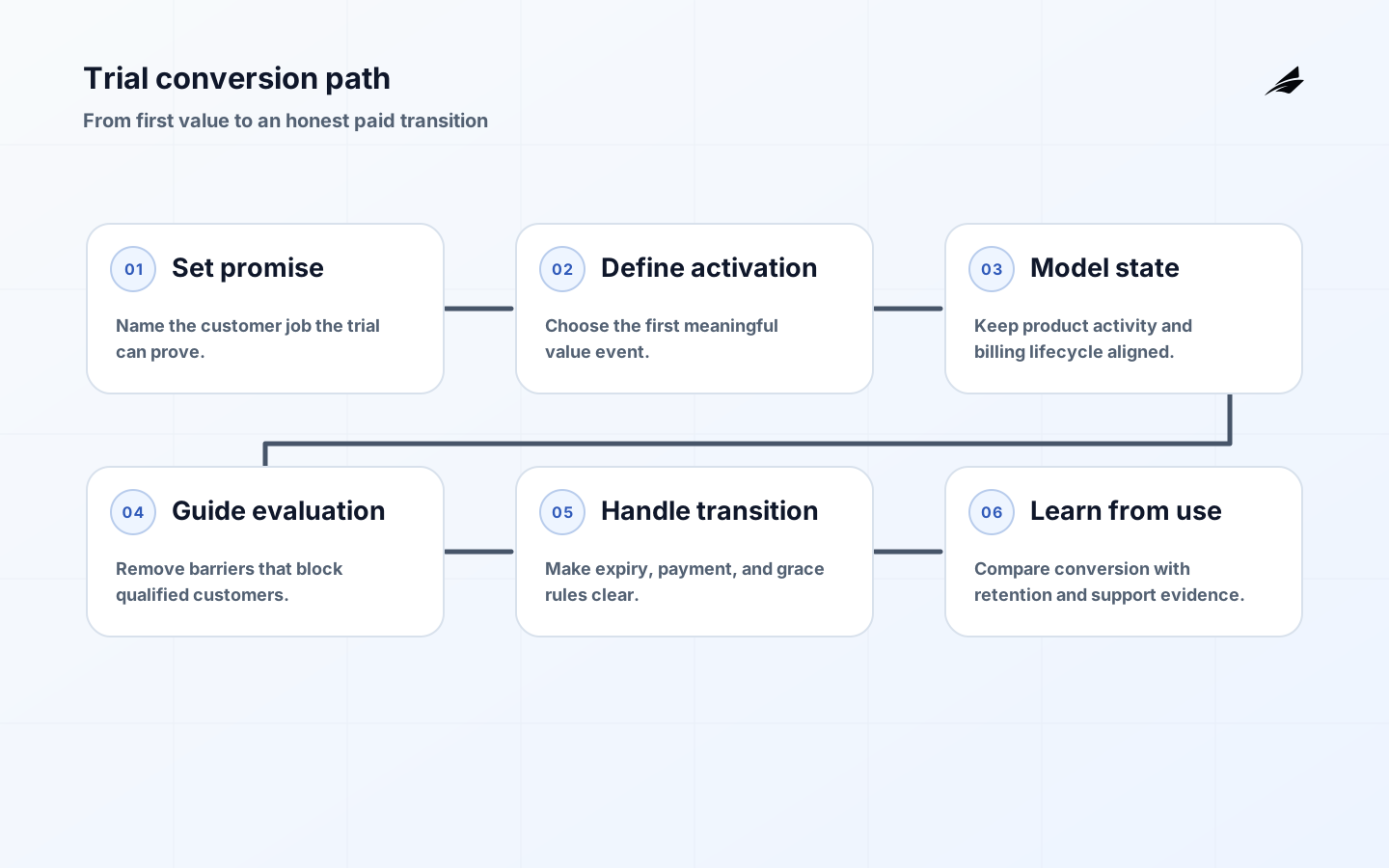
Trial conversion is a product-engineering concern because it shapes what a customer can trust in the product, what an operator can explain, and what a delivery team can change safely. For founders, the work is not to collect more tooling or policy language. It is to make one important decision visible: what state is authoritative, who owns it, which controls enforce it, and how the team learns when reality differs from the plan.
Why Trial conversion Matters
Trial conversion is often reduced to a countdown and a payment form. That framing ignores the question a customer is trying to answer during a trial: can this product reliably help my team complete a worthwhile job? A conversion funnel can look healthy while attracting the wrong users, masking failed activation, or surprising customers at the end of a trial. Founders need a system that links trial design, product value, billing state, and customer trust instead of optimizing one click.
Define one credible activation event before tuning conversion. It should represent a meaningful customer outcome, such as a workspace connecting its source data and producing a reviewed report, not merely creating an account or clicking through a tour. Segment the measure by customer type and acquisition channel because the same event can have different meaning for a solo evaluator and an enterprise team. Only then can pricing prompts and lifecycle messages support the product journey rather than interrupt it.
Build the Operating Model
A sound trial has a clear promise, a path to the first value event, enough time and capability to evaluate that promise, and an honest transition to paid service. The product should explain any limits before a user invests work. Billing state should be modeled separately from product activity so the team can see whether conversion failed because value was not reached, ownership was unclear, payment details were unavailable, or the customer deliberately chose not to continue.

| Trial decision | Useful question | Risk if ignored |
|---|---|---|
| Activation | What observable outcome proves first value? | Account creation is mistaken for customer progress. |
| Scope | Which capabilities are needed to evaluate the promise? | Limits either prevent evaluation or create unbounded cost. |
| Expiry | What happens when the trial ends? | Customers see inconsistent messages and access. |
| Payment | When and how is consent collected? | Surprise charges create refunds and distrust. |
Specify trial rules as product policy: eligibility, start and end time, included capability, usage limit, payment collection approach, notification timing, and what happens at expiry. Avoid implementing these rules only in the front end. A customer may return from another device, an event may arrive late, or an account may be managed by an administrator. Write transition rules for upgrades, cancellation, extension, grace periods, and payment failure, then test that every channel reflects the same state.
Design the Architecture and Controls
Use an event trail that joins acquisition, account creation, onboarding actions, activation, trial notices, billing transitions, and support contacts. Keep identifiers privacy-aware and minimize collection to what the product actually needs. Trigger messages from state changes rather than from guessed dates in a marketing tool. When the billing provider sends a lifecycle event, verify it, process it idempotently, and show the resulting state in the account. The customer should never be told they are active while the product denies access.
Conversion work can easily damage trust. Dark patterns, hidden limits, and unexpected charges may increase a short-term metric while creating refunds and support burden. A broad trial with no first-use guidance produces inactivity that looks like weak demand. A narrow trial that blocks evaluation produces false negatives. Watch for people who reach activation but cannot invite a decision-maker, and for teams that enter payment details yet never use the product again. Those are product questions, not copywriting problems.
Roll Out with Evidence
Begin with an instrumented baseline rather than a redesign. Map the existing path and interview a small set of converted, expired, and refunded customers. Form one hypothesis about the largest barrier to activation, make a reversible change, and predefine the segment and outcome that would support it. Do not run overlapping changes that make attribution impossible. Review downstream effects such as support contacts, payment failures, and retention before declaring a conversion experiment successful.
| Signal | What it can reveal | First response |
|---|---|---|
| High signup, low activation | The onboarding path does not reach value | Observe the first blocked step and simplify it. |
| Activation, low conversion | Value or buying authority is incomplete | Review plan fit, collaboration, and proof of value. |
| High payment failure | Billing transition is unclear or fragile | Check notices, payment method flow, and event handling. |
| High early refund | Expectation and delivered value diverge | Compare acquisition claim with real first-use experience. |
Operate and Measure
Use a balanced scorecard: eligible visitors, account creation, activation, time to first value, invited collaborator rate, trial-to-paid conversion, payment failure, refund, and early retention. Add qualitative evidence from cancellation reasons and support transcripts. A useful conversion metric should tell the team what to improve next. It should not pressure the team to charge people before they understand the product. The strongest signal is durable usage by the customer group the business is built to serve.
- Define conversion around a meaningful customer outcome.
- Make trial eligibility, limits, and expiry explicit.
- Connect billing events to a trustworthy product state.
- Evaluate experiments with retention and support signals.
- Prefer clear consent and durable trust over a transient rate.
Implementation Detail
Consider a trial for a collaborative reporting tool. A sensible activation event might be that a team connects a source, produces a report, and shares it with the colleague who approves the result. A solo account that opens a dashboard has not necessarily evaluated the product's value. This definition changes the design: the trial may need a safe sample data option, a clear invitation path, and a way to show the report's provenance. It also changes analysis, because conversion should be read after activation by the intended segment.
Lifecycle messages should be triggered by a customer state that the product can defend. A reminder before expiry can refer to the work already completed and the next evaluation step, rather than use a generic urgency message. If payment details are required, explain when a charge can occur and what happens when they are absent. When a trial expires, preserve enough read-only evidence or export capability for a customer to make a decision, subject to the product's data and cost model. Surprise is not a conversion strategy.
Review Before Scaling
Test trial transitions with the same care used for production billing. Simulate a person upgrading from another device, a payment method failing after expiry, a cancellation arriving after a renewal attempt, and an administrator extending a trial. Check the account page, protected APIs, email or in-product notices, and support tools for consistent state. A discrepancy may not affect aggregate conversion reporting, but it will affect the customer who sees it. Make retries idempotent and make the state transition visible to an operator.
Founder reviews should connect conversion with the rest of the business. Look at whether converted customers retain, whether support workload rises after a change, and whether the trial is attracting the segment the product can genuinely serve. Review refunds as product evidence rather than a nuisance metric. This keeps the team from optimizing for a transaction while leaving value delivery unresolved. A smaller, better-qualified trial cohort can be more informative and more durable than a large funnel with ambiguous intent.
Conversion analysis benefits from a counterfactual question: did the change help the intended customer reach value, or did it merely change who reached the payment screen? Hold a stable comparison where possible, document concurrent product changes, and read results over a period long enough to include early retention. This discipline prevents the team from declaring success on a short-lived shift in funnel behavior. Review this evidence with the owner of trial conversion, the people who operate the surrounding workflow, and the team responsible for customer communication. Agree on one change, one measure, and one follow-up date. That closed loop keeps local fixes from becoming unexamined policy and makes the next decision easier to defend.
Key Takeaways
- Make trial conversion a named operating decision rather than an implicit implementation detail.
- Keep customer impact, evidence, and recovery visible to the team that owns the workflow.
- Start with a narrow path, learn from real outcomes, and expand only after the controls hold.
Frequently Asked Questions
Where should a team start with trial conversion? Start where an incorrect decision would create meaningful customer, commercial, or operational harm. Map the current state, the owner, the boundary, and the evidence available during failure. How much process is enough? Use the smallest process that makes the decision repeatable, reviewable, and recoverable. Add rigor when the data, action, or customer consequence makes a shortcut unsafe.
Conclusion
Strong trial conversion work is not a one-time project. It is a durable agreement between product, engineering, and operations about how the system behaves under ordinary and difficult conditions. When the contract, controls, telemetry, and recovery path agree, founders can improve the product without turning each release or customer exception into a new source of uncertainty.
The practical continuity test for trial conversion is whether a qualified teammate who did not design the workflow can inspect the current state, understand the relevant decision and its limits, and take the next safe action without improvised access or tribal knowledge. Keep the owner, evidence location, escalation route, and recovery rule visible. That discipline makes routine operations calmer and gives the organization a reliable starting point when a customer, release, or incident exposes a new edge case.
Sources
The implementation advice in this trial conversion guide is grounded in Stripe subscription trial documentation, Web Content Accessibility Guidelines 2.2, OWASP Application Security Verification Standard, Google SRE product-focused reliability guidance. These references are useful for checking platform-specific controls and terminology during delivery; the decisions here still need to be applied to the product's data, risk, and customer context.