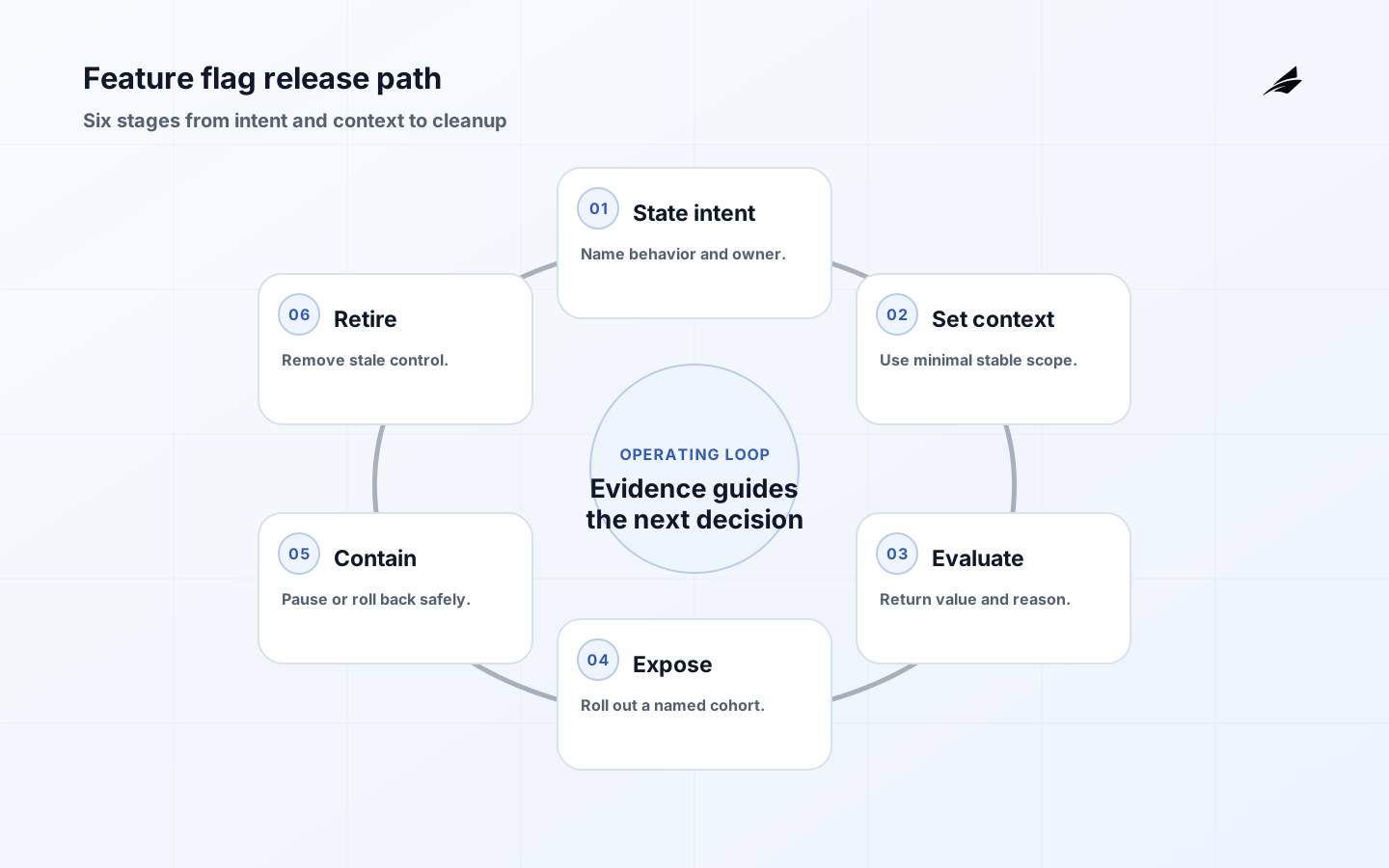
Feature flags let a team deploy code separately from exposing behavior to users. That separation can make a release safer, a canary smaller, and an incident response faster. It can also create a hidden policy layer if flags are added without a purpose, owner, default, scope, or removal rule. The useful unit is not the toggle in an admin screen; it is the decision made for a subject in a context at a particular version. This feature flags guide explains how to design that decision, enforce it where it matters, measure it without leaking sensitive context, and remove the control when its work is complete.
Define the flag contract
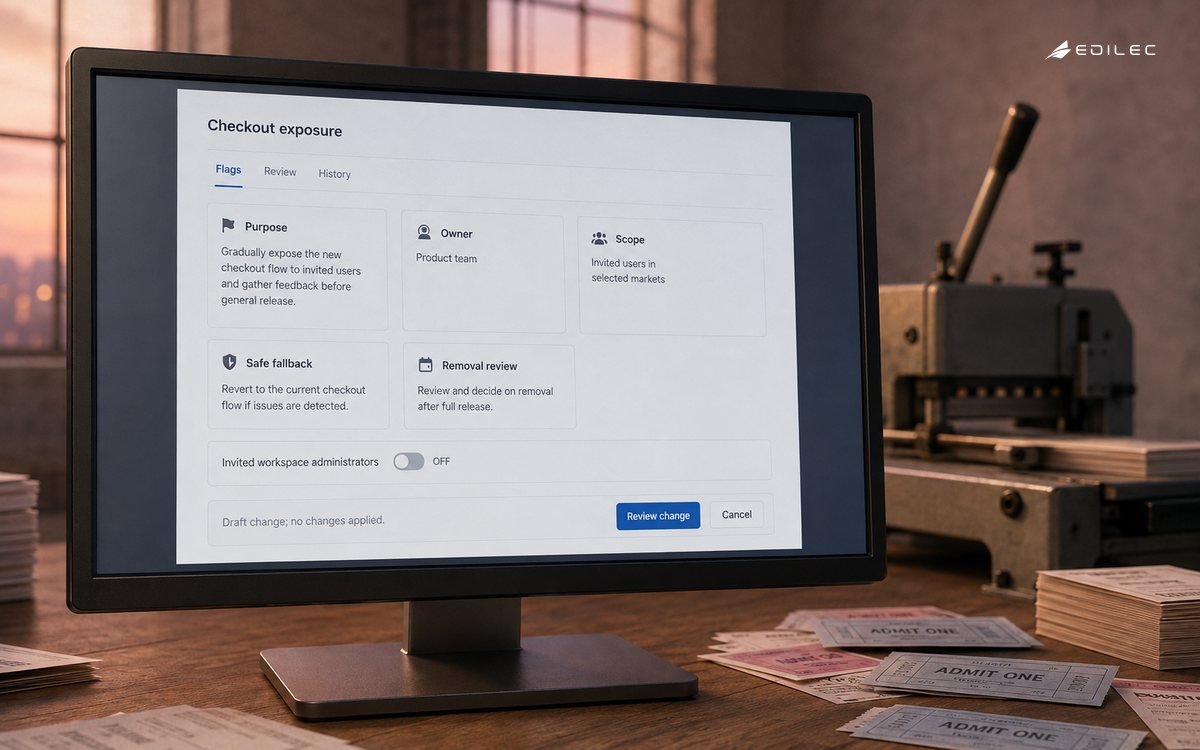
Every flag should answer five questions before code depends on it: what behavior changes, why the change is temporary or durable, who owns the decision, what the safe fallback is, and when the flag will be reviewed. Give the flag a meaningful key and a description that a responder can understand during an incident. A name such as new_checkout_v2 says less than a contract such as “use the new checkout for invited workspace administrators after payment validation. ” Avoid putting secrets, credentials, or high-cardinality personal data in targeting context.
OpenFeature describes feature flags as runtime-controlled changes to application behavior and separates the evaluation API, provider, context, hooks, and events. That separation is a useful architecture boundary even when a team uses a different implementation. Keep application code dependent on a stable evaluation interface, keep the provider replaceable, and make the context explicit. A flag should never be the only check around a privileged mutation. The domain service still decides whether an actor may perform the action.
| Flag kind | Good use | Required retirement signal |
|---|---|---|
| Release flag | Expose a shipped path to a cohort | Cohort reaches decision and code path is removed |
| Kill switch | Disable a harmful or expensive behavior | Incident review and replacement control |
| Experiment | Compare defined variants against an outcome | Analysis complete and winner or stop decision recorded |
| Entitlement flag | Shape a product package | Commercial policy owner and authorization review |
| Operations flag | Tune a bounded runtime behavior | Service owner removes or documents durable policy |
Place evaluation at the right boundary
Evaluate a flag as close as practical to the behavior it controls, but do not confuse proximity with authority. A client-side evaluation can hide a button, yet a server-side command must validate the actor, tenant, resource state, and flag outcome again. A cached value can be useful for availability, but its age and fallback need to be understood. For a destructive action, a stale “enabled” value should not silently grant permission. Treat the flag as one input to a domain decision rather than as a substitute for an authorization policy.
The OpenFeature evaluation model includes a default value and detailed evaluation information such as reason, variant, and error code. Use those fields to make failure behavior explicit. If the provider is unavailable, decide whether the application should remain on the old path, fail closed, or place the operation in a pending state. The right answer depends on the consequence: a cosmetic layout can fall back locally, while a cross-tenant export may need a hard stop and operator review.
| Context field | Example | Control question |
|---|---|---|
| Targeting key | Workspace or subject identifier | Is it stable and non-sensitive? |
| Role | Workspace administrator | Is membership current at execution? |
| Environment | Production | Can test rules leak into live traffic? |
| Version | Application release | Does the flag support rollback by version? |
| Region or tier | Contracted service tier | Who owns the commercial meaning? |
| Evaluation result | Variant, reason, error | Can a responder explain the choice? |
Target small cohorts with stable context
Start with an audience the team can name and support. Internal users, a test workspace, or a percentage of low-risk traffic is easier to observe than a vague “early adopters” rule. Make cohort membership deterministic so a person does not alternate between variants during one workflow. If the flag affects a multi-step transaction, bind the decision to the relevant workspace or transaction version where consistency matters. Document exclusions for support, compliance, or contractual reasons instead of hiding them in a nested rule.
Do not treat targeting data as harmless configuration. A rule based on email domain, geography, plan, or account size may reveal business-sensitive information through behavior or logs. Apply data minimization and keep only the context needed to make the decision. If a flag determines access to personal or regulated data, run a security and privacy review before rollout. The OWASP ASVS provides a practical control vocabulary for validating authentication, access control, logging, and data protection around the code that uses the flag.
Observe decisions and outcomes together
A flag change is not successful merely because evaluations return the expected value. Track exposure, meaningful completion, errors, latency, support contacts, and rollback actions in the same release context. OpenTelemetry’s semantic conventions provide common names and attributes for operations and data across traces, metrics, logs, profiles, and resources. Use a stable flag key and variant in controlled telemetry, but avoid logging raw targeting attributes that do not help diagnose the outcome. The event should let a responder connect a behavior change to a release without creating a second store of personal profiles.
Add guardrails before widening a cohort. For a new import flow, watch successful import completion, duplicate records, correction work, and time to recovery. Set the rollback condition in advance: if the error rate or data correction rate crosses a meaningful threshold, stop exposure and preserve evidence. During review, ask whether a decrease in errors came from better behavior or from users abandoning the path. Pair metrics with support notes and targeted testing so the flag tells a truthful story.
Retire flags before they become policy debt
When a release decision is complete, remove the flag from code, configuration, tests, dashboards, and documentation. A flag that remains after the code path converges still adds cognitive load and can be changed accidentally. Assign a removal owner at creation, set an expiry reminder, and make stale flags visible in the release checklist. A durable operational control can be retained, but rename and document it as such instead of disguising a permanent policy as temporary release plumbing.
Test the hard cases explicitly: provider outage, missing flag, malformed rule, stale cache, changed role, duplicate request, and rollback after partial exposure. Ensure the application has a bounded response for each case. Keep flag changes auditable with actor, scope, previous value, new value, reason, and time. The record should support incident response without exposing secrets. A cleanup pull request can be as important as the launch pull request because it removes an entire class of future ambiguity.
For a release review, Print or pin the flag contract beside the deployment checklist. Confirm the code path, provider configuration, default, cohort rule, owner, expiry, dashboard, rollback command, and customer communication. Test the configuration that will be used in production rather than assuming a staging rule has the same context. This makes the flag a deliberate release artifact and gives the responder a short path to containment if the rollout behaves differently than expected.
A useful cleanup query lists flags by age, environment, owner, code references, last change, and evaluation error. Review the list with product and engineering together. A flag that is old but still needed may deserve a durable policy name; a flag with no owner should be paused or removed after impact is understood. The cost of cleanup is small compared with debugging a nested rule during an incident six months after the original launch.
Key takeaways
- Give every feature flag a purpose, owner, safe default, audience, and review or removal date.
- Use flags to control exposure, never as the sole authorization check for protected actions.
- Keep evaluation context stable, minimal, and explainable under provider or cache failure.
- Observe flag decisions alongside customer outcomes, errors, and recovery work.
- Test outages, stale values, changed membership, partial rollout, and rollback before widening exposure.
- For related product delivery decisions, See roadmap systems, product analytics, and usage reporting.
Frequently asked questions
What is the safest default for a feature flag?
The safest default is the behavior that limits harm when the provider, rule, or context is unavailable. That may be the established path, a denied operation, or a pending state. Decide per workflow; one global default is rarely appropriate for cosmetic behavior, writes, and security-sensitive actions.
Are feature flags an authorization system?
No. A flag can control which experience is exposed, but authorization must be enforced by a trusted service using current identity, membership, resource state, and policy. Treat a client-side flag as presentation control, not as proof that an action is allowed.
How long should a release flag live?
Keep it for the rollout and learning window, then remove it when the team has made the continue, change, or stop decision. If the flag remains because it represents a lasting business rule, give it a durable owner and policy description instead of letting its temporary name mislead future maintainers.
What belongs in a flag audit record?
Record the actor or automation, affected environment and cohort, previous and new value, reason, timestamp, release or incident reference, and resulting evaluation state where useful. Exclude secrets and unnecessary personal data. The record should answer who changed what, for whom, why, and what happened next.
Conclusion: make runtime change deliberate
Feature flags are valuable when they make change smaller, observable, and reversible. They become dangerous when a toggle quietly becomes an authorization shortcut or an unowned second configuration system. Define the contract, evaluate with explicit context, enforce authority at the domain boundary, measure outcomes, and remove the control after the decision. That discipline turns feature flags into dependable release infrastructure.
A durable operating note for plain-language feature flags for safer releases records the assumptions that made the decision safe: the authoritative source, effective time, permitted actor, protected resource, and recovery route. Review that evidence with product, engineering, and support before expanding the flag.
For plain-language feature flags for safer releases, a good handoff ends with observable evidence rather than a verbal promise. Reconcile plain-language feature flags for safer releases changes against the original record.
The smallest useful improvement to plain-language feature flags for safer releases is often a sharper boundary, not another feature. Use plain-language feature flags for safer releases support evidence to decide whether the workflow is ready.
For plain-language feature flags for safer releases, test a revoked permission before treating the first release as complete. For plain-language feature flags for safer releases, name the decision boundary and its owner.
This decision also connects to Product Analytics in Plain Language: Events That Support Decisions, The Plain-language Guide to Onboarding Flows, Pricing Gates Without Surprise: A Practical Entitlement Design Guide. Review those boundaries together when plain-language feature flags for safer releases shares identity, data, billing, or support evidence with another workflow.
For Plain-language Feature Flags for Safer Releases, OpenFeature Introduction defines scope; OpenFeature Flag Evaluation API supports the control; OpenTelemetry Semantic Conventions clarifies evidence; OWASP Application Security Verification Standard guides recovery. Keep customer language aligned with the recorded state for plain-language feature flags for safer releases.
Evidence for “Plain-language Feature Flags for Safer Releases” is grounded in OpenFeature Introduction, OpenFeature Flag Evaluation API, OpenTelemetry Semantic Conventions, OWASP Application Security Verification Standard; each source informs a specific decision, test, or operating trade-off described in this guide.