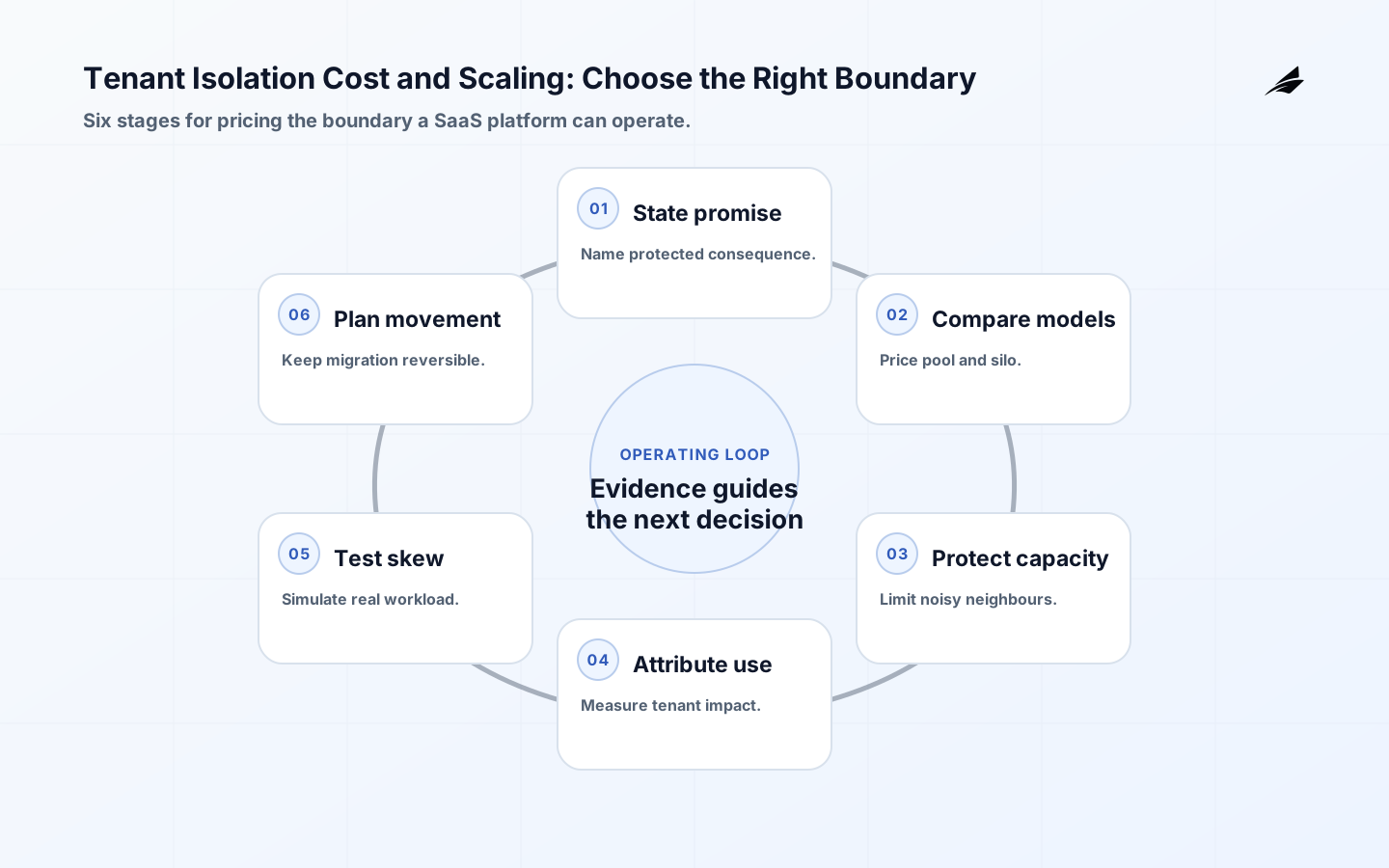
Tenant isolation cost is not the price of a database per customer. It is the cost of keeping a tenant from reading, affecting, or being affected by another tenant while the platform changes and scales. A pooled model can be efficient and agile; a silo can reduce blast radius or satisfy a requirement; a bridge can reserve stronger separation for selected workloads. The useful question is not which model sounds safest, but which boundary protects the material consequence at a sustainable operating cost. This guide complements the tenant isolation checklist and the plain-language tenant isolation guide.
Define the isolation cost boundary before comparing designs
Write the customer promise in terms of resources and consequences: data must not cross a tenant boundary, one workload must not exhaust shared capacity, and a repair must not touch an unrelated account. Identify the data, compute, queues, caches, object stores, keys, network paths, and operators involved. AWS notes that isolation strategies vary with domain, compliance, deployment model, and services. Translate that observation into cost categories: infrastructure, provisioning, upgrades, capacity headroom, telemetry, tests, support, audit, incident response, and migration. A model that is cheap to run but expensive to prove or repair may not be the economical choice.

| Cost category | Pool exposure | Silo exposure |
|---|---|---|
| Infrastructure | Shared capacity and allocation controls | Per-tenant capacity and idle cost |
| Operations | Central changes with broad impact | More provisioning and lifecycle tasks |
| Isolation proof | Logical policy and negative tests | Resource boundary plus path checks |
| Incident scope | Potentially wider blast radius | Often easier tenant-specific containment |
Compare pool, silo, and bridge models using the same workload
Use a representative workload rather than a blank architecture diagram. Estimate steady traffic, burst traffic, storage growth, search activity, background jobs, exports, and tenant onboarding. A pool benefits when demand is uneven because capacity can be shared, but AWS calls out noisy neighbours, harder tenant cost tracking, larger impact scope, and compliance pushback as trade-offs. A silo makes attribution and containment clearer, but it can strand capacity and increase operational repetition. A bridge can reserve a separate queue, storage class, or account for high-risk work while pooling the rest. State what moves between segments and how that move is authorised.
Price noisy-neighbour protection as a product control
A shared platform needs a policy for how much load each tenant may create and how the system responds when the limit is reached. Use rate limits, concurrency caps, queue weights, reserved capacity, payload limits, or workload-specific quotas where they fit. Decide whether the user sees a retryable delay, a hard limit, or a request for an upgrade; this is a product promise as well as a platform mechanism. Measure the effect on other tenants, not only the caller that exceeded its budget. AWS recommends proactive tenant-aware health data and throttling because a disproportionate workload can cascade into a wider reliability problem.
Make shared consumption attributable enough to manage
A pooled environment does not need perfect accounting to support good decisions, but it does need a useful attribution model. Attach tenant and workload context to requests, jobs, storage operations, and capacity signals where privacy and cardinality allow. Separate measured consumption from chargeable usage; the two may use different time windows or exclusions. Review the tail of the distribution, because a small number of tenants may create most of the queue, index, or export cost. When a pricing or capacity policy changes, preserve the old definition long enough to explain customer-facing differences and reconcile the transition.
| Signal | Decision supported | Failure to avoid |
|---|---|---|
| Peak concurrency | Set fair workload limits | Protecting averages while bursts fail |
| Storage and index growth | Choose partition or migration timing | Late discovery of a hot tenant |
| Queue age by tenant | Add capacity or adjust priority | One backlog hiding several experiences |
| Cost per useful outcome | Compare architecture and product value | Optimising infrastructure while support cost rises |
Include cost and scale in isolation tests
AWS's SaaS foundations guidance recommends cross-tenant impact, tenant consumption, workflow, onboarding, throttling, data distribution, and isolation tests. Build those scenarios before the platform has accumulated an irreversible data footprint. Use flat, spiky, and skewed distributions; test a single very large tenant beside many small tenants; and include third-party dependencies such as billing or provisioning. Capture resource use, customer latency, denied work, recovery time, and cost deltas. A design that passes a clean security test but fails under a concentrated workload has not solved the tenant isolation problem it will meet in production.
Budget the operational evidence, not only the runtime
Every isolation model needs dashboards, alerts, access reviews, test fixtures, runbooks, release checks, and people who can investigate. A pooled model may need more tenant-aware telemetry and policy tests; a silo model may need more fleet management and configuration drift detection. Include support training and customer communication in the estimate. A control that no one can interpret during an incident becomes a hidden liability. NIST's SSDF is a useful lifecycle lens because secure development practices need to be integrated with the delivery model rather than added as a final approval step.
Plan migration and reversibility before scale removes options
If the first architecture is pooled, define what evidence or workload threshold would justify moving a tenant or resource into a bridge or silo. If the first architecture is siloed, define how common upgrades, schema changes, and observability remain manageable. Use stable tenant identifiers and migration states such as planned, copying, dual-read, verified, and cut over. Keep a rollback or quarantine path for partial moves. The cost of change is often dominated by data shape, customer downtime, and evidence gaps rather than compute. Designing the transition early makes the architecture a choice instead of a trap.
Make the decision with a scorecard and an owner
Score each model against the actual requirements: confidentiality, integrity, availability, compliance, tenant growth, workload skew, operator access, cost attribution, deployment speed, recovery, and migration. Use a high, medium, or low rating only when the supporting evidence is written. Name the assumption that could change the score, such as a new regulated segment or an export feature. The accountable owner should be able to say what will be measured after launch and which threshold triggers reconsideration. This is more durable than choosing the architecture that is easiest to describe in a sales slide.
Turn the architecture choice into a scorecard
A practical scorecard can compare three models across confidentiality, availability, compliance, capacity efficiency, tenant cost attribution, fleet operations, deployment speed, incident containment, and migration effort. Give each criterion a consequence and evidence source. For example, “pool is cheaper” is incomplete; “pool reduces idle compute for uneven tenants, but requires queue isolation and creates a broader failure scope” is a decision statement. Note the assumptions that could invalidate the comparison, such as a regulated customer segment or a new export workload. Have the product, platform, security, finance, and support owners sign the assumptions rather than only the preferred model. Revisit the scorecard after a representative workload test. The written trade-off becomes a useful operating asset when it explains why the boundary exists and what evidence would justify changing it.
Do not let a cost review remove the evidence that made the boundary defensible. If tenant-level telemetry is too expensive or too cardinal, aggregate it at a useful workload dimension, sample a defined reference, or retain an event summary rather than discarding attribution entirely. The decision should state what is no longer observable and which compensating control remains. A lower platform bill is not a successful optimisation if it lengthens incident investigation or makes a noisy-neighbour dispute impossible to explain. Treat evidence as part of the service being bought.
A bridge can be introduced gradually by moving one high-impact resource class first, such as exports or regulated files, while leaving ordinary reads pooled. Measure containment, provisioning time, support effort, and customer latency before moving more. If the bridge introduces a new policy service, include its failure mode in the comparison; a stronger storage boundary does not help if routing falls back to a broad shared path. Staged separation turns an architectural preference into evidence about which boundary produces the most value.
Key takeaways
- Count proving, operating, supporting, and migrating an isolation model—not just its infrastructure.
- Compare pool, silo, and bridge designs against the same skewed workload and customer consequence.
- Treat noisy-neighbour controls and customer messaging as one capacity product decision.
- Instrument enough tenant-aware consumption to manage cost without exposing unnecessary customer detail.
- Set thresholds and migration states before scale makes a boundary expensive to change.
- Related reading: the plain-language guide to feature flags and Tenant Isolation for SaaS Product Engineering: A Practical Guide. For isolation cost scaling, retain the reason and effective time with the outcome.
Frequently asked questions
Why do teams choose a pool despite the risk?
Pooling can improve capacity utilisation, simplify fleet-wide changes, and support faster product iteration. It is a valid choice when the logical boundaries, capacity controls, testing, and compliance evidence are strong enough for the service being offered.
What is a bridge model good for?
A bridge model reserves stronger separation for selected tenants, data classes, or workloads while keeping lower-risk paths pooled. It is useful when requirements vary, but only if the transition and shared control plane are clearly governed.
Which metric should trigger an architecture review?
Use a set rather than one number: cross-tenant test failures, noisy-neighbour impact, cost attribution gaps, support and recovery effort, compliance requirements, and a sustained workload pattern that violates the original assumptions.
Conclusion: buy the boundary you can operate
Tenant isolation cost is the price of a trustworthy promise over time. A shared model can be efficient, a silo can be protective, and a bridge can make a mixed customer base practical. The decision becomes sound when the team prices the operational evidence, tests skewed load, protects capacity, and keeps a migration route open. Choose the boundary that matches the consequence and the people available to run it, then review it from real workload rather than architectural fashion.
For tenant isolation cost and scaling, a good handoff ends with observable evidence rather than a verbal promise. Test tenant isolation cost and scaling with normal, delayed, denied, and corrected workflow cases.
The smallest useful improvement to tenant isolation cost and scaling is often a sharper boundary, not another feature. Review tenant isolation cost and scaling evidence with product, engineering, and support for and scaling guide.
For tenant isolation cost and scaling, test a duplicated request before treating the first release as complete. Reconcile tenant isolation cost and scaling changes against the original record.
A practical example for tenant isolation cost and scaling is an operator loses access during a handoff. Give tenant isolation cost and scaling a named owner and a review date for and scaling guide.
This decision also connects to Trial Conversion Engineering Notes for Safe State Changes, How Engineering Teams Should Think About Workspace Models, How Engineering Teams Should Think About Roadmap Systems. Review those boundaries together when tenant isolation cost and scaling shares identity, data, billing, or support evidence with another workflow.
For Tenant Isolation Cost and Scaling, Tenant Isolation - SaaS Lens defines scope; The isolation mindset - SaaS Lens supports the control; Pool isolation - SaaS Lens clarifies evidence; Secure Software Development Framework (SSDF) Version 1. 1 guides recovery.
Evidence for “Tenant Isolation Cost and Scaling: Choose the Right Boundary” is grounded in Tenant Isolation - SaaS Lens, The isolation mindset - SaaS Lens, Pool isolation - SaaS Lens, Secure Software Development Framework (SSDF) Version 1.1; each source informs a specific decision, test, or operating trade-off described in this guide.