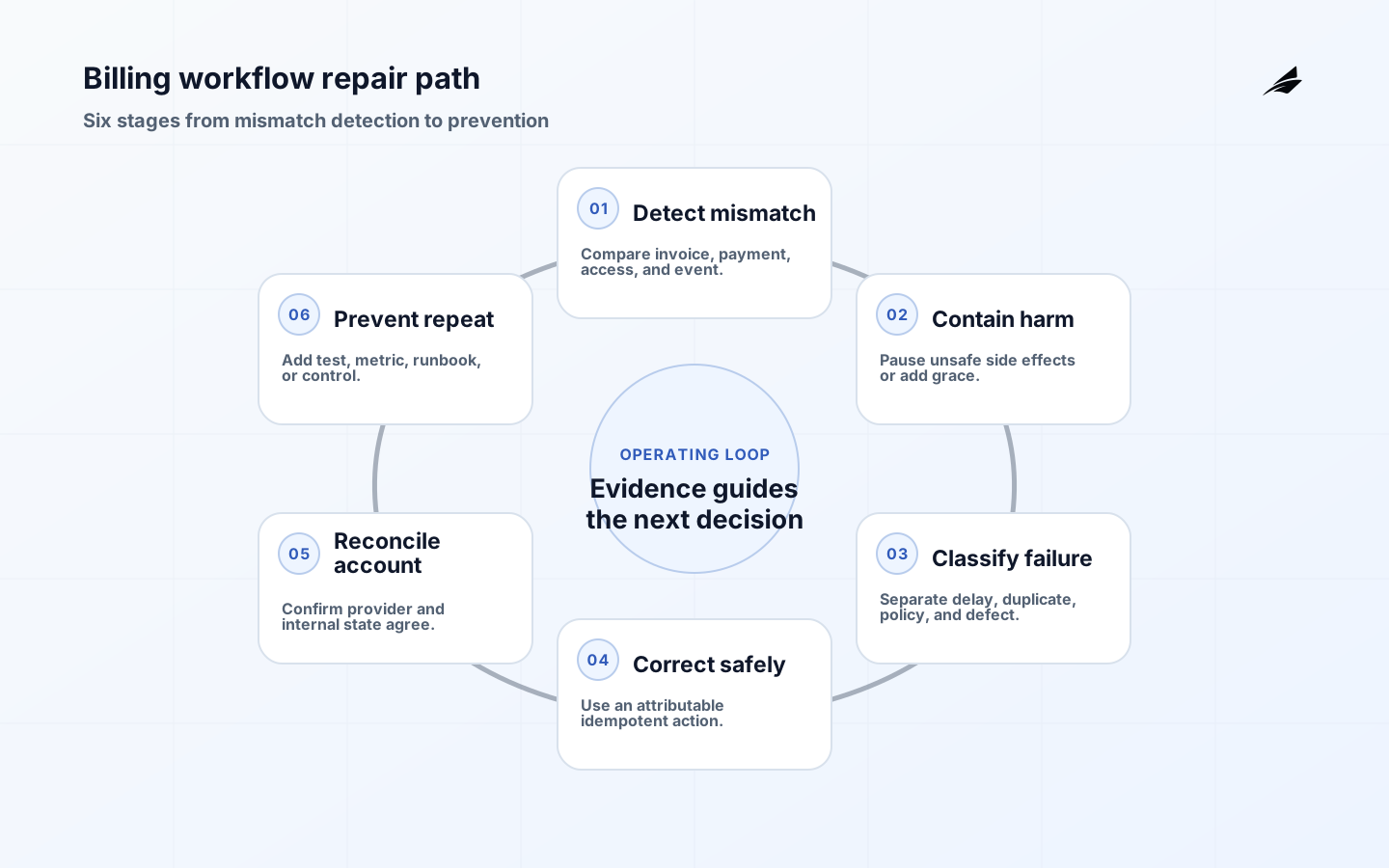
Billing workflow mistakes become expensive when a system cannot explain which state it trusted. A paid invoice may coexist with a stale entitlement, a failed payment may be retried after a customer has already supplied a new method, or a duplicate webhook may issue the same credit twice. Stripe's documentation separates invoices, subscriptions, payment outcomes, retries, and events; that separation is the foundation for fixing billing workflows. Edilec's plain-language billing workflows guide explains the normal lifecycle. This article focuses on failure patterns, containment, and repair.
Mistake 1: collapsing billing states
The most common error is a single paid boolean used for invoice display, entitlement, customer messaging, and finance reporting. Invoice creation, payment success, subscription status, and access policy answer different questions. The fix is to retain each state and define the transition that matters for each side effect. A customer may see payment action required while access remains in a short grace period; finance may hold the invoice open; support may route the account to a secure update flow. Make these states visible in logs and support tooling so operators do not guess from a summary field.
Mistake 2: treating webhooks as trusted commands
A webhook is an external observation, not permission to perform every downstream action. Verify authenticity, record the event ID, handle duplicates, fetch current state when necessary, and reject transitions that do not fit the account. Webhook delivery can be delayed or retried, and a later event may be received before an earlier one. The repair is a state machine with idempotent transitions, not a switch statement that sends an email on every message. Make replay testing part of the integration contract.
| Mistake | Visible symptom | Fix |
|---|---|---|
| One paid flag | Access and finance disagree. | Model invoice, payment, subscription, and entitlement separately. |
| Command webhook | Duplicate or premature side effect. | Verify, deduplicate, and apply allowed transitions. |
| Hidden retry | Customer sees unexplained attempts. | Expose policy, next attempt, and terminal state. |
| Manual database edit | No audit or reproducible reason. | Use an attributable correction workflow. |
| No reconciliation | Old exceptions accumulate. | Compare provider and internal records on a schedule. |
Mistake 3: using one retry policy for every failure
A temporary issuer decline, missing payment method, authentication requirement, and hard decline do not deserve identical treatment. The fix is to classify failure evidence, choose a retry or customer-action path, and define what happens after the final attempt. Stripe documents Smart Retries and invoice.payment_failed events as part of recovery, but the product still owns the customer experience and entitlement rule. Tell the customer when another attempt will occur, how to update payment details, and what access remains during the grace period. Do not promise recovery merely because a retry is scheduled.
Mistake 4: changing plans before payment is settled
A mid-cycle upgrade can create a prorated invoice or require authentication. If the application grants the larger entitlement as soon as the update request is accepted, it may deliver service for a charge that never succeeds. The repair is a pending transition: calculate the change, show the amount and action, wait for the qualifying payment state, and then apply access. If payment fails, preserve the prior plan or move to a clearly documented pending state. Store the requested change and the final result so support can explain what happened.
Mistake 5: fixing records with an invisible manual edit
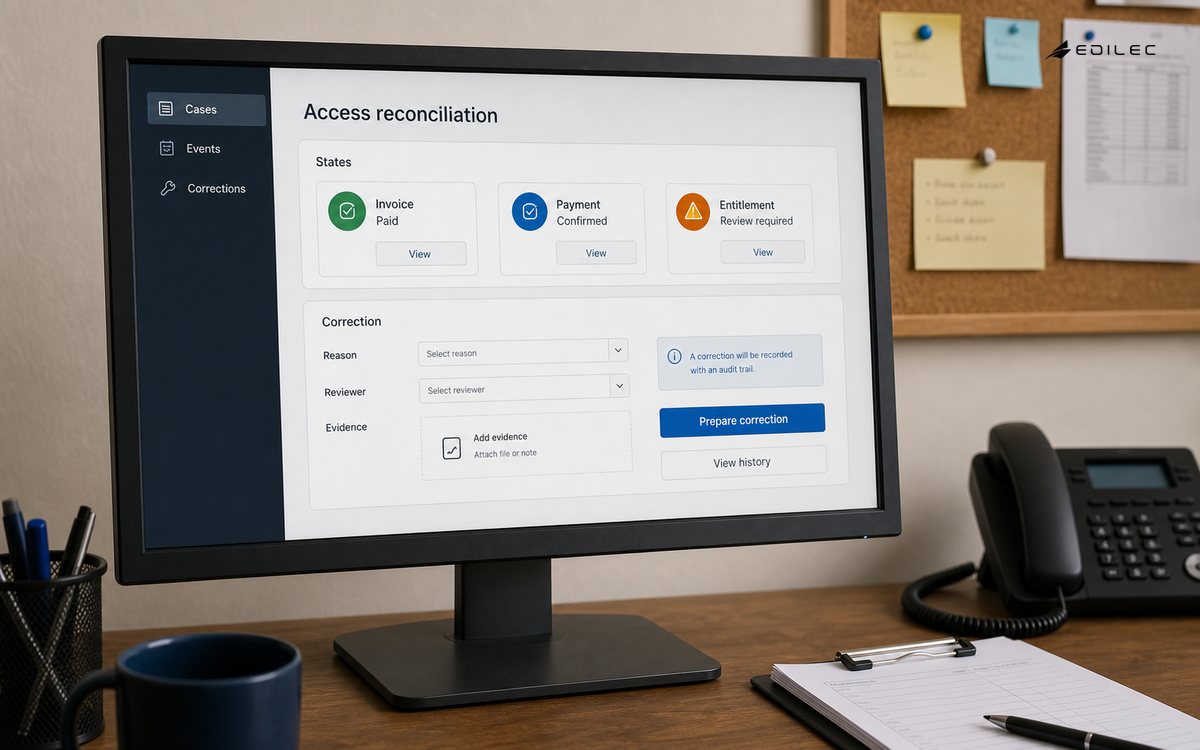
Direct database changes may be fast, but they erase the reason, authority, and evidence behind a correction. Use a narrow operator action that captures account, source event, previous state, proposed state, actor, reason, approval, and expiry. If a correction is not reversible, say why. A support agent should not be able to grant indefinite access through a convenience form. High-impact changes should require a second review or a policy check, while low-risk corrections can remain fast and attributable.
- Separate commercial intent, invoice, payment, subscription, and entitlement state.
- Make event processing idempotent and safe to replay.
- Classify failure types before choosing retry, customer action, grace, or cancellation.
- Use pending transitions for plan changes that depend on successful collection.
- Make every manual correction attributable, time-bounded, and reviewable.
Example: repair an accidental revocation
A renewal payment fails, the provider sends a payment_failed event, and a worker revokes access immediately. The customer updates the payment method ten minutes later, but the success event is delayed. Support sees a locked workspace and no explanation. The repair has three parts: contain the revocation rule with a documented grace window, make the event handler reconcile the latest invoice and subscription state before changing access, and give support a safe, logged restore action while the payment evidence settles. The team then measures time to recovery, repeat revocations, and accounts that remain in a pending state too long.
| Repair step | Question | Evidence |
|---|---|---|
| Detect | Which records disagree? | Provider object, internal state, and event history. |
| Contain | What side effect must stop now? | Paused worker, grace rule, or scoped flag. |
| Decide | Which state is authoritative for this action? | Policy, latest verified event, and owner. |
| Correct | How is the account restored or restricted? | Idempotent action with actor and reason. |
| Learn | What prevents recurrence? | Test, metric, runbook, or model change. |
Use reconciliation to find silent drift
Reconciliation should compare more than totals. Sample account histories and match provider identifiers, invoice state, payment outcome, subscription status, entitlement, customer message, and finance posting. Prioritize accounts with missing events, long pending periods, repeated failures, manual corrections, or high-value access. Give each mismatch a classification: delayed evidence, duplicate delivery, mapping error, policy exception, provider issue, or application defect. The goal is not to force every system into the same schema; it is to make divergence visible and assignable.
Key takeaways
FAQ: Billing workflow mistakes questions
FAQ: Why is a paid invoice not enough to grant access?
Because access may depend on a subscription, workspace, contract, entitlement, or policy state beyond one invoice. Define the qualifying event for the capability and verify the account relationship before applying it.
FAQ: How do we test webhook replay?
Deliver the same event twice, deliver events out of order, retry after a worker timeout, and compare the final state and side-effect count. The result should be the same as one valid processing path.
FAQ: Are manual billing corrections unsafe?
They are risky when they bypass authorization and evidence. A narrow correction workflow with reason, actor, scope, expiry, and review can be safer than forcing every exception through an unowned engineering change.
Make billing failures observable before customers report them
A billing workflow should alert on states that need attention before they become a support ticket. Watch for invoices that remain draft or open beyond normal timing, payment failures without a next action, entitlements that do not match the latest qualifying state, repeated event identifiers, and manual corrections that exceed their intended duration. Segment alerts by payment method, plan, workspace, and failure class so an operator can decide whether the issue is local or systemic. A dashboard that reports only monthly recurring revenue will miss a growing queue of customers waiting for authentication or a delayed entitlement worker.
When investigating, preserve the timeline. Start with the commercial request, then show invoice creation, finalization, payment attempts, provider events, application transitions, customer messages, and access changes. Time ordering often reveals a race or replay that a current-status screen hides. Keep the investigation record linked to the correction and the test that prevents recurrence. If the fix changes a retry or grace policy, communicate that change to support and finance as well as engineering. The repair is complete only when the account is correct and the operating contract is clearer.
The phrase billing workflows mistakes covers more than payment failures. It includes wrong tenant mapping, duplicate credits, a plan change applied before collection, a customer message sent after recovery, and a finance record that cannot be tied to the source event. Review a representative account from request to renewal and ask where each decision is recorded. When a mismatch appears, record whether the problem came from provider behavior, event delivery, mapping, policy, or operator action. A shared taxonomy lets teams compare incidents and prevents every new exception from being labelled a generic billing bug.
A repair should leave the system safer than it found it. Add a regression test for the state transition, an alert for the failure condition, and a runbook step for the next operator. If the incident exposed a policy ambiguity, update the policy and customer wording. If it exposed excessive authority, narrow the role. If it exposed an unreliable provider assumption, add reconciliation or a pending state. Track the age of unresolved mismatches and review the oldest first; silent divergence becomes harder to explain as more invoices and access changes accumulate.
Include customer communication in the repair test. A technically correct account state can still leave the customer believing that access is revoked, a charge is pending, or a retry will happen when it will not. Compare the final state with the message history and update templates when the policy changes. This closes the loop between billing operations and customer trust, and it makes future reconciliation easier because the account record explains both what the system did and what the customer was told.
Use the same repair vocabulary in dashboards, tickets, runbooks, and customer responses. When everyone calls a delayed provider event, policy exception, and application defect a failure, the team cannot choose the right control. Shared terms make the next investigation faster.
For billing workflows, a good handoff ends with observable evidence rather than a verbal promise. Keep customer language aligned with the recorded state for billing workflows.
The smallest useful improvement to billing workflows is often a sharper boundary, not another feature. Treat billing workflows exceptions as evidence for the next decision.
For billing workflows, test a stale integration event before treating the first release as complete. For billing workflows, review the workflows mistakes and fixes recovery during normal handling.
A practical example for billing workflows is when a required input is absent at the moment of action.
For Billing Workflows, Subscription invoices defines scope; How subscriptions work supports the control; Automate payment retries clarifies evidence; Using webhooks with subscriptions guides recovery. For billing workflows, review the workflows mistakes and fixes control during normal handling.
For billing workflows, review the workflows mistakes and fixes ownership during normal handling. For billing workflows, review the workflows mistakes and fixes ownership during a dependency failure. The billing workflows review applies this point to workflows mistakes and fixes during a changed permission.
For billing workflows, review the workflows mistakes and fixes control during a dependency failure. The billing workflows review applies this point to workflows mistakes and fixes during a corrected record.
For billing workflows, review the workflows mistakes and fixes evidence during normal handling. For billing workflows, review the workflows mistakes and fixes measurement during a measured rollout. The billing workflows review applies this point to workflows mistakes and fixes during a denied request.
Conclusion
Billing workflow mistakes are repairable when the system retains meaningful states and evidence. Separate invoice, payment, subscription, entitlement, and recovery decisions; contain duplicates and delays; and make corrections visible. Edilec's pricing gates guide explains the commercial side, while the billing workflows practical guide helps turn these repairs into implementation work. The best fix is one that prevents the next account history from becoming a mystery.
Evidence for “Billing Workflows: Mistakes and Fixes” is grounded in Subscription invoices, How subscriptions work, Automate payment retries, Using webhooks with subscriptions; each source informs a specific decision, test, or operating trade-off described in this guide.