SaaS product development for support teams begins with the moment a customer needs help, not with a generic ticket table. The product must preserve identity, product context, communication history, ownership, service commitments, and a trustworthy route to resolution across channels. Its cost is driven as much by integration and operations as by screens. This delivery plan defines a focused support product without recreating every feature of a mature service platform. The primary planning lens is SaaS product development for support teams, with decisions expressed in language that product users and operating teams can verify.
Nearby planning resources include SaaS Product Development for Support Teams Implementation Checklist, SaaS Product Development for Support Teams FAQ, SaaS Product Development Company for Finance: Scope, Cost, Risks and Delivery Plan, SaaS Product Development Company for Ecommerce: Scope, Cost, Risks and Delivery Plan. Those pages provide companion scope and checklist views; this article develops the technical and operating evidence for the topic here.
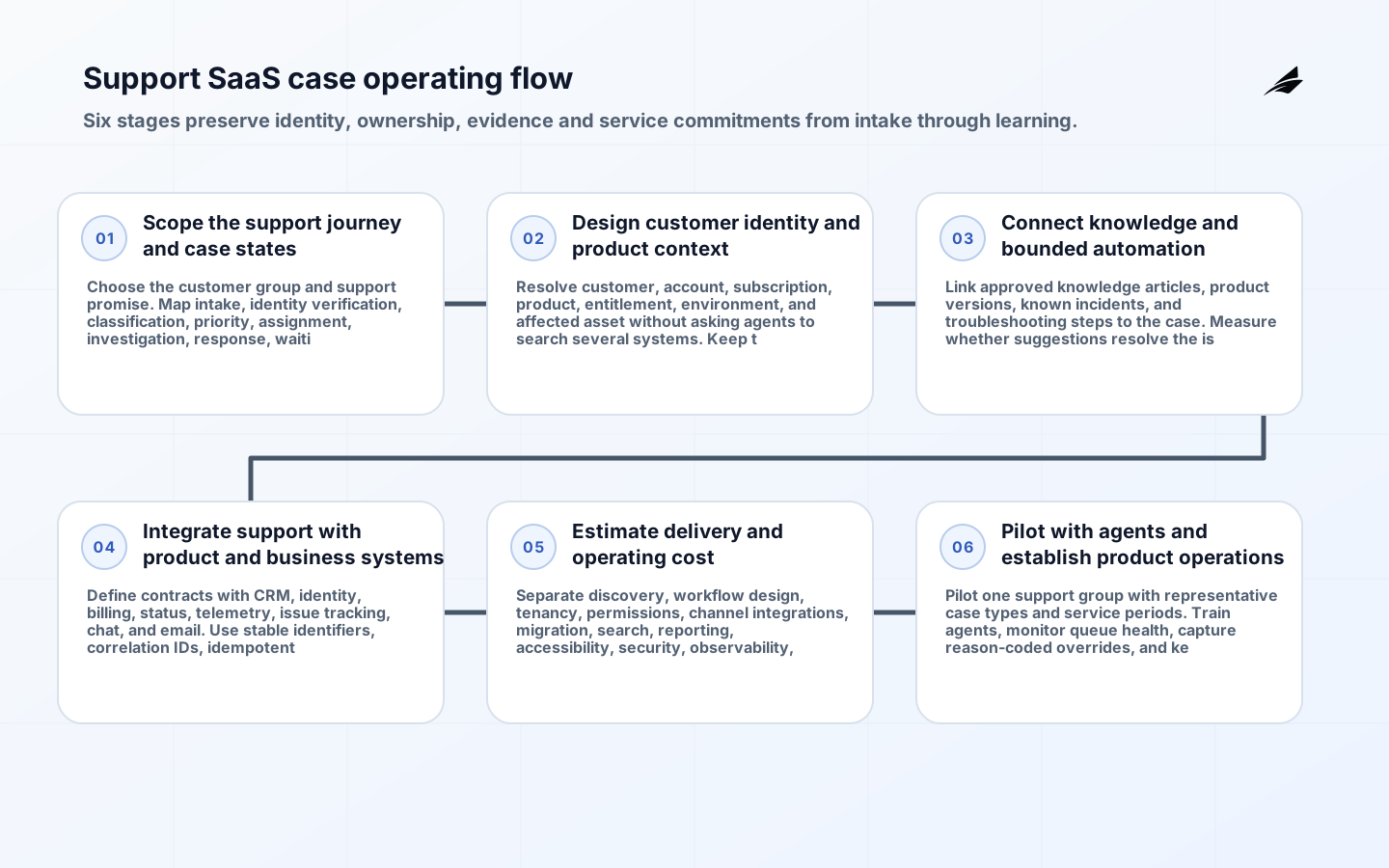
Scope the support journey and case states
Choose the customer group and support promise. Map intake, identity verification, classification, priority, assignment, investigation, response, waiting states, escalation, resolution, reopening, and closure.

Define who can see or change each case state, which timers pause, how customer-visible and internal notes differ, and how duplicate contacts are merged. A loose status field produces inconsistent queues, incorrect service-time reporting, and cases that disappear between teams.
Design customer identity and product context
Resolve customer, account, subscription, product, entitlement, environment, and affected asset without asking agents to search several systems. Keep the source of truth explicit for each field.
Use least privilege and tenant isolation. Mask sensitive data, record support access, and obtain additional approval for impersonation or privileged diagnostics. Incorrect account matching can expose another customer's history or let an agent perform an action outside the customer's entitlement.
| Decision area | Required decision | Acceptance evidence |
|---|---|---|
| Scope the support journey and case states | Choose the customer group and support promise. Map intake, identity verification, classification, priority, assignment, investigation, response, waiting states, escalation, resolution, reopening, and closure. | Define who can see or change each case state, which timers pause, how customer-visible and internal notes differ, and how duplicate contacts are merged. |
| Design customer identity and product context | Resolve customer, account, subscription, product, entitlement, environment, and affected asset without asking agents to search several systems. Keep the source of truth explicit for each field. | Use least privilege and tenant isolation. Mask sensitive data, record support access, and obtain additional approval for impersonation or privileged diagnostics. |
| Connect knowledge and bounded automation | Link approved knowledge articles, product versions, known incidents, and troubleshooting steps to the case. Measure whether suggestions resolve the issue rather than counting recommendation clicks. | Use automation first for routing, duplicate detection, required-field checks, draft summaries, and response assistance. Preserve evidence and agent control for consequential advice. |
Connect knowledge and bounded automation
Link approved knowledge articles, product versions, known incidents, and troubleshooting steps to the case. Measure whether suggestions resolve the issue rather than counting recommendation clicks.
Use automation first for routing, duplicate detection, required-field checks, draft summaries, and response assistance. Preserve evidence and agent control for consequential advice. Outdated knowledge and confident generated replies can increase reopens while appearing to reduce first-response time.
Integrate support with product and business systems
Define contracts with CRM, identity, billing, status, telemetry, issue tracking, chat, and email. Use stable identifiers, correlation IDs, idempotent updates, and explicit error states.
Adopt consistent API problem responses such as RFC 9457 where suitable. Buffer noncritical events and ensure a failed integration does not block urgent case handling. Bidirectional synchronization without ownership rules creates loops, duplicate comments, and contradictory customer status.
| Control area | Failure to prevent | Production proof |
|---|---|---|
| Integrate support with product and business systems | Bidirectional synchronization without ownership rules creates loops, duplicate comments, and contradictory customer status. | Adopt consistent API problem responses such as RFC 9457 where suitable. Buffer noncritical events and ensure a failed integration does not block urgent case handling. |
| Estimate delivery and operating cost | A low build estimate is misleading when every customer requires manual field mapping, history cleanup, or unsupported channel behavior. | Model recurring storage, search indexing, messaging, attachments, AI calls, telemetry, backups, and agent seats. Include data migration and customer onboarding effort. |
| Pilot with agents and establish product operations | A weekday pilot can miss after-hours escalation, attachment growth, email threading, peak incidents, and permission edge cases. | Define SLOs for intake availability, case update, notification, search, and customer-visible response. Instrument request traces and case lifecycle events without storing sensitive content unnecessarily. |
Estimate delivery and operating cost
Separate discovery, workflow design, tenancy, permissions, channel integrations, migration, search, reporting, accessibility, security, observability, and support operations.
Model recurring storage, search indexing, messaging, attachments, AI calls, telemetry, backups, and agent seats. Include data migration and customer onboarding effort. A low build estimate is misleading when every customer requires manual field mapping, history cleanup, or unsupported channel behavior.
Pilot with agents and establish product operations
Pilot one support group with representative case types and service periods. Train agents, monitor queue health, capture reason-coded overrides, and keep an escape route to the prior process.
Define SLOs for intake availability, case update, notification, search, and customer-visible response. Instrument request traces and case lifecycle events without storing sensitive content unnecessarily. A weekday pilot can miss after-hours escalation, attachment growth, email threading, peak incidents, and permission edge cases.
Readiness evidence for a support SaaS release
The release decision should include the case-state model, permission matrix, tenant-isolation tests, customer and subscription matching rules, integration contracts, migrated-history reconciliation, accessibility results, queue reports, SLO definitions, and agent training. Support leadership owns routing and service policy; product owns workflow; security owns privileged access; and platform teams own delivery, storage, telemetry, backup, and notification services.
Run an incident-volume exercise that creates duplicate contacts across email and chat, an identity mismatch, failed CRM lookup, delayed notification, unavailable search, oversized attachment, escalated security case, and customer reopen. Agents must still identify priority, preserve history, communicate status, and recover synchronization without exposing another tenant or losing the service timer.
Taken together, the decision for SaaS product development for support teams must connect scope the support journey and case states, design customer identity and product context, connect knowledge and bounded automation, integrate support with product and business systems, estimate delivery and operating cost, pilot with agents and establish product operations. The release review should show which owner accepts each decision, where its source evidence is stored, which threshold blocks production, and how a failed dependency or incorrect result is contained. It should also explain how changes to data, policy, integrations, identities, customer scope, or software versions trigger renewed testing. That linkage matters because controls assessed independently can still conflict in operation: a secure interface may carry stale data, a reliable service may enforce the wrong authority, and a useful workflow may become uneconomic when review or support demand rises. Record these dependencies as maintained product artifacts, not one-time project notes, so later operators can distinguish an approved constraint from an accidental behavior.
The control chain starts with scope the support journey and case states: Choose the customer group and support promise. Map intake, identity verification, classification, priority, assignment, investigation, response, waiting states, escalation, resolution, reopening, and closure. Evidence must explicitly guard against A loose status field produces inconsistent queues, incorrect service-time reporting, and cases that disappear between teams. Next, design customer identity and product context: Resolve customer, account, subscription, product, entitlement, environment, and affected asset without asking agents to search several systems. Keep the source of truth explicit for each field. Evidence must explicitly guard against Incorrect account matching can expose another customer's history or let an agent perform an action outside the customer's entitlement. Next, connect knowledge and bounded automation: Link approved knowledge articles, product versions, known incidents, and troubleshooting steps to the case. Measure whether suggestions resolve the issue rather than counting recommendation clicks. Evidence must explicitly guard against Outdated knowledge and confident generated replies can increase reopens while appearing to reduce first-response time. Next, integrate support with product and business systems: Define contracts with CRM, identity, billing, status, telemetry, issue tracking, chat, and email. Use stable identifiers, correlation IDs, idempotent updates, and explicit error states. Evidence must explicitly guard against Bidirectional synchronization without ownership rules creates loops, duplicate comments, and contradictory customer status. Next, estimate delivery and operating cost: Separate discovery, workflow design, tenancy, permissions, channel integrations, migration, search, reporting, accessibility, security, observability, and support operations. Evidence must explicitly guard against A low build estimate is misleading when every customer requires manual field mapping, history cleanup, or unsupported channel behavior. Next, pilot with agents and establish product operations: Pilot one support group with representative case types and service periods. Train agents, monitor queue health, capture reason-coded overrides, and keep an escape route to the prior process. Evidence must explicitly guard against A weekday pilot can miss after-hours escalation, attachment growth, email threading, peak incidents, and permission edge cases. Reading these checks as one chain prevents a local pass from hiding an end-to-end failure. The accountable owners should review the chain after any material incident or change and record whether the original assumptions, thresholds, and fallback remain valid.
Implementation takeaways
- Model case states and timers before designing dashboards.
- Resolve customer, subscription, entitlement, and product context safely.
- Use automation to assist agents without hiding source evidence.
- Budget integration, migration, observability, and product support.
- Pilot peak and after-hours behavior, not only normal weekday cases.
Frequently asked questions
| Question | Answer |
|---|---|
| Should the MVP support every channel? | No. Start with the channels required by the chosen customer journey and design a channel model that can expand without fragmenting case history. |
| What is the most important integration? | The one that supplies authoritative customer and product context for correct triage and permitted action; this varies by business. |
| How should AI be introduced? | Begin with bounded routing, summarization, and drafting, measure correction and reopens, and keep agent authority. |
| Which metrics matter? | Resolution quality, reopen rate, queue age, escalation, customer effort, agent effort, and service-level attainment. |
Conclusion
A support SaaS product succeeds when it helps an agent understand the customer, own the next action, and preserve a coherent record through resolution. Fast intake is useful, but accuracy of identity, context, permissions, and handoffs determines whether the service earns trust.
The delivery plan should therefore fund the less visible product work: migration, integrations, accessibility, observability, incident handling, and support for the support system itself. A narrow workflow operated well provides a stronger foundation than a broad feature list with fragile case state.