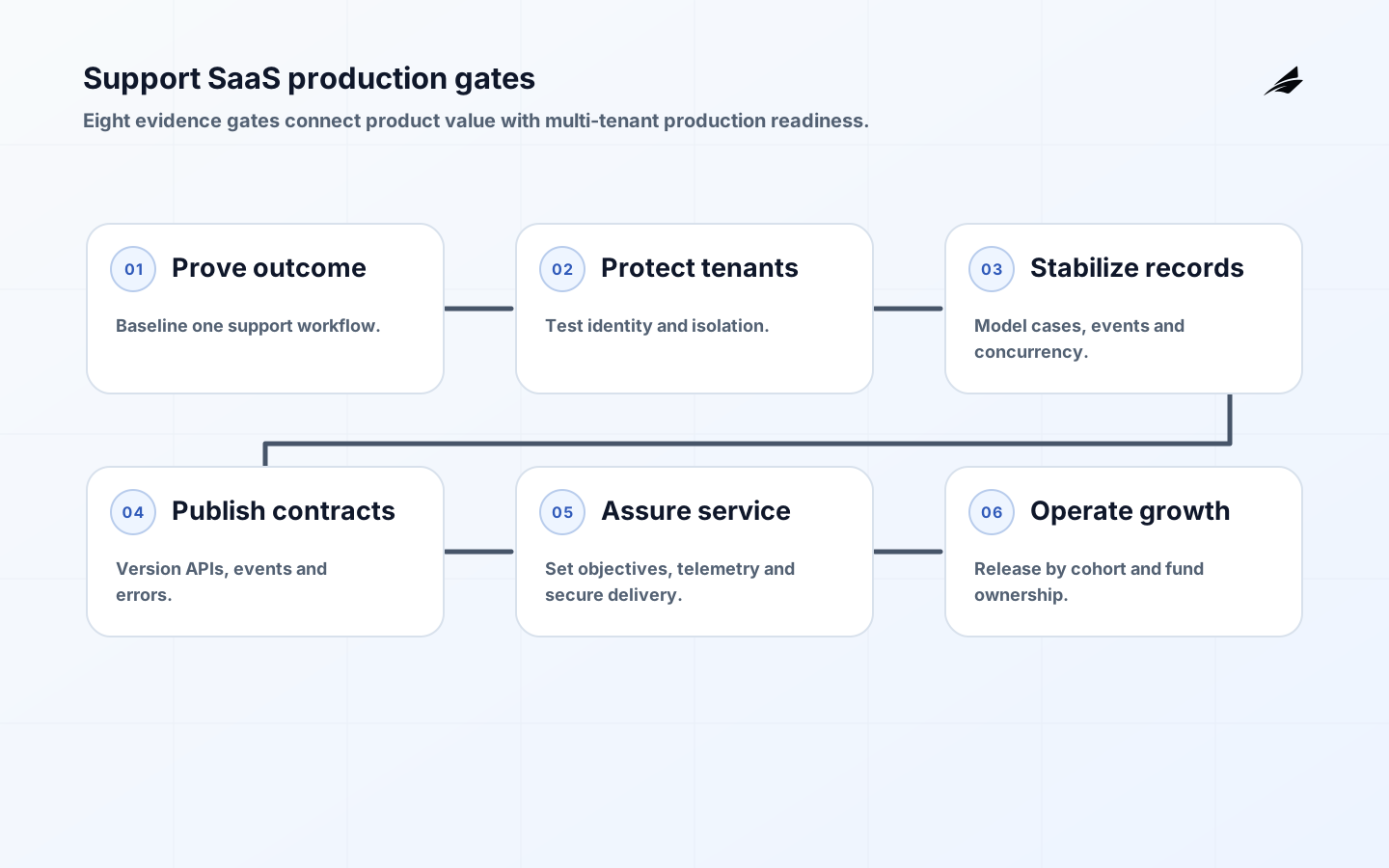
SaaS product development for support teams combines product discovery, multi-tenant software architecture and service operations. The implementation challenge is not merely to put support workflows in a browser. The product must separate customer data, preserve case history, integrate with identity and business systems, remain usable during dependency failures, support safe changes and give operators evidence about reliability. This checklist turns those concerns into release gates that a product, engineering and support organization can verify.
Use the checklist as an evidence record rather than a ceremonial sign-off. NIST's SSDF informs secure development and vulnerability response. DORA's delivery measures help teams observe change performance without treating one metric as a target. Google SRE guidance connects service-level objectives to alerting. OpenTelemetry defines interoperable traces, metrics and logs. OpenAPI and RFC 9457 help teams publish stable interfaces and useful errors. Adapt the depth of each gate to the consequence of the support workflow.
Gate 1: define the support outcome and product boundary
Name the user, service moment and measurable constraint. Examples include reducing handoffs for entitlement questions, shortening incident qualification or helping customers complete a safe self-service change. Observe real cases across routine, escalated and outage conditions. Record which decisions agents make, what evidence they inspect and where they leave the current tool. Define a baseline for completion time, error, reopen rate, customer effort and manual reconciliation.
Choose what the SaaS product owns. It may be the authoritative case system, an orchestration layer or a decision workspace over existing systems. State which capabilities remain in CRM, billing, identity, telemetry and knowledge platforms. List excluded workflows and emergency paths. Assign a product owner, technical owner, security owner and service operator. Approve the outcome only when each acceptance measure has a source, calculation and review cadence.
| Gate | Required evidence | Do not proceed when |
|---|---|---|
| Outcome | Observed workflow, baseline and acceptance measure | Problem is stated only as a feature request |
| Boundary | System-of-record map and exclusions | Two systems can update the same record without reconciliation |
| Ownership | Named product, engineering and operations owners | Production decisions depend on an unavailable project team |
| Risk | Abuse, privacy and failure scenarios | High-consequence actions lack human or policy controls |
Gate 2: approve tenancy, identity and data isolation
Select a tenancy model based on data sensitivity, scale, customization and operating cost. Shared infrastructure can still provide strong logical isolation when every storage, cache, search, queue and export path enforces tenant scope. Dedicated resources may reduce some risks but increase fleet complexity. Document the boundary and test it continuously. Include analytics, backups, support tooling and operational scripts; tenant separation is not limited to the primary database.
Define workforce, customer and service identities. Support delegated customer administration, revocation and recovery as lifecycle workflows. Use least privilege for agents and operators, with stronger checks for impersonation, refunds, credential reset or bulk export. Keep audit events attributable to the human and service involved. Test cross-tenant identifiers, stale sessions, background jobs, copied URLs, search indexes and restore procedures. A passing user-interface test is not proof of isolation.
Gate 3: design the case and event model
Model durable business concepts before screens. Give tenants, organizations, users, cases, conversations, assets, entitlements and actions stable identifiers. Define state transitions and who may cause them. Preserve event time, source and actor. Avoid a single mutable status field when investigations need to explain how work changed. Record attachments and messages with classification, version and retention. Product analytics should derive from owned events rather than scraping interface behavior.
Decide how concurrent edits, duplicate requests and late events are handled. Use optimistic concurrency or another explicit policy instead of last-write-wins for consequential records. Define idempotency for retried commands. Separate customer-visible state from internal work state while maintaining traceability between them. Build fixtures for reopened cases, merged organizations, expired entitlement, missing telemetry and delayed approvals. These become regression tests for the model and migrations.
Gate 4: publish stable integration contracts
Inventory every inbound and outbound interface, owner, version, authentication method, rate expectation and failure policy. OpenAPI can describe HTTP contracts; event schemas need equivalent versioning and compatibility rules. Use RFC 9457 problem details for consistent errors. Avoid exposing internal database shapes directly. A customer-oriented contract should remain stable when the underlying CRM or billing implementation changes.
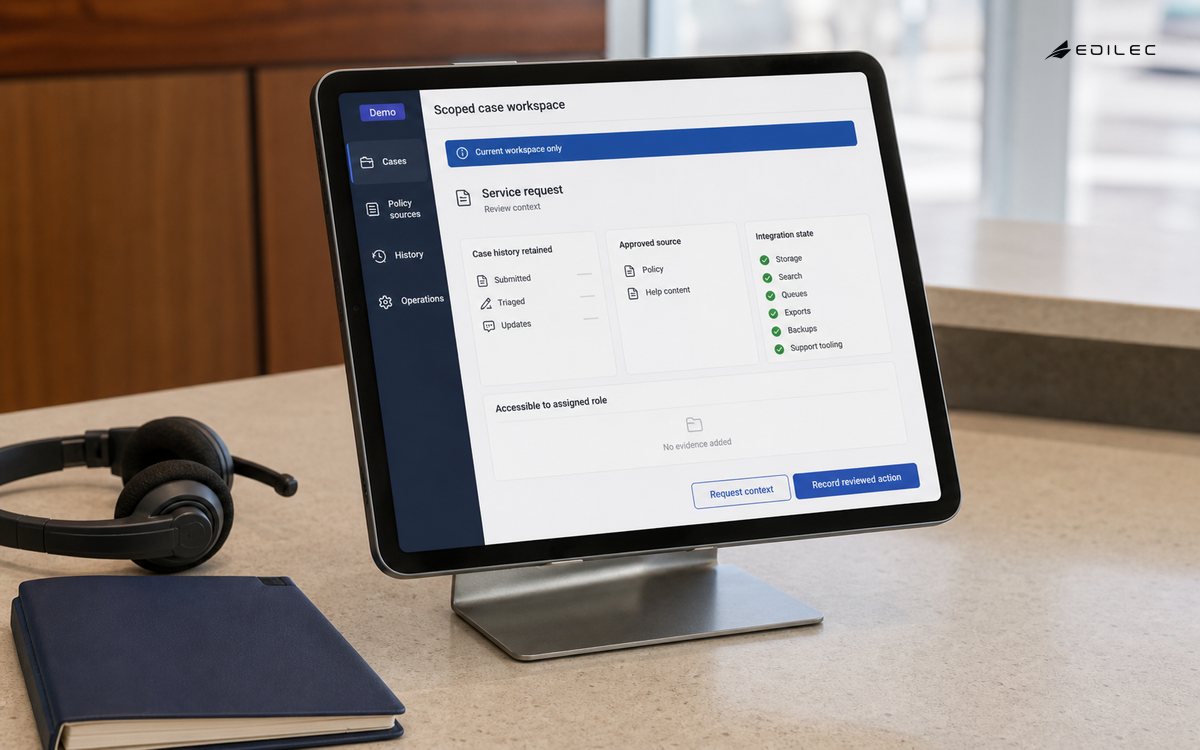
Test timeouts, partial success, retries and duplicate delivery. Correlation identifiers should connect a user action with workflows and downstream calls. Webhooks need signatures, replay protection, delivery history and customer-visible retry status. Provide sandbox data that represents permission and failure cases, not only happy paths. Establish deprecation periods and usage telemetry before removing fields. Integration documentation and change communication are part of the product.
| Interface concern | Design decision | Production evidence |
|---|---|---|
| Retry | Idempotency and bounded backoff | Duplicate command test and retry metrics |
| Error | Stable type, status and customer-safe detail | Client handling for validation, denial and outage |
| Change | Version and compatibility policy | Consumer inventory and deprecation report |
| Event | Ordering, deduplication and replay | Lag, dead-letter and reconciliation dashboard |
Gate 5: define service objectives and observability
Choose service-level indicators from user-visible outcomes: case retrieval, message submission, safe execution of an approved action or timely update of critical status. Set objectives according to customer need and dependency capability. Google SRE guidance illustrates alerting on error-budget consumption rather than every transient symptom. Define maintenance, exclusions and measurement windows. A contractual availability number should not replace internal objectives for individual workflows.
Instrument traces, metrics and logs with shared tenant-safe identifiers using OpenTelemetry conventions where useful. Protect personal and secret data in telemetry. Monitor queue age, dependency latency, failed authorization, reconciliation differences and asynchronous completion, not only HTTP errors. Create dashboards for operators and runbooks for expected failure. Test alert delivery and ownership. If the service degrades, the interface should show current known state and avoid ambiguous success.
Gate 6: secure the delivery system
Apply NIST SSDF practices across planning, source, dependencies, build, verification, release and vulnerability response. Protect repositories and artifacts, review privileged changes, scan dependencies and retain release provenance. Threat-model tenant crossing, malicious attachments, support impersonation, poisoned webhook input and misuse of automation. Security requirements should appear in acceptance tests, not in a separate document reviewed after feature completion.
Define a vulnerability intake and response process before launch. Customers need a reporting route and material issues need triage, remediation and communication ownership. Rotate secrets and signing keys through rehearsed procedures. Test backup restoration without crossing tenants. Review support access and emergency authority. A secure code review cannot compensate for broad production roles or unmonitored operational scripts.
Gate 7: release a complete support slice
Choose one case type and deliver it end to end: intake, identity, context, decision, action, communication, telemetry and recovery. Use feature flags only with owners, expiry and fallback behavior. DORA's measures can reveal delivery throughput and instability, but teams should use them for diagnosis rather than competition. Review change failure, recovery and customer outcome together. Small changes are useful only when the operating system can detect and reverse them.
Pilot with a bounded tenant cohort and named support supervisors. Reconcile records between the product and systems of record. Train on exceptions and degraded modes. Keep a controlled fallback until data and behavior are proven. Expand by cohort after adoption, reliability, security and support evidence meet thresholds. Record customer feedback with workflow context, and reserve capacity for product improvements instead of letting urgent support consume every release.
Gate 8: establish product operations
Assign daily ownership for incidents, access requests, schema changes, tenant onboarding, billing, cost and customer communication. Define support tiers without separating product engineers from recurring failure evidence. Review noisy alerts, repeated tickets and manual corrections as product signals. Maintain a service catalog and dependency inventory. Test recovery, credential rotation and customer export on a schedule and after material architectural change.
Measure whether the product improves support: successful completion, time to resolution, transfer rate, reopen rate, customer effort, automation exceptions and data reconciliation. Segment carefully to find underserved workflows without creating surveillance. Review unit cost such as cost per active tenant or resolved workflow alongside reliability. Retire unused features and stale flags. A SaaS product remains healthy when the team can explain and improve its behavior after launch.
Key takeaways
The implementation checklist is complete only when the team can show evidence for product value, tenant isolation, stable contracts, service objectives, secure delivery, controlled rollout and product operations. A feature demonstration is an early milestone, not production acceptance. Keep the evidence in one release record so product, security and operations reviewers can reach the same decision without reconstructing context from separate tools.
- Tie scope to one measurable support outcome.
- Test tenant isolation beyond the primary application path.
- Version APIs and events, including failure behavior.
- Alert on user-visible reliability and reconcile asynchronous work.
- Release by cohort and fund ongoing product operations.
Frequently asked questions
Should the SaaS product replace the CRM?
Only if becoming the system of record is a deliberate product decision. Often the safer design is a focused workflow layer with explicit synchronization and reconciliation.
What service level should a support product promise?
Base it on customer consequence and measured dependency capability. Define individual workflow indicators before negotiating one aggregate availability figure.
Is one database per tenant required?
No universal model is correct. Shared and dedicated designs can both be safe when isolation, operations, backup, cost and testing are engineered consistently.
Conclusion
SaaS product development for support teams becomes production-ready when product decisions and operating controls reinforce each other. Use these gates to require traceable evidence, not paperwork: a measured support outcome, isolated tenant data, durable records, predictable interfaces, observable reliability, secure releases and a team prepared to run the service. That foundation lets the product grow without turning every new customer or integration into an unmanaged exception.