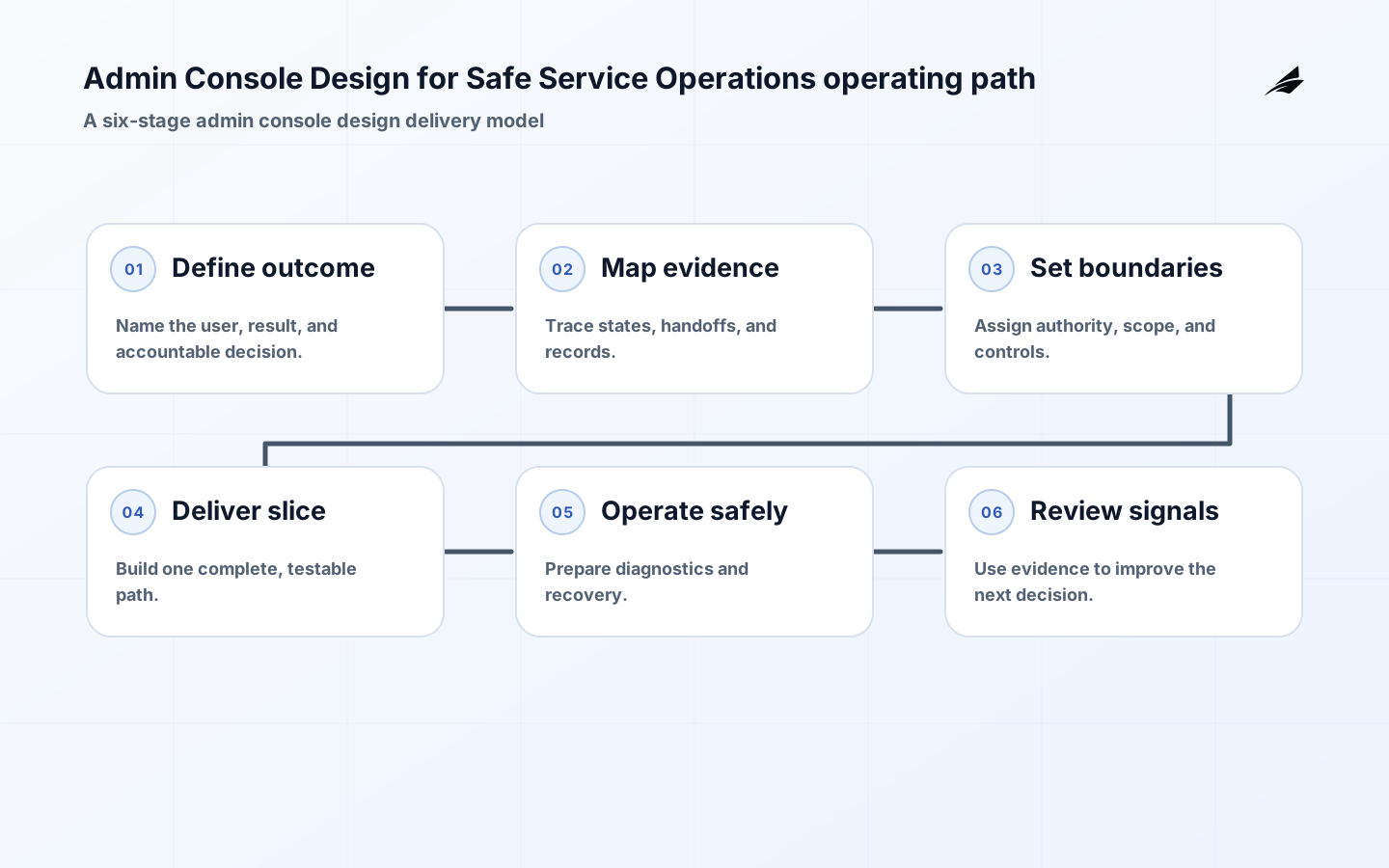
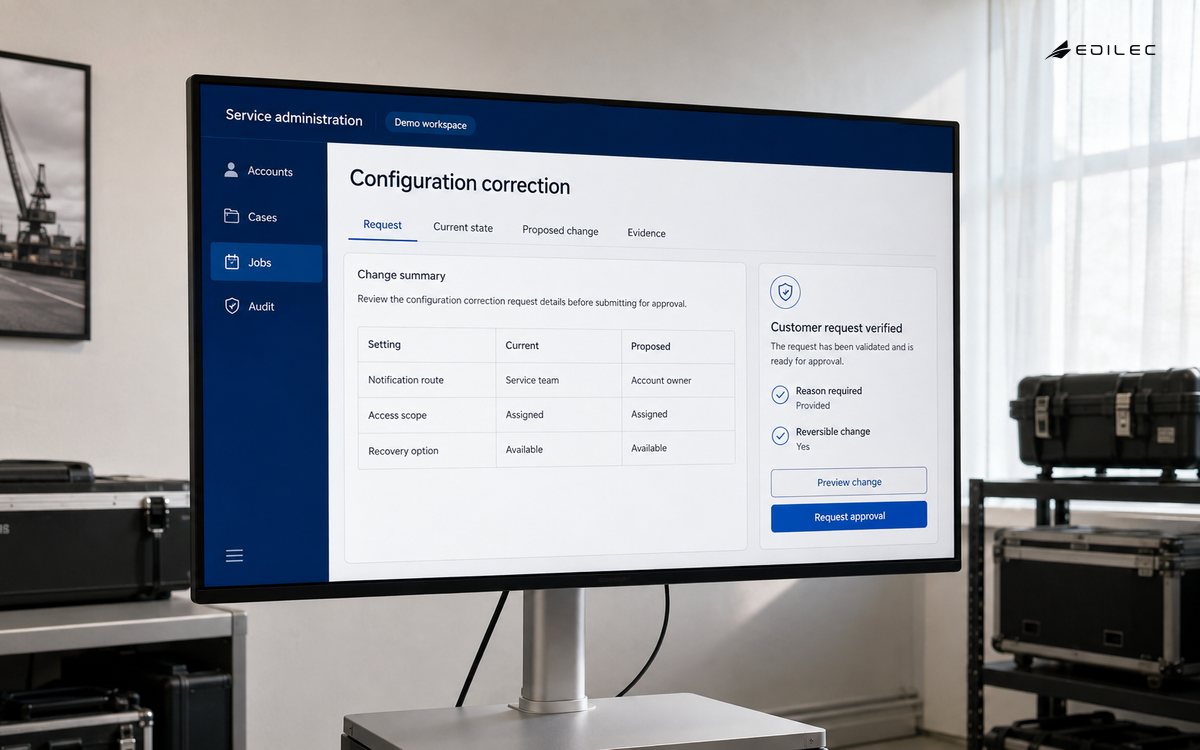
Admin console design is easiest to misjudge when it is reduced to a technology choice or a list of screens. In practice, it is an agreement about how people, software, and records produce a result that can be trusted after the original request is forgotten. Consider a concrete case: a support lead must correct an account configuration after verifying a customer request, while an engineer investigates why a background task failed. That case exposes decisions about authority, timing, incomplete input, and recovery that a happy-path demo hides. This guide treats admin console design as an operating design problem. It connects the customer or internal outcome to the controls, records, and signals needed to keep delivery understandable as volume grows. The goal is neither maximum process nor theoretical perfection; it is a small set of explicit choices a product, engineering, and operations team can test together.
Define the admin console design outcome before choosing tools
Begin with one sentence that a person doing the work would recognise. For admin console design, the useful test case is a support lead must correct an account configuration after verifying a customer request, while an engineer investigates why a background task failed. Define the expected finish, the person accountable for the decision, what happens when a prerequisite is missing, and what a customer or colleague can see while work is pending. Then collect a routine case, a delayed case, and a disputed case from recent work. Ask who started each one, which fact permitted the next step, who could override it, and which record would settle a question later. This changes the conversation from “what should the system do?” to “what result must this system make dependable?” It also gives the team a legitimate basis for postponing requests that do not protect the first result.
| Question | Decision to record | Evidence before release |
|---|---|---|
| What result matters? | A specific outcome for a named user or account. | A walkthrough with a beginning, end, and exception. |
| Who may act? | A role, approval route, and escalation owner. | Accepted and rejected examples. |
| What proves it? | A durable record with time and source. | A support view that explains the case. |
| How does it recover? | A safe correction or contact path. | A rehearsed failure scenario. |
Map actors, states, and evidence in admin console design
Draw the journey from the triggering request through the last accountable action. Include people who initiate, approve, investigate, and experience the result, plus the services that create or transform the operator, customer account, requested action, approval, before-and-after values, case reference, and audit event. At every handoff, write the current state, allowed next state, input that permits it, and evidence left behind. A diagram that only names systems cannot reveal whether a notification is being mistaken for a decision or whether an automated retry has the authority to change a customer commitment. Walk the map with a product lead, an engineer, and the person who resolves exceptions. Their disagreements are useful: they show where policy has been left as tribal knowledge. Keep stable identifiers across the map so an investigation can join a request, a change, and its downstream effect without guesswork.
Set boundaries and ownership for admin console design
The critical boundary is least-privilege roles, tenant-scoped search, confirmation for consequential actions, and immutable records of privileged changes. Treat every important value as a claim with an origin, effective time, and owner. In this design, operations owns the procedure and approval rules; engineering owns enforcement; security reviews high-impact capabilities. Write down which representation is authoritative and which systems hold derived copies for speed, search, or local work. A derived copy must retain a source reference and a clear refresh or correction behavior; otherwise it quietly becomes a competing authority. This is also where accessibility and security become practical engineering requirements. Clear labels, keyboard operation, and recoverable errors reduce accidental action, while server-side checks prevent an interface state from becoming the only guard. The OWASP verification guidance and WCAG 2.2 are useful reference points for turning those obligations into testable work.
| Element | Minimum contract | Operational check |
|---|---|---|
| Actor or account | Stable identifier and scoped authority. | Can an investigator explain who acted? |
| Business state | Allowed transition and effective time. | Can invalid changes be rejected? |
| Decision input | Source, version, and validation rule. | Can the result be reproduced? |
| Customer-facing status | Meaningful state and next action. | Can a person recover without a hidden workaround? |
Build a thin but complete admin console design slice
A first delivery should connect identity provider, case system, account service, job runner, audit log, and administrative interface through one end-to-end outcome rather than simulate breadth with disconnected screens. In this case, design read and write capabilities separately, require a reason for exceptional actions, and make bulk changes harder than routine investigation. Put validation as close as possible to the decision that relies on it, and make retries safe by using stable request identifiers and explicit state transitions. Publish contracts for APIs, events, or imports before several teams depend on accidental behavior. A contract needs more than field names: it should state meaning, scope, version, required values, treatment of duplicates, and what a receiver may assume when work arrives late. Resist extracting components merely to look sophisticated. A boundary earns its cost when it improves independent change, containment, or clarity for the people who operate the product.
Make admin console design operable on an ordinary Tuesday
Operational readiness means the team can answer a real question without tracing logs by hand across unrelated tools. For admin console design, that means break-glass access, session expiry, searchable audit trails, replay-safe job controls, and an escalation path for data changes. Define who can inspect a case, who can correct it, what requires approval, and how exceptional access is limited and recorded. Instrument the path from user action through asynchronous work with correlation identifiers; OpenTelemetry conventions provide a useful common vocabulary for this kind of trace context. Practice a failed dependency, duplicate input, and an authorised reversal before launch. The exercise should result in a decision to retry, quarantine, compensate, or contact the affected person, not just a dashboard screenshot. Recovery is part of the product promise because customers experience the failed path as much as the successful one.
Measure admin console design with decision-quality signals
Choose measures that tell the team whether the promised outcome and controls are holding. Useful signals here include privileged action volume, approval bypasses, failed authorizations, time to resolve cases, and repeat manual repairs. Pair speed or adoption measures with a quality measure, because faster completion can conceal a growing queue of corrections or excluded users. Record the population, time window, and product version behind each metric so a release does not look like a behavioural change. Review signals with the people who own the outcome, not only the people who can query the data. Site reliability practice is helpful here: an objective is valuable when it creates a conversation about risk and action, rather than a number collected for its own sake. When a threshold is crossed, specify the next investigation and the person responsible for it.
Review admin console design changes before they become habits
Review administrative workflows with the operators who use them under time pressure. Select a recent correction, access change, and failed job, then ask whether the console showed enough tenant context, made the impact legible, and recorded the reason for the action. Remove shortcuts that exist only because a normal workflow lacks evidence or a safe retry. A quarterly access review should include the console itself, service accounts, and emergency roles, because a secure feature can still be undermined by broad management access.
Common admin console design failures to avoid
- Putting customer actions behind one broad admin role.
- Relying on browser checks.
- Hiding dangerous bulk actions among routine controls.
- Keeping logs without useful context.
Key takeaways
- Admin console design begins with an accountable outcome, not a tool selection.
- Map ordinary and exceptional paths with records and decision rights at every consequential handoff.
- Keep authority, evidence, and recovery together where state changes matter.
- Release a narrow, complete path that people can operate and explain.
- Use signals to decide what to improve, retire, or investigate next.
Frequently asked questions
Should support staff have production access?
They should have the narrowest access that resolves ordinary cases. Exceptional access needs a purpose, time limit, and reviewable record.
What deserves an extra confirmation?
Changes to access, money, customer data, or work that affects many accounts deserve clear impact information and a deliberate confirmation step.
Conclusion: make admin console design explainable
A good console reduces risky improvisation by turning approved operational work into constrained, observable actions. The durable test is simple: can the right person complete the intended work, can an authorised colleague explain the result later, and can the team recover without improvising around the system? When the answer is yes, the design has created room for growth without making every new customer, release, or exception a private emergency. For related implementation detail, teams can compare this operating model with the linked product-engineering guides in this collection.