Product Support Tooling: Implementation Checklist
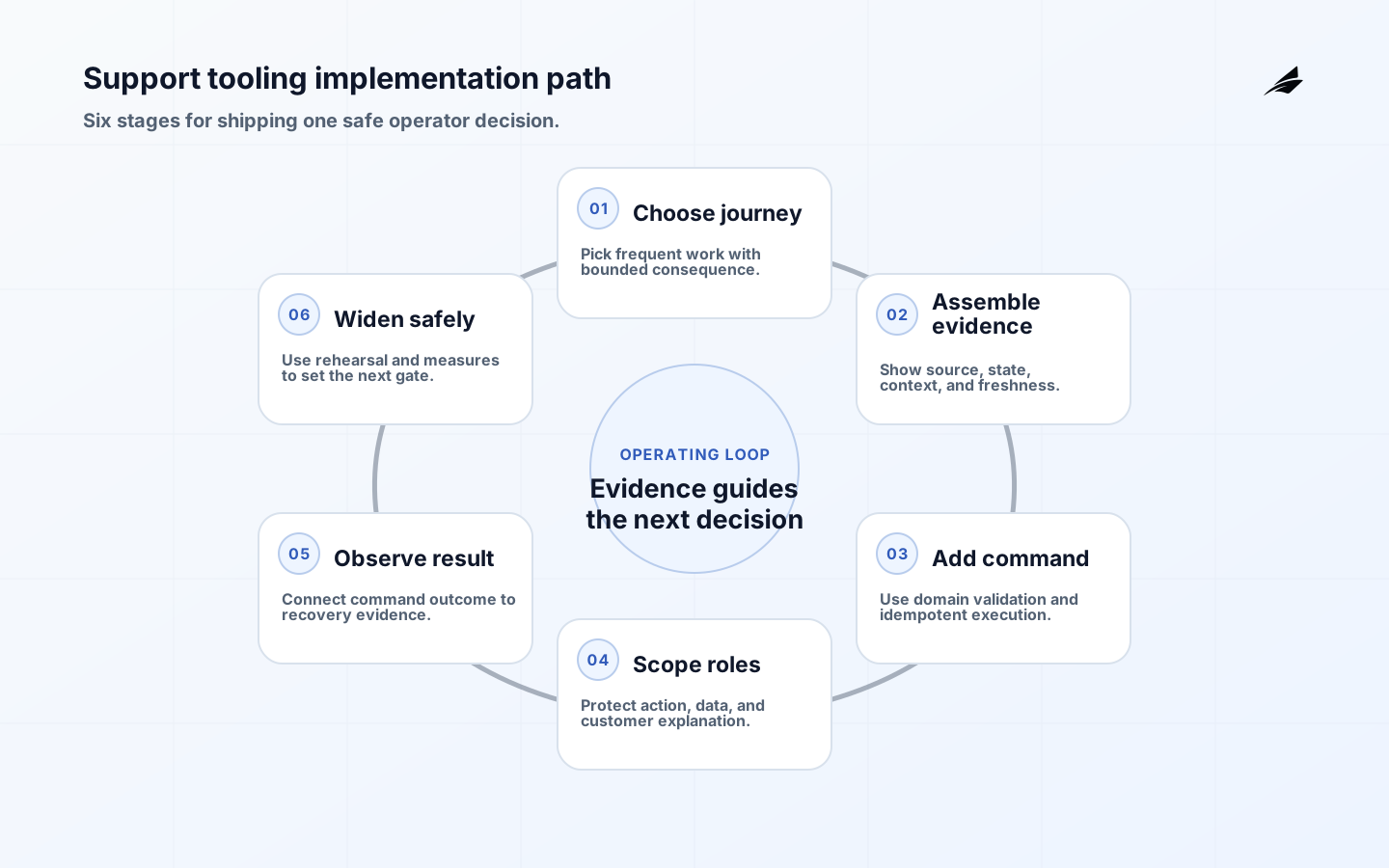
A support tooling implementation succeeds when an operator can resolve a defined customer problem with less searching and less risk. That requires more than connecting a ticket system to a dashboard. The team needs a decision boundary, an evidence contract, role-scoped actions, safe failure behavior, and a way to verify the customer outcome. This checklist turns those requirements into an implementation sequence. It is intentionally narrow: a small support workflow that is explainable and recoverable is a better foundation than a universal console that can change anything but cannot show why.
Choose the first decision and its owner
Pick a journey where support contacts are frequent, the product state is understandable, and the corrective action has a bounded consequence. Write the decision as a preconditioned command: who may do what, to which account or resource, when, and under which evidence. Assign a product owner for the customer promise, a technical owner for the service state, and an operations owner for the runbook. Atlassian’s Jira Service Management product guide is a useful prompt to keep request, incident, knowledge, and change work connected without confusing their different purposes.
| Implementation question | Decision | Acceptance evidence |
|---|---|---|
| First journey | Which case is frequent and bounded? | Representative case sample and owner |
| Source of truth | Which service owns the state? | Source reference and freshness |
| Permitted action | What may support change? | Command preconditions and authorization |
| Verification | How is customer recovery confirmed? | New state, communication, and timestamp |
Build the evidence path before the action path
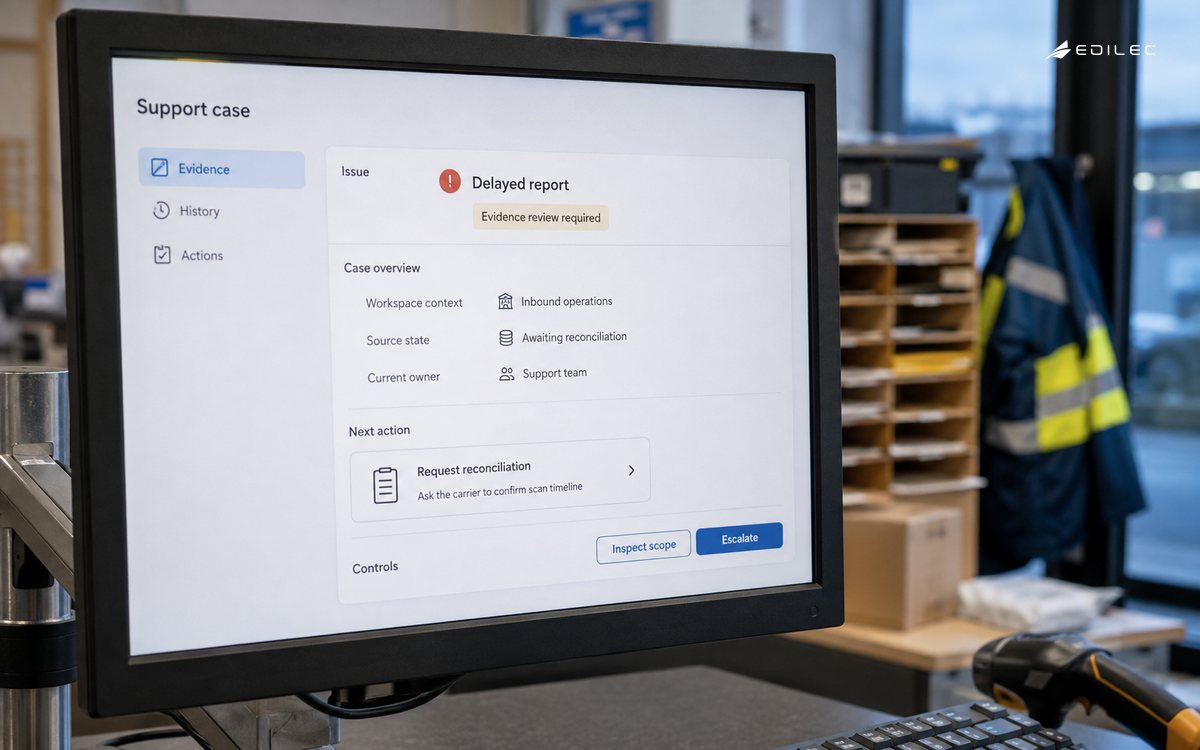
Implement a composed read view that shows account or workspace context, request identifier, relevant state, recent transitions, dependency result, and current owner. Label observations with their source and timestamp. Keep personal and confidential information out unless the role and purpose require it. Connect the support case to the service request and background job with a correlation ID. If evidence is missing, show “unknown” or “pending” and provide an escalation route; do not turn absence into a green status. The support operator should be able to write a customer-facing explanation directly from the view without copying a private engineering note.
Add one narrow, idempotent command
The first command might retry an idempotent import, reissue a notification, or request reconciliation. Put the command in the owning domain service rather than updating a support database. Recheck current state and authorization at execution, accept an idempotency key, and return a result that distinguishes completed, rejected, pending, and quarantined. Show the intended scope before confirmation. If the command can affect money, access, or durable customer data, require an appropriate approval or a two-person review. Preserve the original outcome and record the corrective action as a new event.
| Command safeguard | Why it matters | Test case |
|---|---|---|
| Precondition check | Prevents stale diagnosis from causing a wrong change | State changes after preview |
| Idempotency key | Stops a double click or retry duplicating work | Same command submitted twice |
| Role and purpose check | Limits sensitive interventions | Operator lacks action scope |
| Verification step | Confirms effect rather than request receipt | Dependency completes late |
Implement role-scoped access and usable errors
Create roles from real responsibilities: view case evidence, manage a queue, retry a job, approve a correction, or inspect sensitive fields. Test each action through the server, not only in the interface. Use labels that describe the customer impact and the next safe step. Apply WCAG 2.2 principles to keyboard focus, status changes, form errors, tables, and confirmation dialogs. A support tool that is hard to operate quickly encourages copy-paste workarounds and unnecessary elevation. Accessible language and predictable control placement are part of the risk control, not a visual polish step.
Connect implementation to operating evidence
Instrument the case from intake through outcome. Capture identifiers, actor or service identity, action, target, source version, result, duration, and reason. The OpenTelemetry observability primer explains why traces, metrics, and logs are more useful together; here the key is to preserve a safe, stable join between them. Track time to first useful diagnosis, resolution without escalation, repeat-contact rate, command rejection reasons, correction age, and operator workload. Review severe cases even when the aggregate is healthy, because a low-volume access or billing mistake can matter more than many routine resolutions.
Run the readiness review before widening scope
Rehearse a normal case, a duplicate request, stale evidence, missing context, a role change during investigation, a downstream outage, and an action that must be rolled back. Ask an operator to explain the case while an engineer traces the evidence path. Confirm that customer language is honest, that the command’s result is visible, and that a second operator can reproduce the reasoning. Use the NIST SSDF as a reminder to integrate security practices into delivery: threat modeling, review, testing, and response should appear in the same change record as the support feature.
Make the checklist executable in a support rehearsal
Use a recent difficult case, remove unnecessary personal data, and ask an operator to work it from intake to verification. Record where they need another system, where the command wording is ambiguous, and where the customer explanation depends on an unstated rule. Convert each finding into a small acceptance example with an owner.
Repeat the rehearsal with a case that should be denied. The operator should see enough evidence to explain why the action is unavailable without learning details outside their role. The service should reject the command even if the interface is bypassed, and the audit record should show the decision without exposing sensitive payloads.
Then rehearse a dependency that completes late. A submitted retry may be pending rather than failed; the tool should show that state, prevent a duplicate command, and tell the operator how completion will be verified. This is where idempotency, correlation, and customer language meet in one practical test.
Close the rehearsal by deciding the expansion gate. Define the minimum evidence for accuracy, access control, accessibility, and recovery, along with a pause condition. If the team cannot agree on what would make it stop, the command is too broad or the outcome is not yet well defined.
Keep the first implementation deliberately narrow. A read-only case view with a reliable correlation path may be enough to remove repeated investigation, while a broad account editor creates new approval and audit obligations. Use observed cases to decide which command is worth adding next. Each addition should have a bounded scope, a failure response, and a clear measure of customer benefit.
Training is part of implementation. Give operators examples of completed, pending, rejected, and quarantined outcomes, including the language they should use with customers. Practice escalation with the same evidence that the tool records. If training requires undocumented exceptions, revise the workflow before increasing access.
Finally, review the support tool after a release that changes the underlying product state. Confirm that old cases remain readable, new states have reasons, and commands still enforce the intended preconditions. A tool that only works for yesterday’s state model creates risk exactly when customers need it most.
The implementation should leave behind an operational handoff: role definitions, evidence fields, command limits, failure states, escalation owner, and review measures. Without that handoff, the system may work in testing but still depend on the original builders during the first customer incident. Make the handoff part of the acceptance criteria.
A second useful check is to remove one dependency from the happy path. If the customer service is unavailable, can an operator still tell whether the request was accepted, pending, or safe to retry? Designing that answer early prevents a support tool from turning an outage into repeated duplicate work.
Use the same acceptance record for the operator, service, and customer surfaces. It should state the precondition, command, result, evidence, and communication. Shared language makes it easier to identify whether a failure belongs to the product rule, the command execution, or the explanation shown after the action.
Do not count a successful request as a successful recovery. Confirm the resulting domain state, the absence of duplicate work, and the customer-visible effect. If verification is asynchronous, expose the pending state and the owner who will review it. This keeps the implementation honest when a dependency responds slowly.
Key takeaways
- Choose a frequent, bounded customer decision and name its owners.
- Build a source-labelled evidence view before adding mutations.
- Make commands idempotent, role-scoped, preconditioned, and verifiable.
- Treat accessible language and predictable interaction as operational safeguards.
- For related planning, See SaaS product development implementation, product readiness, and release notes mistakes and fixes.
Frequently asked questions
Which workflow belongs first?
Choose a workflow with enough volume to learn, a state that can be joined to authoritative evidence, and a correction whose risk the team can bound. Failed imports, delayed notifications, and stuck reports often work well because the customer outcome and verification signal are visible. Avoid a universal editor until those smaller decisions are understood.
When should a support action remain manual?
Keep a human in the loop when evidence is ambiguous, the action is irreversible, or the impact is high. Manual does not mean informal: require a reason, approval where appropriate, a narrow scope, and a recorded result. Automate repeatable collection and checks first, then use observed cases to decide whether a command can be safely standardized.
What should readiness review cover?
Review the decision boundary, source authority, role permissions, accessible interaction, normal and interrupted paths, audit evidence, customer explanation, recovery, and operating measures. The review is complete when an operator can solve a representative case without relying on a private escalation and can name the first safe response when evidence is incomplete.
Conclusion: ship a support decision, not a console
The strongest support tooling implementation is a small, controlled decision that makes evidence and responsibility visible. Build the read path, add one safe command, test it under real timing, and measure the customer result. This sequence gives the team a foundation for broader support operations without turning privileged access into an undocumented product surface.
A durable operating note for product support tooling implementation records the assumptions that made the decision safe: the authoritative source, effective time, permitted actor, protected resource, and recovery route. Give product support tooling implementation a named owner and a review date for the tooling checklist.
For product support tooling implementation, a good handoff ends with observable evidence rather than a verbal promise.
The smallest useful improvement to product support tooling implementation is often a sharper boundary, not another feature. Review product support tooling implementation evidence with product, engineering and support before expanding scope.
This decision also connects to Release Notes Mistakes: Fix the Record Before Support Finds It, SaaS Reliability Operations: Run the Service Well, Subscription Access Control: An IT Manager’s Operating Guide. Review those boundaries together when product support tooling implementation shares identity, data, billing, or support evidence with another workflow.
Evidence for “Product Support Tooling Implementation: A Safe Operations Checklist” is grounded in How to Use Jira Service Management, OpenTelemetry Observability Primer, Secure Software Development Framework (SSDF) Version 1.1, Web Content Accessibility Guidelines 2.2; each source informs a specific decision, test, or operating trade-off described in this guide.