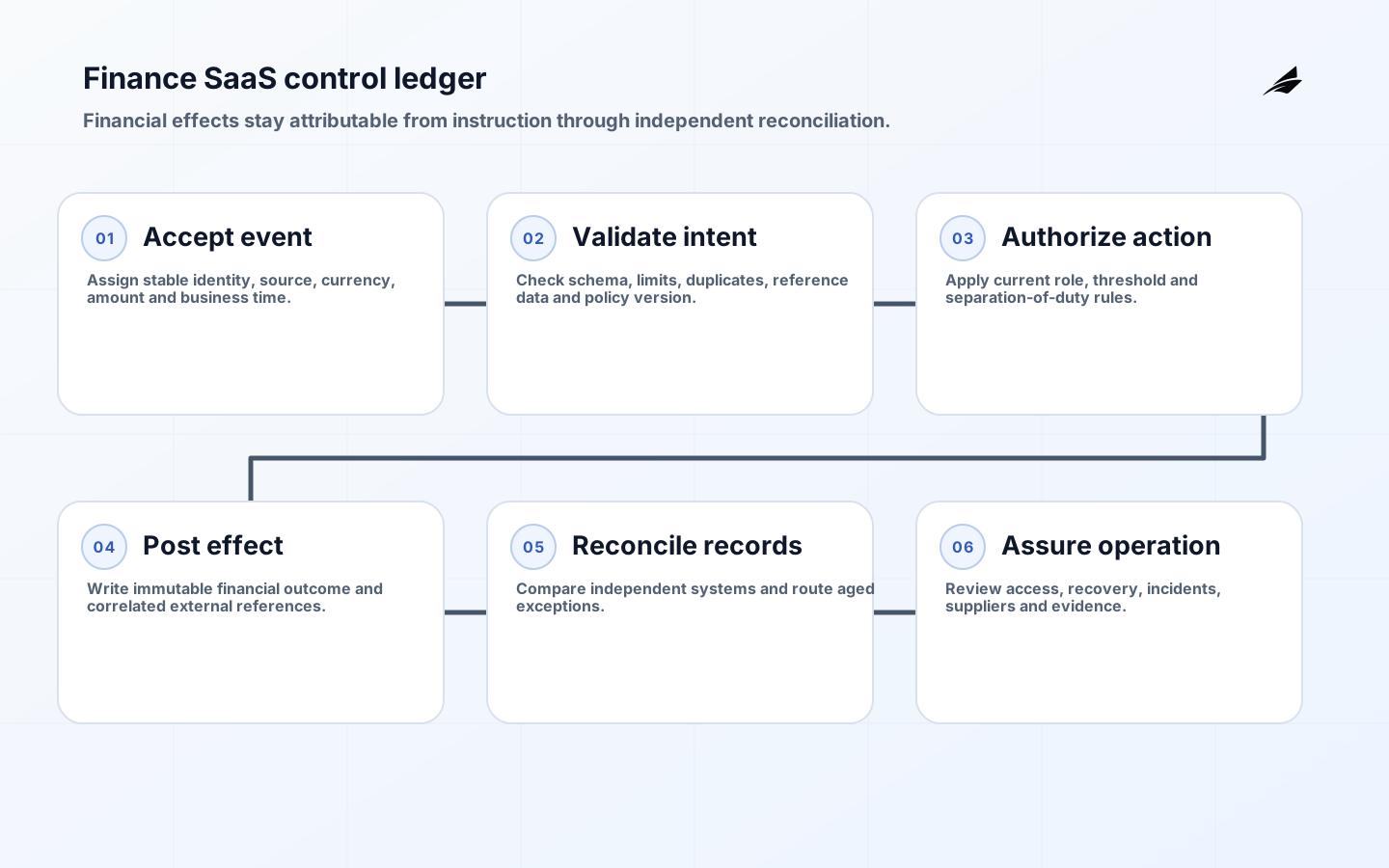
A finance SaaS product development company should be evaluated on its ability to preserve financial meaning, control change and produce operating evidence, not only on framework proficiency. Finance software moves value or supports decisions about value. A duplicated event, stale balance, unauthorized approval or unexplained correction can create customer, regulatory and accounting consequences. The delivery plan must define authoritative records, precision, posting rules, reconciliation, access, audit, recovery and third-party responsibility before a team estimates screens and integrations.
Use the finance SaaS security and delivery checklist for acceptance and the finance product development FAQ for buyer questions. Compare sector-specific needs with the ecommerce SaaS delivery plan only after identifying finance obligations. This article is planning guidance, not legal, accounting or regulatory advice; qualified specialists must confirm the rules for the product, customer and jurisdiction.
Define the financial product boundary
Describe the product by financial events and accountable decisions. Identify who initiates an event, who authorizes it, when it becomes irrevocable, which ledger or provider records the effect and how disputes are resolved. Distinguish balances shown for convenience from books of record. Map money movement, fees, taxes, foreign exchange, refunds, reversals and settlement where relevant. State whether the product stores cardholder data, initiates payments, provides advice, performs underwriting or only supports an institution’s workflow, because obligations and assurance change materially.
| Scope decision | Evidence required | Why it changes delivery |
|---|---|---|
| System of record | Ledger and provider authority by event | Defines posting and correction |
| Regulated activity | Counsel and compliance interpretation | Changes controls and approvals |
| Payment data | Current PCI DSS scope and provider design | Changes architecture and assessment |
| Customer identity | Verification, recovery and fraud model | Changes onboarding and support |
| Service criticality | Availability, RTO, RPO and communication | Changes resilience and staffing |
Design an auditable financial event model
Use stable event identity and explicit states. Preserve original instructions, authorization, posting, reversal and external references. Monetary values need defined currency, precision and rounding; never rely on binary floating point for exact money. Prefer append-only financial effects and compensating entries over editing history. Separate operational workflow state from ledger state so a case can be reopened without rewriting a posted event. Store policy and product versions needed to reproduce calculations. Consequential manual adjustments require reason, authority, evidence and independent review where separation of duties applies.
Make reconciliation a product feature
Reconcile independent records at defined intervals: internal ledger to payment provider, bank, accounting platform or customer statement. Match by stable references, amount, currency and business time, while handling fees, batches and timing differences. Route breaks to a queue with aging, ownership and bounded correction. A dashboard showing all green based on one source is monitoring, not reconciliation. Test missing, duplicated, delayed and out-of-order events before launch. Define how late corrections affect closed periods and customer communication.
Set security, privacy and access requirements
Classify data and trust boundaries during discovery. Use individual identities, phishing-resistant authentication where appropriate, least privilege, tenant isolation and server-side authorization. Separate routine administration from emergency access. Encrypt transport and sensitive stored data, manage keys independently and exclude secrets or full payment data from logs. NIST SSDF supplies secure-development practices; OWASP ASVS 5.0.0 provides verifiable application requirements. Select controls according to risk and contract rather than claiming a framework badge.
Design fraud and abuse cases with business owners: changed payout account, repeated refund, approval collusion, account recovery, export, limit override and webhook replay. Log actor, role, target, prior state, outcome and correlation identifier for consequential actions. Protect and retain evidence according to purpose. A development partner should explain its own privileged access, subcontractors, environment separation, vulnerability response and secure handover. Customer ownership of production accounts and cryptographic control should be explicit.
Select a finance SaaS development company
| Evaluation area | Ask the company to demonstrate | Warning sign |
|---|---|---|
| Domain integrity | Event, ledger and reconciliation design | Only UI portfolio examples |
| Secure delivery | Threat model, SSDF practices and ASVS evidence | Pen test treated as entire program |
| Operations | Telemetry, incident, restore and support rehearsal | No named post-launch owner |
| Third parties | Dependency, access and exit inventory | Opaque subcontracting |
| Handover | Customer-controlled accounts, code, IaC and runbooks | Access depends on vendor staff |
Run a paid discovery or technical assessment before committing to a large fixed scope. Provide real anonymized workflows, edge cases, reports, provider constraints and control requirements. Ask candidates to produce a domain model, threat model, architecture decisions, reconciliation design, delivery plan and assumption-based estimate. Verify references for similarly consequential systems, but do not infer regulatory fitness from a logo. Confirm intellectual property, open-source licenses, data location, breach duties, service levels, audit rights, subcontractors and exit assistance in the contract.
Estimate cost from assurance and uncertainty
Finance SaaS cost is shaped by event complexity, integrations, migration quality, identity and fraud controls, reporting, regulatory evidence, availability, performance and support coverage. Separate discovery, product build, platform, assurance, data migration, launch and ongoing operation. Include external assessment, provider fees, observability, backup, disaster recovery, security testing and compliance work. Show ranges tied to assumptions. A low estimate that excludes reconciliation, admin tooling or recovery simply moves cost into incidents and manual operations.
| Cost workstream | Deliverables | Acceptance evidence |
|---|---|---|
| Discovery | Workflow, obligations, data and controls | Approved decisions and exclusions |
| Core product | Customer and operator journeys, event rules | End-to-end scenario tests |
| Integrations | Contracts, idempotency and reconciliation | Failure and replay tests |
| Assurance | Security, privacy, accessibility and performance | Versioned test results |
| Operations | Deployment, monitoring, recovery and support | Rehearsal and ownership |
Use a control-led delivery sequence
- Confirm product activity, jurisdictions, obligations, owners and risk appetite.
- Model financial events, authority, precision, posting, correction and reconciliation.
- Resolve architecture, payment, identity, data, supplier and recovery boundaries.
- Build one complete financial journey with operator controls and retained evidence.
- Test abuse, duplicate, delayed, rollback, restore and reconciliation scenarios.
- Pilot within limits, compare records independently and transfer production ownership.

Each release should have traceable source, reviewed migration, automated tests, deployment plan, rollback or forward-repair criteria and business reconciliation. Separate deployment from customer exposure when possible. DORA’s current metrics can help improve delivery throughput and instability, but finance teams also need correctness, unmatched-item age, unauthorized attempts, manual adjustment rate and recovery evidence. Release velocity is useful only while financial state remains attributable and recoverable.
Control the highest-consequence risks
Maintain a joint risk register covering incorrect calculation, duplicate or lost event, excessive access, account takeover, provider outage, data breach, failed migration, unreconciled settlement, model error and vendor dependency. Every risk needs an owner, preventive control, detective signal, response and retained proof. FFIEC guidance emphasizes interconnected assets, processes and third-party providers and the need for secure, resilient services; regulated institutions should map relevant supervisory expectations directly with their compliance teams.
Plan migration and financial cutover
Profile source records and define conversion rules for currency, precision, identifiers, status and historical corrections. Rehearse with a closed period and compare opening balances, transactions and control totals. Set a freeze or controlled dual-entry window with one authority for every event type. Parallel running is useful only when differences are investigated and resolved. Define who approves reconciliation and what variance blocks launch. Preserve source extracts, mappings, run logs and sign-off under appropriate protection.
After cutover, reconcile frequently until volume and exceptions stabilize. Restrict legacy writes, retain read access according to policy and remove privileged integrations that no longer serve a purpose. Test customer statements, exports, tax reports and operational dashboards, not only balances. Keep a rollback boundary before irreversible external effects; after that point, use a forward-repair plan with controlled postings. Communicate known delays and correction behavior to support and finance teams before customers encounter them.
Key takeaways
- Define financial authority and regulated boundaries before estimating features.
- Preserve immutable event history and use controlled compensating corrections.
- Build independent reconciliation and exception ownership into the product.
- Select a partner on control evidence, operations and handover, not presentation alone.
- Price assurance, recovery and ongoing ownership as real delivery work.
Frequently asked questions
How long does finance SaaS development take?
Duration depends on activity, jurisdictions, integrations, migration, assurance and review turnaround. Ask for a range with dependency dates and evidence gates. A narrow internal reconciliation tool differs from a customer-facing money movement platform. Discovery should reduce uncertainty before the company commits to a launch date or fixed price.
Can a development company make the product compliant?
It can implement and document controls, but the accountable business must determine applicable obligations with qualified legal, compliance and accounting specialists. Compliance also includes policies, people, suppliers and ongoing operation. Contracts should define responsibilities and evidence without transferring accountability through vague claims.
What belongs in a finance MVP?
One bounded financial journey with correct event handling, authorization, audit, reconciliation, support and recovery. Volume, roles and channels may be narrow. Integrity controls cannot be deferred because a pilot built on untraceable balances produces misleading product evidence and unsafe operational habits.
Conclusion
The right finance SaaS product development company makes financial meaning and operating evidence visible from discovery onward. Scope the event model, reconciliation, security and recovery before the interface expands. Estimate the whole service, release through tested controls and keep production authority with the customer. That is how a finance product becomes maintainable and trustworthy rather than merely functional in a demonstration.