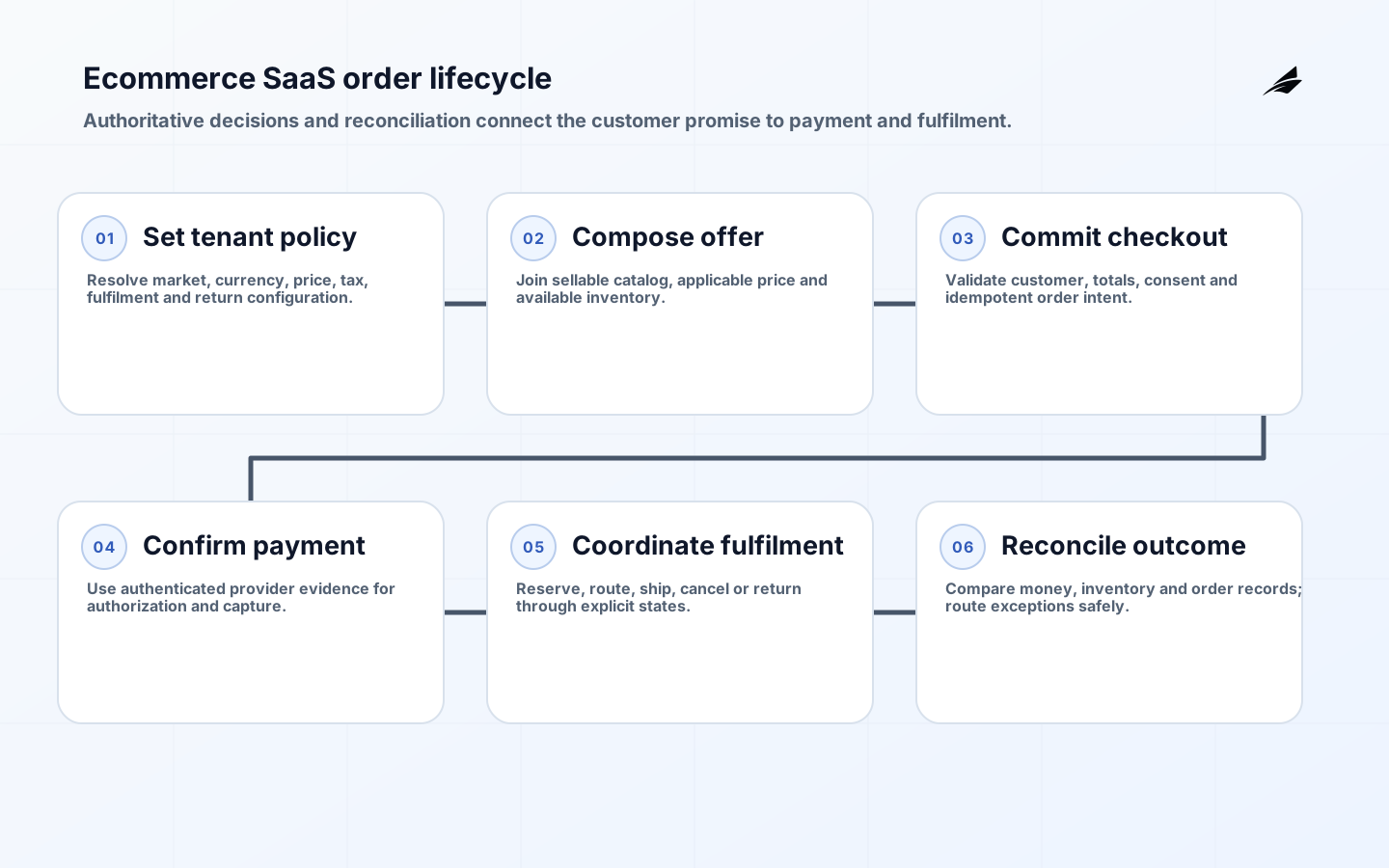
Ecommerce SaaS product development is the design of a multi-tenant operating system for catalog, pricing, inventory, checkout, orders, fulfilment, returns and reporting. A storefront demo covers only the visible edge. The difficult work lies in authoritative state, idempotent financial actions, integration failure, tenant configuration and support. A credible development plan begins with the commercial model and order lifecycle, then proves one complete transaction under realistic failure and recovery conditions.
This guide helps a buyer define the scope and evaluate a product partner. It complements the ecommerce SaaS production checklist and ecommerce development FAQ. Costs are expressed as drivers and gates because channel count, payment scope, catalog complexity, jurisdiction, integrations, migration and service objectives change effort more than the number of screens.
Define the commerce model before the feature list
State whether tenants are merchants, brands, marketplaces or internal business units. Define who owns customer relationships, product data, pricing, payment acceptance, tax decisions, fulfilment and refunds. Map business-to-consumer and business-to-business differences such as contracts, price lists, approvals, credit, purchase orders and partial fulfilment. Identify markets, currencies, languages and legal entities. These decisions shape isolation, workflows, reporting and integration far more than visual theme options.
Write the order lifecycle as explicit states with permitted transitions and compensating actions. Include cart expiry, payment authorization, inventory reservation, fraud review, fulfilment split, cancellation, refund, return and chargeback. Assign an authoritative system to each record. Do not let payment, warehouse and SaaS databases all appear to own order truth. Reconciliation must identify incomplete or contradictory events and give operations a bounded correction path.
| Domain | Authoritative decision | Failure that must be designed |
|---|---|---|
| Catalog | Sellable identity and attributes | Stale or conflicting channel data |
| Pricing | Applicable price and promotion | Concurrent rules or expired offer |
| Inventory | Available and reserved quantity | Oversell and delayed warehouse event |
| Payment | Authorized, captured or refunded value | Unknown result or duplicate request |
| Order | Customer commitment and lifecycle state | Partial transition across systems |
Design tenancy, configuration and extension boundaries
Choose a tenant isolation model from data sensitivity, scale, operational capability and contractual commitments. Enforce tenant context in identity, queries, caches, jobs, events, exports and logs. Test negative cross-tenant cases at each layer. Configuration should be versioned, validated and auditable; unrestricted per-tenant code creates an unmaintainable fork. Prefer extension points such as webhooks, typed APIs, rules with bounded inputs and approved themes.
Separate product defaults from merchant policy. A tenant may configure return windows or fulfilment methods, but the platform must preserve invariants such as valid currency, balanced financial records and authorized transitions. Use capability flags and migration versions rather than checking tenant names in application code. Build support tools that explain effective configuration and change history, because production incidents often arise from the interaction of global and tenant-specific settings.
Bound payment and security scope deliberately
Reduce card-data exposure by using appropriate hosted payment components or tokenization, while confirming the actual PCI DSS responsibilities with the acquiring and compliance parties. Inventory payment-page scripts and control change where applicable. Treat provider webhooks as untrusted network input: authenticate them, prevent replay, store event identity and make handlers idempotent. Never infer a completed payment solely from a browser redirect.
Apply server-side authorization to customer, merchant, support and platform actions. Protect account recovery, exports, bulk price changes, refunds and support impersonation as high-consequence functions. Use OWASP ASVS to select verifiable application controls, retain audit events, limit sensitive logs and define a vulnerability response process. Threat models should include credential stuffing, enumeration, promotion abuse, bot traffic, inventory hoarding and cross-tenant access.
Make checkout accessible, fast and explainable
Adopt WCAG 2.2 as the accessibility reference and test the complete purchase and support journeys with keyboard, screen reader, zoom and mobile input. Focus handling, error association, target size, accessible authentication and consistent help directly affect conversion and inclusion. Preserve entered data when validation fails. Do not make a timed session or drag interaction the only route through a critical step without an accessible alternative.
Set performance budgets around user tasks, not only server averages. Measure catalog discovery, add-to-cart, checkout readiness and order confirmation from the client. Optimize images, caching and scripts without allowing stale price or stock to become authoritative. Degrade optional recommendations or analytics before core purchase functions. Test peak scenarios with realistic product, promotion and tenant distributions; a uniform synthetic catalog can hide the expensive queries seen in production.
Treat integrations as products with contracts
For payment, tax, shipping, ERP, warehouse, CRM and marketplace connections, define data ownership, schema, authentication, rate limits, ordering, duplicate handling, replay, observability and support. Use queues where temporary delay is acceptable, and preserve an event or command ledger for reconciliation. Version external contracts and publish deprecation windows. A connector is not complete until failures are visible and operations can distinguish waiting, rejected, duplicated and manually corrected work.
Plan migration as a sequence of reconciled datasets: tenants, users, catalog, price, inventory, customers, open orders and financial history. Define which records can be transformed, which must remain immutable and how identifiers map. Rehearse volume and timing, then compare counts, totals and sampled records. Keep a cutover decision and fallback plan that accounts for new writes; restoring a database backup alone may not undo messages sent to payment or fulfilment partners.
Set service objectives from the order journey
Define indicators for successful browse, cart mutation, checkout, payment confirmation and order visibility. Include correctness and freshness where infrastructure uptime would conceal stale stock or a wrong price. Specify measurement points, windows and exclusions. Use dependency health, queue age and reconciliation backlog as leading signals, but page responders for customer-impacting conditions that require urgent action. Rehearse provider outage, webhook delay and partial fulfilment before seasonal peaks.
Build a support timeline that correlates user action, order state, payment event, inventory decision, integration delivery and administrative change. Give support bounded actions for retry, cancellation or escalation rather than database access. Preserve customer communication history. During an incident, operations should know whether to pause checkout, disable a payment method, queue fulfilment or continue in a reduced mode, and who has authority to make that choice.
| Cost driver | Why effort changes | Evidence that narrows estimate |
|---|---|---|
| Commerce model | Marketplace and B2B add roles and settlement | Approved order and money flows |
| Integrations | Contracts and failure modes vary | Sandbox tests and interface inventory |
| Migration | Quality and open transactions create risk | Profiled data and rehearsal |
| Assurance | Payment, privacy and markets affect controls | Scoped obligations and threat model |
| Reliability | Peak and recovery objectives shape architecture | Load profile and service objectives |
Deliver one complete order before broad catalog scope
- Confirm tenant, customer, order and financial ownership.
- Model lifecycle states, invariants, failures and correction authority.
- Build one product-to-order path with a real payment sandbox.
- Add accessibility, telemetry, reconciliation and support controls.
- Pilot with bounded tenants, products and fulfilment routes.
- Observe operations before expanding channels and extensions.

Key takeaways
- Scope the platform from tenant economics and the order lifecycle.
- Keep clear authority for catalog, inventory, payment and order state.
- Design integration failure, reconciliation and support from the start.
- Treat accessibility, security and user-centered reliability as core features.
- Estimate from evidence and launch through bounded commerce slices.
Frequently asked questions
Should the product use an existing commerce engine?
Use one when its domain model, extension limits, operating model and economics fit the differentiating workflow. Build custom capability where the business truly differs. Evaluate upgrade path, data export, tenant isolation, payment scope and integration failure before comparing feature lists.
What belongs in an ecommerce SaaS MVP?
One coherent customer and merchant journey with production-grade order state, payment evidence, security, accessibility, telemetry, reconciliation and support. Additional channels, promotion types and advanced analytics can wait if they do not change the investment decision.
Can cost be estimated per screen?
Not responsibly. A simple-looking refund screen may coordinate payment, order, tax, inventory and accounting records. Estimate capabilities and risk after mapping states, integrations, data migration, assurance and service objectives, then keep contingency around unknown external behavior.
Contract and handover terms should preserve the ecommerce company’s control of source, merchant data, payment-provider accounts, domains, infrastructure definitions and deployment access. Require an architecture record, integration catalogue, data dictionary, migration evidence, test results, runbooks, dependency inventory and known-risk register. Verify handover by asking the receiving team to deploy a safe change, investigate a failed order and reconcile a payment exception using ordinary access. This exercise reveals whether knowledge is operational or merely documented.
Plan analytics as a governed output of the transaction model rather than a second source of truth. Define events and dimensions, consent behavior, freshness and correction. Revenue dashboards should reconcile to authoritative order and payment records. Product experiments must not alter totals, authorization or accessibility controls, and their assignment should be observable so customer support can explain different behavior.
Create a seasonal readiness gate well before peak demand. Rehearse forecast load, provider quotas, inventory updates, operational staffing, incident communication and rollback. Freeze only changes whose risk cannot be controlled; urgent security and correctness work still needs a tested path. After the peak, reconcile orders and financial records, review customer impact and turn temporary capacity or workarounds into explicit retirement tasks.
Version merchant-facing configuration and offer a preview before activation. Validate conflicts, show the effective date and retain the previous value for rollback. Bulk changes should report partial failure explicitly and give operations a reconciliation file rather than presenting the entire upload as successful.
Conclusion
An ecommerce SaaS product succeeds when commercial rules become reliable, inspectable software across tenant and provider boundaries. Start with an authoritative order lifecycle, build one complete transaction, and prove failure handling as carefully as the happy path. That approach creates a platform that can add channels and tenants without turning every payment exception into an engineering emergency.