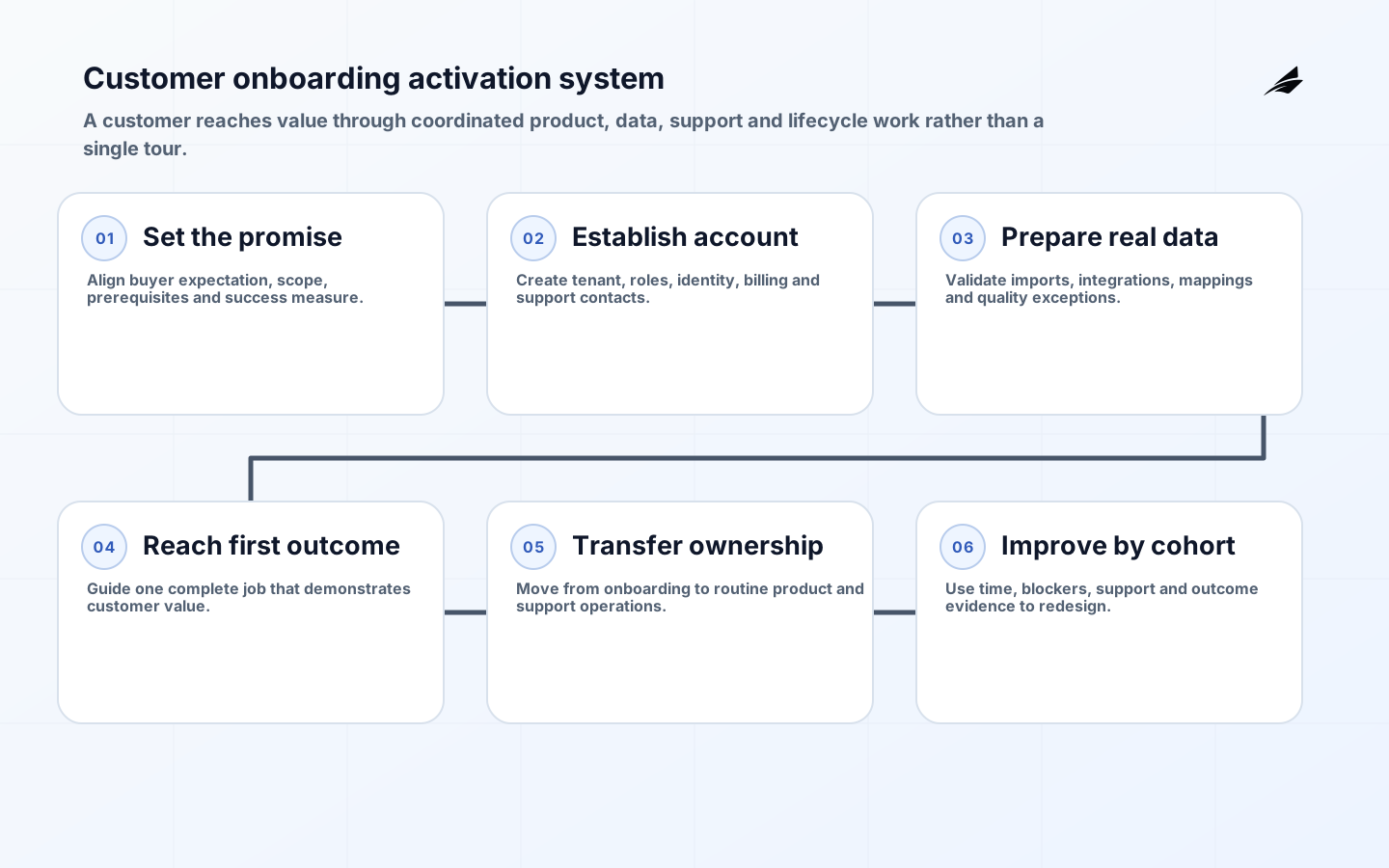
Customer onboarding systems that scale coordinate the work required for a customer to reach a first repeatable outcome. They do more than display a welcome checklist. In a complex SaaS or service product, onboarding may include commercial commitments, tenant creation, identity, data import, integration, configuration, training, approvals, support and operational handoff. If these activities live in separate spreadsheets and inboxes, growth creates longer delays, inconsistent promises and hidden customer risk.
This guide describes the product and operating architecture for scalable onboarding. It complements in-app guidance for complex software and product analytics for early SaaS teams. The goal is not to make every customer journey identical. It is to standardize the evidence, ownership and handoffs around a clear outcome while preserving justified variation.
Define activation as a customer outcome
Write the first meaningful outcome in the customer’s language: a team completes its first approved payroll, resolves a case using real data, publishes a compliant campaign or monitors a production service. Account creation, invited users and completed tours are milestones, not necessarily value. Define the target cohort and the evidence that proves the outcome. Different customer segments may have different activation definitions, but each should be specific enough to guide product and operational decisions.

Baseline the current journey across sales, implementation, product and support. Include time spent waiting for customer decisions, credentials, data and internal approvals. Separate elapsed time from active work. Identify rework caused by unclear promises or bad inputs. GOV.UK’s service measurement guidance recommends deriving measures from the service’s purpose and combining multiple data sources; that principle prevents onboarding teams from optimizing checklist completion instead of customer success.
| Measure | What it reveals | Misleading interpretation |
|---|---|---|
| Time to first outcome | End-to-end activation speed | Assuming all waiting is internal delay |
| Prerequisite completion | Customer and provider readiness | Treating completion as delivered value |
| Rework rate | Input, promise or configuration quality | Blaming individual implementers |
| Support demand | Confusion and operational burden | Counting fewer tickets as success without outcome |
| Outcome retention | Whether value repeats after handoff | Stopping measurement at go-live |
Build one joined onboarding service blueprint
Map customer actions, visible product behavior, internal work, systems, suppliers and evidence for every stage. Define the commercial-to-delivery handoff: purchased scope, exclusions, timeline assumptions, success measure, security requirements, integrations and named decision-makers. The onboarding system should not allow an unsupported promise to become invisible. Record exceptions with cost, owner and product implication so repeated bespoke work can inform packaging or roadmap decisions.
Use one onboarding record with stable customer, tenant and project identifiers. It should show phase, next outcome, blockers, owner, target date, prerequisites and linked evidence. Avoid a single percentage that hides the critical path. A customer can be 90 percent complete while a missing identity decision prevents any safe launch. Model dependencies and decision dates. Preserve history when ownership, scope or target changes so teams can explain delay without reconstructing messages.
Make account, identity and data readiness explicit
Automate tenant creation through a controlled service rather than a runbook of console clicks. Establish organization identity, billing account, region, plan, feature entitlements, administrators, support contacts and lifecycle state. Use idempotent provisioning and retain an operation reference. Verify that cancellation, suspension and deletion can reverse or retire created resources. Keep implementation access separate from customer roles and time-bound privileged support.
Treat data migration as a product workflow. Define source, owner, allowed fields, mapping, quality rules, transformation, validation and reconciliation. Provide a dry run and clear exception report. Do not declare import success because a file was accepted; compare counts, totals, relationships and sampled records, then obtain accountable acceptance. Integrations need credential ownership, permissions, rate limits, failure handling and a test transaction. A missing data contract is a common cause of late onboarding delay.
| Readiness area | Required evidence | Stop condition |
|---|---|---|
| Commercial | Signed scope, exclusions and success outcome | Promise conflicts with supported product |
| Identity | Named owners, roles and recovery path | Shared or unverified administrator |
| Data | Mapped fields, quality report and reconciliation | Material records missing or unexplained |
| Integration | Tested permissions, error path and owner | Production credential or callback unavailable |
| Operations | Support, monitoring and escalation accepted | No owner after launch |
Combine self-service with accountable human support
Self-service works for understandable, reversible and well-instrumented steps. Show prerequisite, expected duration, validation and current status. Save progress and provide a stable way back. Use contextual help rather than a one-time tour. Human support remains necessary for ambiguous data, policy decisions, organizational change and high-consequence configuration. Route requests with the customer record and attempted steps so support does not restart discovery.
Design assisted and self-service paths to reach equivalent outcomes. Customers who need accessibility support, security review or a different channel should not receive a lower-quality record. WCAG 2.2 applies to the complete onboarding process, including identity, forms, uploads, external payment and support. Test keyboard, screen readers, zoom, reflow, error recovery and accessible authentication with representative users and data.
Automate routine handoffs while exposing exceptions
Automation should create tasks, validate prerequisites, provision standard resources, notify accountable people and update status from authoritative events. It should not guess that work is complete because a date passed. Use an event or command reference and distinguish pending, successful, failed and unknown. Retry only idempotent operations. Put failures in an owned queue with evidence, customer impact and next action. Measure manual intervention so hidden service cost remains visible.
Segment templates by product and cohort, but govern variation. Each optional step should have a reason and owner. Feature flags can stage capabilities, but their defaults, dependencies and removal dates belong in the onboarding record. Avoid cloning a workflow per customer; repeated exceptions should become configurable policy or a deliberate bespoke service. Protect internal notes and customer-visible status as separate fields to prevent accidental disclosure.
Define completion and the operating handoff
Go-live is a gate, not the end. Confirm the customer has reached the agreed outcome, administrators can manage routine work, data and integrations are reconciled, support channels are known, monitoring is active, billing matches entitlement and outstanding risks are accepted. Transfer the record to customer success or support with open actions and decision history. Do not close onboarding while a temporary implementation account remains privileged or a manual data job lacks ownership.
Measure outcome persistence after 30, 60 or 90 days according to the product cycle. Review whether the customer repeats the valuable action, expands healthy use, raises avoidable support issues or reverts to an old workaround. Combine analytics with research and account context. Instrument important events with stable definitions and privacy-conscious properties. OpenTelemetry signals can follow technical handoffs, while product events describe customer progress; neither replaces direct observation and conversation.
Improve the system by cohort, blocker and outcome
Review cohort distributions rather than a single average. Separate small and large accounts, integration paths, industries, regions and onboarding models. Inspect the longest cases and fastest successful cases. Classify blockers by owner and root cause: commercial promise, customer readiness, product usability, data quality, supplier delay or internal capacity. Fund the recurring system problem instead of asking coordinators to chase harder.
Use periodic usability benchmarking on complete tasks, as GOV.UK’s benchmarking guidance recommends. Test whether changes reduce time, error and false confidence. Maintain a product decision log connecting onboarding evidence to templates, packaging and roadmap. Retire steps that no longer protect an outcome. The scalable system becomes shorter and clearer as the product matures, not merely more automated.
Plan capacity and onboarding economics before volume arrives
Forecast starts by cohort, prerequisite lead time, specialist skills and likely exception rate. A system that launches ten accounts at once may overload security review, data migration or customer decision-making even when provisioning is automated. Set work-in-progress limits around constrained steps and make the queue visible to commercial teams. Use scheduled start windows or qualification criteria when uncontrolled arrival would harm existing customers.
Calculate cost to onboard using active labor, waiting coordination, vendor charges, data processing and support through stable use. Separate standard and bespoke work. Price implementation or require prerequisites when variation creates real cost. Track whether product changes reduce repeatable effort without shifting it to the customer. Automation is valuable when it lowers elapsed time, error or skill dependence while preserving evidence, not merely when it removes a task from one team’s dashboard.
Prepare an overload mode. Define which starts can pause, which customer commitments are protected, how status is communicated and how priority is approved. Avoid assigning every customer the highest urgency. A capacity plan tied to signed demand and product telemetry lets leaders add people or improve bottlenecks before an onboarding backlog becomes a retention problem.
Key takeaways
- Define activation as a repeatable customer outcome, not account setup.
- Use one record for promises, prerequisites, blockers, decisions and evidence.
- Treat tenant provisioning, data migration and integrations as controlled workflows.
- Automate standard work but keep exceptions and manual effort visible.
- Measure outcome persistence and improve recurring blockers by cohort.
Frequently asked questions
Who should own customer onboarding?
A named service or product owner should own the end-to-end outcome. Sales, implementation, product, engineering and support own parts, but one accountable person must resolve conflicts and improve the whole system.
Can a CRM be the onboarding system?
It can hold commercial context and high-level milestones. Complex provisioning, data and product events often require a workflow service integrated with the CRM. Choose one authority for each field and avoid synchronized duplicates without reconciliation.
Where can AI help?
AI can summarize notes, classify blockers or suggest next actions when grounded in approved records. Keep permissions, source references and human review. Do not let generated output create customer commitments or production configuration without authorization.
Conclusion
Scalable onboarding is a joined operating system for reaching customer value. It aligns promises, account and data readiness, product guidance, human support and measurable handoffs around one outcome. When blockers and exceptions remain visible, growth can reduce friction instead of multiplying hidden coordination work.