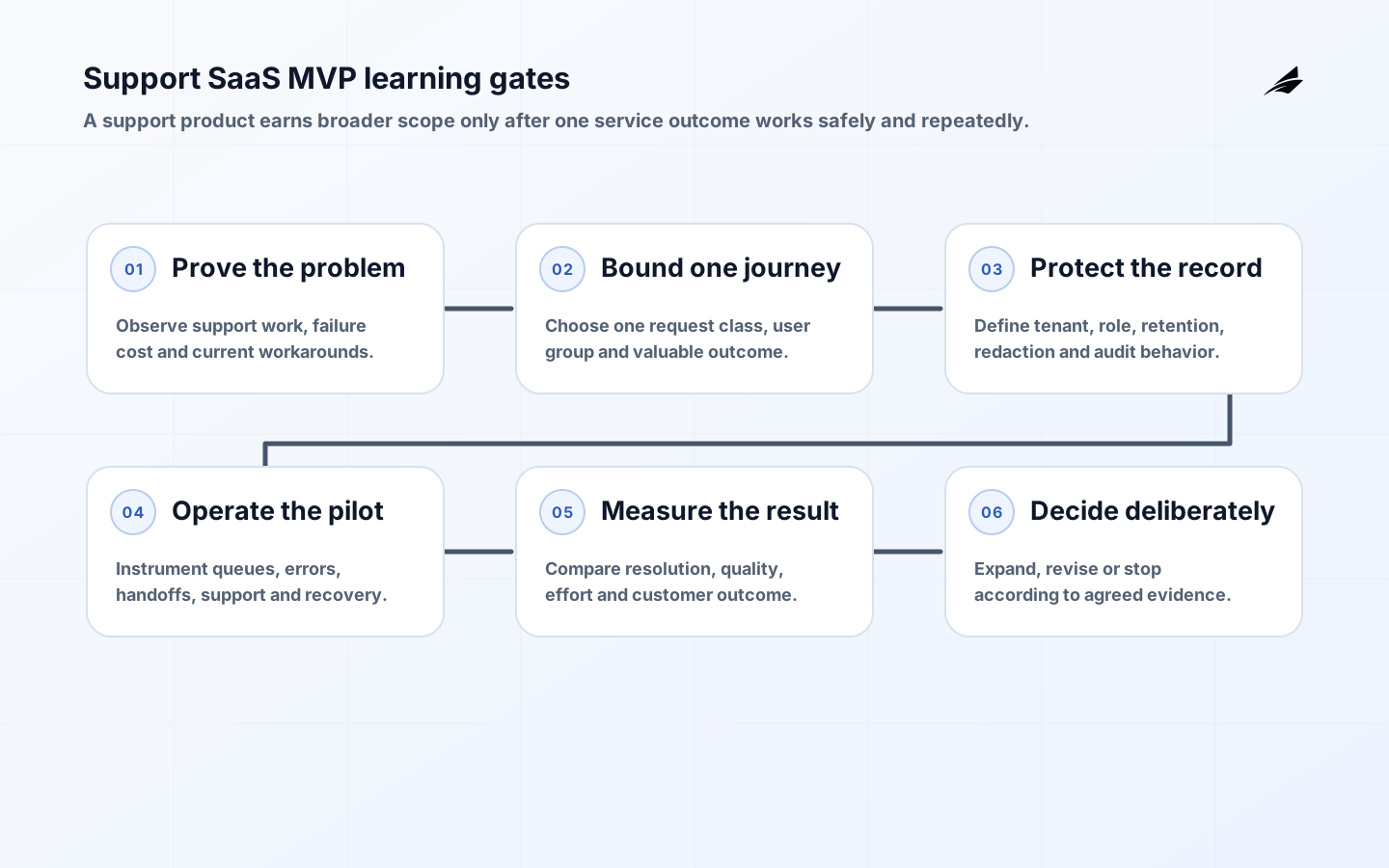
SaaS MVP development for support teams should test one service improvement without turning customers or agents into unpaid quality assurance. The minimum viable product is the smallest dependable service that can show whether a target team gets a repeatable outcome: faster triage, better routing, more consistent answers, fewer handoff failures or clearer workload visibility. It is not a broad ticketing clone with weak permissions, unknown data retention and manual recovery hidden behind the word pilot.
Use this implementation checklist with the support-team SaaS MVP delivery plan and the support-team SaaS MVP FAQ. The checklist follows the evidence sequence recommended by GOV.UK’s discovery guidance: understand users, constraints and the problem before committing to build.
1. Define one support outcome and a narrow pilot boundary
Observe agents handling real work. Record incoming channels, request classes, information they seek, tools they switch between, approvals, escalations and rework. Interview support leaders and downstream teams, but do not rely only on policy descriptions. Select one frequent and consequential problem for a coherent user group. State the result in operational language, such as reduce misrouted account-access cases or make warranty evidence complete before technical review.
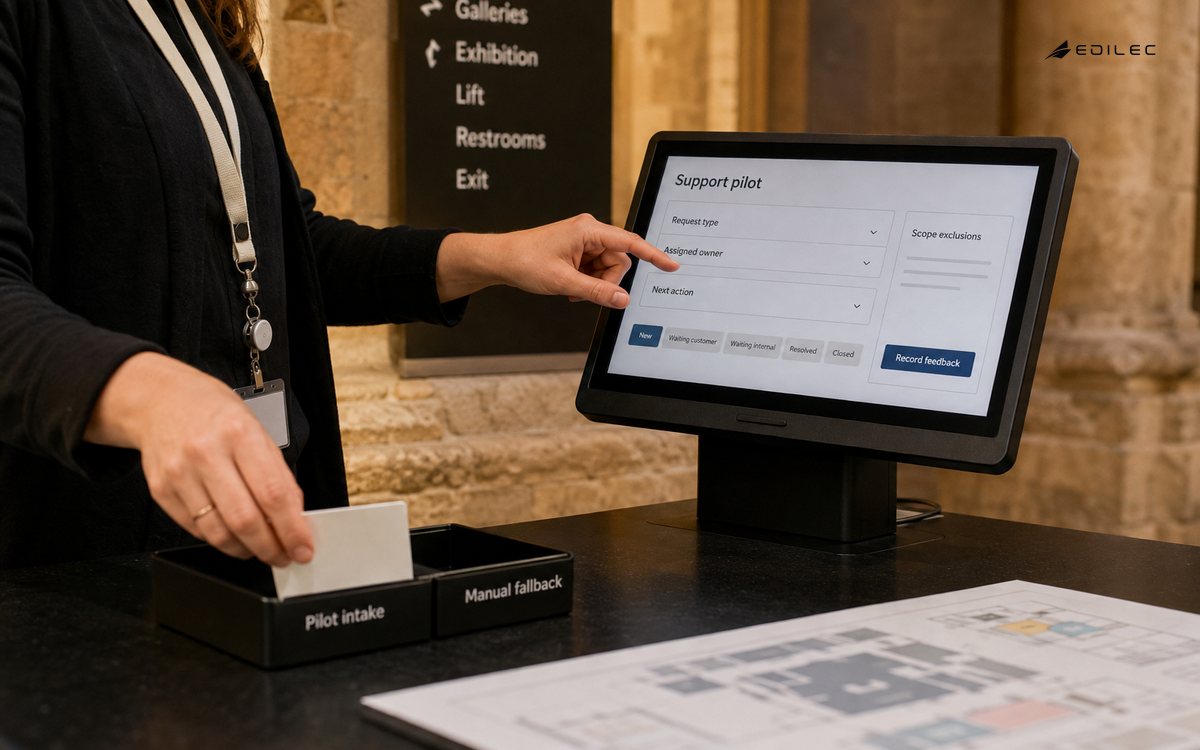
Write the pilot boundary: eligible users, customers, channels, request types, regions, data classes, integrations, service hours and exclusions. Define counter-evidence that would stop or change the product. If agents still need substantial manual correction, customers cannot understand status or data access cannot be controlled, expansion is not justified. Keep a manual fallback and tell users what the pilot can and cannot do.
| Assumption | Low-cost test | Evidence to continue |
|---|---|---|
| Problem is material | Observe cases and quantify rework | Repeated consequence across target team |
| Workflow can be standardized | Map variants and exception causes | Common core with bounded exceptions |
| Data is available | Sample records and permission paths | Required fields accessible lawfully |
| Users will adopt | Prototype in real support sessions | Agents complete work with less friction |
| Outcome can be measured | Baseline cohort and service metric | Reliable comparison is possible |
2. Design the support record and authority model
Define the authoritative object: case, conversation, task, customer, order, entitlement or incident. Give every record a stable identifier and explicit lifecycle. Distinguish new, waiting for customer, waiting for internal team, resolved and closed; avoid one overloaded status field. Preserve event history so operators can explain who changed priority, ownership, entitlement or customer-facing state. Model service-level clocks with pause rules and source timestamps rather than calculating them only in the interface.
Map roles for agents, supervisors, specialists, administrators, service accounts and customers. Enforce tenant and record scope on the server, including search, exports, attachments, background jobs and support impersonation. Define sensitive fields, redaction, retention and deletion. NIST’s current Digital Identity Guidelines can inform assurance and recovery decisions; the exact level must follow risk rather than an MVP shortcut.
3. Automate a bounded step without hiding judgment
Choose automation whose input, output and failure can be inspected: classify a request, suggest a route, retrieve an approved answer, check evidence completeness or prepare a summary. Keep the accountable person visible. For rules, store the rule version and explain why it matched. For model-assisted behavior, define allowed sources, confidence or uncertainty handling, prohibited actions and human review. Never let generated text create refunds, account changes or promises without authorization appropriate to the consequence.
Design exceptions before the happy path is polished. What happens when customer identity is uncertain, an attachment is unreadable, two systems disagree, a dependency times out or automation confidence is low? Put the item in an owned queue with reason, evidence and next action. Do not silently default to a plausible category. Measure correction rate and downstream harm, not just automation volume.
| Capability | MVP acceptance | Defer until evidence |
|---|---|---|
| Case intake | One channel with validated fields and attachments | Every social and messaging channel |
| Routing | Explainable suggestion plus human override | Autonomous reassignment across all queues |
| Knowledge | Approved source with citation and freshness owner | Open-web answer generation |
| Analytics | Outcome, queue and exception measures | Large executive dashboard suite |
| Administration | Named roles and auditable configuration | Highly customized customer policy engine |
4. Build a secure and operable foundation
Prefer a modular application with clear interfaces over premature distribution. Automate environment setup, database migration and deployment. Protect repositories, branches, build credentials and artifacts. NIST’s SSDF provides a practical vocabulary for secure development, while the OWASP ASVS helps select verifiable web controls. Threat-model tenant isolation, attachments, customer identity, administrator tools, exports and integrations.
Instrument the support journey. Record request receipt, validation, routing, ownership, dependency calls, customer updates, escalation and completion using privacy-conscious event definitions. Monitor queue age, failed jobs, provider errors and permission denials. Back up authoritative data and test restoration. Provide status communication and a support contact. The team operating the MVP should be able to find a failed case, understand its state and recover it without direct database edits.
5. Verify usability and accessibility in real support work
Support interfaces are dense and time-sensitive, so keyboard order, focus, labels, status messages and error recovery matter. Use semantic controls before custom widgets. Test zoom, reflow, contrast, screen readers and keyboard-only operation across the complete workflow, including filters, tables, drawers and notifications. WCAG 2.2 applies to complete pages and responsive variations, not an isolated component showcase. Include users with different access needs and agents working under realistic volume.
Measure whether the interface reduces cognitive work. Can an agent see customer identity, request, entitlement, prior attempts and next action without opening six panels? Does the system preserve filters and draft work safely? Are destructive actions confirmed according to consequence? Use concise content and progressive disclosure, but never hide status or policy needed to make a decision. Review support documentation and in-product guidance together.
6. Run a pilot that can challenge the product thesis
Baseline the existing process for the target cohort. Combine task completion and operational measures with research, as GOV.UK’s service measurement guidance recommends. Useful measures include time to accurate routing, first useful response, resolution, reopen rate, transfers, customer effort, agent correction, escalation and support cost. Segment results by request type, customer cohort and channel so averages do not hide failure.
Run the pilot long enough to include ordinary variation and a few exceptions, but time-box the decision. Hold weekly reviews with product, support, engineering, security and data owners. Inspect individual records behind metrics. Track manual work performed outside the product, because founder or specialist intervention can make a weak MVP appear successful. At the end, decide to expand, revise, retain as a specialized service or stop.
7. Complete operational acceptance before broader launch
- A named service owner accepts the workflow, exclusions and success criteria.
- Tenant, role, customer identity and administrator paths have been tested.
- Retention, export, deletion and attachment handling match the customer promise.
- Representative dependency failure and duplicate events produce recoverable states.
- Support staff can trace, correct and explain a case without hidden intervention.
- Backup restoration and incident communication have been exercised.
- Pricing, entitlements and cancellation behavior match the actual product.
- Pilot evidence and counter-evidence are documented for the scale decision.
8. Test support economics and the commercial promise
Model price against the unit customers understand, then estimate hosting, model or API use, storage, vendor licenses, implementation and support effort. A workflow can save agent minutes while creating expensive exception handling or specialist review. Tag manual interventions and support time by account. Define which setup, integration and service levels are included, and keep early discounts time-bounded so the pilot does not conceal unsustainable delivery.
Make product claims match evidence. If the MVP suggests routes, call it assistance rather than autonomous resolution. State supported languages, channels, availability and data boundaries. Contracts and sales materials should describe export, deletion, support and incident communication as they actually work. Record customer-specific commitments in the backlog and operating plan; a small wording exception can create a permanent architecture or staffing obligation.
Before scale, compare outcome value with total service cost by cohort. A segment that needs repeated bespoke data cleanup may be better served through a priced professional service or a narrower product promise. A transparent economic model helps the team choose where automation, product redesign or customer qualification creates the next learning advantage.
Key takeaways
- Choose one repeatable support outcome and a coherent pilot cohort.
- Make the support record, lifecycle and authority model explicit.
- Automate inspectable steps and route uncertainty to accountable people.
- Measure service outcomes and hidden manual work, not feature usage alone.
- Require secure, accessible and recoverable operation before expanding scope.
Frequently asked questions
Should the MVP replace the existing help desk?
Usually not at first. Integrate or shadow one bounded workflow so the team can compare outcomes and retain a fallback. Replacement becomes reasonable only after migration, reporting, integrations and operational capability have been proven.
Does a support SaaS MVP need AI?
No. Better records, routing rules, integrations and status can create substantial value. Use AI when the task benefits from probabilistic classification, retrieval or summarization and the team can evaluate failures and preserve human authority.
How long should the pilot run?
Duration depends on request frequency and variation. Set an evidence threshold rather than an arbitrary calendar target: enough representative cases, users and exceptions to compare against the baseline, plus a fixed review date to prevent indefinite experimentation.
Conclusion
A credible support SaaS MVP is narrow in product scope and complete in service responsibility. It protects customer records, makes uncertain work visible, helps agents reach one outcome and produces evidence for a real investment decision. Teams that preserve these standards can learn quickly without making pilot users carry avoidable operational risk.