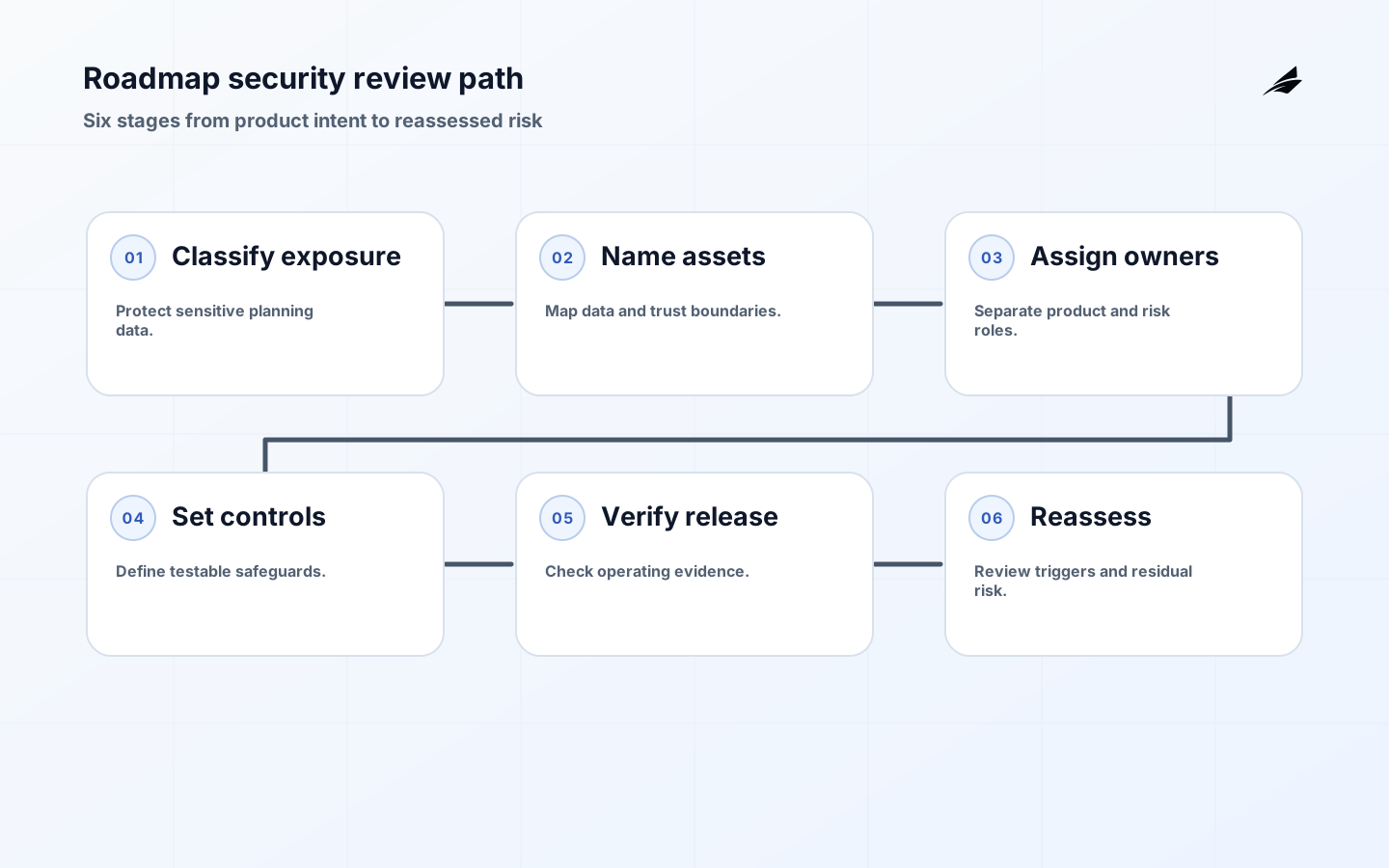
A roadmap systems security review protects product decisions before dates, customer promises, and implementation choices make them expensive to change. The review is not a request to threat-model every idea at maximum depth. It is a proportional way to identify what the roadmap reveals, what the planned change can affect, who owns the control, and which evidence is required before release. Treat roadmap systems as part of the product security lifecycle: a planning record can expose sensitive strategy, create an access decision, or hide a risk that will later become a launch blocker.
Classify roadmap exposure
Start by listing what a roadmap item contains and who can see it: customer commitments, target dates, vulnerability remediation, pricing changes, acquisition plans, architecture constraints, incident follow-up, and named accounts. The right visibility for a public feature theme may be wrong for a customer-specific promise or security weakness. Use workspace and role boundaries, and make shared links expire or require deliberate access when the content is sensitive. Record the owner of the information classification instead of leaving the decision to the tool’s default permissions.

Then classify the planned change by affected asset: identity, data, authorization, tenant scope, external integration, billing, availability, or operational control. Ask what an attacker, disgruntled insider, compromised account, or accidental recipient could learn or alter. This is a practical first pass that turns “security later” into a bounded question. High-risk items should carry a deeper review path; low-risk items can record a short rationale and continue without a meeting that adds no useful evidence.
| Roadmap exposure | Example | Planning control |
|---|---|---|
| Public direction | Broad theme or problem area | Approved summary and no sensitive detail |
| Commercial commitment | Named customer or pricing behavior | Restricted access and owner for promise |
| Security work | Vulnerability or hardening item | Need-to-know visibility and remediation evidence |
| Architecture change | New integration or trust boundary | Design owner, dependency, and threat check |
| Incident follow-up | Corrective action after failure | Link to evidence and verification date |
Assign security ownership to the decision
The product owner owns the customer outcome, but that does not make the product owner the sole security decision maker. Assign an engineering owner for implementation boundaries, a security partner or accountable reviewer for material risk, and an operations or support owner for recovery and communication. The record should show who can accept residual risk and who must be consulted. If those roles are missing, the roadmap is not ready to promise a date because the control path is still implicit.
Use security requirements that are testable. “Secure the export” is too broad; “the export service checks current workspace membership, applies the selected account scope, emits an audit event, and denies a stale or missing authorization context” can be verified. The NIST Secure Software Development Framework is designed to integrate secure practices into existing lifecycle models. A roadmap system should make that integration visible as work with acceptance evidence, not a separate checklist that can be skipped when the release is close.
| Decision role | Accountability | Required artifact |
|---|---|---|
| Product owner | User outcome and scope | Problem, audience, and trade-off |
| Engineering owner | Service and data boundary | Architecture note and test plan |
| Security reviewer | Risk and control adequacy | Threat, control, and residual risk note |
| Operations owner | Detection and recovery | Runbook, alert, and containment path |
| Risk accepter | Explicit decision on remaining exposure | Named approval and expiry or trigger |
Review the whole information path
Follow the item from intake to archive. Include roadmap viewers, comments, attachments, integrations, exports, notifications, search indexes, backups, and analytics. A record can be safe in the planning application but leak through a webhook or an automatically generated report. For implementation changes, trace data and authorization through APIs, queues, background workers, caches, and support tooling. The OWASP Application Security Verification Standard offers control areas for access control, data protection, validation, logging, and configuration that can be mapped to this path.
Review access changes as part of the product decision. A new administrator surface may require a new role, a new integration may introduce a service identity, and a new export may widen the blast radius of an account compromise. Ask whether the feature flag, roadmap record, and release process agree about who is allowed to know and who is allowed to act. A mismatch is a useful finding even when no vulnerability is known yet because it creates a boundary the team may otherwise forget to test.
Require evidence before commitment and release
Set a minimum evidence contract for each risk class. For an authorization change, require tests for allowed, denied, stale, and cross-scope requests. For sensitive data, require redaction, retention, and access review. For availability, require dependency behavior, rate limits, and containment. For a third-party integration, require credential scope, failure handling, and revocation. Use a stable decision identifier so the evidence can be found after the item leaves the roadmap view.
Do not make security evidence inaccessible to the people responsible for delivery. Use clear headings, readable tables, keyboard-friendly controls, and status text that explains whether a review is pending, accepted, blocked, or complete. WCAG 2.2 applies to internal web tools as well as public pages. Better accessibility also makes the review more precise: a visible control owner and plain-language failure state reduce the chance of an accidental approval based on a color or icon that someone interpreted differently.
Keep the review alive through delivery
Security review should not end when the item is moved to committed. Revisit the record when scope expands, a dependency changes, a new data type appears, the target customer segment changes, or an incident reveals an assumption was wrong. Gate release on the evidence that matters, not on a checkbox that says “security reviewed. ” If residual risk is accepted, add an expiry or reassessment trigger so an exception cannot become permanent by forgetting it.
After release, compare the intended control with operating evidence. Did denied requests remain denied? Did the audit record contain the scope and actor needed for investigation? Did a support operator have a safe recovery path? Use incidents and near misses to update the threat scenario, acceptance test, or roadmap policy. This closes the loop between planning and operation and prevents security from being described as a one-time approval rather than an ongoing product property.
Use a lightweight security triage at roadmap intake and a deeper review only when the classification calls for it. The intake record can ask whether the item changes trust, data, exposure, tenant scope, financial behavior, or recovery. That question takes minutes and creates a useful escalation trigger. It also prevents security review from arriving as a surprise after the product team has already announced a date and negotiated a customer commitment.
At closeout, compare the planned control with production evidence. Sample denied requests, inspect audit scope, test the support view, and verify that the documented owner still exists. If a control is accepted temporarily, keep the exception visible in the roadmap or risk register until it is closed. A security review is valuable only when it changes the conditions under which the team ships and operates the product.
Do not let restricted roadmap access prevent the right people from understanding their responsibilities. Share the minimum useful risk and control information with delivery, support, and operations, while keeping exploit details or commercial secrets limited to those who need them. A clear summary helps teams act on the control without turning the planning system into an unrestricted security archive.
Include customer communication in the security release plan when the risk could affect trust, access, or data. Decide who explains a denial, delay, or containment action, what evidence can be shared, and how support receives the same facts. A control that works technically but leaves customers and operators inventing different explanations can still create material operational harm.
Key takeaways
- Classify roadmap content and planned changes by exposure, asset, and consequence.
- Assign product, engineering, security, operations, and risk-acceptance responsibilities explicitly.
- Trace information and authorization through the roadmap tool, integrations, delivery path, and runtime services.
- Turn security intent into testable controls with evidence, owners, and review triggers.
- Keep internal review surfaces accessible and status language precise.
- For adjacent product decisions, See roadmap systems guide, feature flag security, and tenant isolation.
Frequently asked questions
When should security review a roadmap item?
Review early when the item affects identity, authorization, sensitive data, tenant boundaries, external exposure, billing, availability, or recovery behavior. Early review can be lightweight and proportional. The important thing is to identify the risk and the required evidence before the roadmap presents an unqualified date or promise.
Does every roadmap item need a threat model?
No. A small content change may need only a classification and access check, while a new trust boundary needs deeper analysis. Record why the selected review is sufficient and what change would trigger a fuller assessment. Proportionality is stronger when the rationale is visible.
How should security trade-offs be recorded?
Name the affected asset and customer, the control that is missing or incomplete, the residual risk, the accountable decision maker, the owner of the mitigation, and the date or event that requires reassessment. Avoid a vague “accepted” label with no scope or expiry.
Can roadmap access itself be a security concern?
Yes. A roadmap can contain unannounced launches, customer commitments, vulnerability details, or acquisition information. Apply least privilege, use need-to-know sharing, protect attachments and integrations, and keep access changes auditable. The planning system is part of the information path, not a neutral container.
Conclusion: move security upstream
A roadmap systems security review makes risk visible while the team can still change scope, ownership, and sequence. Classify exposure, assign accountability, trace the information path, define testable controls, and recheck the result after release. This keeps security connected to product decisions without making every planning conversation heavy or leaving important controls to a last-minute promise.
Before widening roadmap systems security review for saas teams, run a small rehearsal with normal, denied, delayed, and corrected cases. Give roadmap systems security review for saas teams a named owner and a review date for systems security review.
The measurement plan for roadmap systems security review for saas teams should pair an outcome with a reason to investigate it. Measure roadmap systems security review for saas teams outcomes alongside correction effort.
A durable operating note for roadmap systems security review for saas teams records the assumptions that made the decision safe: the authoritative source, effective time, permitted actor, protected resource, and recovery route. Make roadmap systems security review for saas teams corrections visible, scoped, and reversible during systems security review.
For roadmap systems security review for saas teams, a good handoff ends with observable evidence rather than a verbal promise.
This decision also connects to Plain-language Roadmap Systems for Better Decisions, How Operations Leaders Should Think About Tenant Isolation, A Field Guide to In-app Guidance for Growing Teams. Review those boundaries together when roadmap systems security review for saas teams shares identity, data, billing, or support evidence with another workflow.
For Roadmap Systems Security Review for SaaS Teams, OWASP Product Security Guide defines scope; OWASP Product Security Management supports the control; OWASP Application Security Verification Standard clarifies evidence.
For roadmap systems security review for saas teams, OWASP Logging Cheat Sheet supports scope. Apply these references to the concrete workflow described here.
Evidence for “Roadmap Systems Security Review for SaaS Teams” is grounded in OWASP Product Security Guide, OWASP Logging Cheat Sheet, NIST Secure Software Development Framework, OWASP Application Security Verification Standard; each source informs a specific decision, test, or operating trade-off described in this guide.