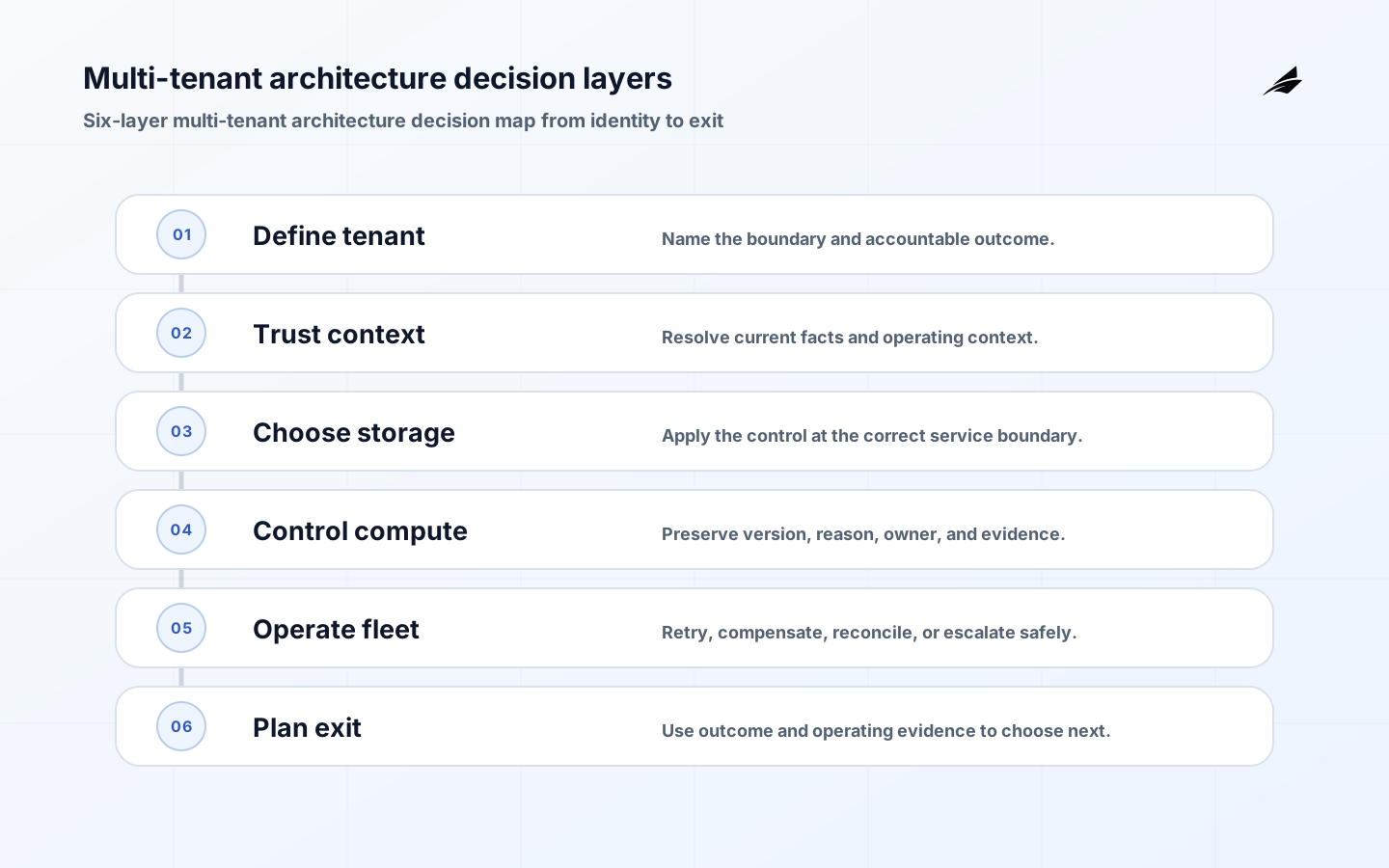
CTO isolation decisions across tenant boundaries begin with a bounded operating question. Make corrections visible, scoped, and reversible during multi-tenant architecture work. Keep customer language aligned with the recorded state.
Multi-tenant architecture becomes a leadership concern when it changes who can act, what a customer experiences, and how the team explains a result under pressure. Name the decision boundary and its owner. The system should make tenant identity, application-plane enforcement, and resource isolation explicit enough to operate. The target is concrete: a customer in one organization cannot read, alter, or consume another organization's resources. Test the architecture with normal, delayed, denied, and corrected workflow cases, then record the state, evidence, and recovery path.
Make the multi-tenant architecture decision explicit
The central decision for multi-tenant architecture is that isolation is an end-to-end property, not a database naming convention. Those details make disagreements tractable. The earlier related guide, tenant isolation cost and scaling guide, is useful context when the work touches adjacent product operations, but it does not replace a decision record for this specific workflow.
| Decision area | Question to resolve | Evidence to keep |
|---|---|---|
| Authority | Which record can decide multi-tenant architecture now? | Owner, version, and effective time. |
| Boundary | Where is the rule enforced? | Policy result, actor, target, and reason. |
| Exception | Who may change the normal path? | Approver, expiry, and recovery action. |
| Review | How will drift be detected? | A trend tied to cross-tenant authorization denials, missing-context errors, per-tenant saturation, and exception expiry. |
Build a CTOs Choose Multi-Tenant Architecture That model people can explain
A practical model for multi-tenant architecture has three layers: a stable business definition, an enforceable system rule, and an observable operating loop. Make tenant context an explicit input to every request, command, query, asynchronous job, cache key, and audit event. Authentication establishes who made the request; a tenant boundary decides which resources are in scope. This distinction matters because an authenticated administrator can still be pointed at the wrong organization if the application merely trusts an object identifier from the browser.
Implement the smallest dependable CTOs Choose Multi-Tenant Architecture That path
Add automated checks at the boundary where multi-tenant architecture can cause harm, and keep the customer-visible state aligned with the internal record. Start with a tenant registry, membership model, and an authorization policy that evaluates actor, tenant, action, and resource together. Put the tenant constraint in data access paths rather than relying on every screen to remember it. Exercise the same boundary in exports, background workers, search indexes, object storage, analytics, support tooling, and recovery scripts. An architecture review is incomplete until those indirect paths have named owners and repeatable tests.

- Write the multi-tenant architecture rule in plain language before encoding it.
- For How CTOs Should Choose a Multi-Tenant Architecture That Can Evolve, Keep the recovery evidence explicit.
- Keep customer-facing status aligned with the authoritative record
- Assign an expiry or review date to temporary exceptions
Operate CTOs Choose Multi-Tenant Architecture That with evidence, not assumptions
Operating multi-tenant architecture requires a short, reviewable set of signals instead of a broad dashboard with no decision attached. Monitor cross-tenant authorization denials, missing-context errors, per-tenant saturation, and exception expiry. Instrument denied cross-tenant attempts, policy evaluation failures, missing tenant context, queue retries, and unusually expensive tenants. Review a representative sample of support actions and privileged changes; they are common places for an otherwise sound design to bypass normal checks. Capacity controls also belong here: quota, rate limits, and fair scheduling turn noisy-neighbor protection into a visible product behavior rather than an incident response improvisation.
| Signal | What it can reveal | First response |
|---|---|---|
| Unexpected denial or failure | A boundary, context, or data-quality problem. | Inspect the decision record and affected scope. |
| Manual override | A missing path or unclear responsibility. | Require a reason, expiry, and follow-up review. |
| Stale or inconsistent state | A delayed dependency or weak reconciliation. | Compare source evidence and replay safely. |
| Customer confusion | A mismatch between system state and explanation. | Improve the visible state before adding more controls. |
CTO isolation decision review
Make the normal path and exception path explicit for CTO isolation decisions across tenant boundaries.
Treat CTO isolation decisions across tenant boundaries as an operating system rather than a screen.
Use a small scenario review before expansion.
Keep customer language aligned with system state for how ctos should choose a multi-tenant architecture that can evolve.
| Decision area | Control to apply | Evidence to retain |
|---|---|---|
| Scope | Name the supported boundary for CTO isolation decisions across tenant boundaries | Approved scope and exclusions |
| Authority | Use trusted facts and current context | Source, version, and timestamp |
| Action | Enforce at the service that commits the result | Allow or deny reason |
| Recovery | Retry, compensate, reconcile, or escalate | Correction and review record |
The primary references for this decision are AWS SaaS Lens: The isolation mindset, AWS SaaS Lens: Preventing cross-tenant access, Azure Architecture Center: Tenancy models, Azure Architecture Center: Storage and data in multitenant solutions, OWASP Multi-Tenant Application Security Cheat Sheet.
For related planning, See Multi-tenant Architecture: Architecture Guide, Subscription Access Control: Architecture Guide, Tenant Isolation Cost and Scaling: Choose the Right Boundary.
How ctos should choose a multi-tenant architecture that can evolve: Key takeaways for CTOs — about multi tenant architecture workflow
- Multi-tenant architecture should have a written business definition and a named owner.
- Enforce consequential decisions where the work happens, not only in the interface
- Record reasons, effective times, and expiry for exceptional handling
- Measure quality and recovery as well as completion or conversion
- Use customer evidence to refine the model after a controlled release
Frequently asked questions about multi-tenant architecture
Where should the CTOs Choose Multi-Tenant Architecture That team start?
For multi-tenant architecture, a prototype is only persuasive when it uses representative identities, records, and failure conditions.
Who should own CTOs Choose Multi-Tenant Architecture That?
Ownership for multi-tenant architecture is shared but not vague.
What should trigger a CTOs Choose Multi-Tenant Architecture That review?
For multi-tenant architecture, Investigate every sign that tenant scope has been reconstructed informally: an operator pasting an identifier into a query, a support script that bypasses a policy, a background job with no tenant context, or a report assembled from a shared export. Reproduce the exact actor, tenant, resource, and route before changing the rule. Then decide whether the repair belongs in identity propagation, the data policy, a service interface, or the operational procedure. Record the incident class and add a regression test that attempts the same cross-tenant access through the relevant API, queue, cache, and export path. A recurring exception is design evidence, not permission to normalize a workaround. CTOs should also ask whether the incident exposed a capacity boundary: a tenant that can monopolize a shared worker or query pool can damage other customers without reading their data. Treat confidentiality and fair use as related but separately measured controls, with clear ownership for both.
Ownership is clearer when how ctos should choose a multi-tenant architecture that can evolve separates the promise from the mechanism.
Before widening how ctos should choose a multi-tenant architecture that can evolve, run a small rehearsal with normal, denied, delayed, and corrected cases.
Review the chosen pool, bridge, or silo boundary with support evidence before rollout. Confirm that tenant context, resource limits, operational ownership, and the recovery path are explicit.
For how ctos should choose a multi-tenant architecture that can evolve, review the about multi tenant architecture ownership during a changed permission.
When an event is delayed, verify that tenant context remains attached to the request, job, cache, or queue message. In the ordinary path, test the same boundary against the intended tenant and resource.
When an event is late, review the architecture scope. During normal handling, retain the evidence needed to explain the isolation decision.
A durable operating note for multi-tenant architecture records the authoritative source, effective time, permitted actor, protected resource, and recovery route. After a permission change, review the recovery path.
For how ctos should choose a multi-tenant architecture that can evolve, test a stale event before treating the first release as complete.
A practical example for how ctos should choose a multi-tenant architecture that can evolve is an incomplete setup.
For how ctos should choose a multi-tenant architecture that can evolve, review the about multi tenant architecture measurement during a changed permission.
For how ctos should choose a multi-tenant architecture that can evolve, review the about multi tenant architecture evidence during a late event.
Compare a normal tenant flow with a changed-permission case. In a support review, inspect authorization, data isolation, and operator evidence at the tenant boundary.
Review the architecture against failure modes that can change tenant context, including delayed events, duplicate messages, partial migrations, and recovery. Record the owner and escalation path for each boundary.
Use a recovery drill to rehearse multi-tenant architecture. When an event is late, review ownership and escalation.
Use a support-review case to test tenant isolation during recovery. Confirm that the affected tenant remains identified, the correction is scoped, and the owner can explain the evidence.
The measured rollout should exercise isolation across identity, storage, caches, queues, exports, and support tooling. Test delayed and duplicate events, then confirm that recovery preserves tenant scope and ownership.
A concrete operating test for how ctos should choose a multi-tenant architecture that can evolve is to rehearse about multi
Conclusion
Multi-tenant architecture earns trust when a customer, operator, and engineer can reach the same explanation of what happened and what should happen next. The result is not bureaucracy. Before broadening a pooled service, run a deliberate tenant-boundary exercise: try a guessed identifier, an asynchronous retry, an export, a support action, a cache hit, and an operational query. Verify that each route either reaches only the intended tenant or fails safely with useful evidence. Repeat the exercise when storage, identity, search, or queueing changes. This is how a design decision stays true as the platform acquires more paths than its original diagram could show.
Make the next review concrete: select one tenant, trace a real request through its services and storage, then repeat the
Sources for multi-tenant architecture
- AWS SaaS tenant isolation
- AWS multi-tenant API authorization
- OWASP Authorization Cheat Sheet
- OpenTelemetry semantic conventions
Evidence for “How CTOs Should Choose a Multi-Tenant Architecture That Can Evolve” is grounded in AWS SaaS Lens: The isolation mindset, AWS SaaS Lens: Preventing cross-tenant access, Azure Architecture Center: Tenancy models, Azure Architecture Center: Storage and data in multitenant solutions, OWASP Multi-Tenant Application Security Cheat Sheet; each source informs a specific decision, test, or operating trade-off described in this guide.