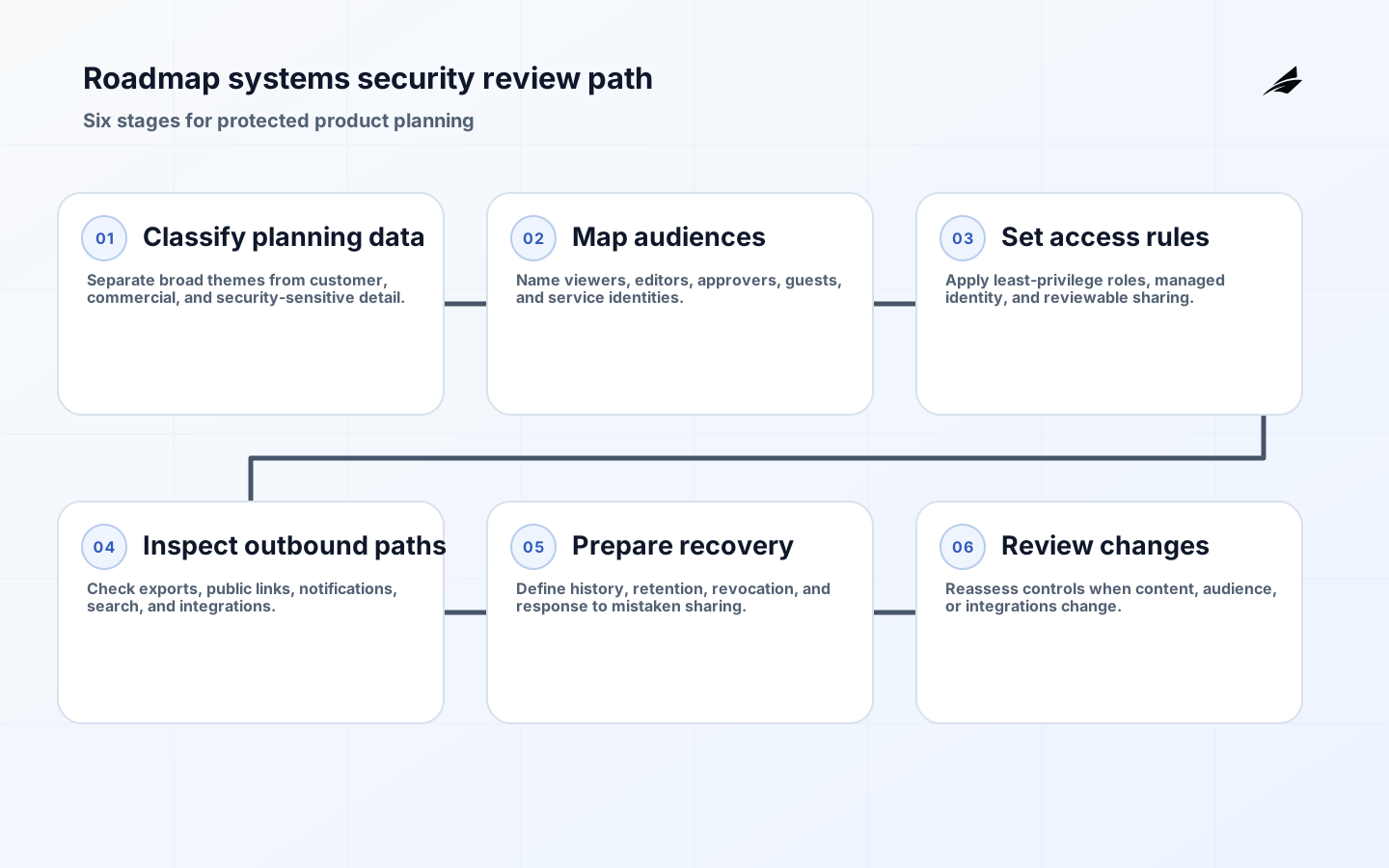
Roadmap systems often become a quiet concentration of sensitive material. They may hold customer commitments, unreleased product details, sales forecasts, architecture decisions, employee names, incident follow-ups, and links to security findings. Because the tool feels collaborative, teams sometimes grant broad access and rely on professional discretion. That is not a security model. A useful security review begins by understanding the planning work the system must enable, then applying proportional controls to the data, actions, integrations, and exports involved. The aim is not to lock a roadmap in a vault. It is to let the right people make informed product decisions without making every draft, customer request, or vulnerability visible to an audience that has no operational need for it.
Map roadmap data, readers, and consequential actions
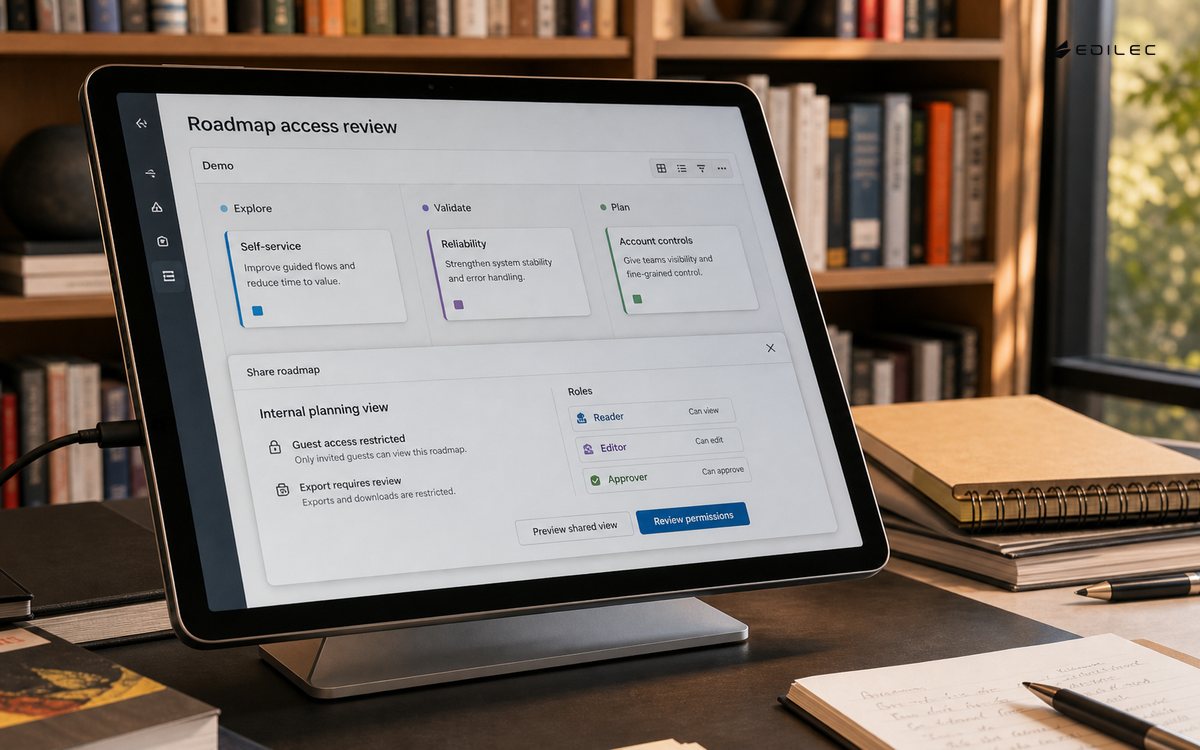
Inventory the types of information in the roadmap before assigning roles. A high-level theme may be safe for a broad internal audience, while a linked customer escalation or unpatched weakness needs narrower handling. Identify readers separately from editors, approvers, integration identities, and export recipients. Then map consequential actions: changing a public target date, linking a confidential account, inviting an external guest, exporting a filtered view, or connecting a BI tool. Each action can alter confidentiality or integrity. Review the default sharing setting, inherited project permissions, group membership, guest accounts, and service tokens. In many tools, a user can technically see a record because it is connected to a broad workspace; that does not prove the access is appropriate. Build a simple access matrix that a product owner and security reviewer can discuss together.
| Roadmap content | Typical audience | Handling question |
|---|---|---|
| Themes and outcomes | Product and delivery teams. | Can a broad internal group view this safely? |
| Named customer requests | Account and product owners. | Is the customer identity necessary to the decision? |
| Security remediation | Limited accountable team. | Could disclosure increase exploitation risk? |
| Commercial dates and terms | Authorized product and revenue roles. | Who may change or export this commitment? |
Apply roles and boundaries that match planning work
Use least privilege in a practical way. A viewer may comment on a proposal without being able to alter target dates; a product manager may edit an initiative but not administer all workspace members; an external collaborator may see a deliberately shared view but not search the full roadmap. Avoid a single “admin” role that combines user management, content access, export control, and integration credentials. Separate those duties where the tool allows it, and record compensating review where it does not. Authentication should follow the organization’s identity policy, with managed accounts and timely deprovisioning. Service integrations need their own identities, scoped permissions, rotation procedure, and owner. Test permissions with representative accounts rather than assuming the configuration screen tells the complete story. A denial that surprises an editor is a usability issue; an allowance that surprises a security owner is a control failure.
Secure integrations, automation, and search
Roadmap tools are rarely isolated. They pull tickets from issue trackers, notify chat channels, create customer-facing reports, and feed dashboards. For each connection, document the data crossing the boundary, the identity used, the direction of change, failure behavior, and who notices an unexpected result. A chat notification should contain the minimum context needed for the receiving group; a full customer account name or private security discussion may not belong there. Search indexing and AI-assisted summaries need the same scrutiny as an API integration, because they may expose content through a different interface or retention model. Configure webhook signature verification, least-privilege API scopes, retry behavior, and audit logging. When an integration is retired, revoke its credentials and test that the downstream view no longer receives updates. The product implementation checklist offers a useful rhythm for turning those decisions into release checks.
| Control area | Review evidence | Operational test |
|---|---|---|
| Identity | Managed user and service-account inventory. | Remove a departing user and verify access ends. |
| Sharing | Guest, public-link, and export settings. | Attempt a download with a viewer-only account. |
| Integration | Scopes, secret ownership, and event log. | Disable the token and observe a safe failure. |
| Auditability | Content, permission, and export events. | Trace who changed a date and who was notified. |
Review change, recovery, and retention
Security is also about preserving trustworthy planning records. Decide who can alter history, how accidental deletion is recovered, how long obsolete drafts remain available, and where backups are protected. A roadmap with no recoverable history invites quiet revisionism; unlimited retention can preserve information that no longer has a business need. Define review triggers: new external collaboration, a material integration, a new data class, a public roadmap view, or an incident involving the planning system. Keep a short exception register for cases where a team needs broader access temporarily, including the owner, reason, expiry, and next review date. Finally, rehearse a compromised account or mistaken public share. The response should identify what was exposed, revoke access, preserve evidence, communicate responsibly, and improve the control that allowed it.
- Classify the data in the roadmap before discussing roles.
- Separate viewing, editing, administration, and integration identities.
- Review exports, links, notifications, and search as disclosure paths.
- Test real permission outcomes with representative accounts.
- Set review and expiry dates for exceptions and third-party access.
Make the security review a planning habit
A useful review is repeatable enough to happen before sensitive material spreads. Add it to the creation of a new roadmap workspace, a change in external sharing, a new system integration, and a major planning cycle. The reviewer should ask about content classification, audience, identity, sharing, outbound data paths, retention, recovery, and owner. Capture the answer as a short decision record, not a ceremonial questionnaire. The record should name the assumptions that would require another review, such as a partner gaining access or a security issue being discussed in the tool. This turns security into a way of making planning constraints visible early, when teams can still choose a simpler collaboration pattern.
Keep the human element in scope. Users will copy a roadmap screenshot into a deck, paste an item into chat, or create a temporary public link when the official route is awkward. Study those workarounds as design feedback. Sometimes the right response is training or a tighter control; sometimes it is a safer, easier way to share a curated update. Publish a clear owner for access requests and urgent revocation, and make the escalation route available to the people who discover a mistaken share. A policy that nobody can operate during a busy planning week is a policy that will be bypassed quietly.
A roadmap systems security review should also examine the quality of the planning record itself. If users cannot tell whether an item is a discovery idea, a funded commitment, or a customer-specific obligation, access controls alone will not prevent harmful interpretation. Use clear states, accountable owners, and dates with a known confidence level. Restrict editing of material commitments while preserving a discussion route for contributors. This reduces both accidental disclosure and accidental misinformation. The review is most effective when it improves the ordinary experience of planning rather than appearing only after a security concern has already been raised.
Include vendors in the review boundary. A roadmap application may process its own backups, analytics, search indexes, support requests, and AI-assisted features through sub-processors. The system owner should know which functions are enabled, what content they can receive, where configuration is documented, and how an account can be exported or closed. For integrations, keep a register that pairs each token with an owner and purpose, then remove it when the associated project ends. Regularly reviewing this small inventory is more effective than a one-time approval because planning tools change quickly as teams add helpers during busy cycles. The operational question is always the same: can the organization still explain where a sensitive roadmap item can travel?
- Classify initiatives before assigning a broad workspace audience.
- Keep customer identities out of views where they add no decision value.
- Separate content editing from membership administration and external sharing.
- Review public links, exports, and notification integrations regularly.
- Give every service token a purpose, owner, expiry, and revocation route.
- Practice revoking a mistaken share and preserving the related audit evidence.
Review access after reorganizations, major launches, and partner changes; inherited collaboration permissions rarely remain correct by accident.
Key takeaways
- Roadmap collaboration does not justify unrestricted access.
- Content type and action determine the necessary control.
- Exports and integrations are first-class security boundaries.
- Managed identities and scoped service accounts improve accountability.
- Recovery, retention, and exception review protect the planning record.
Frequently asked questions
Can customers see a product roadmap?
They can see a deliberately curated view when the business chooses to share one. Do not expose the internal roadmap by default. Create a separate audience, minimize identifiers and sensitive rationale, and review dates and commitments before publication.
Is role separation realistic for a small team?
Small teams may have people who hold multiple responsibilities, but the permissions and review trail can still be distinct. Document the combined role, use managed accounts, and have another accountable person review material changes and access exceptions.
Conclusion: protect planning without paralysing it
A secure roadmap system helps teams collaborate with confidence because it makes sensitive context visible only where it supports a decision. Map the content and actions, constrain access and integrations, and test the routes where information escapes the main view. Those habits preserve both confidentiality and the credibility of the product decisions recorded in the roadmap.