SaaS integration services should make a business process dependable across systems that were not designed as one application. For a small business, the practical goal may be to create an invoice after an order, update customer status after payment, synchronize inventory or route a support request. The engineering challenge is preserving identity, authorization, meaning and recoverability while APIs fail, events arrive more than once and external providers change. A connector that succeeds in a demonstration but cannot reconcile missed work transfers hidden labor to the business.
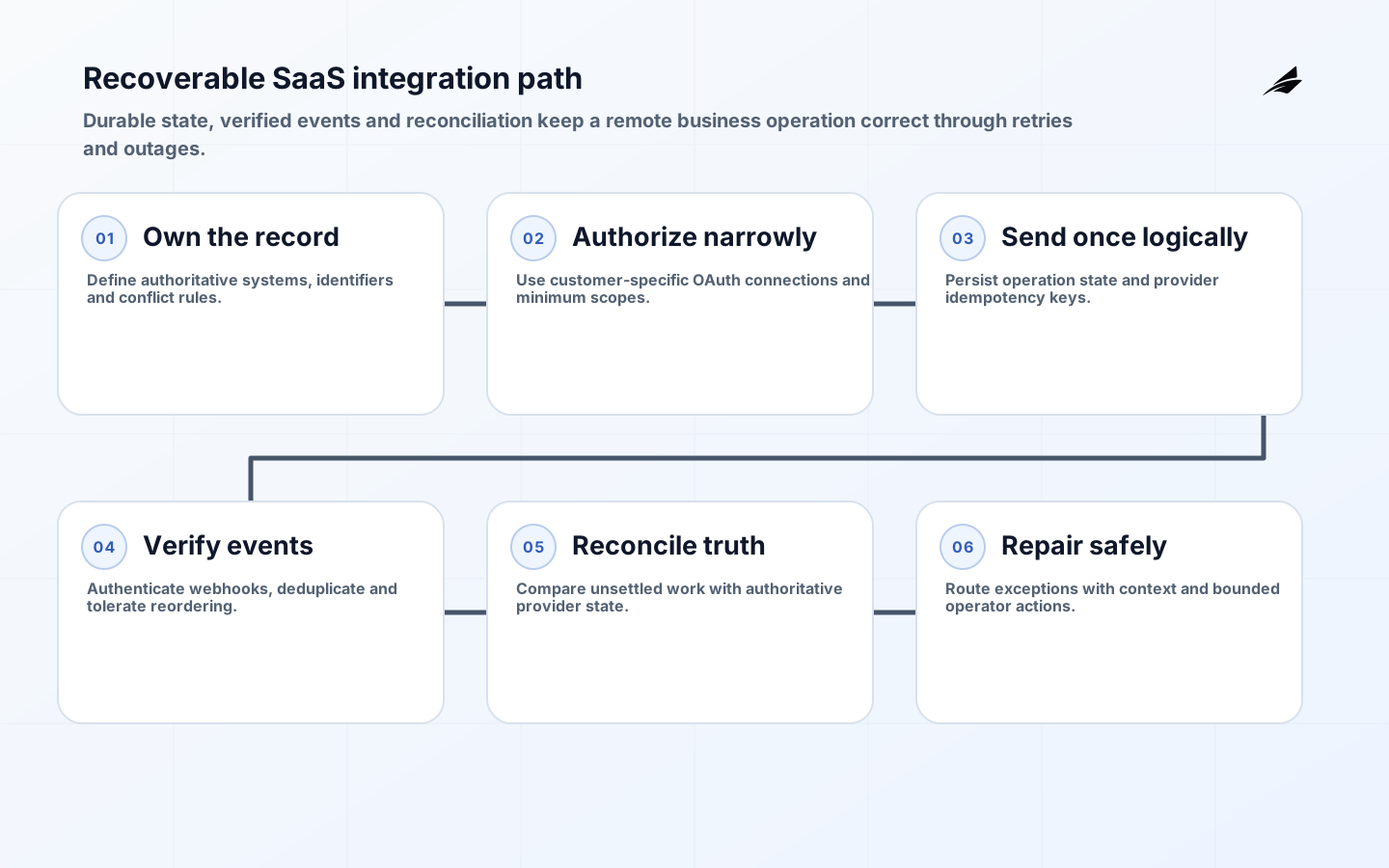
A reliable integration starts with system ownership and business state, then applies HTTP semantics, stable API contracts, secure OAuth, idempotent operations and verified webhooks. OWASP API Security guidance helps teams examine authorization, resource consumption, inventory and unsafe use of third-party APIs. RFC 9110 defines HTTP semantics, RFC 9457 standardizes machine-readable problem details and RFC 9700 records current OAuth security practices. Provider documentation remains essential because webhook signatures, retries and idempotency behavior differ.
Define the workflow and source of truth
Map the business workflow before choosing an integration tool. Identify the trigger, authoritative record, required fields, transformations, approvals, destination action, confirmation and correction path. For each field, name the source of truth. Customer contact details may belong in a CRM, invoice state in an accounting platform and fulfillment state in an order system. Bidirectional synchronization without explicit ownership can create loops and overwrite newer information.
Define what must be timely and what can be eventually consistent. A user waiting for an interactive confirmation needs a different design from a nightly reporting feed. Record expected volume patterns, sensitive data, retention, provider quotas and acceptable recovery delay. Decide what happens when only part of the workflow succeeds. If an order is accepted but invoice creation fails, the system should retain a durable state that operations can inspect and retry rather than asking staff to reconstruct events from email.
| Integration decision | Question | Required record |
|---|---|---|
| Ownership | Which system is authoritative for each entity and field? | Data ownership and conflict policy |
| Trigger | Is work initiated by request, schedule or event? | Trigger contract and delivery expectations |
| Completion | How is durable success confirmed? | External identifier and reconciled state |
| Correction | How can failed or incorrect work be repaired? | Retry, replay and human exception procedure |
Design an explicit API contract
An API contract should define resources, identifiers, methods, representations, validation, authorization, pagination, rate behavior and compatibility. Use HTTP methods according to their semantics and document whether an operation is safe or idempotent. Return status codes that reflect the result rather than using a successful response for every condition. For failures, RFC 9457 problem details can provide a consistent type, title, status and instance while allowing domain-specific fields.
Version deliberately. Prefer additive changes where consumers can ignore fields they do not understand. Treat removed fields, changed meaning and stricter validation as compatibility risks even when the endpoint URL is unchanged. Maintain an inventory of consumed and exposed APIs, their owners, credentials and provider lifecycle notices. Test against provider sandboxes, but also validate representative production constraints because sandbox behavior, quotas and data variation may differ.
Use OAuth without weakening account security
Use the authorization flow supported for the client type and provider, following the current OAuth security best practice. Authorization code flows should use protections such as PKCE where applicable, exact redirect URI matching and state or equivalent transaction binding. Avoid deprecated or exposed token patterns. Request only scopes required for the workflow, explain the requested access to the user and keep each customer connection separate so one credential cannot cross account boundaries.
Store tokens encrypted through an appropriate secrets or key-management facility, never in logs or browser storage not designed for them. Restrict which services can retrieve them. Handle rotation, expiry, refresh failure, revocation and provider account disconnection as normal lifecycle events. A user needs a way to see connected systems and revoke access. Audit connection creation and privileged changes without recording token values or excessive provider data.
Make writes safe to retry
Networks can fail after a provider accepts a request but before the caller receives the response. Blind retry can then create duplicate charges, contacts or orders. Use the provider’s supported idempotency mechanism for consequential writes and generate a key tied to one logical operation. Persist the key, request identity and outcome long enough to resolve retries. Do not reuse a key for a different operation, and verify provider-specific retention and comparison rules.
When a provider lacks idempotency support, use a stable external reference where possible and check for an existing result before creating another. This approach still needs concurrency control because two workers can check simultaneously. Serialize work by business key, use a durable operation record or apply a database uniqueness rule around local state. Reconciliation remains necessary because no distributed workflow can assume that every remote result and local acknowledgment update together.
Verify and process webhooks defensively
Receive webhook requests over HTTPS and verify them using the provider’s documented signature process. Verification often requires the exact raw request body, the signature header, the configured secret and a timestamp tolerance, so parsing or rewriting the body first can invalidate the check. Compare signatures using a timing-safe method where the platform supports it. Rotate webhook secrets deliberately and restrict the endpoint to the methods and content it expects.

Acknowledge valid deliveries promptly after durable capture, then process them asynchronously. Providers commonly retry when delivery fails or times out, so deduplicate using the provider’s event or delivery identifier. Do not assume arrival order. Fetch current authoritative state when event order matters, or apply transitions only when their version is newer. Retain enough event metadata to replay and investigate without indefinitely storing unnecessary personal or payment data.
| Failure | Control | Operational proof |
|---|---|---|
| Duplicate request | Idempotency key or unique business reference | Repeated attempts produce one business outcome |
| Forged webhook | Raw-body signature and timestamp verification | Invalid delivery rejected without state change |
| Out-of-order event | Version check or authoritative-state lookup | Older event cannot overwrite newer state |
| Missed delivery | Scheduled reconciliation and replay | Drift is detected and repaired from durable records |
Apply API security to every object and operation
Check authorization at the object and function level on the server. A user who can list their invoices must not gain another customer’s invoice by changing an identifier, and an ordinary account must not reach an administrative operation because a client hides its button. Use non-guessable identifiers as defense in depth, not as authorization. Validate fields and mass-assignment behavior so callers cannot set ownership, role or internal status attributes that were not intended for them.
Protect resources through request-size limits, pagination, timeouts, concurrency controls, provider-aware backoff and bounded retries. Validate data returned by third-party APIs before trusting it, particularly URLs, files and fields later used in commands or templates. Maintain an API and credential inventory so deprecated endpoints and forgotten test integrations do not remain exposed. Record security-relevant actions with customer, connection and operation context.
Operate integrations as business services
Track business-state transitions, not only HTTP response totals. Useful measures include operations awaiting completion, age of the oldest item, retry exhaustion, reconciliation drift, token failures, quota pressure and time to repair an exception. Correlation identifiers should connect the originating action, internal job, provider request, webhook and final state. Avoid putting secrets or sensitive payloads in identifiers and logs.
Provide an exception queue that shows what failed, why, customer impact, safe next action and whether a retry could duplicate work. Support staff should be able to retry or resolve authorized cases without broad production access. Write runbooks for provider outage, credential revocation, schema change, quota exhaustion and webhook backlog. Test replay and reconciliation before relying on them during a real outage.
Apply the pattern to an order-to-invoice integration
Consider an online order service that creates an invoice in an accounting platform. The order system owns the order and creates a durable invoicing operation with a stable external reference. A worker sends the request with a provider-supported idempotency key and records the remote invoice identifier. If the response is lost, the same logical operation is retried safely. The customer-facing status remains pending until the result is confirmed.
Payment and invoice updates arrive by signed webhook. The receiver validates the raw request, records the event, acknowledges it and processes it asynchronously. Duplicate deliveries are ignored by event identifier, while out-of-order events trigger an authoritative invoice lookup. A scheduled reconciliation compares unsettled operations with provider state. Exceptions enter a support queue with both identifiers and an approved correction path. This design makes failure visible and repairable without pretending that remote calls are atomic.
Use a controlled integration delivery plan
- Map the business workflow, source systems, records and accountable owners.
- Define field authority, identifiers, state transitions and conflict rules.
- Document API methods, errors, compatibility and provider limits.
- Implement least-scope OAuth connections and secure token lifecycle handling.
- Add idempotent writes, verified webhook intake and durable asynchronous processing.
- Build observability, exception handling, replay and scheduled reconciliation.
- Test duplicates, delays, reordered events, revoked credentials and provider outages.
- Release to a bounded customer group and verify both automated and human repair paths.
Key takeaways
- Define system and field ownership before synchronizing data.
- Use HTTP semantics and structured problem responses consistently.
- Follow current OAuth security practices and request minimum scopes.
- Make consequential writes idempotent and retain durable operation state.
- Verify webhook signatures, deduplicate deliveries and tolerate reordered events.
- Reconcile external state and give support teams safe repair tools.
Frequently asked questions
Are no-code integration tools suitable for small businesses?
They can be suitable for bounded, low-consequence workflows when they support required authentication, retries, logging and data controls. Evaluate ownership, failure recovery, export, pricing and connector-change behavior. Consequential financial, identity or regulated workflows may require custom controls or an integration service around the tool.
Should integrations use polling or webhooks?
Use provider capabilities and timeliness needs to decide. Webhooks can deliver changes promptly but require verification, deduplication and replay handling. Polling is simpler for some low-volume workflows but consumes quotas and introduces delay. Many dependable designs use webhooks for prompt updates and periodic polling for reconciliation.
How should an integration handle a provider outage?
Capture intended work durably, apply timeouts and bounded backoff, expose pending state and prevent retry storms. Preserve idempotency information so processing can resume safely. Notify operators based on customer consequence, then reconcile provider state after recovery. Do not report completion until authoritative evidence supports it.
Conclusion
Reliable SaaS integration services connect business records without hiding the realities of distributed failure. They define authoritative systems, use explicit API and error contracts, secure OAuth connections, make writes retry-safe, verify webhooks and preserve durable state for reconciliation.
For a small business, simplicity comes from clear ownership and recoverable behavior, not from assuming every request succeeds. An integration that can explain its state, tolerate duplicate events and give staff a safe correction path reduces manual work while preserving control as connected services evolve.