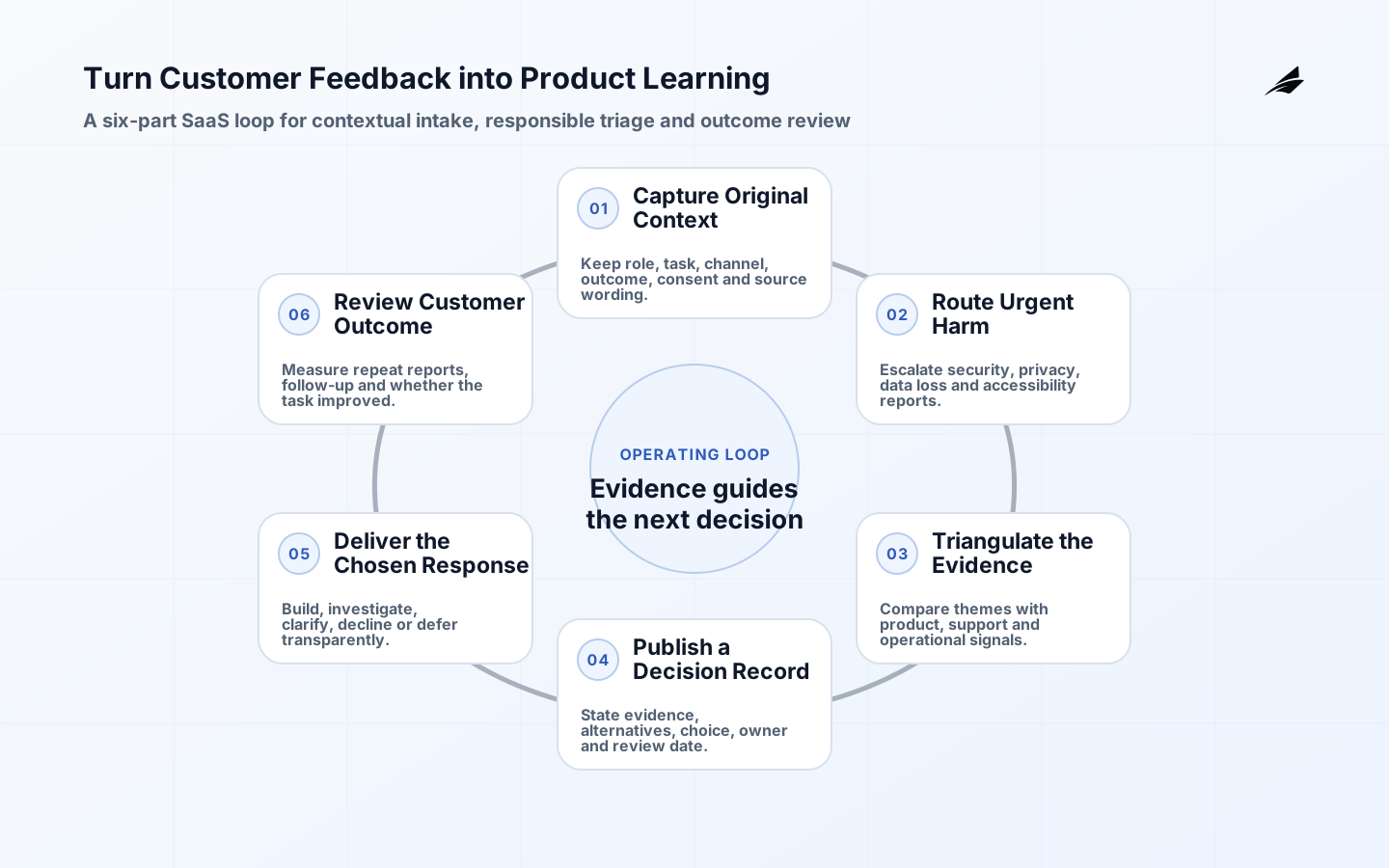
Customer feedback loops are a product system for learning from experience without mistaking the loudest request for the highest-value decision. A useful loop captures the customer's words, preserves enough context to understand the situation, protects sensitive information, links evidence from support and product behavior, decides deliberately, and closes the loop honestly. It can include interviews, in-product prompts, support tickets, account reviews, and observed task failures, but these inputs must not become an unsearchable pile.
Why Customer Feedback Loops Matter
Raw feedback is valuable but incomplete. A request to 'add a dashboard' may describe a missing decision, slow access to data, or a permissions issue. A complaint about reliability may be tied to one integration, a confusing recovery state, or a broader service problem. The loop should preserve the reported problem and then seek corroborating context: role, workspace setup, task, frequency, consequence, product version, and relevant operational signals. This prevents product teams from solving a proposed feature instead of the underlying job.
Respectful collection is also a trust requirement. Ask only for information that will be used, explain the channel's purpose, and avoid placing confidential data into broad product tools. Free-text submissions can include personal data, credentials, or sensitive business facts. Set access, retention, redaction, and escalation rules before inviting customers to share. If a report may be a security incident or a legal complaint, route it to a trained process rather than treating it as an ordinary feature vote.
Collect Feedback With Context
Build a small intake taxonomy that supports retrieval without forcing customers to diagnose the product. Capture the channel, customer role, workspace, task, stated outcome, urgency, consent or handling notes, and a link to the original source. Analysts can later add a problem theme, but preserve the original phrasing. Avoid scoring feedback by customer revenue alone; commercial context can inform prioritization, yet it should not erase evidence from smaller or less vocal customers.

| Input | Strength | Limitation to correct |
|---|---|---|
| Support ticket | Contains concrete failure context. | Overrepresents customers who ask for help. |
| Interview | Explores motives and language deeply. | Small samples are not prevalence estimates. |
| In-product prompt | Captures a moment near the task. | Must not interrupt consequential work. |
| Usage signal | Shows observed behavior at scale. | Does not explain intent by itself. |
Design accessible feedback interactions. A form should identify required fields, explain what happens after submission, work with keyboard and assistive technology, and avoid time-limited input for a nonurgent request. Offer a route for customers who cannot use the embedded channel. Do not make rating prompts appear in the middle of a critical workflow or after every small action. The collection experience itself communicates whether the company values the customer's time.
Triage Evidence, Not Just Volume
Triage separates urgent harm from product opportunity. Security, privacy, data-loss, accessibility, and reliability reports need clear escalation rules and response owners. Other feedback can be grouped into problem themes and reviewed against strategic goals, affected workflows, evidence quality, reach, severity, and delivery cost. A request count is one signal, but ten identical requests may arise from one confusing label while one carefully documented workflow failure may block a major customer task.
Connect feedback to product and operational evidence cautiously. A report that exports fail can be compared with error traces and job completion data; a claim that a workflow is hard can be explored through session observation or interviews. Do not use instrumentation to surveil individuals or to override their stated experience. The goal is triangulation: different forms of evidence should sharpen the problem definition and reveal uncertainty, not manufacture a false certainty.
Turn Insight Into Decisions
Write a decision record for material themes: the problem statement, evidence reviewed, affected roles, alternatives considered, decision, owner, expected outcome, and review date. The decision might be build, investigate, clarify documentation, change a process, decline, or defer. A visible decision record prevents the backlog from becoming an implied promise and gives account teams an accurate explanation. It also lets the team revisit assumptions when the product or customer context changes.
| Decision outcome | Appropriate when | Follow-through |
|---|---|---|
| Build | Evidence supports a bounded product change. | Define an outcome measure and customer cohort. |
| Investigate | Problem is plausible but evidence is incomplete. | Assign a research question and deadline. |
| Clarify | Existing capability is hard to find or understand. | Improve language, guidance, or support material. |
| Decline or defer | Trade-off is not justified now. | Record rationale and communicate without false promises. |
Close the loop at the right level of certainty. Thank a customer for a report, explain whether the team needs more context, and share a decision when it is real. Do not promise delivery dates before the work is planned. When a change ships, describe the problem it addressed and invite the relevant customers to validate the outcome. A transparent 'not now, because.' is often more trust-building than a vague acknowledgement that disappears into a backlog.
Measure the Learning Loop
Track time to acknowledge high-severity reports, time to a documented decision, themes with insufficient context, repeat reports after a fix, customer follow-up rate, and outcomes for shipped changes. Review whether feedback represents only power users or a varied set of roles and accessibility needs. The health metric is not the number of ideas collected. It is whether the organization can convert relevant experience into a credible decision and learn whether that decision improved the customer's work.
Example: Export Friction
Several administrators report that exports are unreliable. The feedback system links each report to workspace, role, export type, and task consequence, then routes possible data exposure to security review. Product and engineering compare reports with job failures and find that a large file limit is poorly explained, while a smaller group encounters a retry bug. The team improves validation and language for the first issue, fixes the retry path for the second, and asks affected customers to confirm the result. One complaint becomes two testable problems rather than one generic feature request.
The customer feedback workflows guide gives teams a companion model for connecting customer evidence to operations. Use it to choose one feedback channel to make more contextual, secure, and accountable before expanding collection volume.
Review Feedback Operations
Periodically audit the feedback repository itself. Check who can access sensitive reports, whether retention rules are applied, which channels have become noisy, whether high-severity items followed the correct escalation, and how many decisions still lack an owner or review date. This is particularly important after introducing a new survey, account-management process, or AI-assisted summarization tool. The repository contains customer trust; it should be managed with the same care as other operational data stores.
Make room for disconfirming evidence. When a team is excited about a requested change, recruit customers who use the workflow differently and inspect whether the proposed solution creates a new burden. When a team intends to decline a theme, state the evidence and revisit condition rather than erasing it. A feedback loop is healthy when it can change a roadmap belief in either direction and when customers can see that thoughtful reporting influences how the product is understood.
Use summaries carefully when feedback volume grows. Automated clustering can help identify repeated language, but a human owner should sample original reports, check for minority experiences, and verify that separate problems were not collapsed under one convenient label. Never send confidential customer text to an unapproved service merely to produce a summary. The operational question is not whether the team can generate a neat theme cloud; it is whether the summary retains enough evidence for a fair, explainable product decision.
Connect the loop to release communication without turning customers into test subjects without context. For a selected change, invite relevant reporters to try it, describe what changed in their workflow, and ask a focused follow-up question. Capture whether the outcome improved, stayed neutral, or created a new obstacle. This closes a gap common in product teams: shipping is often recorded as success even when nobody verifies that the original customer problem was reduced.
Give account-facing teams a disciplined way to contribute without turning every customer conversation into an informal commitment. They can attach context, urgency, and observed workflow impact, but the feedback record should preserve what was promised and by whom. Train them to distinguish acknowledgement from roadmap commitment and to route urgent operational reports promptly. This protects relationships while giving product teams richer evidence than a bare feature request. It also makes feedback handling more consistent when customers work with different representatives.
Review closed feedback themes occasionally to confirm that the stated outcome still holds. A product change can regress after later releases, and a previously deferred problem can become urgent as the customer base or workflow changes.
Key Takeaways
- Collect feedback with task, role, consent, and original-language context.
- Route safety and privacy concerns separately from ordinary product requests.
- Triangulate customer reports with product and operational evidence without overclaiming.
- Publish deliberate decisions and learn from outcomes, not just backlog volume.
Frequently Asked Questions
Should customers vote on every request? Voting can reveal interest, but it rarely captures consequence, context, or strategic fit. Use it as one input, not a roadmap algorithm. How quickly should teams respond? Acknowledge serious reports promptly and set expectations for review. The right delivery time varies; what matters is that customers receive an honest, attributable response rather than an implied promise.
Conclusion
Customer feedback loops work when they treat experience as evidence to be handled carefully, not as a vote tally. Contextual intake, responsible triage, transparent decisions, and outcome review help a SaaS team learn continuously while preserving customer trust.
Sources
Use the NIST Privacy Framework, WCAG 2.2, the OWASP ASVS, and OpenTelemetry when implementing feedback collection, handling, and product context.