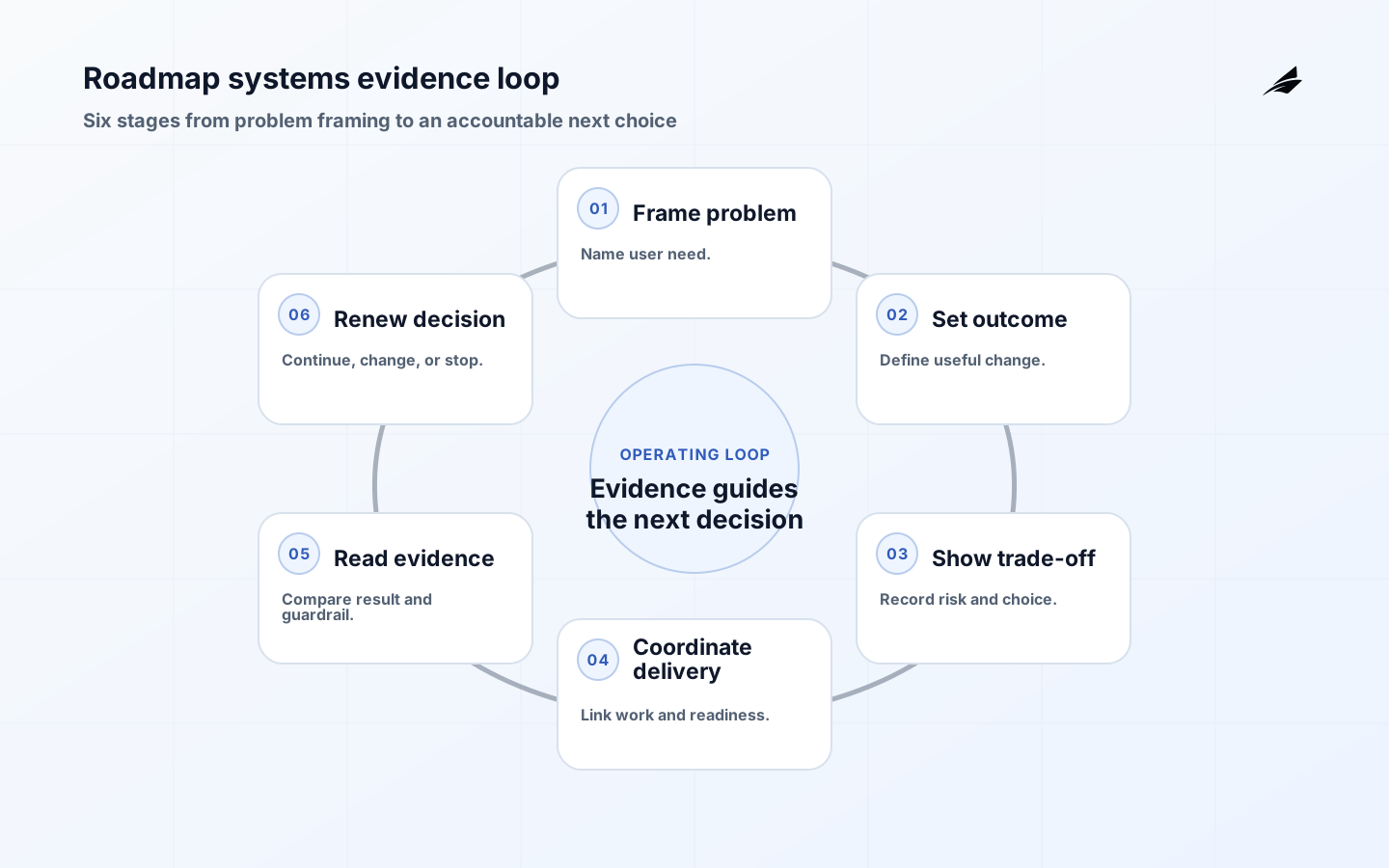
Roadmap systems help a team decide what to pursue, why it matters, and what evidence should change the decision. The visible roadmap is only the front door. Behind it should be a small set of linked records for customer needs, constraints, security concerns, delivery work, and observed outcomes. A plain-language roadmap system does not promise that every idea will ship or that every date is exact. It makes confidence, ownership, trade-offs, and learning legible so product and engineering can make better choices together.
Frame work around an outcome
Begin with the user or business problem, not the solution name. “Add an export redesign” is a delivery description; “let workspace administrators reconcile a monthly report without manual cleanup” describes an outcome. The second version gives the team something to test and a reason to question the solution if the evidence says another path is better. Add the affected segment, current friction, consequence, and a boundary for the first release.
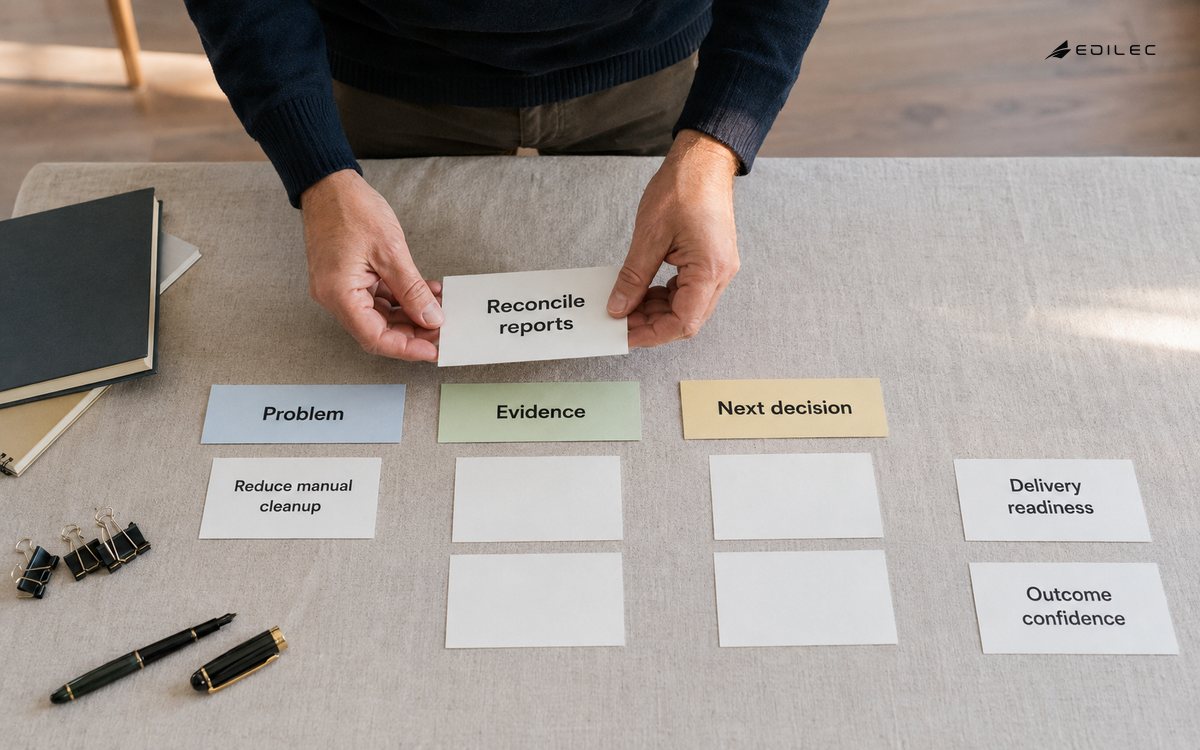
Write the key assumption in a form that can be challenged: if we change a particular part of the workflow for a defined group, a measurable result should improve because a stated barrier is removed. Record what would disconfirm the assumption. This is more useful than a confidence score with no explanation. The team can then distinguish “we lack evidence” from “we have evidence against the idea,” which leads to different next actions.
| Roadmap question | Useful answer | Avoid |
|---|---|---|
| Why now? | Customer problem, risk, dependency, or strategic constraint | A stakeholder preference with no consequence |
| For whom? | Named segment, role, or workflow state | Everyone as an undefined audience |
| What changes? | Observable behavior or operational result | A feature label alone |
| What could stop it? | Risk, dependency, or disconfirming signal | A generic confidence color |
| When do we revisit? | Evidence window or trigger | A date that never gets updated |
Separate decisions from delivery
A roadmap system should not compete with the issue tracker, release system, analytics catalog, or incident timeline. Let each source own a clear class of facts. The roadmap owns prioritization and intent. Delivery owns task state and dependencies. The service owns runtime state. Telemetry and research own observed behavior. Link across these boundaries using stable identifiers so a reviewer can move from the decision to the evidence without copying every detail into every tool.
This separation also reduces misleading status. An initiative may be fully shipped and still be under review. Another may be delayed but remain the best response to a serious customer problem. A single “green” label cannot represent both delivery readiness and outcome confidence. The OpenTelemetry observability primer provides a useful adjacent idea: shared signals become valuable when they can be correlated across a system. Use the same care for product records.
| Record | Authoritative facts | Reader decision |
|---|---|---|
| Problem brief | Need, segment, current evidence | Is this worth exploring? |
| Roadmap item | Outcome, owner, scope, priority | Should we invest now? |
| Architecture note | Boundaries, dependencies, risks | Can we build safely? |
| Delivery record | Tasks, tests, release state | Is the change ready? |
| Learning review | Results, surprises, next action | Continue, change, or stop? |
Make prioritization a visible trade-off
Prioritization is not a universal score. It is a choice between opportunities, commitments, risks, and capacity under uncertainty. Show the reason an item moved: a contractual obligation, a reliability concern, a new customer pattern, a dependency, or evidence that changed expected value. If a score is used, expose the dimensions and assumptions behind it. Avoid a number that creates an illusion of mathematical objectivity while hiding who made the judgment.
Give security and operational work the same decision quality as feature work. A roadmap item that changes tenant boundaries, exports, identity, or billing can carry customer value through reduced risk and better reliability. The NIST Secure Software Development Framework frames secure practices as part of the development lifecycle. In roadmap terms, that means security tasks need owners, acceptance evidence, and a review path, not a vague label that disappears when the launch date becomes urgent.
Build an evidence contract
Specify the smallest useful evidence before implementation. Define the event or observation, subject scope, time window, expected direction, and guardrail. For a self-serve onboarding change, completion alone can hide a poor experience if more people finish by contacting support or if invited members cannot complete the second step. Pair the primary measure with a quality signal and a cost or risk signal. Keep qualitative evidence in the review, not as an afterthought that cannot challenge a dashboard.
Make the evidence accessible to the people who must act on it. A planning page should use meaningful headings, accessible tables, visible status text, and keyboard-operable controls. WCAG 2.2 emphasizes testable criteria that apply across devices and disabilities. The same principle improves comprehension for everyone: a written explanation of “paused because import data is incomplete” is clearer than a color-only status or a cryptic icon.
Operate the system through review rituals
Use three review moments: shaping before commitment, readiness before release, and learning after the evidence window. Shaping asks whether the problem and audience are clear. Readiness asks whether the implementation can be supported, measured, secured, and reversed. Learning asks what happened and whether the original choice still stands. Each review should have a short agenda and a named decision owner; otherwise the roadmap becomes a passive report rather than an operating system.
Allow the lifecycle to move backward. An item can return from committed to shaped when a dependency changes, from delivering to paused when a safety issue appears, or from learning to follow-up when the result is mixed. Preserve the prior decision and the new reason. This history protects the team from rewriting the past and helps future planners recognize repeated patterns, such as launches that consistently lack an owner for customer communication or a plan for correcting data.
A good roadmap review can be run in thirty minutes when the record is prepared. The owner states the problem and expected outcome; engineering names the boundary and dependency; support adds a difficult customer case; and the group chooses the next decision, not just a status color. If the group cannot identify the next evidence needed, the item belongs in shaping rather than commitment. This keeps meetings focused on learning and prevents a roadmap from becoming a queue of unexamined promises.
Keep the history useful to a new teammate. Record why a solution was selected, which alternatives were rejected, what evidence was considered weak, and what would make the team revisit the choice. Link the decision to the release and learning review. Months later, the team should be able to tell whether the original problem disappeared, moved, or was simply hidden by a new workflow. That continuity is the real value of roadmap systems.
For teams with several products, Add a portfolio view only after each product can explain its own decisions. A portfolio summary should show shared dependencies, capacity pressure, customer commitments, and risk concentration, not flatten every item into one score. A dependency owner can then negotiate sequence with evidence instead of relying on whichever team speaks first. Keep the underlying product records linked so the portfolio view does not become a new unowned source of truth.
A roadmap item should also state what the team will not build in the first slice. Naming exclusions protects the outcome from scope drift and gives customer-facing teams an honest explanation of what is supported. Revisit exclusions when evidence shows a missing capability is blocking the intended result; do not add every request by default. This keeps the roadmap legible as a set of choices rather than a catalogue of wishes.
Key takeaways
- Describe the customer problem and outcome before naming a solution.
- Keep the roadmap responsible for decisions while linking to systems that own delivery, runtime, and evidence facts.
- Expose the assumptions, trade-offs, risk owners, and triggers that can change a priority.
- Define measurement and guardrails before the release, and include research and support context.
- Use shaping, readiness, and learning reviews to keep the roadmap an active decision system.
- For related operating patterns, See roadmap checklist, feature flags, and roadmap security review.
Frequently asked questions
What makes a roadmap system different from a backlog?
A backlog coordinates implementation work, while a roadmap system records the outcomes and decisions that guide investment. One outcome can require many tasks, and tasks can be rearranged without changing the outcome. Keeping the layers distinct helps teams avoid treating completed tickets as proof that customers benefited.
How can teams avoid roadmap theatre?
Make every meaningful item carry an owner, an assumption, a review trigger, and evidence that could change the decision. Allow items to be paused or retired, and show why the priority moved. A system that only displays commitments cannot support learning because it has no honest state for uncertainty or reversal.
Should dates be included?
Use dates when a customer, contract, dependency, or operational event creates a real constraint. For exploratory work, show a decision window and confidence instead of a false promise. If a date changes, record the reason and new trade-off so stakeholders see the decision rather than only the new calendar position.
How much detail belongs on a roadmap?
Keep the visible view concise: problem, outcome, audience, owner, timing, confidence, and next review. Link to deeper product, architecture, delivery, security, and research records. The roadmap should be readable in a meeting while still providing a path to the details needed for a responsible decision.
Conclusion: turn ideas into accountable choices
Roadmap systems are effective when they preserve the reason for a decision and make it easy to change that decision when evidence changes. Frame work around outcomes, separate planning from delivery, expose trade-offs, define evidence, and review the result. That approach keeps a roadmap useful to leadership without turning it into a promise machine or a duplicate task tracker.
The smallest useful improvement to plain-language roadmap systems for better decisions is often a sharper boundary, not another feature. For plain-language roadmap systems for better decisions, name the decision boundary and its owner.
For plain-language roadmap systems for better decisions, test a revoked permission before treating the first release as complete. For plain-language roadmap systems for better decisions, record the state, evidence, and recovery path.
A practical example for plain-language roadmap systems for better decisions is when an older fact arrives after a newer decision.
A roadmap system is accountable when its promise, decision rule, and delivery mechanism are explicit. Make corrections visible, scoped, and reversible, and record why the roadmap changed.
This decision also connects to Roadmap Systems Checklist for Reliable Digital Operations, Roadmap Systems Security Review for SaaS Teams, A Field Guide to In-app Guidance for Growing Teams. Review those boundaries together when plain-language roadmap systems for better decisions shares identity, data, billing, or support evidence with another workflow.
For Plain-language Roadmap Systems for Better Decisions, AWS SaaS Lens Foundations defines scope; Monitoring Systems with Advanced Analytics supports the control. Review plain-language roadmap systems for better decisions evidence with product, engineering and support before expanding scope.
Evidence for “Plain-language Roadmap Systems for Better Decisions” is grounded in NIST Secure Software Development Framework, OpenTelemetry Observability Primer, Web Content Accessibility Guidelines 2.2, AWS SaaS Lens Foundations, Monitoring Systems with Advanced Analytics; each source informs a specific decision, test, or operating trade-off described in this guide.