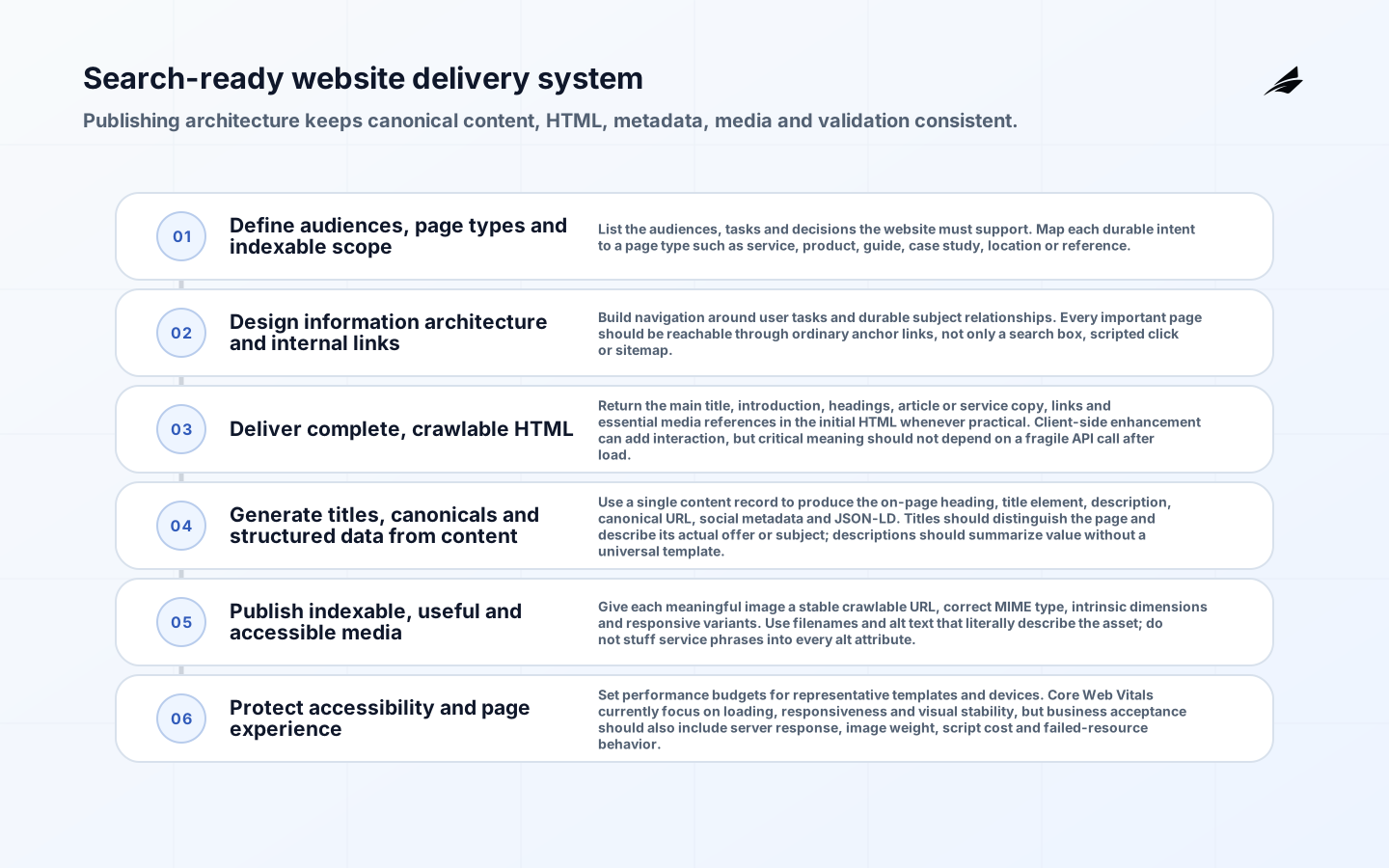
Search-ready website development means the publishing system exposes useful pages through stable URLs, crawlable links, meaningful HTML and consistent metadata. It does not mean hiding phrases, generating thousands of near-duplicate pages or adding schema that the visible page does not support. This scope and delivery plan brings search requirements into architecture, content modeling, frontend rendering, media handling and release operations so discoverability is a property of the product rather than a cleanup project after launch.
A search engine can only evaluate what it can retrieve and understand, while a reader judges whether the result answers a real need. The same source record should drive the visible heading, canonical URL, title, description, structured data, sitemap entry and internal links. Google Search Essentials and the structured-data policies emphasize crawlable, people-first content and representative markup. The project therefore needs editorial ownership and engineering controls together; neither a plugin nor a metadata spreadsheet can compensate for weak page value.
Pair this plan with the search-ready implementation checklist, the search-ready website FAQ, and the schema and sitemap technical checklist when defining acceptance and ongoing monitoring.
Define audiences, page types and indexable scope
List the audiences, tasks and decisions the website must support. Map each durable intent to a page type such as service, product, guide, case study, location or reference. Define which combinations deserve standalone URLs and which should remain filters or page sections. Indexable pages need distinct purpose and substantial visible content. If two planned pages would answer the same question with swapped nouns, consolidate them before templates make duplication cheap.
Create an indexability matrix covering canonical status, robots rules, sitemap inclusion, navigation, required fields and archive behavior. Include previews, search results, parameters, pagination and retired records. Decide how a draft becomes public and how a deleted page redirects or returns a clear status. Scope should include an inventory of legacy URLs and inbound links so migration preserves equity and users do not encounter redirect chains.
| Page state | Indexing treatment | Publishing rule |
|---|---|---|
| Canonical public page | Index, self-canonical, sitemap eligible | Required content and quality checks pass |
| Draft or preview | Authenticated or noindex, excluded from sitemap | Never linked from public navigation |
| Filter or tracking URL | Canonicalized or blocked from creation | Parameters do not create crawl traps |
| Retired page | Relevant direct redirect or 410 | No redirect to an unrelated home page |
Design information architecture and internal links
Build navigation around user tasks and durable subject relationships. Every important page should be reachable through ordinary anchor links, not only a search box, scripted click or sitemap. Use descriptive anchor text that explains the destination in context. Create hubs where they help readers compare related material, but avoid giant footers or hidden link blocks designed only for crawlers. Breadcrumbs should reflect a meaningful hierarchy and produce stable paths.
Plan canonical URLs that are lowercase, readable and independent from presentation changes. Avoid dates or category folders unless they are part of durable identity. Define slug uniqueness and redirect ownership. Internal links should be generated from explicit relationships and editorial choices, with orphan and broken-link audits in the release process. A sitemap aids discovery; it does not replace a coherent link graph.
Deliver complete, crawlable HTML
Return the main title, introduction, headings, article or service copy, links and essential media references in the initial HTML whenever practical. Client-side enhancement can add interaction, but critical meaning should not depend on a fragile API call after load. Google's JavaScript guidance explains that rendering is a separate processing stage and that not every bot executes scripts equivalently. Server rendering, prerendering or static generation can reduce that dependency when implemented consistently.
Test rendered output with JavaScript enabled and disabled, slow networks, failed API calls and direct deep links. Ensure status codes are correct before the application shell loads; a soft 404 that returns 200 can waste crawl effort. Do not show a permanent 'loading article' placeholder while asynchronously fetched content fails. Hydration must preserve server-rendered text and links rather than replacing them with an empty state.
| Delivery concern | Acceptance evidence | Common defect |
|---|---|---|
| Initial HTML | Meaningful content and links in response source | Empty application shell |
| Status code | 404, 410 and redirects returned at HTTP layer | Every route returns 200 |
| Hydration | No text loss or layout replacement | Server and client data disagree |
| Deep link | Route renders without prior navigation | Client router requires home-page session |
Generate titles, canonicals and structured data from content
Use a single content record to produce the on-page heading, title element, description, canonical URL, social metadata and JSON-LD. Titles should distinguish the page and describe its actual offer or subject; descriptions should summarize value without a universal template. Canonicals must resolve to an indexable equivalent and use the same host and path policy as internal links. Do not canonicalize distinct pages merely because they share a layout.

Add structured data only for entities and properties visible or supported on the page. Validate syntax and eligibility, but also review meaning. Connect organization, website, breadcrumb, article, author and product entities through stable identifiers where appropriate. Google's structured-data policies prohibit misleading or hidden representations. Rich-result eligibility is not guaranteed, so markup should be maintained as accurate machine-readable publishing data rather than as a ranking promise.
Publish indexable, useful and accessible media
Give each meaningful image a stable crawlable URL, correct MIME type, intrinsic dimensions and responsive variants. Use filenames and alt text that literally describe the asset; do not stuff service phrases into every alt attribute. Place explanatory media near the relevant text and include a natural caption when interpretation or attribution requires it. Decorative images should have empty alt text. Avoid hotlinked assets that can disappear or block crawling.
Create an image sitemap only when discovery needs justify it, and ensure robots rules permit fetching. Use modern compression while retaining a supported fallback where needed. Lazy-load below-the-fold media without withholding dimensions or requiring user interaction to reveal the URL. Videos need a descriptive page context, thumbnail and available embed. Accessibility and image search both benefit from accurate surrounding text; neither benefits from unrelated stock photographs.
Protect accessibility and page experience
Set performance budgets for representative templates and devices. Core Web Vitals currently focus on loading, responsiveness and visual stability, but business acceptance should also include server response, image weight, script cost and failed-resource behavior. Reserve media space, remove unused client code and cache immutable assets. Measure field data by template and geography rather than relying only on a fast developer laptop.
Apply WCAG 2.2 to navigation, focus order, contrast, forms, errors, headings and media alternatives. Accessibility improves the semantic structure that readers and machines depend on, but it is a human requirement first. Test keyboard and screen-reader flows across menus, modals and forms. Search-ready development should not trade usability for a visually impressive animation that delays content or prevents navigation in less capable browsers.
Validate releases and monitor indexing evidence
Automate checks for duplicate titles, missing headings, conflicting canonicals, noindex in sitemaps, broken internal links, malformed JSON-LD, oversized images and redirect chains. Crawl the built site as deployed, not only source files. Sample rendered pages manually on mobile and desktop. Submit sitemaps after launch and inspect coverage, enhancements and performance data, recognizing that discovery and indexing can take time.
Monitor by page type and release cohort. Track valid indexable URLs, excluded reasons, crawl errors, impressions, clicks, conversions and content freshness. Investigate a decline by checking deployment, status codes, rendering, internal links and demand before changing copy. Do not manufacture pages to inflate an indexed count. A smaller library of distinct, maintained pages is more useful and more supportable than a large set competing with itself.
Estimate cost, sequence and ownership
Cost follows the number of page types, content migrations, integrations, rendering complexity, media work, accessibility target and release risk. Separate foundation work from per-template and per-record work. A typical sequence is inventory, information architecture, content model, rendering prototype, template build, migration, validation and monitored launch. Run editorial and engineering tracks together because missing fields discovered after migration cause expensive rework.
Assign owners for content quality, templates, redirects, structured data, sitemaps, analytics and incident response. Budget ongoing work for dependency upgrades, broken links, content review and performance regression. Avoid proposals that promise rankings or price the work only by metadata count. The deliverable is a reliable publishing system and useful content; organic visibility remains influenced by demand, competition, reputation and search-engine decisions.
| Cost driver | Why it matters | Control |
|---|---|---|
| Page-type count | Each template needs semantics and validation | Consolidate overlapping intents |
| Legacy migration | URLs, media and links require mapping | Inventory and rehearsal |
| Client rendering | Adds failure and crawl complexity | Server-render critical content |
| Content depth | Research and review require expertise | Prioritize durable high-value pages |
Key takeaways
- Define indexable scope before templates generate URLs.
- Return complete meaningful HTML with correct status codes and crawlable links.
- Drive visible content, metadata, schema and sitemaps from consistent records.
- Use media to explain the page and describe it accurately for accessibility.
- Validate the deployed site and monitor by page type instead of chasing raw page counts.
Frequently asked questions
Can a search-ready build guarantee rankings?
No. It removes technical barriers and improves clarity, but rankings depend on relevance, quality, reputation, demand and search-engine systems. Guarantees are not credible.
Is JavaScript bad for search visibility?
No, but critical content and status behavior should remain reliable through rendering. Server-rendering or static generation often simplifies discovery, performance and failure handling.
Should the site publish thousands of pages?
Only when each page has distinct purpose, accurate substantial content and ongoing ownership. Programmatic duplication can waste crawl resources and weaken the library.
How long does implementation take?
A small site may take weeks; a large migration can take months. Inventory quality, page types, integrations, content readiness and redirect complexity drive the schedule.
Conclusion
Search-ready website development aligns publishing architecture with reader value. Stable URLs, crawlable HTML, accurate metadata, coherent links, useful media, accessibility and release monitoring form one system. When those foundations are built into templates and content operations, the site can grow without hiding technical debt behind bulk pages or promotional claims.