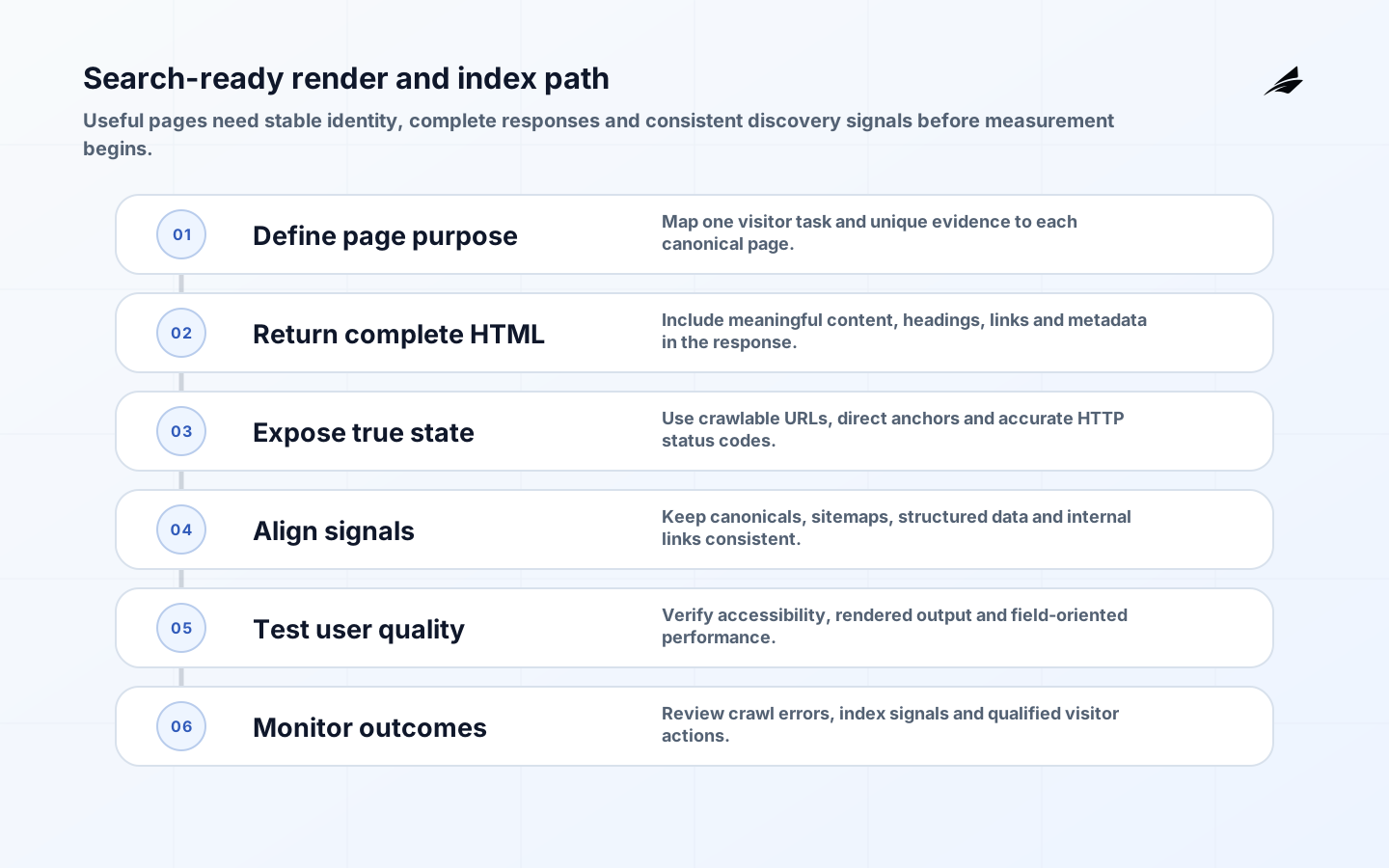
Search-ready website development means the public site can be discovered, fetched, understood and used without relying on hidden keyword lists or crawler-only pages. The implementation must return meaningful HTML, stable URLs, accurate status codes, crawlable links and page-specific metadata while serving a fast, accessible experience. Content quality and reputation determine whether pages deserve visibility; technical delivery removes avoidable barriers and supplies consistent evidence about each page.
This plan is for a new website or substantial rebuild. It pairs with the search-ready implementation checklist and implementation FAQ. Scope and cost should be based on page types, content workflows, integrations, migration risk and rendering architecture—not a promise to place thousands of phrases in metadata. Search engines ignore or distrust manipulative repetition, and users leave pages that do not answer their task.
Define audiences, tasks and page types
Inventory the decisions visitors make: understand a service, compare an approach, verify capability, read evidence, contact the company or use a product. Group pages around those tasks and assign one primary purpose to each canonical URL. Define templates for services, products, case studies, articles, locations and reference pages only where the organization can maintain distinct useful content. Navigation and contextual links should reflect real relationships, not every possible phrase combination.
Create a page contract for each type: required fields, title pattern, heading rules, indexability, canonical behavior, structured data eligibility, image needs, owner and review cadence. Model content as structured fields where reuse is deliberate, while preserving enough editorial freedom for a page to answer its specific intent. Prevent publication when essential metadata, ownership or body content is missing. Thin pages should be improved, consolidated or excluded rather than hidden in the interface for crawlers.
| Page type | Primary visitor task | Required unique evidence |
|---|---|---|
| Service | Evaluate fit and delivery approach | Scope, process, proof and next step |
| Product | Understand capability and constraints | Actual behavior, screenshots and documentation |
| Article | Answer a focused question | Explanation, examples and sources |
| Case study | Assess demonstrated outcome | Context, method, evidence and limitations |
| Location | Find genuinely local availability | Service area, contact and local operating detail |
Choose rendering that produces complete public HTML
Google processes JavaScript through crawling, rendering and indexing, but it still recommends server-side rendering or prerendering as a strong approach because users and other crawlers receive content sooner. The initial response for an indexable page should include its title, description, canonical, primary text, headings and crawlable links whenever feasible. Hydration can add interaction without making basic meaning depend on a successful client API call.

Test production responses directly, not only the browser DOM. Verify that assets needed for rendering are crawlable, routes return a real 200, missing pages return 404, permanent moves use a single 301 or 308, and protected pages use the right authentication response. Avoid serving a generic app shell with 200 for every path. Use content-hashed assets and resilient enhancement so a JavaScript failure does not erase navigation, article text or forms.
Design stable URLs, redirects and canonical signals
Use short descriptive paths that reflect durable information architecture. Keep one preferred trailing-slash and hostname policy. Parameterized filters, tracking codes, print views and duplicate paths need explicit handling. A canonical is a hint for substantially duplicate pages, not a substitute for redirects, correct links or distinct content. Self-reference the canonical on normal pages and keep it consistent between initial HTML and rendered DOM.
Before migration, crawl the existing site and map every valuable URL to the most relevant new destination. Do not send unrelated pages to the home page. Eliminate redirect chains and preserve query behavior required by campaigns or applications. Update navigation, contextual links, XML sitemaps, hreflang and structured data to use final URLs. Retain redirects long enough for users, links and crawlers to transition, and monitor old-path requests after launch.
Implement accurate metadata and structured data
Every indexable page needs a concise, unique title and a useful description that reflects visible content. One clear H1 should identify the page; H2 and H3 headings should organize the answer rather than repeat variants. Images need meaningful filenames and alt text based on what they show. Open Graph metadata supports sharing but does not replace on-page context. A meta keywords tag and hidden text provide no legitimate ranking benefit.
Use structured data only for content that is visible and matches an eligible type. Follow Google policies and the underlying Schema.org vocabulary. Article, breadcrumb, organization, product or FAQ data must describe the actual page and remain synchronized with it. Validate syntax in continuous integration and inspect rendered output. Structured data can enable richer understanding, but it does not guarantee a display feature and should never assert reviews, prices or authorship that the page cannot substantiate.
| Technical signal | Implementation test | Common failure |
|---|---|---|
| Title and description | Unique and present in initial HTML | Template text repeated site-wide |
| Canonical | One absolute preferred URL | Conflicts with redirect or sitemap |
| Links | Real anchor href to final URL | Click handler without discoverable href |
| Structured data | Valid and matches visible content | Unsupported or fabricated properties |
| Status code | Represents actual resource state | Soft 404 app shell with 200 |
Make performance and accessibility release requirements
Set budgets for server response, JavaScript, CSS, image weight and Core Web Vitals by page type. Optimize the largest real content element, reserve media dimensions to prevent layout shifts and keep interaction work short. Measure field data by device and route because laboratory scores cannot represent every user. Performance work should prioritize reading and task completion; removing useful content to chase a score defeats the purpose of the page.
Use semantic HTML, keyboard-operable navigation, visible focus, accessible names, sufficient contrast and understandable errors. WCAG 2.2 is a stronger acceptance basis than an automated score alone. Test menus, carousels, search, forms, cookie controls, media and accordions with keyboard and assistive technology. Accessibility improves content structure and resilience while serving users directly; it should be designed into components rather than repaired after templates spread.
Control discovery, sitemaps and indexing intentionally
Link important pages from relevant public pages using descriptive anchor text. XML sitemaps should list canonical, indexable URLs with accurate modification dates and can be partitioned by type for diagnosis. A sitemap helps discovery but does not make low-value pages indexable. Keep robots.txt for crawl management, not removal of indexed content. Use meta robots or authentication when a page should not appear, and do not block assets required to render indexable pages.
Define rules for previews, staging, internal search, faceted combinations, campaign pages and expired content. Staging must be access-controlled; robots.txt alone does not keep a URL private. For removed content, choose a relevant redirect, a useful replacement page or a genuine 404/410. Publication workflows should update internal links and sitemaps automatically, while editorial owners decide whether a page remains current and distinct.
Deliver in auditable stages and measure outcomes
Discovery produces the page inventory, analytics baseline, keyword-to-task research and migration risk map. Design establishes templates, components and content contracts. Build implements rendering, routing, metadata, structured data and integrations. Content migration includes rewriting and quality review, not bulk copy. Prelaunch runs crawls, response checks, accessibility, performance and visual regression. Launch follows a monitored cutover with rollback and redirect verification.
After launch, monitor server errors, redirect loops, soft 404s, canonical divergence, sitemap processing, rendering failures, Core Web Vitals and conversion by page type. Search Console data is sampled and delayed, so combine it with server logs, analytics and direct fetch tests. Judge improvement by qualified discovery and completed user tasks, not raw indexed-page count. A smaller set of clear, maintained pages can outperform a large inventory of repetitive pages.
Run a prelaunch audit against generated production output
Crawl the release candidate exactly as an unauthenticated user and record final status, title, description, canonical, robots directives, headings, links, structured data, images and response size for every public URL. Compare the inventory with the approved page map and migration redirects. Render representative templates with JavaScript disabled, delayed and failed. Test a real missing URL, removed page, query variant and redirected legacy path. Resolve conflicting signals before the domain cutover.
Sample content manually across services, products, articles and contact paths. Confirm that page copy is complete, current and useful; no template placeholders, hidden phrase blocks or internal editorial notes remain. Validate keyboard operation, zoom, mobile layout and forms. Capture performance on realistic devices and networks. Store the audit and release identifier so postlaunch changes can be distinguished from migration defects. This evidence makes a search-ready website implementation plan measurable rather than aspirational.
Key takeaways
- Build pages for real visitor tasks and distinct evidence.
- Return meaningful HTML, status codes, links and canonicals without crawler-only content.
- Treat structured data as an accurate description, not a shortcut.
- Make accessibility and field performance part of template acceptance.
- Measure qualified outcomes and index health after launch.
Frequently asked questions
Does a JavaScript website automatically have poor search visibility?
No. Search engines can render JavaScript, but client-only content adds failure and delay modes. Server rendering or prerendering, crawlable links, correct responses and rendered-output testing make discovery more reliable for users and different crawlers.
How many pages should a new website publish?
Publish as many distinct, maintained pages as the audience and business can support. Page count is not an objective. Each canonical page should satisfy a clear task and contain evidence that is not merely a rearrangement of another page.
Can metadata contain extra phrases that are hidden from visitors?
Metadata should summarize the visible page naturally. Hidden keyword lists or crawler-only blocks are manipulative and provide no durable value. Put relevant concepts in useful headings, explanations, examples and links that help the reader.
Conclusion
A search-ready site is a well-engineered publishing system. It gives each useful page a stable identity, complete response, accurate metadata, crawlable relationships and an accessible experience. Technical controls cannot manufacture authority, but they ensure strong content is discoverable and measurable. The durable plan combines content ownership, rendering discipline, migration evidence and postlaunch improvement.