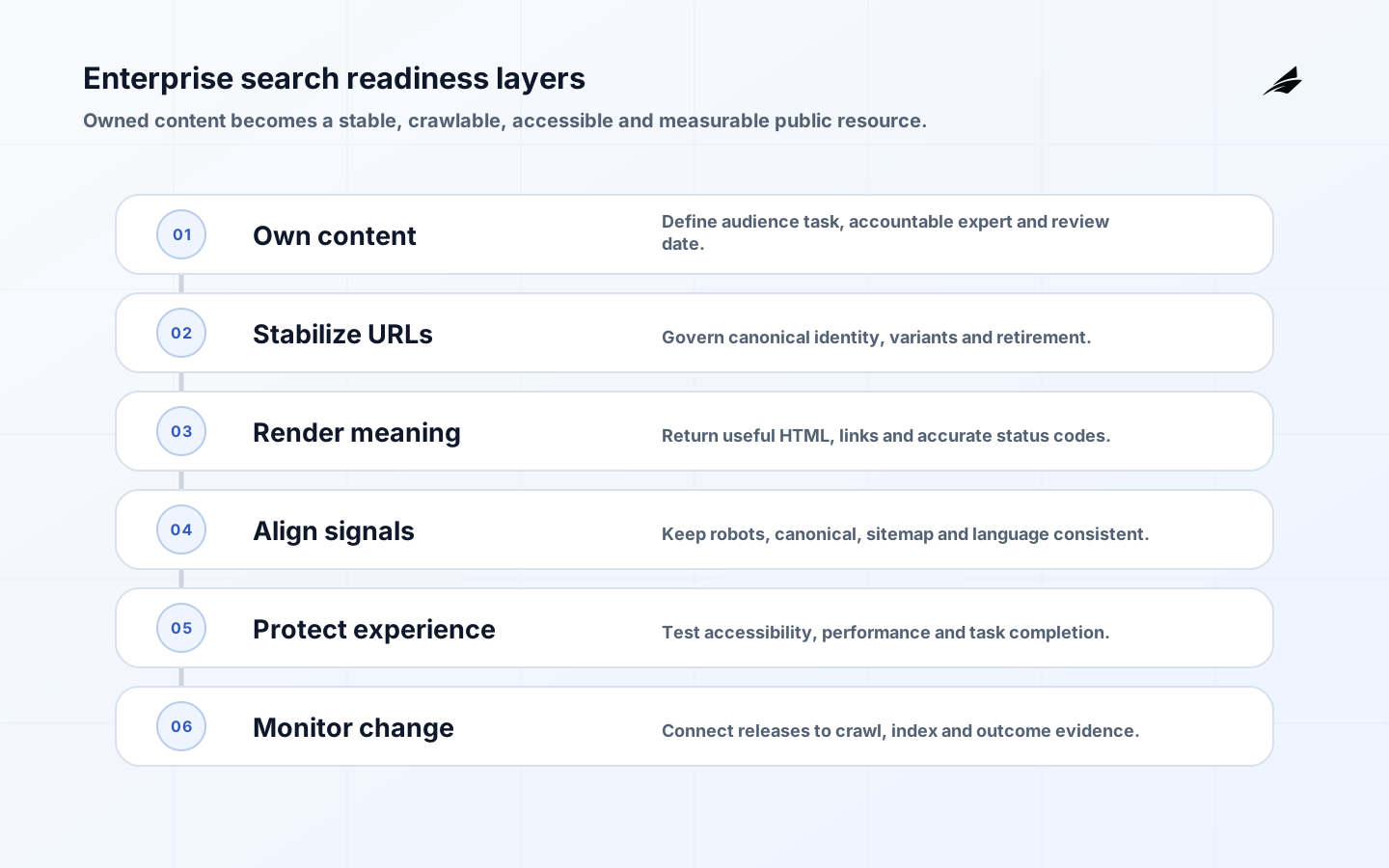
SEO-ready website development for enterprise teams is the engineering and governance work that makes important public content discoverable, understandable, accessible and maintainable at scale. It is not a plugin, a launch-time metadata pass or a promise of rankings. Enterprise sites need stable page ownership, crawlable architecture, meaningful information, controlled migrations and monitoring that connects technical changes to search and user outcomes. This guide gives business, content, design and engineering leaders a shared delivery model. It complements Edilec's search-ready implementation checklist, SEO-ready architecture guide and SEO-ready website FAQ.
Key takeaways
- Begin with audience tasks, content ownership and inventory, not page templates.
- Deliver useful content and crawlable links in rendered HTML with meaningful status codes.
- Control canonical URLs, redirects, localization and structured data as governed platform features.
- Treat accessibility and performance as user quality, not isolated search tactics.
- Release migrations by evidence and monitor indexing, traffic and conversion together.
What makes an enterprise website search-ready?
A search-ready site lets crawlers discover a stable URL, retrieve a successful response, render meaningful content, understand the page's subject and relationships, and avoid contradictory indexing instructions. Google Search Essentials describes technical requirements, spam policies and key practices, but eligibility for indexing does not guarantee indexing or ranking. The enterprise job is to make the right public information available and reliable, then measure whether qualified users can find and use it.

Create a content model around audience tasks and accountable owners. Each important page needs a purpose, intended audience, canonical identity, review cadence and disposition when it becomes obsolete. Inventory current URLs, backlinks, traffic, conversion, structured data, localization and regulatory obligations before redesign. Keep durable topics separate from campaign presentation. This allows teams to change navigation and components without repeatedly moving the underlying resource or producing near-duplicate pages that compete for maintenance.
| Layer | Owner question | Evidence |
|---|---|---|
| Content | Who maintains the answer and why does it exist? | Inventory, brief and review date |
| URL | Is this a stable canonical public resource? | Route rules and duplicate tests |
| Rendering | Is useful content present and linkable? | Fetched and rendered HTML |
| Indexing | Are directives consistent and intentional? | Robots, canonical and sitemap audit |
| Experience | Can users read, interact and complete the task? | Accessibility, field performance and journey test |
How should architecture support crawling and rendering?
Return meaningful primary content and links in server-rendered or pre-rendered HTML when practical. Google's JavaScript SEO guidance explains that Google processes JavaScript applications through crawling, rendering and indexing, and still recommends server-side or pre-rendering because it helps users and crawlers. Use ordinary anchor elements with useful destinations, expose pagination and detail routes, and avoid requiring a click or viewport event before important content exists.
HTTP behavior is part of information architecture. Return 200 only for useful pages, 404 or 410 for unavailable resources, and redirects for genuine moves. Prevent soft 404s and redirect chains. Generate XML sitemaps from canonical, indexable content rather than treating the sitemap as a second database. Keep robots.txt, robots meta directives, canonical tags and authentication aligned. Test both initial and rendered HTML with representative public URLs, including pages behind routing, localization and consent components.
How should metadata and structured data be governed?
Generate unique titles and concise descriptions from controlled fields while allowing editorial judgment for high-value pages. Canonical links should identify the preferred equivalent URL and remain consistent between initial and rendered HTML. Define rules for faceted navigation, tracking parameters, print views, syndication and regional variants. For multilingual content, use stable localized URLs and reciprocal language annotations, and ensure each page actually serves the stated language. Do not canonicalize materially different regional pages merely to simplify reporting.
Use structured data only when it accurately represents visible page content. Google's structured data guidelines state that correct markup creates eligibility, not a guarantee of rich-result display, and prohibit hidden or misleading representation. Centralize schemas for organization, breadcrumbs and supported content types; validate required properties and monitor production reports. Assign ownership for changes because a CMS field or template refactor can invalidate thousands of instances even when individual JSON-LD syntax remains valid.
| Failure | Likely cause | First check |
|---|---|---|
| Important pages not discovered | Links require interaction or routes are orphaned | Rendered anchors and internal-link graph |
| Wrong URL indexed | Canonical, redirect or parameter inconsistency | Initial HTML and response chain |
| Rich result lost | Markup no longer matches visible content | Template output and feature report |
| Traffic falls after migration | Missing redirects, content or rendering regression | Source-target sample and server logs |
How do content quality, performance and accessibility fit?
Write for the question a qualified reader needs answered. Use descriptive headings, precise terminology, evidence, clear authorship and contextual links to deeper material. Avoid manufacturing thin pages for every phrase or region when the underlying answer is identical. Enterprise experts should review claims and maintenance obligations before publication. Search demand can inform vocabulary and prioritization, but it should not override product truth, legal review or user comprehension. A useful page earns internal links because it supports a real journey.
Performance and accessibility affect whether people can use what they find. Google's Core Web Vitals guidance points teams to LCP, INP and CLS measurement while emphasizing overall page experience. Use field data by template and user segment, not a single laboratory score. Build against WCAG 2.2 with semantic structure, keyboard operation, visible focus, accessible authentication and clear errors. Do not delay primary content behind oversized scripts, intrusive overlays or unstable layout.
How should an enterprise site be migrated and operated?
Treat migration as a controlled information-system change. Build a source-to-target URL map, preserve high-value content and links, reconcile metadata and structured data, and test redirects at scale. Benchmark crawlability, indexed pages, search landing traffic, conversion and performance by template before cutover. Release a representative section first when architecture permits. Monitor server logs, crawl errors, index coverage and key journeys immediately; keep people available to correct route, rendering and analytics defects rather than assuming search systems will adapt without loss.
After launch, combine technical and editorial operations. Monitor broken links, unintended noindex or canonical changes, template performance, structured-data validity, stale content, orphan pages and search demand that exposes missing answers. Review large drops by page group, country, device and query intent before attributing cause. Keep a change record linking releases to affected templates and URLs. The SEO-ready implementation checklist can anchor release reviews. Retire content deliberately with redirect, replacement or clear removal based on user need.
Enterprise governance works best when it is embedded in publishing. The CMS should require the fields that templates and review actually use, validate indexability combinations, preview canonical and language metadata and identify an accountable owner. Approval can scale by risk: a routine copy correction may publish quickly, while a route change, legal claim, structured-data template or mass redirect needs specialist review. Keep reusable components semantically sound and prevent local editors from changing heading order or hiding essential text solely for visual preference. Train authors to write link text and image alternatives that describe purpose. A central team should provide tested patterns and office hours, while business owners remain responsible for factual accuracy and timely review.
Measurement should connect discovery to a useful outcome without reducing the program to rank tracking. Report qualified organic landing sessions, task or conversion completion, search appearance, indexed canonical pages, crawl waste, field performance and accessibility defects by meaningful page group. Annotate releases, migrations and major content changes. Use Search Console and server evidence to investigate, but reconcile analytics consent and tracking limitations before comparing absolute totals. A page can lose traffic because demand changed, a result feature changed, a competitor improved, content became stale or the site regressed technically; evidence should narrow the explanation before teams rewrite or roll back. Review pages with no demand alongside their strategic or service obligation, since important public information can be valuable even when volume is low. Establish a release gate for global navigation, routing, rendering and robots changes because their blast radius exceeds an ordinary component update. Crawl a production-like environment, compare canonical and status outputs with the inventory, and inspect representative rendered pages on slow devices. After release, sample actual bot responses and user journeys rather than relying solely on synthetic checks. Preserve the previous routing configuration long enough to recover quickly from an indexing mistake.
Frequently asked questions
Does SEO-ready mean guaranteed rankings?
No. It means the site removes avoidable technical barriers and publishes useful, well-governed content. Search systems decide crawling, indexing and ranking. Treat any supplier promise of guaranteed organic placement with caution.
Is client-side rendering bad for search?
Not inherently, but it adds dependencies and can delay or obscure content for users and crawlers. Ensure important content, links, status and metadata are visible in rendered output. Server-side or pre-rendering is often the more robust enterprise default.
Should every filtered page be indexable?
Usually not. Index only combinations that provide durable, distinct user value and can be maintained. Control low-value parameter combinations through link design, canonical strategy and indexing rules rather than letting navigation create an unlimited URL space.
How long should migration monitoring continue?
Continue through enough crawl and business cycles to detect slow-moving issues, and retain the redirect map for as long as old URLs have users or links. High-value legacy URLs often justify long-lived redirects.
Conclusion
SEO-ready website development for enterprise teams is an operating capability shared by content, design, engineering and analytics. Give valuable information stable ownership and URLs, make primary content and links reliably renderable, govern metadata and structured data, and protect accessibility and performance. Migrate with a tested URL map and continue observing real search and user journeys after launch. That discipline cannot manufacture demand, but it prevents the platform from hiding or degrading the expertise the organization has worked to publish.