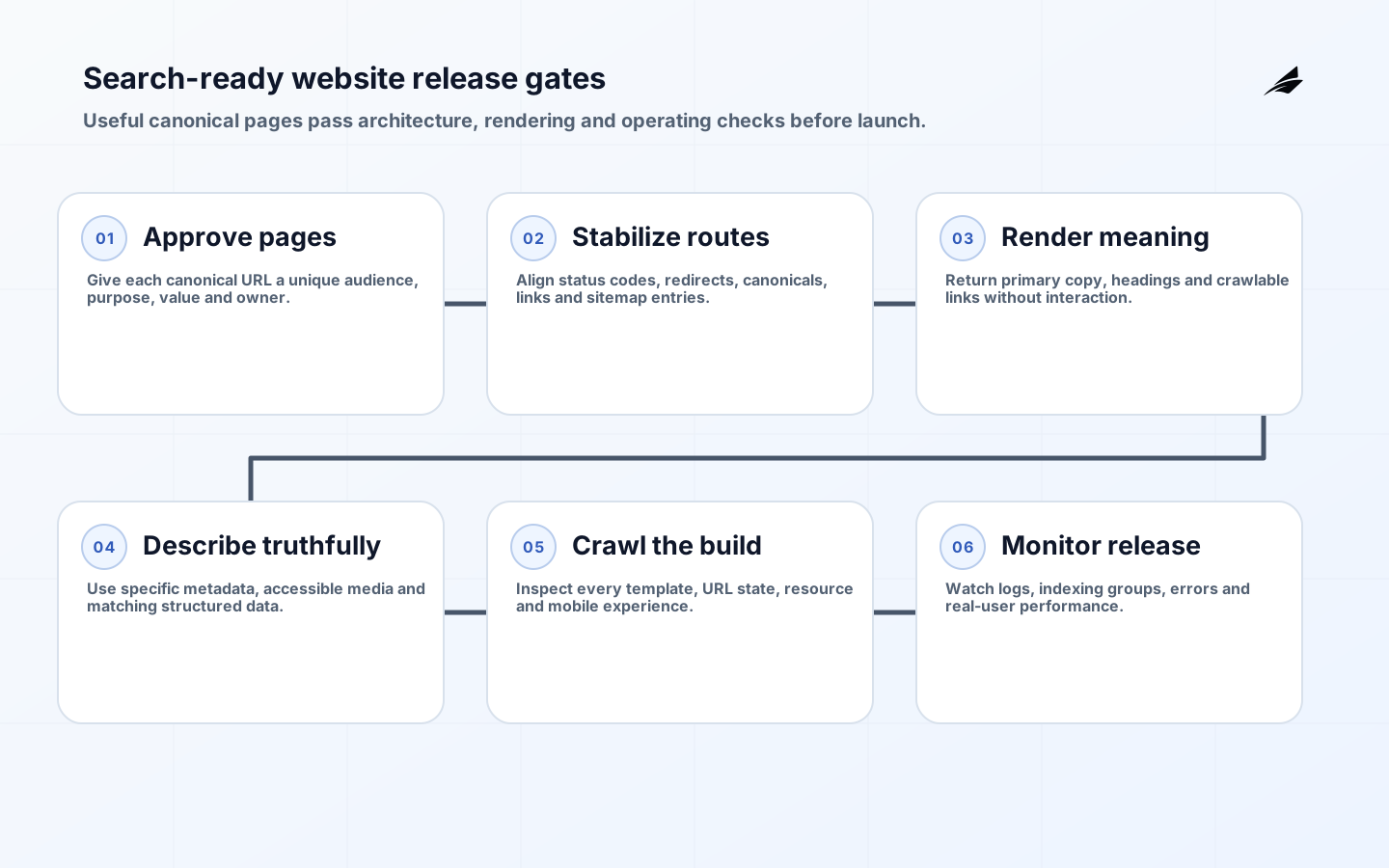
An SEO-ready website development plan makes useful pages discoverable, renderable, understandable and maintainable from the first release. It does not hide keyword lists in markup or promise a top position. Google says there is no guarantee a page will be indexed and no secret that automatically ranks a site first. Engineering can still remove avoidable barriers and give valuable pages clear purpose, content, links and canonical identity.
Use this checklist during architecture, content production, QA and deployment. It is for designers, developers, content owners and operations teams building a new site or replacing one. Every item should have an owner and test evidence. A crawlable site with thin duplicate pages is not ready, and excellent content behind broken rendering or redirects is equally incomplete.
1. Approve the indexable page inventory
List every planned indexable URL with audience, question, unique value, owner and lifecycle. Consolidate pages that answer the same need. Separate canonical content from account, filter, internal-search, preview and campaign variants. Acceptance evidence should identify the responsible owner, the source record, the expected result and the decision required when the result is missing.
Write titles and headings for people deciding whether a page answers them. Each indexable page should provide original explanation, evidence, examples or tools. Template pages need genuinely distinct substance rather than a city or keyword substitution. Test the normal path, boundary conditions and a realistic failure path; a successful demonstration alone does not prove the search-ready website is ready.
| URL class | Handling | Proof |
|---|---|---|
| Preferred content | 200, indexable and self-canonical | Rendered unique main content |
| Permanent old route | Single-hop 301 or 308 | Relevant final 200 destination |
| True duplicate | Accessible with canonical to preferred | Equivalent primary content |
| Removed content | 404, 410 or relevant replacement | No soft-404 template |
| Filter or search result | Controlled by crawl-value plan | Not accidentally submitted as canonical |
2. Stabilize URLs, status codes and canonical signals
Use readable durable URLs and one preferred host, protocol, case and trailing-slash policy. Return 200 for real pages, permanent redirects for moved content and 404 or 410 when unavailable. Avoid redirect chains and soft 404 responses. Keep the definition and its effective date with the implementation so later teams can explain why historical and current behavior differ.
Add self-canonicals to preferred pages and use canonical hints for genuine duplicates only. Keep internal links, redirects, sitemap entries and structured-data URLs aligned. Avoid automatic location or device routing that prevents stable access. Make exceptions visible in the same operating workflow instead of routing them to private spreadsheets or undocumented support messages.
3. Return useful primary content in rendered HTML
Google processes JavaScript in stages, so return meaningful title, heading, main copy and links in initial or server-rendered HTML. Client code can enhance interaction, but critical content should not depend on an event, consent choice or failed API. Use progressive exposure and explicit stop conditions so the team can learn from production without placing the entire estate at risk.
Use semantic HTML and anchors with real href values. Do not block CSS, JavaScript or images needed for understanding. Loading and error states must not leave an empty successful shell. Hidden crawler-only text is not a durable implementation. Measure the business completion time and error consequence, not only component uptime or the number of tasks closed.
4. Implement truthful metadata and structured data
Create unique concise titles and useful descriptions, one clear H1 and logical H2/H3 hierarchy. Give images descriptive filenames, dimensions and accurate alt text. Keep author, publication and update information truthful. Preserve identifiers, timestamps and version information across handoffs so reconciliation can distinguish delay, duplication and correction.
Add structured data only when visible content matches a documented type and required properties. Validate syntax, but remember valid markup does not guarantee a rich result. Keep canonical URLs consistent in JSON-LD and never fabricate reviews or FAQs. Document the recovery sequence and exercise it with representative state before relying on it during a live incident.
5. Build internal links and sitemap coverage
Every important page should be reachable through contextual navigation or links from other indexable pages. Use meaningful anchors and organize hubs around user journeys and topic relationships, not giant footers containing every route. Apply least privilege to people and services, and record material administrative actions with enough context for later review.
Generate XML sitemaps from canonical indexable 200-status URLs and split large sets within protocol limits. Use accurate last-modified values. Sitemaps help discovery but do not replace internal links or force indexing. Review this control when scope, integrations, users or obligations change; a launch-time decision should not become a permanent assumption.
| Surface | Required proof | Failure |
|---|---|---|
| Page HTML | Unique content, title, headings and links | Empty shell or generic metadata |
| Canonical controls | Agreement across tags, links and sitemap | Canonical through redirect or unrelated page |
| Structured data | Visible content matches properties | Markup added solely for appearance |
| Internal links | Important pages reachable descriptively | Orphans or undifferentiated link blocks |
| Sitemap | Canonical 200 URLs and maintained dates | Redirects, duplicates or invented dates |
6. Protect performance, mobile use and accessibility
Set budgets for main content, interaction and layout stability. Optimize images, fonts and third-party scripts, reserve media dimensions and reduce main-thread work. Measure representative devices and networks with lab and field data. Separate a commercial promise from the operational mechanism and evidence that will make the promise dependable.
Apply WCAG 2.2 for keyboard access, focus, labels, contrast, zoom, targets and predictable interaction. Mobile pages should preserve equivalent content and links. Avoid overlays that cover the primary task. Give users a clear degraded state and next action instead of allowing partial data or failed automation to appear complete.
7. Crawl and render the production build
Run a crawler against the built environment with launch-equivalent robots and authentication. Verify status, canonical, title, headings, directives, internal links, image references and sitemap membership. Render representative JavaScript templates. Automate repeatable verification where it shortens feedback, while retaining accountable human judgment for consequential ambiguity.

Check for staging hosts, placeholder copy, parameter explosions, mixed protocols, broken pagination and accidental noindex. Test old routes from a content-based redirect map, and preserve analytics baselines for post-launch comparison. Version configuration with code and deployment records so a defect can be reproduced, contained and corrected without guesswork.
8. Launch with monitoring and a repair plan
Deploy when routing, content and engineering owners can respond. Monitor errors, redirect loops, blank rendering, sitemap fetches, crawl activity, indexing reports and real-user performance. Compare important URL groups rather than one aggregate. Define a small set of leading and lagging measures, then remove metrics that have no owner or operating response.
Define rollback and forward-fix decisions and maintain a versioned page inventory. Treat canonical differences and discovered-but-not-indexed reports as diagnostic signals. Improve uniqueness, internal context and consistency rather than repeatedly submitting unchanged URLs. Record hosting, framework and search-tool constraints as owned dependencies, because none replaces responsibility for the rendered page.
Use a template-by-template search readiness sign-off
Select representative pages from every template and important URL state: a standard page, long page, media-heavy page, pagination or collection, unavailable record and redirected legacy route. Inspect both initial HTML and rendered output. Compare the visible title, heading, content, links, canonical and structured data with the approved inventory. This catches template defects that a homepage-only audit misses and gives teams a repeatable release record.
- Verify one canonical 200-status URL for every approved indexable page.
- Confirm critical copy and crawlable links exist before interaction.
- Check image dimensions, descriptive alt text and accessible captions where needed.
- Validate redirects, error responses, canonicals, directives and sitemap agreement.
- Record performance, accessibility and render findings by template.
Repeat the sample after major framework, routing, content-model or hosting changes. Automation can detect missing tags and broken links, while manual review confirms meaning and visible equivalence. Keep both forms of evidence. A technically valid canonical or schema object can still be misleading when it points to the wrong content, and only contextual review will expose that mistake.
Key takeaways
- Approve unique pages and control low-value variants before coding.
- Return useful HTML with correct status and canonical behavior.
- Use structured data accurately for visible content.
- Connect important pages contextually and submit only canonical sitemap URLs.
- Crawl the real build and launch with monitoring and ownership.
Frequently asked questions
Does this checklist guarantee ranking or indexing?
No. It removes common barriers and improves clarity, but search systems decide whether and where to index a page. Rankings depend on relevance, usefulness, quality, competition and other signals. Any provider promising an automatic first position is making an unsupported claim.
Should keywords be placed in hidden fields?
No. Write clear titles, headings and copy for users, and use metadata only for documented purposes. Hidden or repetitive text reduces quality and violates the goal of giving users and crawlers the same useful content.
Is an XML sitemap enough for discovery?
No. A sitemap is a discovery aid. Important pages should also be linked through navigation, hubs or related content. If a page is orphaned, duplicated or low value, sitemap inclusion does not fix the underlying problem or guarantee indexing.
Conclusion
An SEO-ready website is built around stable information architecture, visible useful content and verifiable release controls. Search readiness belongs in routing, rendering, content, accessibility and operations—not in a last-minute plugin. The same discipline that helps crawlers understand the site helps people navigate and trust it.
Start with the page inventory and crawl the real build. Resolve duplicate intent, unstable URLs, blank rendering and broken internal paths before launch. Then monitor canonical page groups and improve from evidence rather than chasing shortcuts.